

 Research Article
Construction and Preliminary Exploration of Materials Mechanics Curriculum System Based on Knowledge Graph
Received Date:September 13, 2025; Published Date:October 14, 2025
Abstract
With the advancement of intelligent teaching and the application of smart technologies, knowledge graphs serve as crucial information technology in modern education. Their application in mechanics curriculum systems under the “New Engineering” background is particularly important. This paper constructs and analyzes the materials mechanics curriculum system from multiple perspectives, including current problems in mechanics teaching, knowledge graph technology, and applications. It identifies the framework and key knowledge points for constructing a materials mechanics knowledge graph and establishes an interactive materials mechanics knowledge platform for teachers and students by embedding mainstream teaching software. This paper preliminarily explores the construction of knowledge graphs for materials mechanics systems, providing references and suggestions for the subsequent construction and improvement of curriculum systems related to materials mechanics.
Keywords:Knowledge graph; Materials mechanics; New Engineering
Introduction
Currently, China is vigorously promoting innovation-driven development mechanisms and actively implementing major development strategies such as “Belt and Road Initiative,” “Made in China 2025 - Industry 4.0,” and “Internet Plus.” The new normal economic era, characterized by new models, new formats, new technologies, and new industries, is developing rapidly. This has raised higher standards for cultivating high-quality engineering and technological talents, making the acceleration of “New Engineering” talent education reform and innovation increasingly urgent [1,2]. Since 2017, the Ministry of Education has vigorously promoted the construction of “New Engineering” goals and has successively reached a series of construction consensus. “New Engineering” emphasizes the practicality, continuity, interdisciplinarity, and comprehensiveness of disciplines. New Engineering education represents a fundamental transformation of the world’s largest engineering education system, constituting a new high-level talent cultivation system and serving as a strategic tool for addressing the fundamental question of “whom to cultivate, how to cultivate, and for whom to cultivate” in the new era [3]. Unlike traditional engineering talents, emerging industries and new economies require a large number of high-quality compounds of “New Engineering” talents with strong practical ability, innovation capability, and international competitiveness. Therefore, talent cultivation under the “New Engineering” background represents an important task facing current higher education. New Engineering comprises emerging engineering disciplines, fields, and directions formed through the intersection and integration of multiple disciplines, closely connected to rapidly developing new industries and new economies. For civil engineering majors, materials mechanics constitutes an important component of general education in universities under the New Engineering background, playing a supporting role in the overall development of various professional disciplines [4,5].
However, materials mechanics content is complex, characterized by abstraction, strong logic, and strong correlation with mathematics and other fundamental mechanics disciplines. If the knowledge points of materials mechanics and their associated knowledge cannot be systematically organized and arranged, relying solely on the unidirectional teaching method of “cramming” (entirely teacher-led lectures) makes it difficult to achieve ideal teaching outcomes. Under the New Engineering background, the materials mechanics curriculum system should place greater emphasis on systematic teaching and strengthen the cultivation of innovative thinking and practical abilities. In view of this, this paper adopts a knowledge graph technology perspective to organize materials mechanics knowledge points, construct a network knowledge structure at the “knowledge point-association-knowledge point” level, and build a systematic and visualizable materials mechanics knowledge graph system. This provides effective support for materials mechanics curriculum knowledge graph construction, aiming to provide relevant basis and reference for the construction and improvement of materials mechanics curriculum systems under the “New Engineering” background.
Current Status of Materials Mechanics Teaching
As a compulsory fundamental course for mechanical engineering majors, materials mechanics primarily studies the mechanical properties of materials under loading conditions, including elasticity, plasticity, and fracture. It enables the prediction of material performance under different stress and strain conditions. Through optimized structural design and selection of appropriate materials, dimensions, and shapes, it improves structural safety and efficiency while reducing costs and improving material utilization rates. Students can improve their mechanical literacy and practical operational abilities by learning the fundamental knowledge and operational skills of mechanical properties and materials mechanics experiments, establishing a solid foundation for future professional course learning and mechanical design work. Therefore, materials mechanics holds an indispensable and important position in mechanical engineering education. However, this course is highly theoretical, characterized by high abstraction, holistic complexity, making it extremely difficult for students to learn.
Current materials mechanics course teaching faces the following problems:
Low Teaching Efficiency
Under the current New Engineering background, civil engineering mechanics courses must continuously broaden students’ knowledge scope while simultaneously improving and enhancing students’ practical abilities, leading to reduced mechanics course hours. Materials mechanics courses contain extensive content, including upper and lower volume materials. Mechanical engineering majors must not only learn four basic deformations and combined deformations but also master the application of energy methods in solving structural displacement and statically indeterminate structures.
Most teachers can only complete the syllabus-required content in class but lack problem-solving explanations and practice. Therefore, students generally report that mechanics courses are difficult to learn, with difficulty understanding fundamental mechanics principles. They can only apply formulas to complete related calculations or directly search for standard answers to complete assignments or tests. At this point, teachers obtain very limited information about students’ knowledge mastery and cannot track students’ understanding levels of knowledge points. Teachers can only repeatedly review and lecture on knowledge points, failing to achieve “individualized teaching” effects [6,7].
Weak Connection Between Teaching and Engineering Practice
Materials mechanics is a fundamental discipline. The purpose of offering this course is ultimately to cultivate students’ ability to solve practical engineering problems. Therefore, the ability to flexibly apply learned theoretical knowledge to engineering practice is particularly important for students in this major.
In materials mechanics learning, the lack of understanding of practical engineering problems, combined with the continued use of existing models and methods for teaching, results in students only learning how to solve problems. When encountering subsequent professional courses or practical problems, they find it difficult to flexibly apply knowledge learned for model simplification and computational analysis [8]. For example, when teaching knowledge points about column stability, students only memorize typical constraint conditions corresponding to length coefficients and Euler critical stress calculation formulas. Teachers only focus on students’ understanding of basic concepts but rarely explain this knowledge point through practical engineering cases related to stability. If a large-span spatial engineering collapse case were used in conjunction with explaining this knowledge point, it could introduce subsequent steel structure design principles courses.
Similarly, when learning other materials mechanics knowledge points, they can be associated with other practical engineering cases. Therefore, teaching should focus on cultivating students’ comprehensive abilities and higher-order thinking, enabling them to think independently and possess the ability to solve complex problems. Only in this way can high-standard “golden course” construction be realized, establishing a solid foundation for students’ future development.
Low Correlation Between Curriculum and Subsequent Courses
Materials mechanics serves as a supporting point for all engineering- related majors. For current civil engineering, materials me chanics has low correlation with subsequently learned professional courses [7,8]. In existing teaching models, materials mechanics assessment often adopts a final examination-based grading method, ignoring intermediate processes. This assessment method cannot comprehensively reflect students’ learning status and represents more of students’ final cramming and rote memorization, making it impossible to understand learned knowledge points and lacking individualized assessment for students with different foundations.
When learning this course, students only focus on materials mechanics calculation formulas and calculation principles. For example, when teaching how to calculate bending internal forces in simply supported beams, students only memorize moment diagrams and shear force diagrams for several typical loading conditions. Teachers also only focus on students’ mastery of this knowledge point. However, if appropriate constraint changes are made to simple supports, simple statically indeterminate problem explanations can be introduced to students, establishing connections with subsequently learned structural mechanics courses.
Similarly, when learning other materials mechanics knowledge points, similar methods can establish associations with subsequently learned professional courses.
Framework Construction of Materials Mechanics Curriculum System Based on Knowledge Graph
Knowledge graph-based intelligent teaching application systems use data as support, knowledge graphs as guidance, intelligent recommendation as the center, teachers as leaders, and students as subjects. With information resource construction and resource application system construction as the core, they provide students with excellent autonomous learning resources and learning environments, stimulate students’ autonomous learning enthusiasm, and explore promoting the application of this teaching assistance system in academic year and credit system reform fields, providing support and guarantee for precision teaching, personalized learning, and disciplinary knowledge graph construction [9-11].
The construction and discussion of the materials mechanics system knowledge graph in this paper is primarily based on the correlation between knowledge points in course chapters and the correlation with subsequent professional courses to build the course knowledge graph system framework, organizing their interrelationships from two dimensions.
Through relationship extraction and knowledge fusion of member force and deformation relationships, the course knowledge learning process is constructed, applying this knowledge point graph in application scenarios among teachers and students. Taking the learning of moment diagrams and shear force diagrams for simply supported beams as an example, including computational numerical accuracy, learning situation analysis, and evaluation, it is necessary to define the materials mechanics system knowledge framework before constructing the graph.
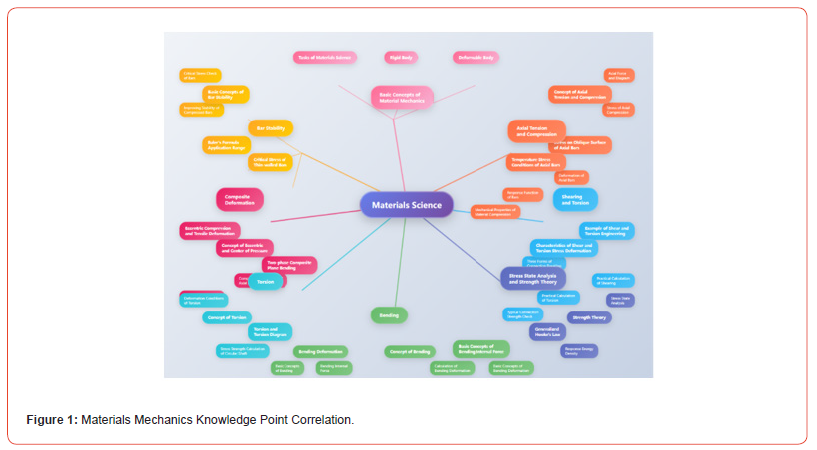
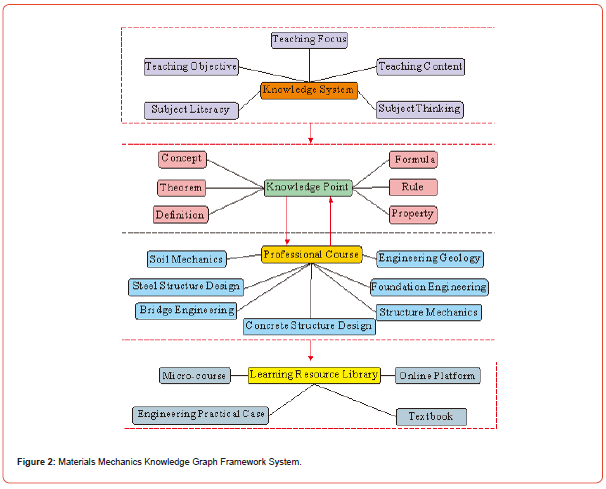
Simultaneously, the correlation between the materials mechanics curriculum system and related knowledge points is organized, including corresponding learning resource libraries, as specifically shown in Figure 1. Additionally, based on higher education civil engineering professional training requirements and teaching syllabi, the correlation between materials mechanics courses and subsequent professional course knowledge points is organized, as shown in Figure 2.
Finally, using knowledge graph visualization tools, the course knowledge structure system is intuitively presented in “map” form, allowing students to search for related knowledge points and related content on the map, thereby assisting mixed teaching with materials mechanics as the thread, providing efficient learning methods and rich resources for civil engineering professional students.
Application of Materials Mechanics Curriculum System Knowledge Graph
The materials mechanics curriculum system knowledge graph can be embedded in mainstream teaching platforms such as Chaoxing Learning Platform. Teachers adjust corresponding knowledge systems based on student learning situation analysis and individualized curriculum resource needs.
Constructing Materials Mechanics Teaching Methods Based on Knowledge Graphs
Knowledge graph-based materials mechanics teaching is a dynamic
process requiring continuous verification and reflection.
Learning characteristics and behaviors from taught class students
are refined to extract understanding situations and characteristics
of materials mechanics knowledge points. Therefore, this paper
adopts a “three-stage” [12] teaching method for instruction and
evaluation, with specific details as follows:
• Pre-class: Online assignment of question-and-answer
and multiple-choice tests guides students to search for related
knowledge and watch videos, conducting pre-class evaluation
based on test results.
• In-class: Using practical engineering cases as knowledge
point entry points for related knowledge explanation, conducting
in-class testing through integration of engineering practice
with theoretical knowledge, incorporating taught knowledge
into engineering practice as much as possible. Additionally, assignment
evaluation includes both teacher evaluation and peer
evaluation.
• Post-class: Guiding students through extensive repetitive,
progressive practice, watching course videos, pre-class testing,
question answering, and discussion analysis (assignments and
preparation of practical engineering cases). All exercises require
organizing involved knowledge points and learning resources,
using course knowledge graphs as frameworks to organize practice
and related resource construction.
Learning Situation Analysis and Evaluation
Learning situation analysis and learning evaluation constitute important components of the materials mechanics learning process. Using knowledge graph technology can efficiently and accurately assist in student learning situation analysis and evaluate corresponding knowledge mastery situations. Through utilizing knowledge graphs’ learning information tracking and feedback characteristics, comprehensive expression of student learning situation information becomes possible. Simultaneously, based on offline and online teaching platforms, starting from the “three-stage” teaching method, corresponding evaluation models are designed with clear evaluation nodes. Beyond conventional mechanics evaluation methods such as multiple-choice questions and calculation problems, evaluation methods with higher-order, innovative, and challenging characteristics must be designed, such as practical engineering case analysis problems. Finally, based on students’ self-evaluation, peer evaluation, and teacher evaluation results, comprehensive evaluation results are produced, providing assistance and suggestions for students’ systematic learning of related knowledge points.
Course Resource Establishment
One of education’s main technical characteristics is individualized teaching and on-demand delivery. Therefore, how to provide teaching information materials, teaching information services, or teaching tools according to learner characteristics to meet learners’ individualized growth and development needs is particularly important. Currently, the preliminarily established materials mechanics resource library only targets learning resource libraries for knowledge points in each course chapter. Based on establishing course knowledge graphs, it is necessary to continue improving resource libraries corresponding to courses. Simultaneously, knowledge graph-based learning resource recommendation can mine resource relationships from massive materials mechanics resources, helping students with effective recommendation and learning, greatly improving students’ learning efficiency and teachers’ efficiency in analyzing student learning situations. Additionally, knowledge graph visualization recommendation compared to pure calculation formulas or problem methods can greatly attract student interest.
Conclusion
Under multidisciplinary intersection backgrounds, knowledge graphs possess unique advantages in handling complex, cross-integrated mechanics scenarios. In the materials mechanics curriculum system construction process, with first-class course construction as the goal, utilizing online and offline teaching platforms, a materials mechanics’ course knowledge graph system is established.
Based on student cultivation requirements, teaching methods, teaching evaluation methods, and learning resource libraries are adjusted, forming teaching reform with knowledge graphs as the core. This fully utilizes knowledge graph advantages, realizing the integration and intelligentization of teaching resources, teaching content, and teaching methods with engineering practice, improving precision teaching quality and individualized service levels, exploring implementation methods for knowledge graph-based curriculum teaching reform while providing foundational guidance for subsequent course learning.
However, knowledge graph applications in mechanics courses still face many technical and application scenario problems. This paper only conducted preliminary exploratory attempts at graph construction for materials mechanics courses. Subsequently, general education courses and civil engineering professional theoretical courses will be integrated to further improve the materials mechanics curriculum system.
Funding
Guangdong Province Teaching Quality and Teaching Reform Engineering
Project (GDJX2023019);
Wuyi University Teaching Quality and Teaching Reform Engineering
Project (JX2023010);
Wuyi University Teaching Quality and Teaching Reform Engineering
Project (KC2023028);
Guangdong Province Undergraduate Teaching Quality and Reform
Project “Mechanics Course Group Teaching and Research
Room” (Project Number: GDJX2022003).
Conflicts of Interest
No Conflict of Interest.
References
- State Council (2017) State Council Notice on Printing and Distributing the New Generation Artificial Intelligence Development Plan. Bulletin of the State Council of the People's Republic of China 22: 7-21.
- He Q H (2016) Visual analysis of sports education research fields in China based on knowledge graphs. Journal of Beijing Sport University 39(2): 98-103.
- Fan JR, Zhong SC (2022) Disciplinary knowledge graph research: From knowledge learning to thinking development. Educational Technology Research 43(01): 32-38.
- Cheng P, Fan X (2019) Research on MPAcc curriculum teaching based on knowledge graphs under "Golden Course" construction background - Taking Chongqing University of Technology's "Cloud Accounting and Intelligent Financial Sharing" course as an example. Financial Communication 28: 35-38.
- Zeng L, Li Q (2021) Knowledge graphs empowering information technology teaching innovation. Modern Information Technology 5(7): 196-198.
- Liu DJ, Zuo JP, Zhou HW, et al. (2021) Reform and practice of materials mechanics teaching methods under OBE concept. Mechanics and Practice 43(1): 112-119.
- Qu SY, Lu LY, Song L, et al. (2021) Materials mechanics curriculum ideological and political teaching practice: Taking "column stability" as an example. Mechanics and Practice 43(6): 959-963.
- Li J, Fang QH (2022) Application of artificial intelligence combined with big data technology in material tensile property teaching. Mechanics and Practice 44(1): 212-217.
- Zhao JK (2021) Mixed teaching design based on knowledge maps and knowledge graphs. Science and Education Guide 32: 78-80.
- Xu X, Yan RC, Liu Y (2023) Research on mixed teaching models based on knowledge graphs — Taking "Circuit" course as an example. Education and Teaching Forum 38: 71-74.
- Liu MJ, Yu BB, Fang C (2024) Research on intelligent accounting curriculum system construction based on knowledge graphs. Discipline Construction and Talent Cultivation 13: 160-165.
- Wang MR, Wang XW, Xie HH (2022) Reform and practice of materials mechanics mixed teaching model based on OBE concept. Journal of Mudanjiang College of Education 12: 71-73.
-

This work is licensed under a Creative Commons Attribution-NonCommercial 4.0 International License.