


 Research Article
Smart Living Technology: A Design Paradigm for Aging / Disabilities That Adapts Utilizing AI Deep-Learning and Web-Scraping AI Incorporated in a Multidisciplinary Engineering Curriculum to Predict Future Health Outcomes
Received Date:December 25, 2025; Published Date:January 12, 2026
Abstract
Living independently in one’s own home is the overwhelming preference of 75-90% of seniors [1-4]. The proportion of the population over 65
is also growing rapidly, even faster growth of those over 80 [5,6]. Living in familiar home environments increase independence [7-9]. Add to that the
economics of aging [10] the macro-economic burden on society can be vastly reduced by adding assistive technology to living at home $5,000 vs.
assisted living $75,000 [11]. AI has grown exponentially; add that to a Smart home it has now become feasible to create a safe, supportive, economically
feasible home living environment. For all those reasons we started a Geriatric Engineering curriculum in 2019 at a north east engineering school. A
multidisciplinary minor “Geriatric Engineering” evolving to Smart-Living Technology incorporating Universal Design Principles and a more inclusive
program for all disabilities focused on applying engineering rigor to provide home based independent living. Students in Biomedical Engineering,
Construction, Mechanical Engineering and Computer science are leveraging their interdisciplinary skills for problem solving.
We began by designing software that would continually query the needs of individuals by active and passive means and search the web (in
development) using Web-Scraping AI tools that continually finds the latest technology to support an adaptive system. Since our engineering
curriculum requires a design project every year. The course BMET 360 “Introduction to Universal Design for Assistive Technologies” and BMET 362
Integration and Realization of Assistive Technologies have been developed around this smart-living paradigm. Beginning in the spring semester 2026
these updated courses and paradigms will be incorporated into our new curriculum. This paper describes the evolving software and AI developed
to train the next generation of engineers.
Keywords:Predictive analytics; deep learning; web scrapper AI; health score algorithm
Introduction
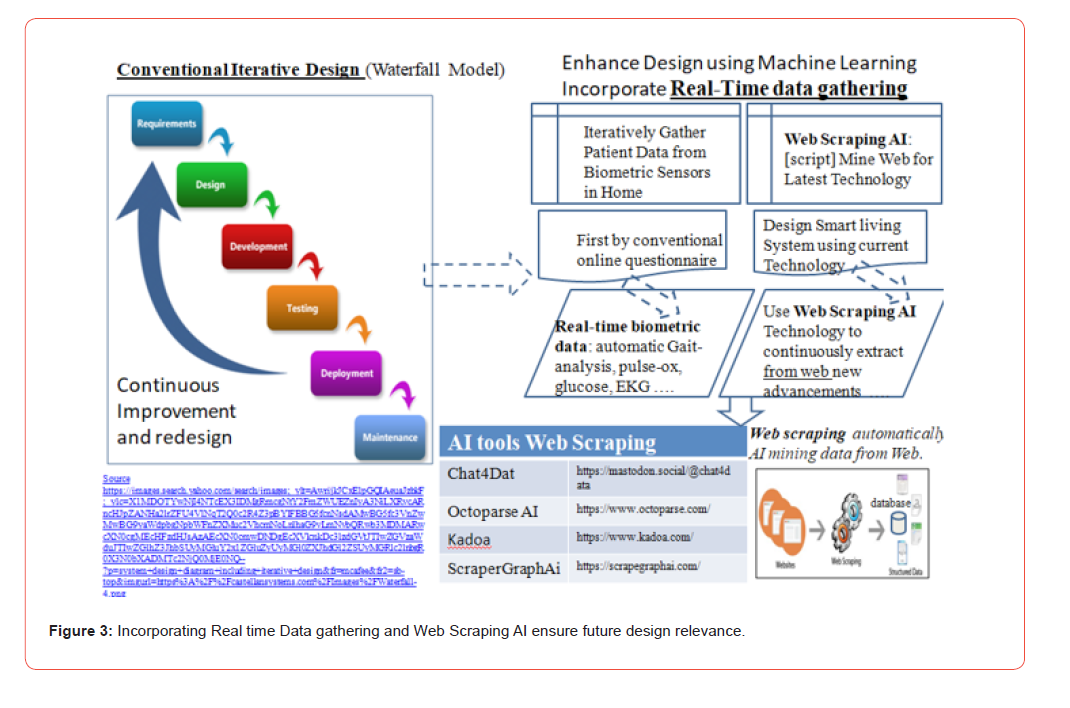
The challenge is to design systems that can be easily adapted as new algorithms and advancing technology become available. Incor porating these paradigms into an engineering curriculum requires a modification of the system design approach currently taught. New Artificial Intelligence (AI) tools are now available to continually search the web for the newest technology and provide that information into a database so engineering students can continually redesign systems. Those software tools are called Web-Scraping AI. There are scripts that can, on their own, search for information on the web, and download those into a database or display them on a regular basis. The information pace of new technologies and vast scope of data now available dwarfs our ability to gather and comprehend manually. Those tools are called Web-Scraping AI [12]. You can write your own [13] Python scripts or use available tools with intuitive web interfaces that can allow anyone to incorporate them into their system design processes. Examples of Web-Scrapers AI Are: are Cha4Data, OctoparseAI, Kadoa and ScrapeGraphAi.
Methods
Designing an Integrated Smart-Living Environment [14] begins with a Hub, a centralized device that connects and manages various smart home devices and systems. It acts as a communication bridge, allowing different devices to work together seamlessly. Then selecting devices that wireless augment that environment: i.e. learning thermostats such as the Nest [15,16] that learns from you daily setting and needs and will adjust accordingly over time. Smart Microwaves with bar-code scanners that read the bar codes on foods and will automatically choose proper settings example such as TOSHIBA ML-EM34P (SS), Smart Countertop Microwave. Smart Garbage, example GeniCan being introduced at CES 2026 that scans and attaches to any garbage can scans bar codes of trash and reorders food from web sites such as PeaPod from Stop-Shop grocery stores. All these devices are relatively cheap under $200.
Innovative Methodology
The First innovative approach in this paper utilized in this Smart-Living/Geriatric Engineering program is to first analyze biometric data in real time (Figure 1), utilizing a Health-score developed at NJIT; i.e. A Health Score Algorithm: (research in progress).
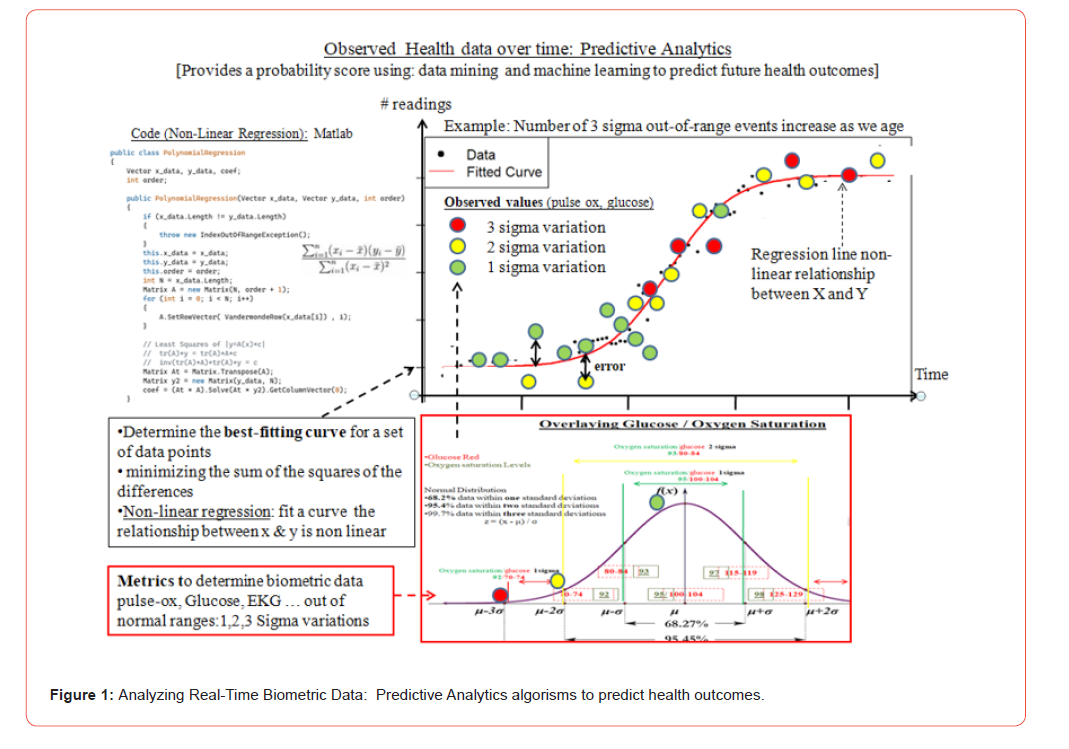
Health Score Algorithm: [17]
Smart Living Technology is designed to prepare future engineers / Computer Scientists / MD’s to incorporate and design new technologies into their future systems and medical practices. Several leading software health companies such as APPLE Health and Withings are generating an overall health score based on similar input devices used in this paper: Pulse-ox, Blood Pressure, ECG and glucose monitors. A system introduced at CES 2025 called the “Omnia Smart Mirror” a hardware/software system provides an overall health score, similar the one we are developing. https://www. cnet.com/health/ces-2025-the-omnia-smart-mirror-is-a-smartscale- and-health-assessment-in-one/, It seems intuitive that all these health monitoring devices will shortly be incorporated into our cell phones, similar to the current Apple Watch, and will in the near future include, in the opening screen of our phones, an overall heath score vastly improving healthcare. Similar to Robin Cooks fictional book “CELL” (referring to your cell phone as your medical practitioner with AI based deep learning and embedded biometric sensors).
Determining an overall health score (Figure 2), a quick synthesis of multiple sensors, is essential in providing a snapshot of health status. Predictive Analytics [18], assist in determining future health outcomes based on previous data and trends potentially can forestall negative outcomes. We postulate this will be useful for all age groups, not only to react but to proactively maintain optimum lifestyles. We relied on Mayo Clinic Studies [19]: Systolic-Diastolic (Systolic/Diastolic: Normal 120/80, Elevated 120-129/<80, Stage 1 Hypertension 130-139/81-89, Stage 2 Hypertension >140/>90), data from the NIH [20]: Normal 95%-100, Contact Physician 91%- 94%, Hypoxemia <90% (insufficient oxygen to tissues) and American Diabetes Association [21,22].
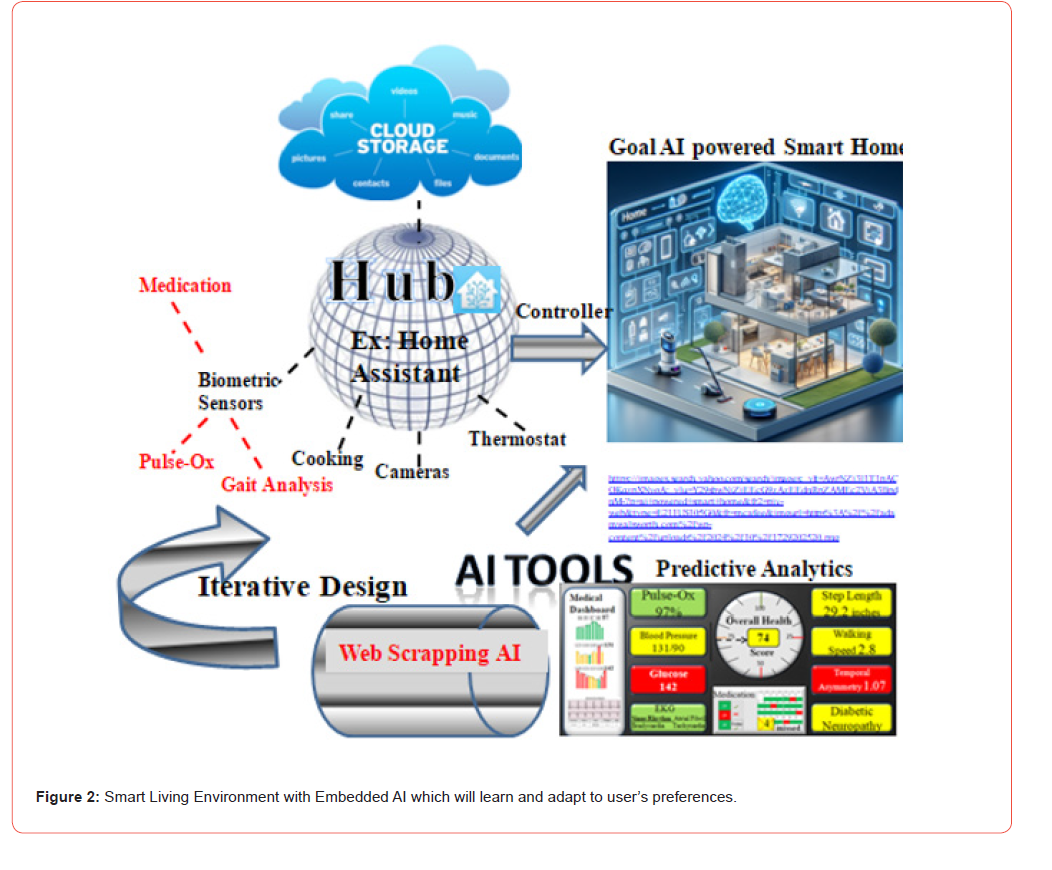
The second innovative component is gathering data from the web (Figure 2) using Web-Scrapper AI [23-25]; which are automatic scripts designed to automatically extract data from websites using artificial intelligence techniques (Figure 2). Once every month, for example, we can request, a search script, that will find for example the most advanced hub technologies. The goal is for students and smart-home designers to utilize the latest technologies. Eventually once we create a standard component-based system, these fields will be automatically populated by the latest highest rated technology of the time. Just for completeness: these devices communicate wirelessly using communication protocols such as: Z-wave, Zigbee an IEEE 802.15.4 -based specification, Wi-Fi, Bluetooth and the latest universal protocol a 2.4 GHz ISM band (Industrial, Scientific, and Medical) called Thread [26,27], (released in 2020). Thread is a universal protocol embedded in most new wireless home devices designed for low-power, wireless IoT (Internet of Things) devices.
The third innovation, in this paper is enhanced iterative design incorporating new AI tools that will assist engineers in exploring new technologies and resources; i.e. Web-Scraping Ai (Figure 3).
Applied Solutions
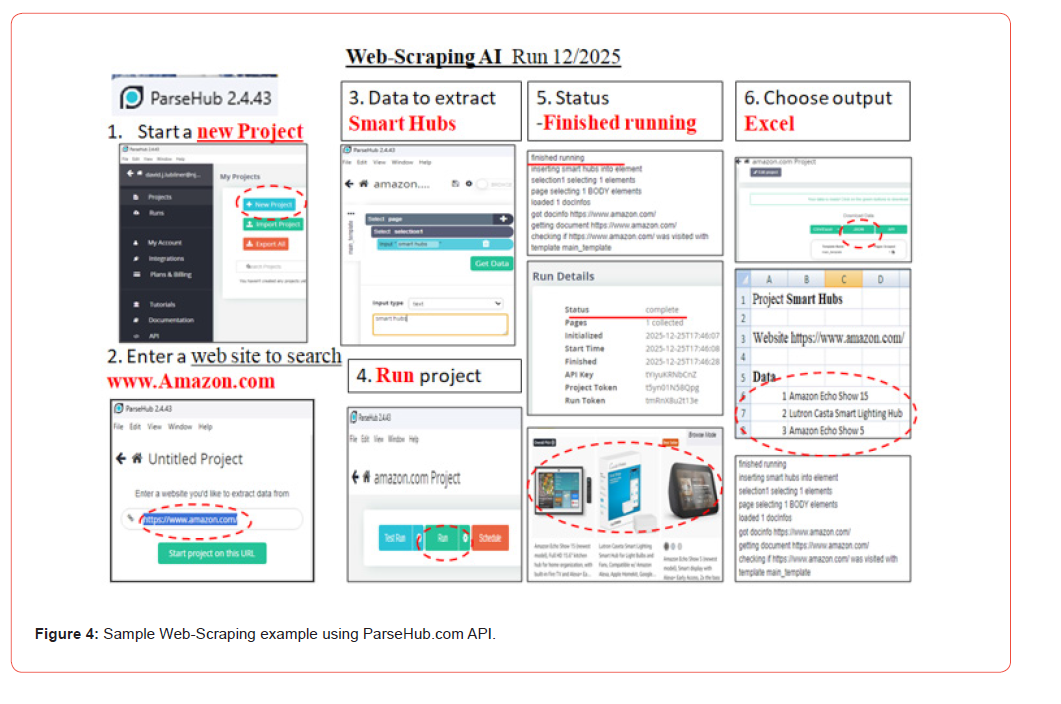
Using a smart scraping AI tool https://www.parsehub.com/ (Figure 4) we created a search script titled “Smart Hubs” extracted from Amazon.com and just displayed the first three results, a simple example to illustrate easy and limited knowledge required to create script. The output can be selected in various formats, we choose EXCEL. This can be later searched and reformatted. The short frequency and scope of this search was just to illustrate how simple scripts can be developed and run using various tools such as OctoparseAI, ScraperGraphAI, Chat4dat (Figure 4). The intent is to develop a paradigm that not only can be taught in an engineering curriculum, beginning in the spring semester 2026 (Biomedical Engineering Technology) BMET360 and BMET 362 in the fall 2026 but to develop a sustainable design methodology that can adapt and incorporate new developing technological solution as they evolve over time [28,29].
Caveats
AI tools have the inherent advantage of quickly extracting datasets and with targeted algorithms with specific desired features such as preferred communications protocols. The downside is the source websites may be heavily weighted, such as Amazon, to paid advertisers that position and weight search results to benefit their own monetary interests. Second the wording in those websites, source material of the search, that describes the features sought are dependent of the veracity, truth, of the companies displaying the feature data of specific devices. Third the AI algorithms are usually proprietary and we have no way to determine their biases that may affect results. We often bestow on computer generated results a higher validity, a cautionary tale we need to teach all future engineers.
Conclusion
During the last decade, we have endeavoured to create a field of study that focused on providing technological and economic solutions to allow older and disabled individuals to live independently. This paper is the latest incremental evolution that builds of the recent artificial intelligence advances to provide real time medical monitoring and predictive analytics to anticipate health events that can often be prevented or alleviated if caught early in their progression. Systems become obsolete quickly and adding web-scrapping AI to inform designers of advancements in a timely manner can insure long term viability of this smart-living solutions.
Acknowledgement
A number of individuals and students continue to provide valuable input to our curriculums and research. Industry representative such as Al Gittrich 85, William Eisenman BS, MS, Alan Shultz MS, Peter Greene MS, MBA and Bill Tomaskovic has provided valuable input to our work. No external Funding was used to support this study.
Conflicts of interest
No conflicts of interest.
References
- Noémie Roy, Roxanne Dubé, Carole Després, Adriana Freitas, France Légaré (2018) Choosing between staying at home or moving: A systematic review of factors influencing housing decisions among frail older adults. PLoS One 13(1): e0189266.
- https://www.aarp.org/home-living/home-community-preferences-survey-2024/.
- https://www.housingwire.com/articles/nearly-90-of-older-adults-want-to-age-in-place-survey/.
- https://www.usatoday.com/story/money/personalfinance/real-estate/2024/12/10/how-america-can-age-in-plaec/76826197007/.
- Su-Min Cha (2025) A Systematic Review of Home Modifications for Aging in Place in Older Adults. Healthcare (Basel) 13(7): 752.
- Ellen A Kramarow (2024) Diagnosed Dementia in Adults Age 65 and Older: United States, 2022.
- https://www.sternathometherapy.com/shows-why-familiar-settings-accelerate-progress/.
- Esther Kane (2025) Mental Health Benefits of Aging at Home.
- Arno Kroner (2025) The Benefits of Staying Home: Why Seniors Thrive in Familiar Surroundings.
- https://www.sciencedirect.com/journal/the-journal-of-the-economics-of-ageing.
- DJ Lubliner (2021) Geriatric Engineering: An Engineering Systems Design Approach to Human Aging. J Am Geriatr Soc 69(3): 621-628.
- https://www.octoparse.com/blog/top-5-ai-web-scrapers.
- https://webscrapingsite.com/resources/automated-web-scraper-autoscraper/.
- https://www.smartlivingtechnology.net/
- Nest Energy Savings: https://www.kiplinger.com/personal-finance/how-to-save-money/can-a-nest-smart-thermostat-save-you-money.
- https://www.home-assistant.io/docs/energy/.
- Lubliner D, Wiggins J, Yanxaio F (2025) Smart Living Technology-Geriatric Engineering Phase II: Expanding the Geriatric Centric Curriculum to Biomedical Engineering and Construction Programs incorporating Universal Design, AI (deep learning) and an overall health assessment score spanning multiple Engineering disciplines. Adv Can Res & Clinical Imag 5(1).
- DJ Lubliner (2015) Biomedical Informatics: An Introduction to Information Systems and Healthcare. Predictive Analytics: 321-341.
- Mayo Clinic https://www.mayoclinic.org/diseases-conditions/high-blood-pressure/symptoms-causes/syc-20373410.
- NIH 2023 https://www.ncbi.nlm.nih.gov/books/NBK470348/.
- American Diabetes Association https://diabetes.org/about-diabetes/diagnosis.
- Marcos Pazos-Couselo, Cristina Portos-Regueiro, María González-Rodríguez, Jose Manuel García-Lopez, Manuela Alonso-Sampredro, et al. (2022) Aging of glucose profiles in an adult population without diabetes. Diabetes Res Clin Pract 188: 109929.
- Web Scraping for Beginners: A Guide 2024. Proxyway. 2023-08-31. Retrieved 2024-03-15.
- Sirisuriya DS (2015) A comparative study on web scraping. Proc. 8th Int. Res. Conf. KDU: 135-
- Gunawan R, Rahmatulloh A, Darmawan I, Firdaus F (2019) Comparison of Web Scraping Techniques 2: 283-287.
- What is Thread - Overview. Thread Group. Retrieved October 25,2015.
- The Thread group - Thread 1.1 Specifications. Thread Group. Retrieved June 26,2021.
- https://universaldesign.ie/about-universal-design/the-7-principles.
- https://www.parsehub.com/.
-

This work is licensed under a Creative Commons Attribution-NonCommercial 4.0 International License.