


 Research Article
Loneliness And Social Isolation - To Screen or Not? Providers’ Communications and Comfortability
Received Date:June 22, 2024; Published Date:June 26, 2024
Abstract
Purpose: Loneliness and social isolation (SI) can significantly impact the health and well-being of older adults, yet it remains unclear whether
healthcare providers address these issues with their older patients. This pilot study examines providers’ communication and comfort levels
regarding loneliness screening.
Methods: A convenience sample of providers who interact with older patients was recruited from healthcare and long-term care settings in
Central Florida (n=59). Communication about social isolation and loneliness was adapted from the revised UCLA 3-item Scale. De Jong Gierveld’s
loneliness 6-item scale measured social and emotional loneliness. Comfort levels with loneliness screening (4 items) were adapted from a food
insecurity screening study.
Results: Providers had a mean age of 46 years, with the majority being female (70%) and white (67%), and an average of 17 years of practice
experience. Approximately 60% of providers believed loneliness screening should be conducted during every visit with older patients. All scales
demonstrated high internal consistencies (Cronbach’s alphas ranged from .825 to .897). However, communication about loneliness and social
isolation was low, with mean item scores of 2.34 and 2.15, respectively. Overall, providers reported moderate comfort levels in conducting such
screenings (mean=3.72 on a 5-point Likert scale).
Discussion: This pilot study provides evidence of the high reliability of validated measures for assessing providers’ communication and comfort
levels in screening for loneliness and SI. The findings highlight low communication and moderate comfort levels among providers and the need for
provider training to facilitate early intervention, particularly for older patients.
Keywords:Loneliness, Social Isolation, Screening, Healthcare Provider, Older Patients, Florida
Introduction
The Silent Epidemic: Loneliness and Social Isolation in Older Adults
Research has established that loneliness and social isolation significantly impact the health and well-being of older adults (CDC, n.d.; NIA, 2021). However, it remains unclear whether healthcare providers address these issues with their older patients. This pilot study examines providers’ communication and comfort levels regarding loneliness screening.
Loneliness and social isolation, while related, are distinct concepts that affect older adults’ health. Social isolation refers to having few social contacts and limited regular interaction, while loneliness is the distressing feeling of being alone or separated (NIA, 2021). While these terms are not significantly linked, they are often used interchangeably and have similar health implications. Loneliness has been recognized by the World Health Organization (WHO)’s Campaign to End Loneliness as a determinant of health. Commonly used measures for assessing loneliness and social isolation include the UCLA Loneliness Scale [1] and the De Jong Gierveld Loneliness Scale [2], which evaluate feelings of loneliness, social relationships, and perceived social support.
Research demonstrates that loneliness and social isolation have significant impacts on physical and mental health, quality of life, cognitive decline, and mortality, particularly among older adults [3]. National surveys point out that more than one-third of older adult’s report feeling lonely, and about 1 in 4 (25%) community-dwelling older adults are experiencing social isolation [4-6]. The combined effects of loneliness and social isolation on health outcomes among older adults have been investigated by Barnes and colleagues (2022) [7], who found significantly higher rates of emergency room visits among those who were both lonely and socially isolated, highlighting the potential cumulative negative consequences of these experiences.
The Essential Role of Providers in Addressing Loneliness
Primary care providers and nurse practitioners are uniquely positioned to address loneliness and social isolation [8, 9], despite older adults typically not seeking office visits due to feeling lonely or socially isolated [10]. Through regular assessments, conversations, and observation of well-being, healthcare providers can identify older adults experiencing loneliness and social isolation. They offer referrals and support, connecting them to community resources such as volunteer organizations, senior centers, and faith-based groups. Additionally, providers explain the impact of loneliness and social isolation on health and provide ongoing monitoring and follow-up support.
However, despite the critical role of healthcare providers in addressing loneliness and social isolation, research by Tung and colleagues (2021) [11] reveals a gap in patient screening and assistance for social isolation within primary care settings. Their findings show that most patients (87%) had not been asked about social isolation in healthcare settings, despite low levels of discomfort with providers providing such screenings (94%). By working to identify and support older adults who may be experiencing these issues, healthcare providers can positively impact their health and well-being.
Leveraging Social Prescribing: Connecting Older Adults to Community Support
Recent research highlights effective strategies, such as “social prescribing,” which involves linking patients with nonclinical support services in the community [12, 8]. This approach includes activities like walking groups and volunteer opportunities. The National Academies of Sciences, Engineering, and Medicine (NASEM) recommends that clinicians periodically assess at-risk patients and connect them with community resources [5]. Primary care physicians can facilitate social prescribing by directly referring patients to community-based agencies or providing access to support service directories [13, 12, 5].
Additionally, peer support groups, particularly those focused on chronic disease self-management, have a strong evidence base in addressing social isolation and loneliness [14, 5]. Although current evidence is limited, cognitive behavior therapy and interpersonal psychotherapy can potentially mitigate negative perceptions of social interactions [5]. In addressing loneliness and social isolation among older adults, healthcare providers play a crucial role by implementing tailored interventions and facilitating connections with community resources.
Study Gaps
While healthcare providers play a crucial role in addressing loneliness and social isolation among older adults, standardized screening procedures within healthcare settings are lacking, potentially hindering timely interventions. Many providers may lack the necessary training or feel uncomfortable discussing these sensitive topics, leading to uncertainty about the extent of discussions between healthcare providers and older patients regarding loneliness and social isolation. This highlights the need for further investigation to inform tailored interventions and enhance patient-provider interactions.
Purpose
This study aims to investigate healthcare providers’ communication practices and their comfort levels with screening for loneliness and social isolation among older adults. By examining these aspects, the study seeks to provide insights that can inform the development of guidelines and training programs tailored to healthcare providers. These initiatives aim to enhance healthcare professionals’ ability to effectively address loneliness and social isolation in clinical practice, ultimately improving patient care and well-being.
Methods
A convenience sample of providers who see older patients was recruited from the Central Florida area’s healthcare and longterm care settings (n=59). Communication about social isolation was adapted from the UCLA 3-item Loneliness Scale [1], a short adaptation of the 20-item Revised UCLA Loneliness Scale [15]. De Jong Gierveld’s 6-item loneliness scale assessed overall, emotional, and social loneliness [2] and was also adapted in the current study. The UCLA Loneliness Scale and The De Jong Gierveld Loneliness Scale are reliable and valid measures of loneliness in older adults. They are widely used in research studies and clinical practice. Comfortable levels with loneliness screening (4 items) were adapted from a recently published food insecurity screening study [16].
The UCLA Loneliness Scale, comprising three self-report items, assesses feelings of loneliness and social isolation in older adults. These items inquire about the frequency of lacking companionship, feeling left out, and experiencing isolation. The De Jong Gierveld Loneliness Scale, a 6-item self-report tool, evaluates emotional and social loneliness among older adults. Its items gauge various aspects including feelings of being left over, isolated from others, having companions to talk to, having many friends, experiencing loneliness, and feeling part of a group of friends, providing a comprehensive assessment of loneliness and social connectedness. The comfortable levels with loneliness screening ask if providers are comfortable screening patients for loneliness, talking with patients about challenges to deal with loneliness, financial concerns patients may have, and talking with patients about companionship or home assistance programs in the community.
Descriptive analyses were used to examine the demographic characteristics of study participants, such as age, gender, race, and relevant background variables. Additionally, descriptive statistics were used to examine the means and distributions of the loneliness and social isolation scales and their individual item statistics. To ensure the reliability of the measurement scales, Cronbach’s alpha coefficients were calculated, assessing the internal consistency among the items within each scale.
Results
The study sample consisted of healthcare providers with an average age of 46 years, predominantly female (70%), and 67% identified as white, with an average of 17 years of clinical experience. A substantial portion of providers (about 78%) reported they screened older patients for loneliness during appointments. Approximately 60% of providers advocated for routine loneliness screening during each older patient encounter, contrasting with only 12.5% who suggested annual screening or screening based on specific risk factors. Case managers (16.9%), social workers (18.6%), and nurses (15.3%) were identified as the primary professionals suited to conduct such screenings.
Internal consistency analyses using Cronbach’s alpha coefficients indicated robust reliability across all scales, ranging from .825 to .897. Specifically, the Cronbach’s alpha coefficient for the UCLA Loneliness Scale (3-item) was .897, with corrected itemtotal correlations (CITC) ranging from .783 to .824. The mean score for scale items was 2.15 on a 3-point Likert scale Table 1. For the De Jong Gierveld Loneliness Scale (6-item), the Cronbach’s alpha coefficient was .830, with CITC values ranging from .333 to .735, and the mean score for scale items was 2.34 on a 3-point Likert scale Table 2.
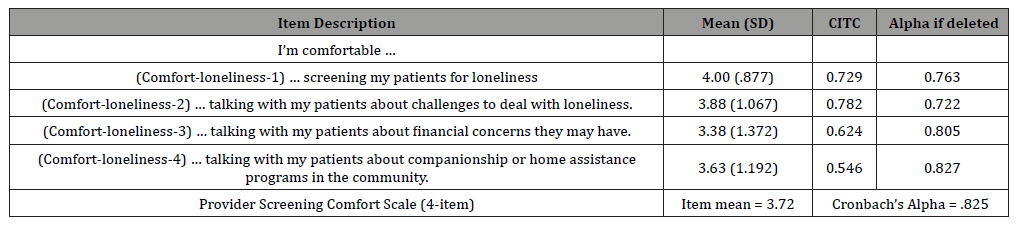
Additionally, the provider’s comfort level with the loneliness screening scale (4-item) demonstrated satisfactory internal consistency, reflected by a Cronbach’s alpha coefficient of .825 and CITC values ranging from .546 to .781. The mean score for scale items was 3.72 on a 5-point Likert scale Table 3. Further exploration of emotional loneliness versus social loneliness, based on De Jong Gierveld’s loneliness measurement, revealed that providers exhibited lower communication regarding emotional loneliness, such as feelings of emptiness, loneliness, or rejection (item means=2.09), compared to social loneliness, such as having someone to rely on, trust completely, or feel close to (item means=2.59). Interestingly, less than 50% of the providers “often” asked about emotional loneliness among their older patients (26%~46%), while a higher percentage reported “often” asked about social loneliness (54%~80%).
Table 1:Communication about Loneliness Scale (n=59).

Table 2:Communication about loneliness Scale (n=59).
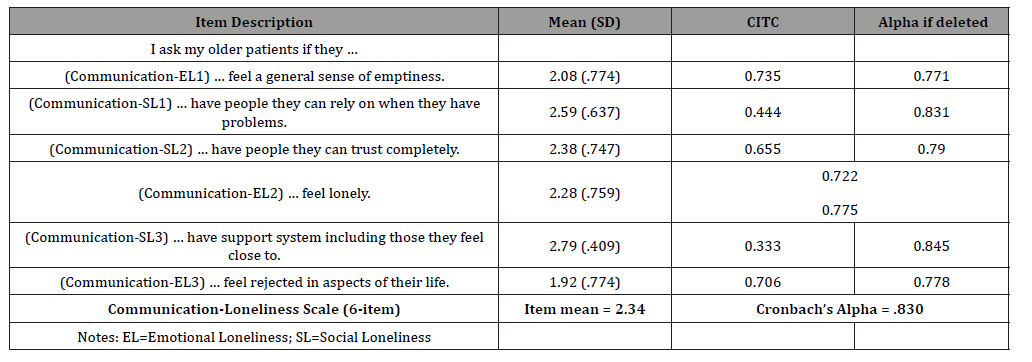
Table 3:Reliabilities of Provider Comfortable Level in Loneliness Screening Scales (n=59).
Discussion
The findings underscore a significant proportion of healthcare providers advocating for routine loneliness screening among older patients during appointments, signaling an increasing recognition of loneliness as a health concern in clinical settings. However, some providers suggest less frequent screening, revealing potential variations in perceived necessity and implementation challenges. Identifying case managers, social workers, and nurses as the most suitable professionals for conducting loneliness screenings highlights the importance of interdisciplinary collaboration in addressing complex psychosocial issues like loneliness. This also prompts questions about the training and preparedness of different healthcare professionals to identify and intervene in loneliness among older patients effectively.
The study’s robust reliability of measurement scales, as indicated by high Cronbach’s alpha coefficients, enhances confidence in the validity of the findings. This underscores the suitability of the scales for assessing provider-patient communication about loneliness and providers’ comfort levels with loneliness screening practices. Additionally, the study reveals modest levels of communication among healthcare providers regarding loneliness and social isolation, with lower scores observed for discussions on emotional loneliness than social loneliness.
While limited research has examined healthcare providers’ screening for social and emotional loneliness, an English community study provided empirical support for the conceptual differences between these two aspects of loneliness among older adults [17]. This raises questions about the factors influencing providers’ comfort levels and communication patterns in addressing different facets of loneliness. Consequently, there is a need for further exploration to inform interventions aimed at improving providerpatient communication in this domain. In light of these findings, policy interventions for older adults should also consider a range of divergent strategies if both emotional and social loneliness are to be effectively addressed [17, 13].
The study’s findings reveal a concerning trend of low to moderate provider-patient communication about loneliness despite most providers’ extensive experience in the field. Barriers to effective communication persist among healthcare providers, including inadequate training, resources, and hesitancy to discuss sensitive topics. Additionally, measuring loneliness and social isolation poses challenges due to their subjective nature. The study highlights the potential role of “other providers” beyond physicians in addressing these issues. It emphasizes the importance of patientcentered care, as advocated by social prescribing approaches (National Academies of Sciences, Engineering, and Medicine, 2020). These findings underscore the urgent need to enhance awareness, training, and support for healthcare providers in addressing loneliness among older patients [18, 19].
To address these challenges, healthcare systems should implement strategies such as standardized screening protocols, interdisciplinary collaboration, and tailored communication skills training. Equipping providers with the necessary tools and resources will better support older adults in addressing loneliness and improving overall well-being. Developing targeted training programs, evaluating early intervention strategies, and refining measurement tools are crucial to improving the quality of care for older adults experiencing loneliness and social isolation.
Acknowledgement
None.
Conflict of Interest
No conflict of interest.
References
- Hughes ME, Waite LJ, Hawkley LC, Cacioppo JT (2004) Three-Item Loneliness Scale[Database record]. APA PsycTests.
- De Jong Gierveld J, Van Tilburg T (2006) A 6-Item Scale for Overall, Emotional, and Social Loneliness: Confirmatory Tests on Survey Data. Research on Aging 28(5): 582–598.
- Centers for Disease Control and Prevention (n.d.) (2024) Loneliness and social isolation linked to serious health conditions.
- Thomas K M Cudjoe, David L Roth, Sarah L Szanton, Jennifer L Wolff, Cynthia M Boyd, et al. (2020) The epidemiology of social isolation: National Health and Aging Trends Study. J Gerontol B Psychol Sci Soc Sci 75(1): 107-113.
- National Academies of Sciences, Engineering, and Medicine (2020) Social isolation and loneliness in older adults: Opportunities for the health care system. Washington, DC: The National Academies Press.
- World Health Organization (2024) Social isolation and loneliness.
- Timothy L Barnes, Stephanie MacLeod, Rifky Tkatch, Manik Ahuja, Laurie Albright, et al. (2022) Cumulative effect of loneliness and social isolation on health outcomes among older adults, Aging & Mental Health 26(7): 1327-1334.
- Galvez-Hernandez P, Gonzalez-de Paz L, Muntaner C (2022) Primary care-based interventions addressing social isolation and loneliness in older people: a scoping review. BMJ Open 12(2): e057729.
- Freedman A, Nicolle J (2022) Social isolation and loneliness: the new geriatric giants: approach for primary care. 2020. Can Fam Physician 66(3): 176-182.
- Arms T, McCumber S (2023) Social Isolation: Levels of Response for Nurse Practitioners. The Journal for Nurse Practitioners19(1): 1-6
- Tung E, De Marchis E, Gottlieb L, Lindau S, Pantell M (2021) Patient experiences with screening and assistance for social isolation in primary care settings. Journal of General Internal Medicine 36(7): 1951-1957.
- Daniel F Morse, Sahil Sandhu, Kate Mulligan, Stephanie Tierney, Marie Polley, et al. (2022) Global developments in social prescribing. BMJ Global Health 7(5): e008524.
- Mann F, Bone JK, Lloyd-Evans B, Frerichs J, Pinfold V, et al. (2017) A life less lonely: The state of the art in interventions to reduce loneliness in people with mental health problems. Social Psychiatry and Psychiatric Epidemiology 52(6): 627-638.
- Joo JH, Bone L, Forte J, Kirley E, Lynch T, et al. (2022) The benefits and challenges of established peer support programmes for patients, informal caregivers, and healthcare providers. Family Practice 39(5): 903-912.
- Russell D, Peplau LA, Cutrona CE (1980) The revised UCLA Loneliness Scale: Concurrent and discriminant validity evidence. Journal of Personality and Social Psychology 39(3): 472-480.
- Bernhardt C, Hou S, King C, Miller A (2022) Identifying barriers to effective patient-provider communication about food insecurity screenings in outpatient clinical settings: A mixed-methods study. Journal of Public Health Management & Practices 28(2): e595-e602.
- Dahlberg L, McKee KJ (2014) Correlates of social and emotional loneliness in older people: Evidence from an English community study. Aging & Mental Health 18(4): 504-514.
- Donovan N, Blazer D (2020) Social Isolation and Loneliness in Older Adults: Review and Commentary of a National Academies Report. Am J Geriatric Psychiatry 28(12): 1233-1244.
- Smith J (2020) Identifying loneliness and social isolation in older adults: A healthcare provider’s role. Journal of Geriatric Care 15(2): 45-58.
-

This work is licensed under a Creative Commons Attribution-NonCommercial 4.0 International License.