


 Research Article
Dementia Among Oldest Old Living with Diabetes, Treated with or Without Metformin - A Cohort Study
Received Date:December 17, 2025; Published Date:January 08, 2026
Abstract
Studies on diabetes have shown that metformin (MTF) may reduce the incidence of dementia, suggesting a geroprotective action, and standing
out as a promising and accessible drug.
Objective: This study aims to investigate dementia frequency in elderly (>80 years) diabetics (DM) with MTF (DMTF) or without MTF (NMTF)
versus non-diabetics.
Methods: This is an observational, analytical, retrospective, cohort study of 194 oldest old patients. Cognition, functionality, and laboratory
data were analyzed. Univariate and multivariate analyses were performed. Survival curves were constructed using the Kaplan-Meier and Log-rank
methods.
Results: This study included 48 individuals with DM, 27 taking MTF. Univariate analyses did not find differences between groups (except for
fasting blood glucose and HBA1c in diabetic and non-diabetic patients). Multivariate analyses confirmed that age, schooling, BADL, IADL, GDS, and
DM did not have a significant impact on the risk of dementia in this oldest old population. As expected, a higher MMSE score was associated with a
lower risk of dementia diagnosis. Survival and dementia/death probability were also similar across groups.
Conclusion: In this well-controlled cohort of very old adults, MTF use was not associated with an additional reduction in dementia or mortality
compared with other DM management strategies. Although DMTF group had a limited sample size, calculations indicated sufficient statistical power
for the intended analyses. However, comparisons between the DMTF and NMTF groups remain susceptible to a higher probability of Type II error
(50%) due to the relatively small sample size of the DMTF group.
Keywords:Longevity; Diabetes mellitus; Dementia; Metformin
Abbreviations: AD: Alzheimer’s Disease; AMPK: Adenosine Monophosphate-Activated Protein Kinase; Aβ: Beta-Amyloid Peptide; BADLs: Basic Activities of Daily Living; CI: Confidence Interval; DM: Diabetes Mellitus / diabetic group; DMTF: Diabetics using metformin; DSM-5: Diagnostic and Statistical Manual of Mental Disorders, Fifth Edition; FBG: Fasting Blood Glucose; GDS: Geriatric Depression Scale; HbA1c: Glycated Haemoglobin; HR: Hazard Ratio; IADLs: Instrumental Activities of Daily Living; IBGE: Brazilian Institute of Geography and Statistics; MMSE: Mini-Mental State Examination; MTF: Metformin; NDM: Non-Diabetic; NMTF: Diabetics not using metformin; NHIS: National Health Interview Survey; NF-κB: Nuclear Factor Kappa B; NPH: Neutral Protamine Hagedorn Insulin; ROS: Reactive Oxygen Species; SAH: Systemic Arterial Hypertension; WHO: World Health Organization
Introduction
The World Health Organization (WHO) estimated 422 million adults had diabetes in 2014. Diabetes mellitus (DM) prevalence has significantly increased, with 40% of this rise linked to aging and population growth [1]. Type 2 diabetes, in particular, is a known dementia risk factor, possibly due to shared mechanisms like hyperglycemia and hyperinsulinemia. Consequently, the potential of hypoglycemic drugs to mitigate dementia risk in diabetic patients warrants investigations [2]. Hyperglycemia, hyperinsulinemia, oxidative stress, and inflammation, all associated with diabetes, are thought to accelerate dementia through cerebrovascular and neurodegenerative mechanisms. Additionally, insulin resistance and hyperinsulinemia can directly influence Alzheimer’s disease (AD) developments by affecting beta-amyloid production and brain amyloid clearance [3].
Common mechanistic pathways, such as insulin signaling abnormalities, mitochondrial dysfunction, energy homeostasis dysregulation, and neuroinflammation - a key feature of AD - are observed in both DM and AD [4]. Global dementia prevalence affects around 47 million individuals, expected to rise to 131 million by 2050 [5]. Prevalence increases with age, from 1-2% at 65 to 30% at 85. The higher prevalence in females, particularly for AD, is largely due to increased longevity. However, rising agestandardized prevalence rates indicate that age alone does not explain the increase. Insulin resistance is emerging as a critical modifiable risk factor for dementia [6]. In older adults, depression and dementia are the most frequent psychiatric syndromes. The frequent underdiagnosis and undertreatment of depression, 5 which can overlap with dementia, pose clinical challenges. The Yesavage Geriatric Depression Scale (GDS), a brief, validated screening tool, is suitable for elderly individuals without cognitive impairment [7,8].
As the first-line therapy for type 2 DM, metformin (MTF) reduces hepatic glucose output, increases peripheral glucose utilization, and enhances insulin sensitivity [4]. In older adults, MTF exhibits pleiotropic effects, improving physical, clinical, and psychological domains [9]. This suggests its potential to attenuate age-related diseases and influence the aging process. Pharmacological interventions for diabetes, including MTF, dipeptidyl peptidase 4 inhibitors, glucagon-like peptide-1 agonists, sodium-glucose cotransporter-2 inhibitors, and sulfonylureas, have demonstrated associations with reduced cognitive decline, excluding thiazolidinediones [2,4]. The magnitude of this effect appears to be dose- and duration-dependent [2]. Despite promising evidence for MTF’s potential in age-related dementia, its overall role across dementia subtypes remains to be fully elucidated [6]. MTF can penetrate the blood-brain barrier (its concentration in cerebrospinal fluid is approximately one-tenth of that in plasma) [6]. The activation of adenosine monophosphate (AMP)-activated protein kinase (AMPK) by MTF promotes cell survival, neural differentiation, autophagy, neuroprotection, proliferation, and self-renewal. Additionally, it exhibits secondary effects such as the inhibition of inflammation through NF-κB inhibition, regulation of reactive oxygen species (ROS) levels, inhibition of beta-amyloid peptide (Aβ) production, and tau phosphorylation [6,10,11].
Pharmacological interventions to decrease dementia incidence in the population aged 80 and above are urgently needed. The anticipated increase in cognitive disorders in this demographic will result in substantial adverse consequences for patients, caregivers, and public health systems. MTF, a cost-effective and widely available treatment for type 2 DM in Brazil, warrants exploration as a potential geroprotective agent. Therefore, this study aims to evaluate the impact of MTF on dementia frequency by comparing DM patients over 80 years who use MTF with those who do not, within a Brazilian public hospital outpatient clinic.
Patients and Methods
Data collection and analysis
This observational, analytical, retrospective cohort study utilized data from the UNIFESP/EPM Longevos outpatient clinic, which has monitored patients over 80 years old admitted to our service throughout the last 13 years. Annual assessments, encompassing intrinsic capacity, mental and physical performance, and multidisciplinary evaluations, were conducted using validated geriatric tools. We analyzed data from the initial and final consultations of 194 patients, recording mortality (death certificates or medical records) and unfavourable outcomes (dementia and/or death). Collected variables included demographics, functionality (BADLs and IADLs), cognition (education, Mini-Mental State Exam-MMSE, GDS), medical history (hypertension- SAH - stroke, diabetes duration, hypoglycemic medication use), sensory deficits, and laboratory values (fasting blood glucose - FBG - and glycated haemoglobin - HbA1c) [12,13].
Dementia was defined as a chronic, acquired decline in two or more cognitive domains affecting social or occupational function, consistent with traditional definitions, though DSM- 5 acknowledges single-domain impairment [5]. DSM-5 criteria, involving longitudinal clinical and cognitive assessments, were used for diagnosis [14]. Functionality, assessed via Katz (BADL) and Lawton (IADL) scales, was considered essential [15]. MMSE interpretation was always adjusted for years of schooling. Patients were categorized into two groups: non-diabetic (NDM) and diabetic (DM) groups, with a 3:1 ratio. The DM group was further divided into MTF users (DMTF) and non-users (NMTF). DM diagnosis followed the American Diabetes. Association (2010) criteria [16], which include an HbA1c of ≥6.5% or a FBG of ≥126mg/dL.
Statistical analyses: Sample size calculations confirmed adequate size for the total cohort, DM subgroup (minimum of 48 patients, accounting for a 95% confidence level, 80% of power, and a minimum difference of 20 percentage points between the proportions), and DMTF subgroup (minimum of 22 patients, accounting for a 95% confidence level, 50% of power) [17]. Normality was assessed using the Shapiro-Wilk and Kolmogorov- Smirnov tests. Descriptive analyses examined the relationship between MTF use and dementia, as well as other relevant factors. Numerical variables were compared using the non-parametric Mann-Whitney test because these variables did not follow a normal distribution, and the range was provided. Categorical variables were compared using the Chi-square or Fisher’s exact tests, with odds ratios and 95% confidence intervals provided. The risk of dementia associated with the studied variables was calculated using multivariate analyses (logistic regression) with robust standard errors. Survival curves were generated and compared using Kaplan-Meier and Log-rank tests, implemented in GraphPad Prism 10.0.3.
Results
We analyzed data from 194 elderly individuals, 66.49% of whom were women. The median age at outcome or death was 90 years, with a median follow-up of 4 years (0-19). DM was present in 24.7%, with 27 patients (56.25%) using MTF. Gliclazide (30mg/ day, 12.5%) and NPH insulin (12-30 IU/day, 12.5%) were the most commonly used non-MTF hypoglycemic drugs. SGLT-2 inhibitors and GLP-1 receptor agonists were not available for this patient population by 2023. When comparing groups with respect to the analyzed covariates-gender, family history of diabetes mellitus (DM), history of stroke, systemic arterial hypertension (SAH), sensory deficits, and progression to death-no statistically significant differences were observed. The p-values for each covariate were as follows: for gender, 0.7464 (DM vs. NDM), 0.4284 (NDM vs. MTF), 0.3818 (DMTFvs. NMTF), and 0.8061 (NDM vs. NMTF); for family history of DM, 0.1327, 0.1713, >0.999, and 0.4729; for history of stroke, 0.7570, 0.4891, 0.5850, and 0.6808; for SAH, 0.0723, 0.1678, >0.999, and 0.2869; for visual sensory deficits, 0.7507, 0.7515, >0.999, and >0.999; for auditory sensory deficits, 0.2085, 0.9461, 0.1019, and 0.0879; and for progression to death, 0.9145, 0.5943, 0.5596, and 0.8139, respectively.
Analysis of non-diabetic (NDM) and diabetic (DM) groups: The gender distribution reflected the general population studied, with approximately 65% females. According to Table 1, the median age in the NDM and DM groups was 90 and 89, respectively. No statistically significant differences were found between the NDM and DM groups in schooling years, functionality, mood, or cognition. FBG and HbA1c showed statistically significant differences between the NDM and DM groups. Although dementia was diagnosed in 35.86% of the NDM group and 22.92% of the DM group (OR = 0.53, CI 0.2413 to 1.107, as shown in Table 1), no statistically significant difference in dementia frequency was observed between these two groups.
Table 1:A)Median age, laboratory values, functional assessments, mood, and cognitive scores in long-lived non-diabetic and diabetic patients. B) Frequency of dementia among long-lived non-diabetic and diabetic patients.
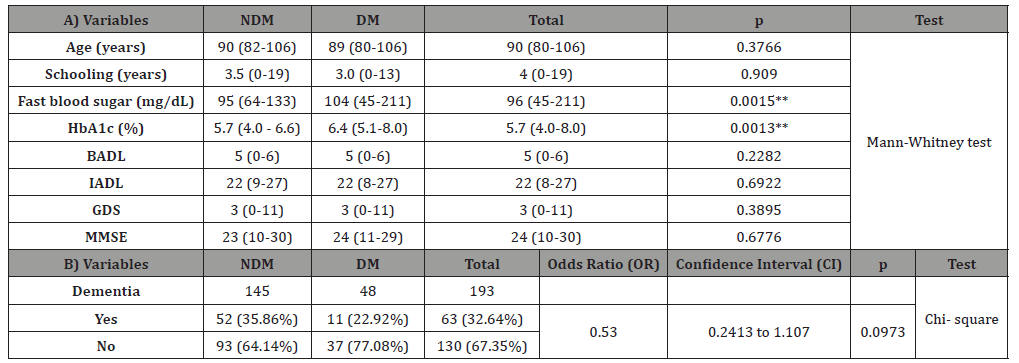
NDM (non-diabetic group); DM (diabetic group); Hb A1c (Glycated Haemoglobin); BADL (Basic Activities of Daily Living); IADLs (Instrumental
Activities of Daily Living); GDS (Geriatric Depression Scale); MMSE: Mini-Mental State Examination.
Analysis of the non-diabetic group (NDM) and the group with diabetes using MTF (DMTF)
Table 2 provides the median age of the NDM and DMTF groups, which were 90 years and 88 years, respectively. There were no statistically significant differences between the groups in schooling years, functionality, mood, and cognitive assessments. FBG and HbA1c showed statistically significant differences between the groups. Table 2 shows dementia frequency in the NDM and DMTF groups, with 35.86% and 22.22% of patients diagnosed, respectively (OR = 0.51, CI 0.1998 to 1.300). There was no statistically significant difference in dementia frequency between the groups.
Analysis of diabetics using MTF (DMTF) or not using MTF (NMTF)
The proportion of female patients remained similar, 71.42% (NMTF) and 59.25% (DMTF), and more than half of the population in the two groups died during follow-up, 52.38% (NMTF) and 62.96% (DMTF). Table 3 shows a median age of 91years for the NMTF group and 88 years for the DMTF group. There were no statistically significant differences between the groups in schooling years, functionality, laboratory tests, mood, cognition, and glucose levels. No statistically significant difference in dementia frequency was found between the NMTF and DMTF groups, with rates of 23.81% and 22.22%, respectively (OR = 0.91, CI0.2665 to 3.411) (Table 3).
Table 2:A) Median age, laboratory values, functional assessments, mood, and cognitive scores in long-lived non-diabetic and diabetic individuals using metformin. B) Frequency of dementia among long-lived non-diabetic and diabetic individuals using MTF.
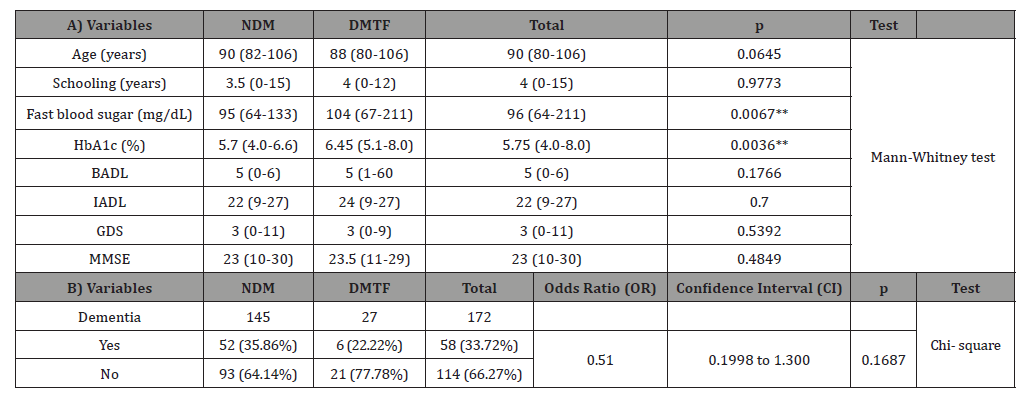
NDM (non-diabetic group); DMTF (diabetics using metformin); HbA1c (Glycated Haemoglobin); BADL (Basic Activities of Daily Living); IADLs
(Instrumental Activities of Daily Living); GDS (Geriatric Depression Scale); MMSE: Mini-Mental State Examination.
Table 3:A) Median age, laboratory values, functional assessments, mood, and cognitive scores in long-lived diabetic patients, based on MTF use. B) Frequency of dementia among long-lived diabetic patients, based on MTF use.
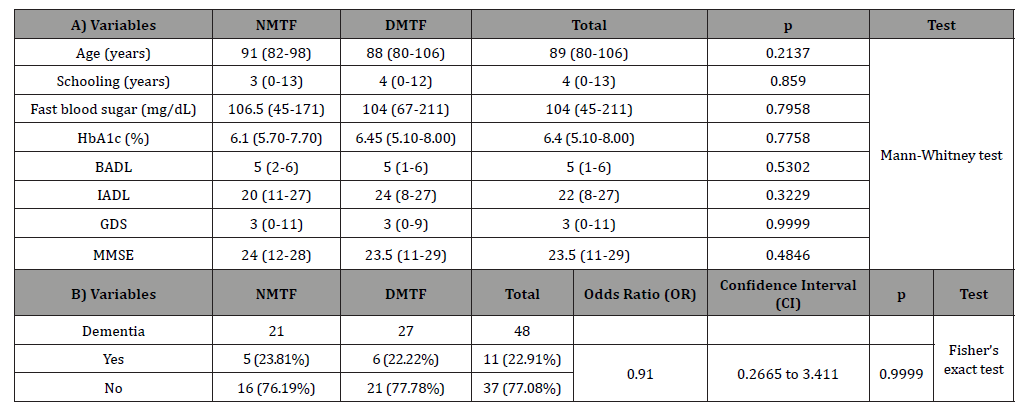
NMTF (diabetics not using MTF); DMTF (diabetics using MTF); HbA1c (Glycated Haemoglobin); BADL (Basic Activities of Daily Living); IADLs
(Instrumental Activities of Daily Living); GDS (Geriatric Depression Scale); MMSE: Mini-Mental State Examination.
Analysis of the non-diabetic group (NDM) and the group with diabetes not using MTF (NMTF)
The median age of the NDM and NMTF groups was 90 years and 91 years, respectively. There were no statistically significant differences between the groups in schooling years, functionality, mood, and cognitive assessments. No statistically significant differences were observed between the groups for either fasting glucose or glycated haemoglobin. Specifically, the median FBG at the end of the study in the NDM group was 95 mg/dL, and in the NMTF group it was 106.5 mg/dL (Table 4). Although dementia was diagnosed in 35.86% of the NDM group and 23.81% of the NMTF group (OR = 0.56, CI 0.2153 to 1.509 as detailed in Table 4), there was no statistically significant difference in dementia frequency between these groups.
Table 4:A) Median age, laboratory values, functional assessments, mood, and cognitive scores in long-lived non-diabetic and diabetic individuals not using MTF. B) Frequency of dementia among long-lived non-diabetics and diabetic patients not using MTF.
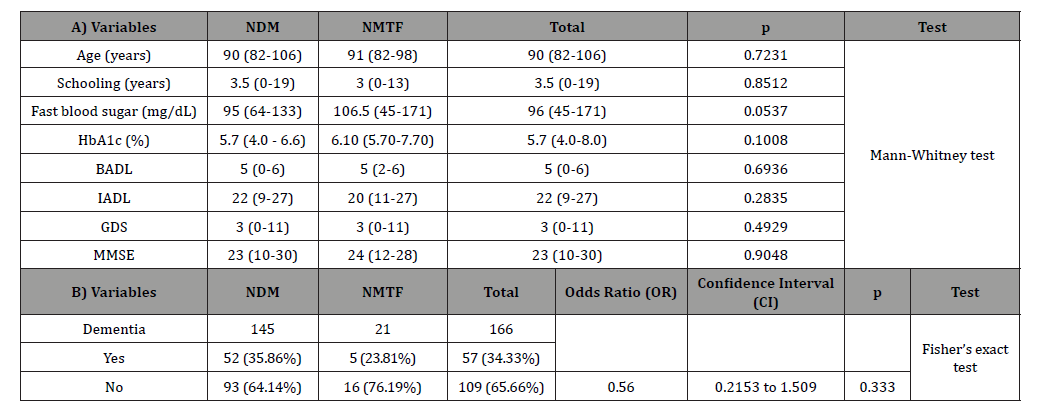
NDM (non-diabetic group); NMTF (diabetics not using MTF); HbA1c (Glycated Hemoglobin); BADL (Basic Activities of Daily Living); IADLs
(Instrumental Activities of Daily Living); GDS (Geriatric Depression Scale); MMSE: Mini-Mental State Examination.
Survival Curves
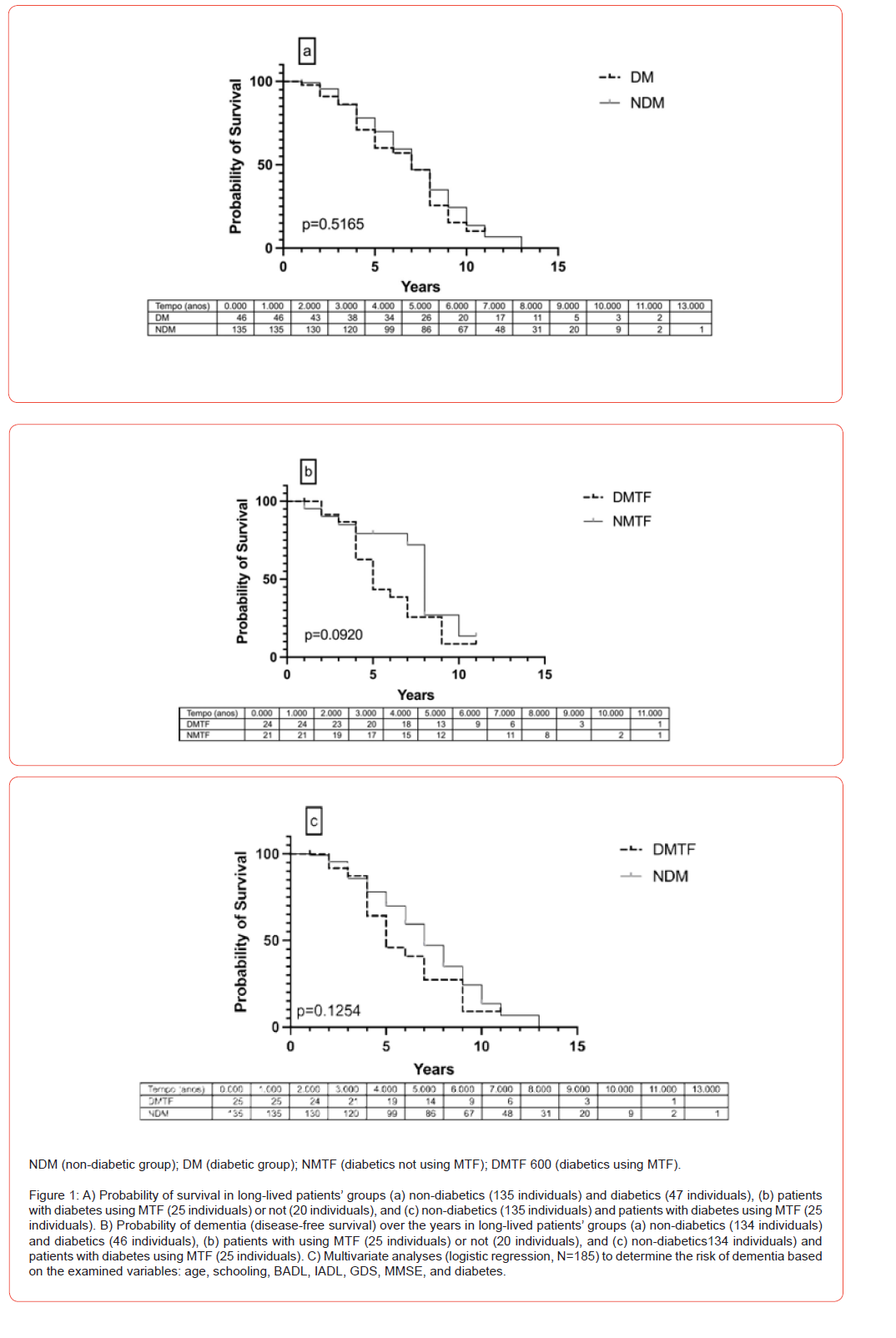
Survival analysis, examining time from follow-up initiation to death, revealed no statistically significant difference between diabetic and non-diabetic patients. Furthermore, Figure 1 demonstrates no association between MTF use and survival in diabetic patients. The median survival from the start of follow-up in the DM and the NDM group was 7 years, ranging from 0 to 11 years in the DM group and 0 to 13 years in the NDM group. In the DMTF group, median survival was 5 years (ranging from 0 to 11 years); in the NMTF group, it was 8 years (ranging from 01 to 11 years).
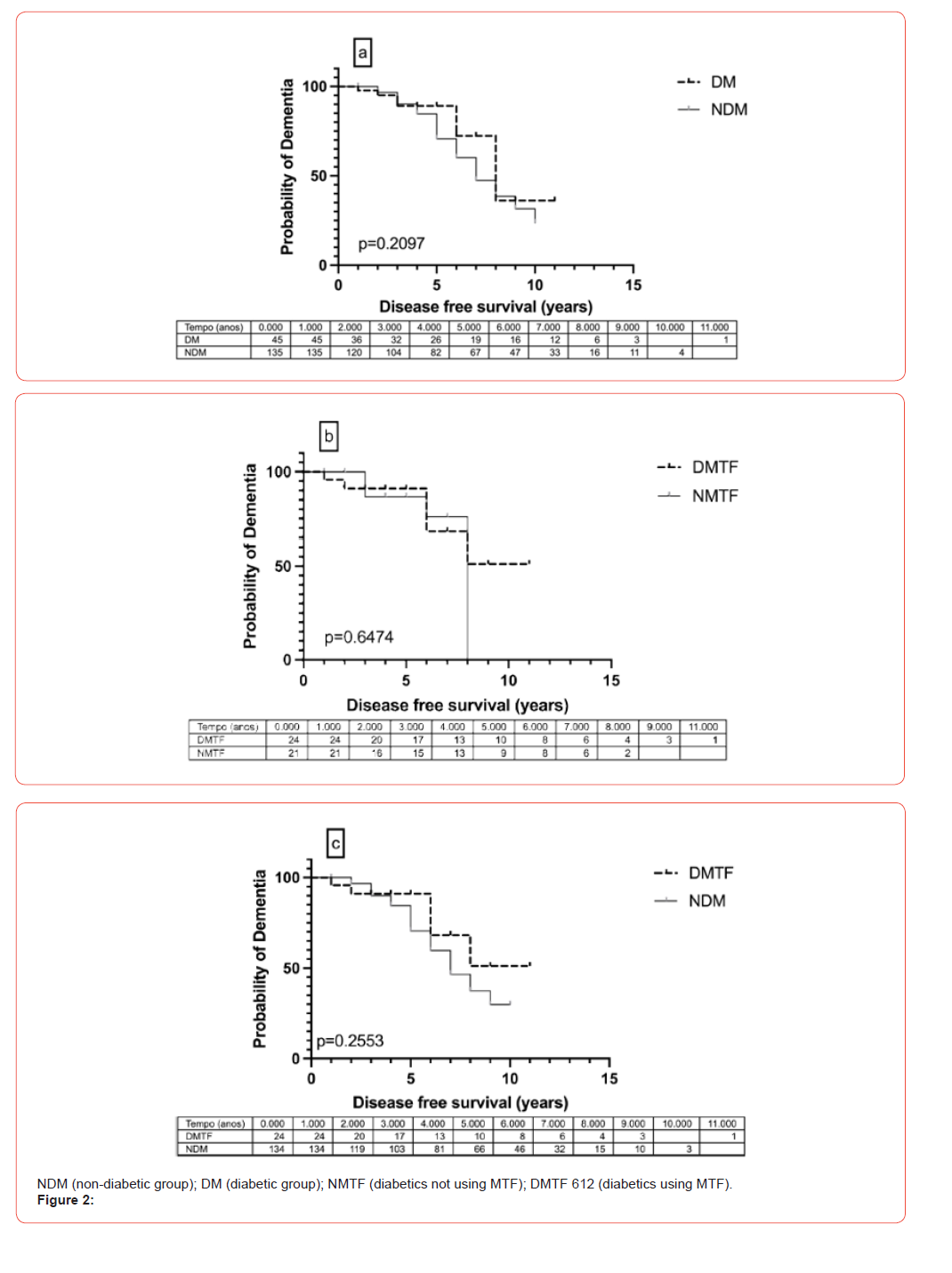
Analysis of disease-free survival, defined as time from follow-up initiation to dementia diagnosis, revealed no statistically significant difference between diabetic and non-diabetic groups. Similarly, Figure 2 shows no association between MTF use and disease-free survival in diabetic patients. Comparison of dementia-free survival curves between the DMTF and non-diabetic groups showed a trend towards improved survival in MTF users after 7 years of follow-up; however, this difference was not statistically significant. The median time from the start of follow-up to the diagnosis of dementia in the DM group was 8 years (ranging from 0 to 11 years); in the NDM group, it was 7 years (ranging from 1 to10 years). For the DMTF and NMTF groups, it was 5 years, ranging from 0 to 11years in the DMTF group and from 1 to 8 years in the NMTF group.
Multivariate Analyses
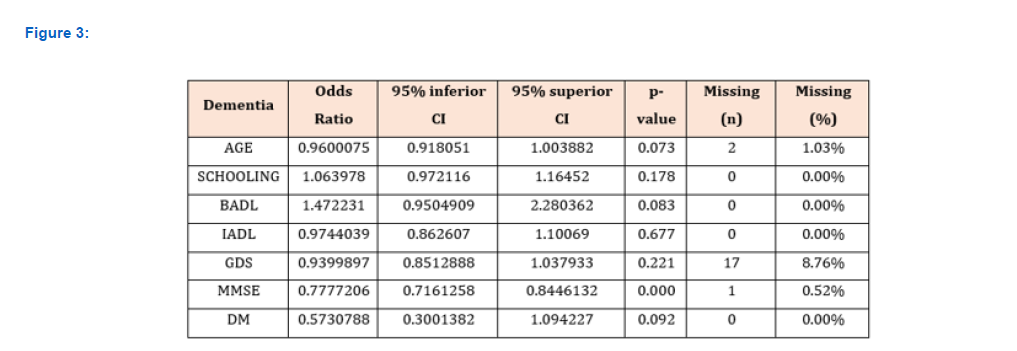
Robust standard error multivariate analyses were conducted to determine the risk of dementia based on the examined variables: age, schooling, BADL, IADL, GDS, MMSE, and diabetes. Only MMSE showed a significant impact on dementia (p<0.001, OR 0.777). This indicates that the risk of dementia decreases by 22% for each one-point increase in the MMSE final score (Figure 3). To further explore the role of education in cognitive outcomes, we performed a Spearman correlation analysis, which demonstrated a modest but statistically significant association between MMSE and years of schooling (Spearman r = 0.3548, p < 0.0001).
Discussion
This study analyzed a cohort of 194 elderly patients (aged 80 and above), including 48 individuals with DM. Among those, 27 were taking MTF. Although the MTF subgroup (DMTF) had a limited sample size, calculations indicated sufficient statistical power for the intended analyses. However, comparisons between the DMTF and non-MTF (NMTF) groups remain susceptible to a higher probability of Type II error (50%) due to the relatively small sample size of the DMTF group. Univariate analyses did not find differences between groups (except for FBG and HbA1 in diabetic and non-diabetic patients). Multivariate analyses confirmed that the studied variables age, schooling, BADL, IADL, GDS, and DM did not have a significant impact on the risk of dementia in this oldestold population. As expected, a higher MMSE score was associated with a lower risk of dementia diagnosis.
Spearman correlation analysis, which demonstrated a modest but statistically significant association between MMSE and years of schooling, reinforces the established relationship between educational attainment and cognitive performance. However, despite this correlation, schooling did not independently predict dementia risk in the adjusted model, suggesting that its influence may diminish in the oldest-old or be overshadowed by other agerelated factors. In this well-controlled cohort of very old adults, MTF use was not associated with an additional reduction in dementia or mortality compared with other management strategies. Despite DM being a known dementia risk factor [3,18], our findings corroborate the hypothesis that effective glycemic control, regardless of therapy, may mitigate this risk.
Consistent with DSM-5 data14, which reports a 30% dementia prevalence at age 85, our study found a 32.47% frequency. The 24.7% DM frequency in our cohort exceeded the 2009 NHIS (National Health Interview Survey) prevalence of 17.9%. Hypertension frequency (75.77%) aligned with other studies, which reported 74% in patients over 80 [19]. Functionally, our population showed independence in BADLs (median Katz score 5/6) and moderate dependence in IADLs (median Lawton score 22). No significant functional differences were observed between diabetic and nondiabetic groups, indicating DM did not impact functionality. Insulin resistance is a key modifiable risk factor for dementia [6]. While Samaras et al [3]. reported 60% dementia prevalence in type 2 DM; our diabetic group had only 22.92%. This may be attributed to adequate glycemic control, evidenced by a median HbA1c of 6.4% and FBG of 104 mg/dL. These values are within or below European DM2 guideline targets for elderly patients [20]. This control likely resulted from regular monitoring at our geriatrics clinic. Due to data limitations, it was not possible to stratify HbA1c groups of patients.
Contrary to Barbiellini et al. [21], we found no significant difference in dementia frequency between diabetic and nondiabetic groups. Their study, which included a younger population, reported a higher dementia risk in diabetics, particularly after 10 years of diagnosis. Our findings suggest effective glycemic control as a key factor. Cognitively, MTF use showed no significant impact on MMSE scores, functionality (BADLs/IADLs), or dementia diagnosis. This is the first study to assess these variables in a communitydwelling population over 80. Our results support the hypothesis that well-managed diabetes, through pharmacological and nonpharmacological interventions, can reduce the risk of dementia and improve outcomes. This finding is consistent with Moran et al. [22], who reported a lower dementia risk associated with better HbA1c control in a younger cohort.
Dementia probability curves showed no significant differences between diabetic and non-diabetic groups or MTF users and nonusers. Reinke et al [23] found a non-linear association between diabetes duration and dementia risk in a German cohort. Chiu et al. [24] also highlighted the link between DM progression and dementia risk. Survival curves showed no significant differences between groups. Tachkov et al. [25] found similar life expectancy in diabetic and non-diabetic individuals. However, Emerging Risk Factors Collaboration reported a higher mortality risk with earlier diabetes diagnosis [26]. Our results suggest that well-managed diabetes in the elderly may not significantly impact survival. One limitation of this study was that cognitive assessment, crucial for dementia diagnosis, relied on the MMSE. Our cohort’s median education was 4 years, reflecting Brazil’s historical social inequality. A review of the MMSE scores across the four tables revealed high intra-group variability, with a wide range (0-19 years). Critically, this variability included patients scoring below 14 points, indicative of severe dementia. However, the groups were deemed comparable on this variable due to the absence of statistically significant differences. While widely used, MMSE scores are influenced by education levels, potentially exhibiting a ceiling effect in highly educated individuals [27].
Although the clinical interpretation of MMSE relies on educational attainment, we elected not to adjust MMSE scores for inter-group comparisons. In the multivariate model, the MMSE was highly significant (p < 0.001), while schooling was not (p= 0.178). This finding strongly suggests that the MMSE is a superior independent predictor or, alternatively, that it accounts for the predictive variance of schooling (e.g., due to collinearity or mediation). Although the GDS indicated low depression risk, we could not determine the “real” depression frequency due to the lack of data on antidepressant use. Given the reported 12% depression prevalence in elderly populations, screening is essential, as depression can precede dementia [28-30]. Finally, while MMSE and GDS are valuable tools, this cross-sectional study treated dementia as a binary, static event, failing to capture its complex and evolving nature. While comparing MTF users (DMTF), non-MTF users (NMTF), and non-diabetics (NDM) is theoretically sound, the groups were not matched for confounders beyond basic demographics. This limitation includes the absence of adjustments for vascular risk factors, medication use, sensory impairments, and subgroup analyses based on HbA1c, DM duration, or comorbidities. We also lacked data on the duration of hypoglycemic drug use, including MTF. Finally, our data compared well-controlled DM patients using MTF, well-controlled diabetics not using MTF, and non-diabetic patients. Crucially, there is no comparator group with poor glycemic control. Therefore, our findings must be interpreted with caution and cannot be generalized to populations outside of well-controlled DM.
Conclusion
This pioneering community-based study uniquely assessed dementia frequency in DM and non-diabetic individuals over 80. It supports the hypothesis that well-controlled diabetes, regardless of treatment, does not worsen dementia or mortality risk compared to non-diabetic individuals. This finding is significant, as DM is a leading modifiable risk factor for dementia in the elderly [18].
Funding
The authors declare no financial support for this work.
Ethics Approval and Consent to Participate
This study was approved by the UNIFESP Ethics Committee (CAAE 67868822.3.0000.5505). Informed consent was signed when participants entered the Longevos Project.
Availability of Data and Materials
The data that support the findings of this study are available from the first author, Maísa Braga Aguiar, upon reasonable request.
Consent for Publication
The person responsible for the Longevos project is a manuscript co-author.
Authors’ Contributions
MBA - Conceptualization; Data curation; Formal analysis; Writing; SK - Data curation; Methodology; ABB - Methodology; LG -Data curation, Validation; MSC - Formal analysis; Project administration; Supervision; GWBC - Conceptualization; Validation; Writing - Review & Editing.
Declaration of Generative AI and AI-Assisted Technologies in the Writing Process
During the preparation of this work, the author(s) used Grammarly and Gemini AI to improve language and readability. After using these tools/services, the author(s) reviewed and edited the content as needed and take(s) full responsibility for the publication’s content.
Acknowledgement
None.
Conflicts of interest
No conflict of interest.
References
- World Health Organization (2016). Global Report on Diabetes. Geneve: WHO Library.
- Wium-Andersen IK, Osler M, Jørgensen MB, Rungby J, Wium-Andersen MK (2019) Antidiabetic medication and risk of dementia in patients with type 2 diabetes: a nested case–control study. Eur J Endocrinol 181(5): 499-507.
- Samaras K, Makkar S, Crawford JD, Kochan NA, Wen W, et al. (2020) Metformin Use Is Associated with Slowed Cognitive Decline and Reduced Incident Dementia in Older Adults With 405 Type 2 Diabetes: The Sydney Memory and Ageing Study. Diabetes Care 43(11): 2691-2701.
- Bendlin BB (2019) Antidiabetic therapies and Alzheimer disease. Dialogues Clin Neurosci 21(1): 83-91.
- Arvanitakis Z, Shah RC, Bennett DA (2019) Diagnosis and Management of Dementia: Review. JAMA 322(16): 1589-1599.
- Ping F, Jiang N, Li Y (2020) Association between metformin and neurodegenerative diseases of observational studies: systematic review and meta-analysis. BMJ Open Diabetes Res Care 8(1): e001370.
- Almeida OP, Almeida SA (1999) Confiabilidade da versão brasileira da Escala de Depressão em Geriatria (GDS) versão reduzida. Arq Neuropsiquiatr 57(2B): 421-426.
- Brown EL, Raue P, Halpert KD, Adams S, Titler MG (2009) Detection of depression in older adults with dementia. J Gerontol Nurs 35(2): 11-15.
- Valencia WM, Palacio A, Tamariz L, Florez H (2017) Metformin and ageing: improving ageing outcomes beyond glycaemic control. Diabetologia 60(9): 1630-1638.
- Chaudhari K, Reynolds CD, Yang SH (2020) Metformin and cognition from the perspectives of sex, age, and disease. Geroscience 42(1): 97-116.
- Hernández-Álvarez D, Mena-Montes B, Toledo-Pérez R, Pedraza-Vázquez G, López-Cervantes SP, et al. (2019) Long-Term Moderate Exercise Combined with Metformin Treatment Induces an Hormetic Response That Prevents Strength and Muscle Mass Loss in Old Female Wistar Rats. Oxid Med Cell Longev 11: 3428543.
- Katz S, Downs TD, Cash HR, Grotz RC (1970) Progress in development of the index of ADL. Gerontologist. Spring 10(1): 20-30.
- Carmona-Torres JM, Rodríguez-Borrego MA, Laredo-Aguilera JA, López-Soto PJ, Santacruz-Salas E, et al. (2019) Disability for basic and instrumental activities of daily living in older individuals. PLoS One 14(7): e0220157.
- American Psychiatric Association (2013) Diagnostic and Statistical Manual of Mental Disorders: DSM-5. 5th Ed. Washington, D.C. American Psychiatric Association.
- Neo J, Fettes L, Gao W, Higginson IJ, Maddocks M (2017) Disability in activities of daily living among adults with cancer: A systematic review and meta-analysis. Cancer Treat Rev 61: 94-106.
- American Diabetes Association (2010) Diagnosis and classification of diabetes mellitus. Diabetes Care 33 Suppl 1(Suppl 1): S62-S69.
- Agranonik M, Hirakata VN (2011) Cálculo de tamanho de amostra: proporçõ Clin Biomed Res 31(3): 382-388.
- Livingston G, Huntley J, Sommerlad A, Ames D, Ballard C, et al. (2020) Dementia prevention, intervention, and care: 2020 report of the Lancet Commission. Lancet 396(10248): 413-446.
- Oliveros E, Patel H, Kyung S, Fugar S, Goldberg A, et al. (2020) Hypertension in older adults: Assessment, management, and challenges. Clin Cardiol 43(2): 99-107.
- Sinclair AJ, Paolisso G, Castro M, Bourdel-Marchasson I, Gadsby R, et al. (2011) European Diabetes Working Party for Older People. European Diabetes Working Party for Older People 2011 clinical guidelines for type 2 diabetes mellitus. Executive summary. Diabetes Metab 37 Suppl 3: S27-S38.
- Barbiellini Amidei C, Fayosse A, Dumurgier J, Machado-Fragua MD, Tabak AG, et al. (2021) Association Between Age at Diabetes Onset and Subsequent Risk of Dementia. JAMA 325(16): 1640-1649.
- Moran C, Lacy ME, Whitmer RA, Tsai AL, Quesenberry CP, et al. (2023) Glycemic Control Over Multiple Decades and Dementia Risk in People with Type 2 Diabetes. JAMA Neurol 80(6): 597-604.
- Reinke C, Buchmann N, Fink A, Tegeler C, Demuth I, et al. (2022) Diabetes duration and the risk of dementia: a cohort study based on German health claims data. Age Ageing 51(1): afab231.
- Chiu WC, Ho WC, Liao DL, Lin MH, Chiu CC, et al. (2015) Progress of diabetic severity and risk of dementia. J Clin Endocrinol Metab 100(8): 2899-2908.
- Tachkov K, Mitov K, Koleva Y, Mitkova Z, Kamusheva M, et al. (2020) Life expectancy and survival analysis of patients with diabetes compared to the non-diabetic population in Bulgaria. PLoS One 15(5): e0232815.
- Emerging Risk Factors Collaboration (2023) Life expectancy associated with different ages at diagnosis of type 2 diabetes in high-income countries: 23 million person-years of observation. Lancet Diabetes Endocrinol 11(10): 731-742.
- Pinto TCC, Machado L, Bulgacov TM, Rodrigues-Júnior AL, Costa MLG, et al. (2019) Is the Montreal Cognitive Assessment (MoCA) screening superior to the Mini-Mental State Examination (MMSE) in the detection of mild cognitive impairment (MCI) and Alzheimer's Disease (AD) in the elderly? Int Psychogeriatr 31(4): 491-504.
- Steffens DC, Fisher GG, Langa KM, Potter GG, Plassman BL (2009) Prevalence of depression among older Americans: the Aging, Demographics and Memory Study. Int Psychogeriatr 21(5): 879-888.
- Hu D, Xie, Xiao Y, Lu C, Zhong J, et al. (2021) Metformin: A Potential Candidate for Targeting Aging Mechanisms. Aging Dis 12(2): 480-493.
- Hu T, Zhao X, Wu M, Li Z, Luo L, et al. (2022) Prevalence of depression in older adults: A systematic review and meta-analysis. Psychiatry Res 311: 114511.
-

This work is licensed under a Creative Commons Attribution-NonCommercial 4.0 International License.