
 Mini-Review
Recent Advances in Sediment Characterization for Beach Nourishment: Practical Developments in Sampling, Analysis and Compatibility Assessment
Received Date:June 29, 2026 Published Date:July 22, 2026
Abstract
Sediment characterization is one of the most influential stages in beach nourishment projects because it directly affects borrow sediment selection, compatibility assessment, overfill estimation and, ultimately, project performance. During the last decade, several methodological developments have progressively improved the reliability of sediment characterization by addressing practical problems frequently encountered during field sampling, laboratory analysis and engineering design. This paper reviews these developments from an engineering perspective, emphasizing representative sediment sampling within trailing suction hopper dredgers, improvements in grain-size analysis, advances in laboratory procedures, new approaches for sediment compatibility assessment and recent developments in monitoring techniques. Rather than providing an exhaustive review of beach nourishment practice, the paper summarizes a coherent sequence of methodological advances that have reduced common sources of error throughout the quality-control process. Practical recommendations are provided for engineers involved in beach nourishment design and construction, while future research needs are also discussed. The review highlights how relatively simple methodological improvements can substantially increase the reliability of engineering decisions without increasing project complexity or cost.
Keywords:Beach Nourishment; Borrow sediment; Grain-size Analysis; Sediment Sampling; Quality Control; Compatibility Assessment; Overfill ratio; Sieving; Monitoring
Introduction
Beach nourishment has become one of the most effective and widely adopted soft-engineering techniques for mitigating coastal erosion while preserving the recreational, environmental and protective functions of sandy beaches. During the last five decades, thousands of nourishment projects have been successfully completed worldwide, transforming beach nourishment from isolated engineering interventions into a mature coastal management strat egy supported by well-established design procedures, construction techniques and monitoring programmes [1-5].
Regardless of project size or location, every nourishment project begins with the same fundamental engineering question: is the borrow sediment suitable for the beach that will receive it? Answering this question requires reliable sediment characterization. Borrow-area selection, compatibility assessment, overfill estimation and construction quality control all depend on the accurate determination of sediment properties. Consequently, the reliability of these engineering decisions cannot exceed the quality of the sedimentological information on which they are based. Many of the methodological questions discussed in this review originated from earlier investigations on beach-profile variability and sediment behaviour carried out during the development of coastal morphodynamic studies [6], and were subsequently refined through applications to beach nourishment engineering.
Traditionally, sediment characterization has relied on statistical descriptors of grain-size distributions, including median grain diameter (D50), sorting coefficient, skewness and kurtosis (Folk and Ward, 1957) [7-10]. These parameters remain fundamental to beach nourishment design because they provide a concise description of sediment characteristics and constitute the basis of most compatibility and overfill methods currently used in engineering practice. However, practical experience accumulated during nourishment projects has demonstrated that obtaining reliable grainsize parameters is often considerably more challenging than generally assumed. Representative sampling, laboratory methodology and data processing may each introduce systematic errors capable of propagating throughout the entire design process.
Over the last decade, a series of complementary methodological developments has progressively addressed these practical limitations. Rather than proposing new morphodynamic models or alternative nourishment strategies, these studies have focused on improving the successive stages of sediment characterization itself, including representative sampling inside trailing suction hopper dredgers, laboratory grain-size analysis, rapid sample preparation, compatibility assessment based on complete grain-size distributions and post-nourishment verification. Collectively, these developments constitute a coherent methodological framework aimed at improving the reliability, repeatability and operational applicability of sediment characterization in beach nourishment projects [11-16].
Most of these methodological advances originated from practical engineering questions raised during real nourishment projects and works rather than from purely theoretical research. Does a grab sample collected from the surface of a hopper dredger adequately represent the entire sediment load? Can manual sieving provide results comparable to those obtained using standardized mechanical shakers? Does sieve diameter influence the calculated grain-size parameters? Can microwave drying replace conventional oven drying without compromising analytical accuracy? Are traditional compatibility methods still appropriate for increasingly heterogeneous borrow sediments? Addressing these apparently simple questions has progressively refined sediment characterization procedures while providing practical solutions that can be readily incorporated into routine engineering practice.
The methodological developments reviewed in this paper are organized according to the chronological sequence of a typical beach nourishment project. As illustrated in Figure 1, sediment characterization is considered as a continuous quality-control process extending from borrow-area investigation to post-construction verification. Within this framework, Figure 2 summarizes the principal methodological advances achieved during recent years and their contribution to improving representative sampling, laboratory analysis, compatibility assessment and field verification.
Unlike previous reviews dealing with beach nourishment from broader perspectives such as coastal management, monitoring strategies or climate-change adaptation [2,4,5,17], the present contribution focuses specifically on recent methodological developments in sediment characterization. Its objective is not to provide an exhaustive review of sedimentological techniques but to summarize practical advances that have demonstrated their value under operational conditions and discuss their implications for engineering practice.
Although the present review concentrates on methodological developments in sediment characterization, these advances should be interpreted within the broader evolution of beach nourishment practice. Recent international reviews have documented the increasing importance of nourishment as a coastal adaptation strategy, together with advances in monitoring technologies, environmental assessment and long-term project evaluation [18-22]. In parallel, several case studies have illustrated how monitoring and performance assessment contribute to improving nourishment design and management over successive projects [23-25].
The paper follows the same sequence encountered during a typical nourishment project. Section 2 reviews representative sediment sampling, from borrow-area characterization to quality control aboard trailing suction hopper dredgers. Section 3 discusses recent advances in laboratory grain-size analysis, including manual versus mechanical sieving, the influence of sieve diameter and rapid microwave drying. Section 4 examines recent developments in sediment compatibility assessment and overfill estimation, while Section 5 addresses post-nourishment verification and future perspectives. Together, these methodological advances illustrate how improving sediment characterization can strengthen quality control throughout the entire beach nourishment process while supporting more reliable engineering decisions.
Representative Sediment Sampling
Sampling as the First Stage of Quality Control
Representative sediment sampling constitutes the foundation of every beach nourishment project because all subsequent engineering decisions depend on the quality of the material collected during field investigations. Grain-size analysis, compatibility assessment and overfill estimation assume that the analysed sample accurately represents the borrow sediment that will eventually be dredged and placed on the beach. If this assumption is not fulfilled, even highly accurate laboratory analyses may lead to erroneous engineering decisions. Figure 2 illustrates the principal stages of sediment characterization during a typical beach nourishment project, from field sampling to post-construction monitoring.
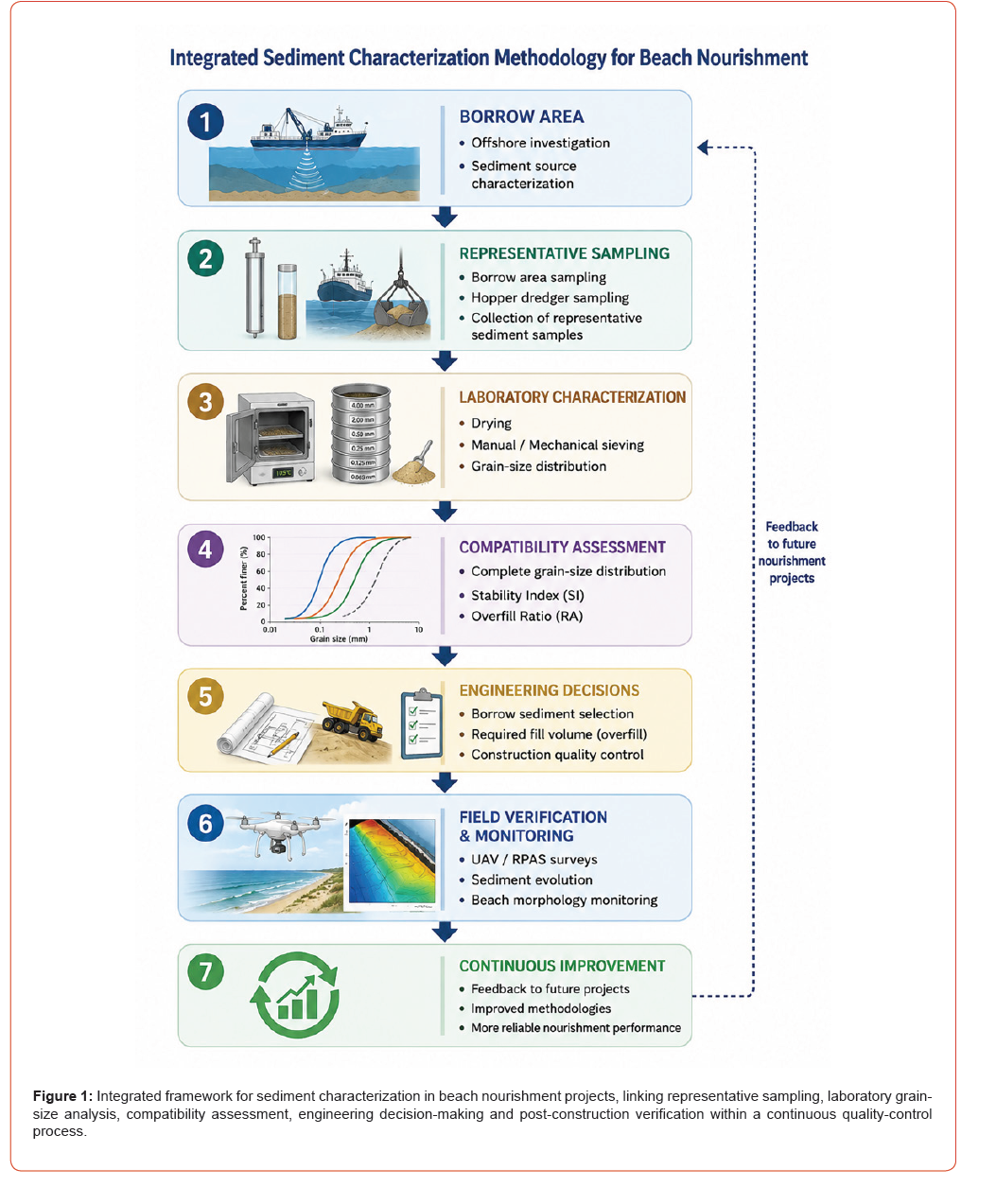
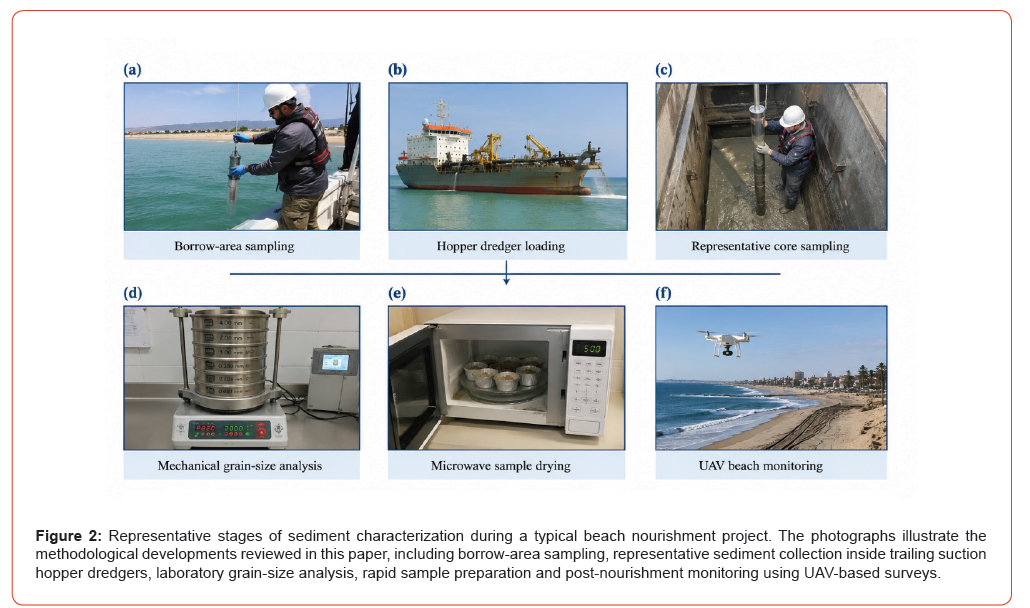
Figure 1: Integrated framework for sediment characterization in beach nourishment projects, linking representative sampling, laboratory grain-size analysis, compatibility assessment, engineering decision-making and post-construction verification within a continuous quality-control process.
Borrow-area investigations have traditionally combined bathymetric surveys, geophysical exploration and sediment sampling to identify suitable deposits and estimate available sediment volumes [26-28]. Within this framework, considerable attention has been devoted to the spatial distribution of sediment types, the presence of unsuitable layers and the estimation of exploitable reserves. However, comparatively less attention has been paid to the representativeness of individual sediment samples, despite their direct influence on the subsequent characterization process.
Natural borrow areas frequently exhibit significant spatial variability resulting from differences in depositional environments, sediment transport pathways and local hydrodynamic conditions. Consequently, sampling density, sampling depth and sample location should not be regarded as routine field procedures but as fundamental elements of engineering quality control. These recommendations are fully consistent with the principles established in the classical Shore Protection Manual [29], where representative sediment characterization was already recognized as a prerequisite for successful beach-fill design, although subsequent methodological developments have substantially refined both sampling and laboratory procedures.
Representative Sampling within Hopper Dredgers
Representative sampling becomes even more challenging once dredging operations begin. During construction, quality control commonly relies on sediment samples collected directly from the hopper of trailing suction hopper dredgers in order to verify that the material being transported complies with project specifications. Conventional practice has generally assumed that the sediment stored inside the hopper is sufficiently homogeneous for surface grab samples to represent the entire load. Nevertheless, this assumption had received little experimental verification until recent methodological studies specifically addressed this issue.
Poullet [12] demonstrated that significant vertical grain-size variations may develop inside hopper dredgers as a consequence of hydraulic segregation during loading. Their results showed that samples collected exclusively from the upper surface may not accurately represent the complete sediment load, particularly when coarse and fine fractions become vertically stratified. Consequently, quality-control decisions based solely on grab samples may introduce systematic bias into sediment characterization.
To overcome this limitation, the authors proposed a percussion- core sampling procedure capable of recovering representative sediment columns throughout the entire hopper depth. The methodology not only provided more representative grain-size distributions but also allowed the internal variability of the dredged material to be quantified for the first time under operational conditions. These findings represent an important methodological advance because they demonstrate that sampling strategy itself may constitute one of the principal sources of uncertainty during beach nourishment quality control.
Engineering Implications
The studies reviewed above reinforce a fundamental principle
of sediment characterization: laboratory precision cannot compensate
for inadequate sampling. Regardless of the sophistication of
subsequent analytical procedures, reliable engineering decisions
require representative field samples.
From a practical perspective, representative sediment sampling
should incorporate four basic principles:
• characterize the spatial variability of the borrow area before
defining sampling locations;
• adapt sampling density to sediment heterogeneity rather
than applying fixed sampling intervals;
• avoid relying exclusively on surface grab samples during
hopper quality control;
• employ standardized sampling protocols throughout
project execution to ensure repeatability and comparability.
These recommendations require only minor modifications to conventional field procedures but substantially improve the reliability of grain-size analysis, sediment compatibility assessment and subsequent engineering design. Finally, representative sampling should be regarded as the first stage of an integrated quality- control methodology rather than as an isolated field activity. Once representative material has been collected, attention shifts to the laboratory, where grain-size distributions are determined and transformed into the engineering parameters used throughout nourishment design. The following section therefore examines recent methodological developments aimed at improving the reliability and reproducibility of laboratory grain-size analysis.
Advances in Grain-Size Analysis
Laboratory Analysis: More Than a Routine Procedure
Once representative sediment samples have been collected, laboratory analysis transforms field observations into the engineering parameters used for nourishment design. Median grain size (D50), sorting coefficient, skewness and kurtosis constitute the basis of sediment compatibility assessment, overfill estimation and several predictive models commonly employed in coastal engineering (Folk and Ward, 1957) [7,9,10].
Because grain-size analysis is routinely performed in sediment laboratories worldwide, the analytical procedures themselves are often assumed to be standardized and fully reproducible. In practice, however, several methodological decisions adopted during sample preparation and sieving may significantly influence the resulting grain-size distribution. Until recently, these sources of variability had received comparatively little attention, despite their direct implications for engineering design.
Recent methodological investigations have demonstrated that apparently minor laboratory procedures-including the sieving technique, sieve dimensions and drying method-may introduce systematic differences in the calculated sediment parameters. Although these differences are generally small from a sedimentological perspective, they may become significant when borrow and native sediments exhibit only slight differences in grain-size distribution. The importance of rigorous particle-size analysis has long been recognized in sedimentology [30]. However, only recently have its practical implications for engineering quality control during beach nourishment projects been evaluated in a systematic manner.
Manual versus Mechanical Sieving
Mechanical sieving using standardized laboratory shakers has traditionally been regarded as the reference procedure for grainsize analysis because it provides controlled vibration conditions and excellent repeatability. Nevertheless, manual sieving continues to be widely used during dredging campaigns, preliminary field investigations and onboard quality-control operations, where laboratory equipment is frequently unavailable. Despite its widespread application, the equivalence between manual and mechanical sieving had rarely been evaluated under controlled experimental conditions. Poullet et al. [13] addressed this issue by comparing both procedures using identical sediment samples analysed under standardized laboratory conditions.
Their results demonstrated that manual sieving may produce systematic differences in grain-size parameters, particularly for median grain size (D50) and kurtosis. Rather than representing random analytical variability, these differences reflected the distinct particle movement generated by manual and mechanical shaking. Consequently, datasets obtained using different sieving procedures should not automatically be considered directly comparable. From an engineering perspective, these findings emphasize that analytical methodology should always accompany reported grainsize parameters. Mechanical sieving should therefore be regarded as the preferred procedure whenever compatibility assessment or contractual quality control depends on laboratory results.
Does Sieve Diameter Influence Grain-Size Distribution?
Portable sieve sets used during nourishment works commonly employ smaller sieve diameters than those recommended for conventional laboratory analysis. Although these portable systems greatly facilitate onboard operations, their potential influence on grain-size distributions had remained largely unexplored.
[14] investigated this issue by comparing analyses performed using sieve sets of different diameters while maintaining identical sediment samples and laboratory procedures. The study demonstrated that reducing sieve diameter may systematically modify grain-size distributions, particularly for medium and coarse sands where particle flow through the mesh becomes increasingly constrained.
The practical implications are particularly relevant for beach nourishment projects. Differences attributed to laboratory equipment may approach or even exceed the natural differences observed between native and borrow sediments. Under these circumstances, engineering decisions regarding sediment compatibility may become influenced by analytical methodology rather than by genuine sediment characteristics. These findings support the need for standardized laboratory equipment and highlight the importance of documenting analytical procedures whenever grain-size distributions are compared between laboratories or successive monitoring campaigns.
Rapid Sample Preparation: Microwave Drying
Drying constitutes an essential stage of grain-size analysis because moisture content directly affects sediment weight and the subsequent calculation of particle-size distributions. Conventional oven drying remains the standard laboratory procedure but typically requires several hours before samples become suitable for sieving. Although this delay is generally acceptable during laboratory investigations, it may become operationally restrictive during active nourishment works, where engineers often require rapid information regarding sediment suitability.
To address this limitation, López-García et al. [14] evaluated the feasibility of replacing conventional oven drying with controlled microwave drying. Experimental comparisons demonstrated excellent agreement between both methodologies while reducing processing time from several hours to only a few minutes. Differences in D50 and the remaining statistical parameters remained well within the uncertainty generally accepted for routine engineering applications. The methodology therefore offers an attractive alternative for rapid quality control during dredging operations, particularly when engineering decisions must be taken within the operational timescale of construction activities.
Engineering Implications
Collectively, these methodological developments demonstrate that laboratory analysis should no longer be regarded as a purely routine operation. Instead, it constitutes a critical stage of engineering quality control whose reliability depends on standardized analytical procedures as much as on instrument precision.
The principal practical implications emerging from these studies
can be summarized as follows:
• representative sampling must be complemented by standardized
laboratory procedures;
• manual and mechanical sieving should not be considered
interchangeable without prior calibration;
• sieve dimensions should remain consistent throughout a
project and between successive monitoring campaigns;
• microwave drying provides an efficient alternative for
rapid sediment characterization during nourishment works;
• laboratory methodology should always be reported together
with grain-size parameters whenever engineering decisions
depend on sediment compatibility.
Taken together, these developments substantially improve the reproducibility of grain-size analysis while reducing avoidable uncertainty in sediment compatibility assessment. Once reliable grain-size distributions have been obtained, the next engineering challenge consists of determining whether the borrow sediment is genuinely compatible with the native beach and estimating the additional fill volume required to achieve long-term nourishment performance.
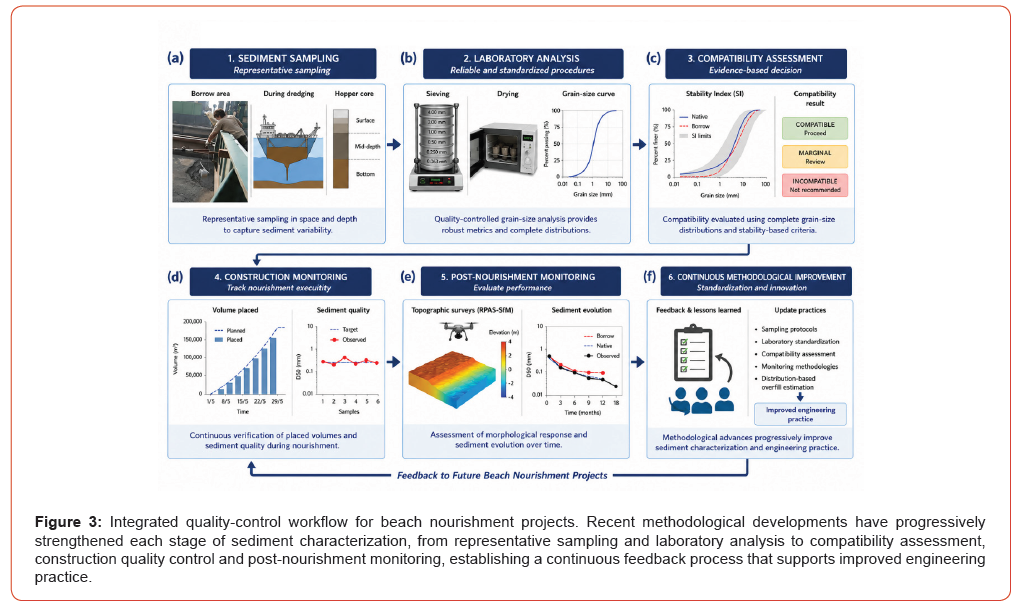
Figure 3 summarizes how recent methodological developments have progressively integrated representative sampling, laboratory characterization, compatibility assessment and monitoring into a unified quality-control workflow for beach nourishment projects.
Sediment Compatibility Assessment
From Grain-Size Parameters to Engineering Decisions
The ultimate objective of sediment characterization is not simply to describe sediment properties but to support engineering decisions regarding borrow sediment selection and nourishment design. Once representative grain-size distributions have been obtained, engineers must determine whether the borrow sediment is sufficiently compatible with the native beach to ensure satisfactory long-term performance. For several decades, sediment compatibility has been evaluated using statistical descriptors such as median grain size (D50), sorting coefficient and, occasionally, fine sediment content [7,8,10]. These parameters provide a convenient and concise description of sediment characteristics and remain widely used in engineering practice because of their simplicity and straightforward interpretation.
However, reducing complex sediment distributions to one or two representative parameters inevitably implies a loss of information. Natural beach sediments frequently exhibit multimodal distributions, carbonate-rich fractions or heterogeneous mixtures that cannot be adequately represented by a single characteristic diameter. Consequently, sediments with similar D50 values may exhibit different hydraulic behaviour after placement, while apparently dissimilar sediments may perform in a comparable manner under wave action. These limitations have progressively motivated the development of compatibility methodologies capable of considering the complete grain-size distribution rather than isolated statistical parameters.
Compatibility Based on Complete Grain-Size Distributions
One of the most significant methodological advances achieved during recent years has been the transition from parameter-based comparisons towards distribution-based compatibility assessment. Pranzini et al. [11] introduced the Stability Index (SI), a probabilistic methodology that evaluates the hydraulic behaviour of every grain-size fraction within the borrow sediment. Instead of comparing only representative statistical parameters, the method considers the probability that each fraction will remain within the nourished beach after placement.
From an engineering perspective, this approach offers several advantages. First, it avoids the implicit assumption that sediment distributions follow ideal log-normal behaviour. Second, it can be applied to heterogeneous borrow sediments frequently encountered in offshore deposits. Finally, it provides engineers with a more physically meaningful description of sediment compatibility by directly considering the expected stability of individual grainsize fractions.
This concept is also consistent with earlier experimental work based on sediment tracers, which demonstrated that individual grain-size fractions may exhibit substantially different transport velocities under identical hydrodynamic conditions [31]. These observations anticipated the need for compatibility approaches capable of considering the behaviour of the complete grain-size distribution rather than relying exclusively on representative statistical parameters. The Stability Index therefore represents an important conceptual evolution in compatibility assessment, extending the analysis from simple sediment description towards prediction of post-placement behaviour.
Improving Overfill Estimation
Compatibility assessment and overfill estimation constitute two complementary stages of the same engineering process. Once borrow sediment has been considered acceptable, the additional sediment volume required to compensate for the preferential loss of finer fractions must be estimated. The methodology proposed by James [8] remains the most widely adopted procedure for calculating the overfill ratio and has been incorporated into numerous engineering manuals and practical guidelines. Its robustness and simplicity largely explain its continued application in beach nourishment projects worldwide.
Nevertheless, increasing experience with heterogeneous borrow sediments has revealed some limitations associated with approaches based exclusively on statistical descriptors. Recent investigations by Contreras-de-Villar et al. [32] proposed an alternative methodology that directly compares the complete grain-size distributions of native and borrow sediments instead of relying solely on representative parameters. Application of the new methodology to several representative nourishment cases demonstrated that conventional approaches may overestimate the required fill volume when sediment distributions deviate significantly from idealized assumptions. By incorporating the complete grain-size distribution, the proposed overfill ratio provides estimates that more closely reflect the actual hydraulic behaviour of the borrow sediment.
Although additional validation under different coastal environments is still desirable, these results suggest that more realistic overfill estimates may reduce unnecessary dredging volumes while maintaining project performance, thereby producing significant economic benefits for large-scale nourishment projects.
Practical Implications for Beach Nourishment Design
The methodological developments reviewed above illustrate a gradual evolution in sediment compatibility assessment. Rather than replacing traditional engineering practice, recent advances complement classical methods by incorporating a more detailed description of sediment characteristics.
Several practical recommendations emerge from these investigations:
• sediment compatibility should be evaluated using the
complete grain-size distribution whenever sufficient data are
available;
• D50 should be regarded as an initial indicator rather than
the sole compatibility criterion;
• heterogeneous borrow sediments require methodologies
capable of accounting for non-standard grain-size distributions;
• compatibility assessment and overfill estimation should
be considered complementary components of the same engineering
workflow;
• improved sediment characterization may produce significant
economic savings by optimizing borrow sediment selection
and reducing unnecessary fill volumes.
These developments demonstrate that advances in compatibility assessment are closely linked to improvements in sediment characterization. As laboratory analyses become more reliable and representative, compatibility methodologies can exploit increasingly detailed sediment information, leading to more robust engineering decisions. The final stage of this process consists of verifying whether the predicted sediment behaviour is confirmed under field conditions. Consequently, post-nourishment monitoring should be regarded as the natural continuation of sediment characterization rather than as an independent engineering activity.
Field Verification and Future Perspectives
Sediment Characterization Does Not End at Construction
Sediment characterization is generally regarded as a design- stage activity whose primary objective is to support borrow sediment selection and nourishment planning. However, once construction has been completed, the placed material immediately becomes subject to wave action, tidal currents and wind-induced sediment transport. As a consequence, the grain-size distribution of the nourished beach progressively evolves through selective transport, sorting and mixing with the native sediment.
This natural evolution demonstrates that sediment compatibility should not be interpreted as a static property determined before construction, but rather as a dynamic process whose validity can only be confirmed through post-nourishment monitoring. Consequently, field verification represents the final stage of sediment characterization and provides essential feedback for improving future nourishment projects. Several monitoring studies have shown that nourished beaches tend to evolve towards site-specific equilibrium conditions, progressively reducing the initial differences between native and borrow sediments [1-2]. These observations reinforce the importance of selecting compatible borrow sediments while also highlighting the need to verify the long-term evolution of the placed material.
Monitoring Sediment Evolution
Traditional post-nourishment monitoring has largely focused on shoreline position, beach profiles and volumetric changes because these parameters provide direct indicators of nourishment performance. Although these surveys remain essential, sediment characterization offers complementary information that helps explain why morphological changes occur. Monitoring programmes carried out after nourishment have demonstrated that grain-size distributions frequently evolve during the months and years following construction. Fine fractions may be preferentially transported offshore or alongshore, while repeated wave action promotes progressive mixing between borrow and native sediments. Consequently, sedimentological monitoring provides valuable insight into the physical processes controlling nourishment adjustment.
Several complementary field studies have also shown that sediment evolution should be interpreted together with morphological response. Monitoring of turbidity during dredging and nourishment operations [33], post-nourishment changes in sediment porosity [34], optimization of beach-profile spacing for coastal monitoring [35] and recent analyses of shoreline evolution under climate-change scenarios [36] illustrate how sediment characteristics, beach morphology and monitoring methodologies progressively converge towards a more comprehensive understanding of nourishment performance.
Sediment evolution should also be interpreted together with morphological adjustment. Previous studies on equilibrium beach profiles demonstrated that profile geometry and sediment characteristics evolve simultaneously under wave forcing, reinforcing the need to analyse both processes jointly during nourishment monitoring [37]. Recent studies by Santos-Vendoiro et al. [14] confirmed that monitoring the temporal evolution of sediment characteristics constitutes an effective means of evaluating the long-term behaviour of nourished beaches and validating compatibility assessments performed during project design.
New Monitoring Technologies
Technological advances achieved during the last decade have substantially improved the efficiency and accuracy of beach monitoring. Among them, unmanned aerial vehicles (UAVs) combined with Structure-from-Motion (SfM) photogrammetry have become one of the most promising tools for rapid coastal surveying. Unlike conventional topographic surveys, UAV-based techniques provide high-resolution digital elevation models with excellent spatial coverage while significantly reducing fieldwork time and operational costs [38,39]. These methodologies are particularly useful for monitoring nourishment evolution because they allow repeated surveys to be performed at relatively short time intervals.
Recent advances in coastal monitoring are not limited to UAVbased photogrammetry. Satellite remote sensing, terrestrial laser scanning, video monitoring and radar techniques increasingly complement traditional topographic surveys, allowing coastal evolution to be assessed over a wide range of temporal and spatial scales [40-42]. In parallel, recent applications developed by our research group have extended these methodologies to the monitoring of coastal defence structures and critical coastal infrastructure, illustrating the growing integration between geomatic techniques and coastal engineering practice (43; 44).
Methodological developments by Contreras-de-Villar et al. [45, 46] demonstrated that RPAS-based surveys can achieve centimetric accuracy under suitable acquisition conditions, making them appropriate for monitoring beach morphology and volumetric evolution after nourishment. Although these techniques do not directly replace sediment sampling, they provide complementary information that improves interpretation of sediment redistribution and beach adjustment. The growing availability of global shoreline datasets also offers new opportunities to place local nourishment projects within a broader spatial context, facilitating comparisons among sites and improving the interpretation of long-term coastal evolution [47].
Long-term experience in positioning and monitoring offshore anti-trawling reefs has also demonstrated the importance of accurate field surveying and repeated inspections for evaluating the performance of marine engineering works under operational conditions [48]. Although developed for a different application, these methodologies share common quality-control principles with beach nourishment monitoring. The integration of sediment characterization with high-resolution topographic monitoring represents an important step towards more comprehensive quality- control programmes capable of evaluating both sediment properties and morphological response.
Towards an Integrated Quality-Control Framework
The methodological developments reviewed throughout this paper demonstrate that sediment characterization should no longer be regarded as a sequence of independent laboratory and field procedures. Instead, it should be considered an integrated quality- control framework extending throughout the entire life cycle of a beach nourishment project. Representative sampling ensures that laboratory analyses describe the material actually dredged from the borrow area. Standardized laboratory procedures improve the reliability and reproducibility of grain-size parameters. Distribution- based compatibility assessment transforms those parameters into engineering decisions regarding sediment suitability and required nourishment volumes. Finally, post-construction monitoring verifies whether those decisions successfully predicted the field behaviour of the nourished beach.
Viewed collectively, these methodological advances reveal a progressive transition from isolated analytical procedures towards an integrated engineering methodology in which each stage contributes to reducing uncertainty and improving decision-making. Future developments will probably focus on greater automation of sediment characterization through image analysis, artificial intelligence and digital laboratory techniques. At the same time, closer integration between sedimentological information, topographic monitoring and numerical modelling is expected to further strengthen the scientific basis of beach nourishment design. Future nourishment projects are also expected to incorporate increasingly adaptive design concepts, combining sediment characterization with nature-based solutions and large-scale sediment management strategies such as the Sand Engine [49].
The next logical challenge is therefore not the development of entirely new compatibility concepts, but the standardization and integration of existing methodologies into routine engineering practice. Achieving this objective would facilitate comparisons among projects, improve reproducibility between laboratories and ultimately contribute to more reliable and cost-effective beach nourishment programmes worldwide. The integration of sediment characterization with complementary engineering information is also becoming increasingly important. Long-term experience gained from beach maintenance programmes [50], the interaction between coastal structures and sandy seabeds [38,51,52], environmental monitoring associated with nourishment works [53, 54] and recent applications of coastal engineering to shoreline resilience and infrastructure management [55] collectively illustrate how sediment characterization has evolved from an isolated laboratory task into an essential component of integrated coastal engineering practice.
Table 1 summarizes the principal methodological developments reviewed in this paper, highlighting the engineering problems addressed, the proposed solutions and their practical implications for beach nourishment projects. Together, these advances illustrate the progressive evolution of sediment characterization from isolated analytical procedures towards an integrated quality- control methodology.
Table 1:Timeline of the main methodological developments reviewed in this paper, showing the engineering challenges addressed, the corresponding methodological advances, the key references and their contribution to engineering practice.

Conclusions
Sediment characterization has traditionally been regarded as a routine preliminary stage of beach nourishment design. However, the methodological developments reviewed in this paper demonstrate that it should instead be considered a continuous quality-control process extending from borrow-area investigation to post-construction verification. The reliability of engineering decisions concerning borrow sediment selection, compatibility assessment and nourishment performance depends directly on the quality of the sedimentological information available throughout the project.
During the last decade, significant progress has been achieved through a sequence of complementary methodological developments addressing different stages of sediment characterization. Representative sampling procedures have improved the reliability of field data obtained from borrow areas and trailing suction hopper dredgers. Standardization of laboratory methodologies has demonstrated that analytical procedures, including sieving technique, sieve dimensions and sample preparation, may significantly influence grain-size parameters used for engineering design. At the same time, new compatibility approaches based on complete grain-size distributions have extended traditional methods beyond the limitations associated with isolated statistical descriptors such as D50.
These advances do not replace the engineering principles that have successfully guided beach nourishment practice for decades. Instead, they strengthen those principles by providing more representative sediment data, more reliable analytical procedures and more robust compatibility assessment methodologies. Consequently, improvements achieved during recent years have resulted not from increasing methodological complexity, but from progressively reducing avoidable sources of uncertainty throughout the sediment characterization process.
From a practical perspective, several recommendations emerge from the studies reviewed in this paper. Representative sampling should receive the same level of attention as laboratory analysis. Analytical procedures should be standardized and fully documented whenever grain-size parameters are compared among laboratories or monitoring campaigns. Compatibility assessment should exploit the complete grain-size distribution whenever possible, particularly for heterogeneous borrow sediments. Finally, post-nourishment monitoring should be considered an essential component of sediment characterization because it provides the feedback required to validate engineering predictions and improve future projects.
Likewise, predicting the morphological response of nourished beaches under energetic wave conditions remains one of the principal challenges of coastal engineering. Experimental studies on beach scarping have shown that beach behaviour depends on the interaction between sediment characteristics and hydrodynamic forcing [56], further emphasizing the importance of reliable sediment characterization during project design.
Collectively, the methodological developments discussed here define an integrated framework for sediment characterization in beach nourishment projects. Rather than representing isolated technical improvements, they form successive stages of a coherent quality-control methodology linking representative sampling, laboratory analysis, compatibility assessment and field verification. Their progressive implementation has contributed to more reliable engineering decisions while providing practical solutions that can be readily incorporated into routine beach nourishment practice. Future research should focus on the international standardization of sediment characterization protocols, broader validation of distribution-based compatibility methods under different coastal settings and closer integration between sedimentological analyses, high-resolution monitoring techniques and numerical modelling. Such developments will further strengthen the scientific basis of beach nourishment design while supporting more efficient, transparent and cost-effective coastal management.
Acknowledgements
None.
Conflict of Interest
No conflict of interest.
References
- Dean RG (2002) Beach Nourishment: Theory and Practice. Singapore: World Scientific.
- Hanson H, Brampton A, Capobianco M, Dette HH, Hamm L, et al. (2002) Beach nourishment projects, practices and objectives A European overview. Coastal Engineering, 47(2): 81 111.
- Hamm L, Capobianco M, Dette HH, Lechuga A, Spanhoff R, et al. (2002) A summary of European experience with shore nourishment. Coastal Engineering 47(2): 237 264.
- Cooke BC, Jones AR, Goodwin ID, Bishop MJ (2012) Nourishment practices on Australian sandy beaches: A review. Journal of Environmental Management 113: 319 327.
- De Schipper MA, Ludka BC, Raubenheimer B, Luijendijk AP, Schlacher TA (2021) Beach nourishment has complex implications for the future of sandy shores. Nature Reviews Earth & Environment 2: 70 84.
- Muñoz Perez JJ (1996) Análisis de la morfología y variabilidad de playas apoyadas en lajas rocosas (Doctoral dissertation), University of Cadiz.
- Dean RG (1974) Compatibility of Borrow Material for Beach Fills. In Proc. of 14th Int. Conf. on Coastal Engineering 2: 1319 1330.
- James WR (1975) Techniques in evaluating suitability of borrow material for beach nourishment. Coastal Engineering Research Center Technical Memorandum, No. 60, U.S. Army Corps of Engineers.
- Blott SJ, Pye K (2001) GRADISTAT: A grain size distribution and statistics package for the analysis of unconsolidated sediments. Earth Surface Processes and Landforms 26: 1237 1248.
- Stauble DK (2005) A review of the role of grain size in beach nourishment projects. Shore & Beach, 73(1): 31 36.
- Pranzini E, Anfuso G, Muñoz Perez JJ (2018) A probabilistic approach to borrow sediment selection in beach nourishment projects. Coastal Engineering 139: 37 44.
- Poullet P, Muñoz Perez JJ, Lopez P, García Lopez S, Martell R, et al. (2019a) Sand size variability inside the hopper of a trailing suction dredger for beach nourishment purposes. Geo Marine Letters.
- Poullet P, Muñoz Perez JJ, Poortvliet G, Mera J, Contreras A, Lopez P (2019b) Influence of Different Sieving Methods on Estimation of Sand Size Parameters. Water 11(5): 879.
- Lopez Garcia P, Muñoz Perez JJ, Contreras A, Vidal J, Jigena B, et al. (2021) Error on the Estimation of Sand Size Parameters When Using Small Diameter Sieves and a Solution. Frontiers in Marine Science 8: 738479.
- Lopez Garcia P, Muñoz Perez JJ, Contreras de Villar A, Contreras de Villar F, Romero Cozar J, et al. (2024) Microwave Drying Method before Sieving to Obtain Accuracy of Sand Size Parameters. Journal of Marine Science and Engineering 12(3): 370.
- Contreras de Villar A, Pranzini E, Anfuso G, Muñoz Perez JJ (2026) A new and more accurate overfill ratio for beach nourishments and its comparison with James’ RA. Marine Geology, pp. 493
- Staudt F, Gijsman R, Ganal C, Mielck F, Wolbring J (2021) The sustainability of beach nourishments: a review of nourishment and environmental monitoring practice. Journal of Coastal Conservation 25(2): 34.
- Speybroeck J, Bonte D, Courtens W, Gheskiere T, Grootaert P, et al. (2006) Beach nourishment: an ecologically sound coastal defence alternative? A review. Aquatic Conservation: Marine and Freshwater Ecosystems 16: 419 435.
- Luo S, Cai F, Liu H, Lei G, Qi H, Su X (2016) A guide to coastal management: Benefits and lessons learned of beach nourishment practices in China over the past two decades. Ocean & Coastal Management, 134: 207 215.
- Liu G, Cai F, Qi H, Liu J, Lei G, et al. (2020) A summary of beach nourishment in China: The past decade of practices. Shore & Beach 88: 65 73.
- Coelho C, Lima M, Ferreira M (2022) A Cost–Benefit Approach to Discuss Artificial Nourishments to Mitigate Coastal Erosion. Journal of Marine Science and Engineering 10(12): 1906.
- Banno M, Shimozono T, Matsuba Y, Kuriyama Y (2023) What can long term in situ monitoring data tell us about our coastlines? Cambridge Prisms: Coastal Futures 1: e26.
- Davison AT, Nicholls RJ, Leatherman SP (1992) Beach nourishment as a coastal management tool: An annotated bibliography on developments associated with the artificial nourishment of beaches. Journal of Coastal Research 8(4): 984 1022.
- Martell R, Mendoza E, Mariño Tapia I, Silva R, Escalante Mancera E (2020) How Effective Were the Beach Nourishments at Cancun? Journal of Marine Science and Engineering 8(6): 388.
- Kelaher BP, Clark GF, Johnston EL, Coleman MA, Bishop MJ (2023) Drone Based Monitoring to Remotely Assess a Beach Nourishment Program on Lord Howe Island. Drones 7(10): 600.
- USACE, U.S. Army Corps of Engineers (2002). Coastal Engineering Manual. Coastal and Hydraulics Laboratory EM 1110-2-1100.
- CIRIA, CUR, CETMEF (2007) The Rock Manual. The use of rock in hydraulic engineering. C683, CIRIA, London.
- PIANC (2009) Dredging Management Practices for the Environment: A Structured Selection Approach. Permanent International Association of Navigation Congresses.
- CERC, Coastal Engineering Research Center (US) (1984) Shore protection manual (Vol. 1). Department of the Army, Waterways Experiment Station, Corps of Engineers, Coastal Engineering Research Center.
- Syvitski JPM (Ed.). (1991) Principles, Methods, and Application of Particle Size Analysis. Cambridge University Press.
- Muñoz Perez JJ, Gutierrez Mas JM, Parrado JM, Moreno L (1999) Sediment transport velocity by tracer experiment at Regla Beach (Spain). Journal of Waterway, Port, Coastal, and Ocean Engineering, 125(6): 332 335.
- Contreras de Villar A, Pranzini E, Anfuso G, Muñoz Perez JJ (2026) A new and more accurate overfill ratio for beach nourishments and its comparison with James’ RA. Marine Geology, pp. 493.
- Roman Sierra J, Navarro M, Muñoz Perez JJ, Gomez Pina G (2011) Turbidity and other effects resulting from Trafalgar sandbank dredging and Palmar beach nourishment. Journal of Waterway, Port, Coastal, and Ocean Engineering 137(6) 332 343.
- Roman Sierra J, Muñoz Perez JJ, Navarro Pons M (2014) Beach nourishment effects on sand porosity variability. Coastal Engineering 83: 221 232.
- Muñoz Perez JJ, Payo A, Roman Sierra J, Navarro M, Moreno L (2012) Optimization of beach profile spacing: an applicable tool for coastal monitoring. Scientia Marina 76(4): 791 798.
- Aguilera Vidal M, Muñoz Pérez JJ, Contreras A, Contreras F, Lopez Garcia P, et al. (2022) Increase in the Erosion Rate due to the Impact of Climate Change on Sea Level Rise: Victoria Beach, a Case Study. Journal of Marine Science and Engineering 10: 1912.
- Bernabeu Tello A, Vidal C, Medina R (2001) Estudio morfológico del perfil de playa: modelo de perfil de equilibrio en dos tramos: modelo de perfil de equilibrio en dos tramos. Revista de la Sociedad Geologica de España 14(3): 227 236.
- Casella E, Rovere A, Pedroncini A, Stark CP, Casella M, et al. (2016) Drones as tools for monitoring beach topography changes in the Ligurian Sea (NW Mediterranean). Geo Marine Letters 36(2): 151 163.
- Pucino N, Kennedy DM, Carvalho RC, Allan B, Ierodiaconou D (2021) Citizen science for monitoring seasonal scale beach erosion and behaviour with aerial drones. Scientific Reports 11: 3935.
- Gares PA, Wang Y, White SA (2006) Using LIDAR to monitor a beach nourishment project at Wrightsville Beach, North Carolina, USA. J. of Coastal Research 22(5): 1206 1219.
- Vandebroek E, Lindenbergh R, Van Leijen F, De Schipper M, De Vries S, et al. (2017) Semi automated monitoring of a mega scale beach nourishment using high resolution TerraSAR X satellite data. Remote Sensing 9(7): 653.
- Vitousek S, Buscombe D, Vos K, Barnard PL, Ritchie AC et al. (2023) The future of coastal monitoring through satellite remote sensing. Cambridge Prisms: Coastal Futures, pp. 1.
- Garcia Lopez S, Velez Nicolas M, Ruiz Ortiz V, Zarandona Palacio P, Contreras de Villar A (2025) Application of UAV SfM Photogrammetry to Monitor Deformations of Coastal Defense Structures. Remote Sensing 17: 71.
- Alonso del Rosario JJ, Yin D, Vidal Pérez JM, Coronil Huertas DJ, Blázquez Gómez E, et al. (2025) The Extremal Value Analysis of Sea Level in the Gulf of Cádiz and Alborán Sea: A New Methodology and the Resilience of Critical Infrastructures. Journal of Marine Science and Engineering 13: 1567.
- Contreras de Villar F, Garcia FJ, Muñoz Perez JJ, Contreras de Villar A, Ruiz Ortiz V, et al. (2021) Beach Leveling Using a Remotely Piloted Aircraft System (RPAS): Problems and Solutions. Journal of Marine Science and Engineering 9(1): 19.
- Contreras de Villar F, Garcia FJ, Muñoz Perez JJ, Contreras de Villar A, Ruiz Ortiz V (2023) Analysis of topographic surveys with RPAS in steep coastal dunes. Land 12(9): 1729.
- Luijendijk A, Hagenaars G, Ranasinghe R, Baart F, Donchyts G, Aarninkhof S (2018) The State of the World's Beaches. Scientific Reports 8: 6641.
- Muñoz Perez JJ, Gutierrez Mas JM, Naranjo JM, Torres E, Fages L (2000) Position and monitoring of anti-trawling reefs in the Cape of Trafalgar (Gulf of Cadiz, SW Spain). Bulletin of Marine Science 67(2): 761 772.
- Stive MJF, De Schipper MA, Luijendijk AP, Aarninkhof SGJ, Van Gelder Maas, et al. (2013) A new alternative to saving our beaches from sea level rise: The Sand Engine. Journal of Coastal Research 29(5): 1001 1008.
- Muñoz Perez JJ, Lopez de San Roman Blanco B, Gutierrez Mas JM, Moreno L, Cuena G (2001) Cost of beach maintenance in the Gulf of Cadiz SW Spain. Coastal Engineering 42: 143 153.
- Muñoz Perez JJ, Khan Mozahedy ABM, Neves MG, Tejedor B, Gómez Pina G, et al. (2015) Sinking of concrete modules into a sandy seabed: A case study. Coastal Engineering 99: 26 37.
- Khan Mozahedy ABM, Muñoz Perez JJ, Neves MG, Sancho F, Cavique R (2016) Mechanics of the scouring and sinking of submerged structures in a mobile bed: A physical model study. Coastal Engineering 110: 50 63.
- Peterson CH, Bishop MJ (2005) Assessing the environmental impacts of beach nourishment. BioScience 55(10): 887 896.
- Gibson RN, Atkinson RJA, Gordon JDM, Smith IP, Hughes DJ (2011) The use of sediment profile imaging (SPI) for environmental impact assessments and monitoring studies: lessons learned from the past four decades. Oceanography and Marine Biology: An Annual Review 49: 235 298.
- Molina R, Manno G, Contreras de Villar A, Jigena Antelo B, Muñoz Pérez JJ, et al. (2025) The Effects of Anthropic Structures on Coastline Morphology: A Case Study from the Málaga Coast (Spain). Journal of Marine Science and Engineering 13: 319.
- Payo A, Kobayashi N, Muañoz Pérez J, Yamada F (2008) Scarping predictability of sandy beaches in a multidirectional wave basin. Ciencias Marinas 34(1): 45 54.
-

This work is licensed under a Creative Commons Attribution-NonCommercial 4.0 International License.