


 Mini Review Article
Mini Review Report–Sustainability Perspective-Guguan Hydropower
Received Date:December 10, 2025; Published Date:December 18, 2025
Abstract
This mini-review critically examines the sustainability implications of the restoration of the Guguan Hydropower Station following the 1999 Chi-Chi Earthquake and Typhoon Toraji in 2001. Reconstruction activities were shaped by severe hydrological, geological, and climatic disturbances, requiring solutions beyond conventional repair. Our motivation for revisiting this project—undertaken with the collaborative support of Dr. Liu, the primary author of the original published study—arises from the need to assess how sustainable safety principles were effectively applied in a high-risk, post-disaster setting. Through the perspectives of resilience theory, lifecycle safety, and sustainable infrastructure management, this review evaluates major interventions such as groundwater leakage mitigation, hydraulic redesign, structural reinforcement, and climate-adaptive construction planning. Although sustainability terminology was not explicitly employed at the time, many decisions inherently aligned with principles emphasized in current sustainable infrastructure scholarship. The analysis concludes that the restoration offers a strong example of sustainability-oriented hydropower rehabilitation under extreme multi-hazard conditions.
Introduction
Hydropower generation plays a vital role in ensuring Taiwan’s energy resilience and supporting national decarbonization efforts. The Guguan Hydropower Station, located along the Dajia River, has historically provided substantial regional electricity supply. Its function was severely compromised by the 1999 Chi-Chi Earthquake and the subsequent Typhoon Toraji in 2001, which led to dramatic geomorphological changes—including a riverbed rise of nearly 19 meters—and extensive damage to the powerhouse, tailrace, and access infrastructure (Liu, Chen, & Chou, 2019 [2]). Restoration efforts initiated in 2002 faced continuous disruption as additional typhoons from 2004 to 2007 repeatedly damaged temporary works and access routes (Hwang, 2010 [4]).
Given these challenges, the reconstruction demanded engineering strategies that were adaptive, robust, and attentive to long-term safety—a combination closely aligned with modern sustainability principles. Our decision to conduct this review, with Dr. Liu’s active participation and expert insight, reflects an interest in re-evaluating the project through a contemporary sustainability perspective. Specifically, this review seeks to illustrate how the measures implemented during restoration embodied practical elements of sustainable safety, even before such terminology gained prominence in infrastructure practice. By systematically reassessing the interventions—covering groundwater control, hydraulic redesign, structural rehabilitation, and risk-informed scheduling—this review aims to clarify how the project anticipated concepts now fundamental in sustainable and resilient infrastructure management (Bosher & Dainty, 2011 [5]; Bakken et al., 2012 [6]).
Reinterpreting the Guguan restoration in this way contributes to broader discourse on sustainable hydropower development, particularly within mountainous regions exposed to severe geological and climatic hazards.
Extreme Challenges and Their Implications for Sustainable Engineering
The Guguan restoration process was shaped by an unusually challenging combination of geological instability, river morphology changes, and frequent severe weather events. One of the most critical issues was extreme groundwater leakage into the powerhouse and tunnels, with inflow rates reaching up to 84 m³/ min—far exceeding safe thresholds and creating both immediate construction hazards and long-term structural risks (Hsiao, 2010 [3]). Persistent groundwater infiltration is widely recognized as a major threat to the sustainability of underground infrastructure because it accelerates material degradation, increases maintenance requirements, and reduces operational efficiency.
A second major difficulty involved the recurrent destruction of access facilities by consecutive typhoons. Temporary bridges, haul roads, and platforms were repeatedly washed away or buried by debris flows. Such failures exposed a vulnerability in traditional temporary construction methods and underscored the need for more robust, climate-adapted temporary works (Tan, Shen, & Yao, 2011 [8]). Modern sustainability literature increasingly emphasizes that temporary works must be designed with resilience in mind, especially in high-hazard regions.
A third profound challenge was the irreversible alteration of the riverbed. The elevation rise permanently submerged the original tailrace outlet, making traditional restoration impractical. This situation required a full hydraulic redesign—an approach consistent with contemporary resilience theory, which encourages adaptation to new environmental baselines rather than attempting to restore pre-disaster conditions (Kondolf, 2014 [9]). Collectively, these challenges demanded a shift from conventional repair thinking toward sustainability-driven decision-making.
Engineering Interventions and their Sustainability Contributions
A suite of engineering measures was implemented to address the extreme site conditions and ensure long-term facility resilience.
Groundwater Leakage Mitigation
The adoption of sleeved-pipe grouting with multi-phase injections was essential for stabilizing fractured rock masses and reducing groundwater inflow. The combination of cement– bentonite slurry and chemical grouts significantly enhanced the structural durability of tunnels and caverns, lowering future maintenance burdens and improving operational reliability (Kondolf, 2014 [9]).
Table 1 provides a breakdown of the two phases of the sleevedpipe grouting method used for groundwater leakage mitigation. For each phase, it specifies the main materials used and articulates the primary sustainability contribution achieved by that phase of work:
Table:1Grouting Materials and Sustainability Impact.

a. Phase 1 (Cement-Bentonite Slurry): Its contribution is
primarily stabilizing the fractured rock and creating a primary
curtain to ensure construction safety.
b. Phase 2 (Chemical Grouts): Its contribution is sealing fine
fissures, which dramatically reduces long-term leakage, thereby
enhancing operational efficiency and lifecycle durability.
Reinforcement of Access Systems
After repeated destruction by typhoons, access routes were redesigned with improved elevation, anchorage, drainage, and slope protection. These measures reduced failure frequency and improved work continuity. In sustainability terms, resilient temporary works minimize material waste and enhance worker safety (Tan et al., 2011 [8]).
Structural Rehabilitation
Damaged reinforced concrete components were removed and replaced, turbine-generator foundations were strengthened, and vibration control measures were improved. These steps extended the lifecycle of the facility and enhanced long-term performance— central metrics in sustainable hydropower management (Bakken et al., 2012 [6]).
Hydraulic Redesign of the Tailrace
Rather than attempting environmentally disruptive dredging, engineers reconfigured the tailrace outlet by elevating and realigning it to match new river conditions. This adaptation reflected environmentally responsible sediment management principles (Huang et al., 2018 [10]).
Risk-Informed Scheduling
Construction activities were sequenced to avoid peak typhoon periods wherever possible, reducing hazard exposure and improving lifecycle efficiency—key features of sustainabilityoriented project management (Bosher & Dainty, 2011 [5]).
Sustainability Assessment and Interpretation
When assessed through modern sustainability frameworks, the
Guguan restoration exhibits robust performance across multiple
dimensions:
a) Structural: Increased resilience to extreme hydrological
events through improved foundations, hydraulic redesign, and
stable access systems (Shen et al., 2011 [1]).
b) Environmental: Avoidance of large-scale dredging
reduced ecological disturbance, aligning with sustainable
sediment management (Kondolf, 2014 [9]).
c) Operational: Upgraded mechanical supports and
reduced groundwater inflow improved lifecycle efficiency and
maintenance profiles (Hsiao, 2010 [3]).
d) Managerial: The project demonstrated adaptive learning
and iterative decision-making, key features of sustainable
governance (Liu et al., 2019 [2]).
Table 2 assesses the Guguan Restoration Project against modern sustainability frameworks across four distinct dimensions: Structural/Technical, Environmental, Operational, and Managerial/ Governance.
Table:2Guguan Restoration Assessment by Sustainability Dimension.
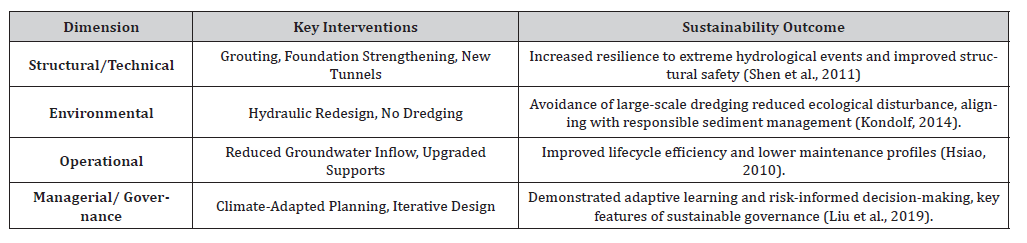
a. It details the Key Interventions for each dimension (e.g.,
Grouting, Hydraulic Redesign, Climate-Adapted Planning).
b. It outlines the resulting Sustainability Outcome (e.g.,
Increased resilience to extreme hydrological events, avoidance
of large-scale dredging, improved lifecycle efficiency).
c. It includes a Reference (citation) to scholarly work or the
original publication that supports the assessment [7,11-20].
Conclusion
Although not explicitly framed as a sustainability initiative at the time, the Guguan Hydropower Station restoration demonstrates strong alignment with contemporary principles of sustainable infrastructure management. The project’s adaptive, resilient, and environmentally responsible decisions provide a compelling example of how hydropower facilities can be rehabilitated in complex, multi-hazard environments. This review, undertaken with Dr. Liu’s involvement, highlights how engineering practice applied under extreme conditions can anticipate and exemplify sustainability principles that later become foundational in the field.
References
- Shen L, Wu Y, Zhang X (2011) Key assessment indicators for the sustainability of infrastructure projects. Journal of Construction Engineering and Management 137(6): 441-451.
- Liu T, Chen P, Chou NNS (2019) Sustainability-based construction of the restoration projects for the Guguan hydropower station. IOP Conference Series: Earth and Environmental Science 283: 012057.
- Hsiao YH (2010) Research on the restoration project of Guguan hydropower station. Sino-Tech Engineering Consultants Journal 108: 95-105.
- Hwang CY (2010) Final report for the Guguan hydropower station restoration project. Taipower.
- Bosher L, Dainty A (2011) Resilience in the built environment. Building Research & Information 39(5): 533-537.
- Bakken TH, Aase AG, Hagen D, Sundt H, Barton DN, et al. (2012) Environmental impacts of hydropower: A global review and recommendations. Renewable and Sustainable Energy Reviews, 16(5): 2843-2852.
- International Hydropower Association (2018) Hydropower sustainability assessment protocol.
- Tan Y, Shen L, Yao H (2011) Sustainable construction practice and contractors’ competitiveness: A preliminary study. Habitat International 35(2): 225-230.
- Kondolf GM (2014) Sustainable sediment management in regulated rivers. Water Resources Research 50(7): 5275-5294.
- Huang L, Krigsvoll G, Johansen F, Liu Y, Zhang X (2018) Carbon emission of global construction sector: A review. Energy and Buildings 174: 158-173.
- Buede DM, Maxwell DT (1995) Rank disagreement: A comparison of multi-criteria methodologies. Journal of Multi-Criteria Decision Analysis 4(1): 1-21.
- Lee J, Edil TB, Benson CH, Tinjum JM (2013) Building environmentally and economically sustainable transportation infrastructure: Green highway rating system. Journal of Transportation Engineering 139(12): A4013006.
- Ling FYY, Zhong Y, Wu P (2016) Using multiple attribute value technique for selecting sustainable structural materials. Journal of Construction Engineering and Management 143(2): 04016098.
- Mendler FS, Odell W (2000) The HOK guidebook to sustainable design. Wiley.
- World Bank (1994) World development report 1994: Infrastructure for development. Oxford University Press, UK.
- World Bank (2006) Infrastructure at the crossroads: Lessons from 20 years of World Bank experience. World Bank Publications.
- Truitt P (2009) Potential for reducing greenhouse gas emissions in the construction sector. US Environmental Protection Agency.
- ASTM International (2014) ASTM C1019-14: Standard test method for sampling and testing grout. ASTM International.
- New Asia Construction and Development Corp (2004) Access tunnel working plan for the Guguan hydropower restoration project.
- New Asia Construction and Development Corp (2004) Grouting method working plan for the Guguan hydropower restoration project.
-

This work is licensed under a Creative Commons Attribution-NonCommercial 4.0 International License.