


 Review Article
From Creep to Dynamic Behavior: A Unifying Physical Explanation of the Mechanical Behaviors of Concrete
Received Date:November 19, 2025; Published Date:December 03, 2025
Abstract
This paper synthesizes previously published research, demonstrating that the macroscopic mechanical behaviors of concrete, ranging from creep to dynamic responses, are fundamentally linked to the interactions between its cracking processes and the actions of water and water vapor at various scales of its porosity. This unified conceptual framework aims to assist researchers in developing mechanical models grounded in relevant physical phenomena.
Keywords:Concrete; cracking processes; water; couplings; mechanical behaviors
Introduction
It is well-established that concrete is a highly heterogeneous material at multiple scales, comprising aggregates, sand, and cement paste made up of various hydrates and dimensions. Additionally, it contains water and water vapor at different porosity scales, including free water and water that is physically or chemically bound. It is also widely recognized that this material experiences cracking under external mechanical loads, leading to kinematic discontinuities. This article explores how certain physical mechanisms associated with water in concrete influence its cracking processes and the resulting effects on its macroscopic mechanical behaviors, from creep to dynamic responses.
Initial State of Hardened Concrete Before External Mechanical Stress
This section summarizes well-accepted knowledge among concrete experts regarding the material’s initial state prior to any external mechanical stress. Understanding this initial state is crucial for grasping the physico-mechanical mechanisms that come into play when external stresses are applied.
Concrete transitions from a viscous liquid to a solid state during the hydration of the cement paste, which primarily consists of cement and water, along with other constituents depending on the concrete type. This hydration process is accompanied by endogenous shrinkage, occurring in the presence of aggregates that are inert from a physico-chemical perspective during hydration. The hydration of the cement paste generates a system of selfbalanced initial stresses within the material, characterized by compressive stresses around the aggregates and tensile stresses in the surrounding hardened cement paste. Notably, these tensile stresses can locally reach the tensile strength of the cement paste, leading to the formation of microcracks.
The water included in the initial material composition serves two primary functions: it imparts viscous fluid properties to the material before cement hydration and participates in the hydration process itself. After hydration, some of the water remains within the porosity of the hardened cement paste, existing in various forms depending on the porosity scale. In broad terms:
a. Water exists as free water and water vapor within the
capillaries (approximately 1 μm in diameter) of the hardened
cement paste.
b. Water is physically and/or chemically bound within the
hydrates (around 10 Å) of the hardened cement paste.
The presence of water and water vapor in the capillaries, forming water menisci, introduces tension forces described by Laplace’s law. These forces act as prestressing forces within the hardened cement paste, contributing significantly to its mechanical strength.
In summary, concrete in its initial state is a heterogeneous material composed of hardened cement paste and aggregates of varying sizes. This hardened cement paste contains selfequilibrating initial stresses and microcracks, composed of hydrates with different geometries and dimensions, and contains water at various scales and in different physico-chemical states. At the capillary scale, water menisci and water vapor exist in equilibrium, generating prestressing within the hardened cement paste. The subsequent chapters of this paper describe the physical mechanisms underlying the mechanical behavior of concrete under various types of mechanical loading, all of which involve cracking and the presence of water in the concrete. This unifying approach represents the primary originality and significance of this paper. The general concept proposed in this paper does not exist in the international literature. The mechanical loadings considered include creep, quasi-static loadings, and dynamic loadings.
Concrete Creep
Creep occurs when concrete is subjected to constant stress over time, whether tensile or compressive. It is mechanically characterized by a gradual increase in strain under a sustained load. Numerous theories attempt to explain the physical mechanisms behind concrete creep, but none have gained universal acceptance among experts. The explanation presented here is part of the unified approach adopted in this paper.
One widely accepted fact is that concrete creep is closely linked to the presence of water within the material. Notably, dry concrete does not exhibit creep. Experimental studies have been conducted on mature concrete (cured for 42 days at 35°C) at various internal humidity levels. These levels were stabilized by applying a waterproof barrier, comprising resin and aluminum foil, on each specimen after the drying phase [1]. The samples were Y-shaped to accelerate and homogenize the drying process, with each branch measuring 40 mm in thickness. The results demonstrated that the basic creep of concrete decreases as internal humidity decreases. In an extreme case, one sample with an internal humidity of 50% showed no creep at al. [1]. In essence, “dry” concrete refers primarily to the absence of free water in the capillaries, not to chemically or physically bound water. This suggests that the water involved in the physical mechanisms of creep is primarily capillary water.
Experimental research has also revealed a strong correlation between intrinsic (or basic) creep, i.e., creep occurring without moisture exchange with the environment, and the formation of microcracks in the material [2,3]. In this context, a microcrack is defined as a crack so small relative to the volume of the material that it does not cause localized strain at that scale. This correlation has been demonstrated using acoustic emission techniques during intrinsic creep tests under compressive loading [2,3]. Based on robust experimental evidence, a physical mechanism has been proposed to explain the origin of concrete creep [3]: under sustained loading, the concrete develops microcracks. The density of these microcracks depends on the magnitude of the applied stress. When the static load is held, these microcracks induce hygral (moisturerelated) imbalances within the concrete. The voids formed by the cracks create localized hygral shocks, generating gradients in water concentration and pressure. These gradients, in turn, trigger moisture movement, both vapor (via Fick’s law) and liquid water (via Darcy’s law), from the surrounding capillaries into the cracks. As a result, the capillaries dry out (due to the reduction of water menisci).
Furthermore, microcracks allow water to access unhydrated portions of cement grains, leading to continued hydration within the cracks. This process promotes the self-healing of microcracks. Both the drying of capillaries and the self-healing of cracks contribute to additional autogenous shrinkage. This self-desiccation shrinkage induced by microcracking is what causes basic creep. Another experimental observation supports this proposed mechanism: concrete exhibits less tensile creep than compressive creep [4,5]. This difference can only be explained by the interaction between cracking and moisture transport. The mechanisms of crack formation differ under tension and compression, as does the orientation of microcracks relative to the applied stress. Consequently, the associated autogenous shrinkage from water and vapor movement also varies depending on whether the stress is tensile or compressive [4,5].
Macrocrack Propagation in the Quasi-Static Loading Regime
Previous experimental studies [6,7] investigating the influence of loading rate on macrocrack propagation under quasi-static conditions (i.e., low loading rates) have shown that the crack propagation rate increases as the loading rate increases. It is important to recall that a macrocrack, defined as a crack causing strain localization within the structure, is always preceded by a zone of microcracking known as the process zone.
Two key physical mechanisms are involved in this regime, both
of which were previously discussed in the context of concrete creep:
a) As a macrocrack advances, fluid transfer occurs within the
process zone. Water and water vapor migrate from the cement
paste’s pore structure into the newly formed microcracks. This
movement reduces the size of the water menisci within the
pores, which significantly increases Laplace forces (i.e., surface
tension) in the process zone.
b) The water entering the microcracks also triggers a
chemical response, self-healing, where further hydration of
unreacted cement particles takes place, partially sealing the
cracks.
These surface forces and self-healing processes induce autogenous shrinkage within the process zone, which generates compressive stresses that act to resist crack propagation. However, at higher loading rates, the time available for these physicochemical mechanisms to act is reduced. Because the kinetics of water movement and chemical reactions are relatively slow, less autogenous shrinkage and healing can occur. As a result, fewer compressive stresses develop to oppose the crack, allowing it to propagate more rapidly. This explains the observed increase in crack propagation rate with loading rate. Interestingly, macrocrack propagation can also occur under long-term creep loading if the sustained stress exceeds approximately 80% of the material’s compressive strength [8]. This observation highlights the continuity of the underlying physico-chemical mechanisms between the quasistatic regime and creep behavior.
Strain Rate Effects Under Dynamic Loading
Concrete structures are often subjected to dynamic loads, ranging from moderate (e.g., wind) to extreme (e.g., explosions or vehicular impacts). Extensive research has shown that concrete responds differently under dynamic loading conditions compared to static ones. In particular, concrete exhibits a pronounced strainrate dependency, especially under tensile loading. This strain-rate effect has been shown to have a physical origin tied to the presence of free water within the hydrates of the cement paste [9, 10]. Experimental evidence indicates that when this physically bound water is removed, the strain-rate effect nearly disappears. This finding holds true across concretes with differing mix designs but similar levels of water retained in the nanoporosity of the hydrates. As such, they display a consistent absolute increase in tensile strength as the strain rate rises [9,10].
Unlike creep and quasi-static behavior—which are governed by larger pore structures and capillary water—strain-rate effects are governed by the nanometer-scale porosity of cement hydrates and involve a different type of water. The physical mechanism responsible has been hypothesized to resemble the Stefan effect, a well-known phenomenon in fluid mechanics. The Stefan effect occurs when a thin film of viscous fluid is confined between two parallel plates that are being pulled apart. The fluid resists this separation, generating a restoring force that is proportional to the rate of separation. In the case of concrete, this restoring force—produced by the viscous behavior of water in the hydrate nanopores—acts to resist the formation and growth of microcracks into macrocracks. Thus, the increased tensile strength of concrete at higher strain rates can be attributed to this Stefan-like resistance, which serves as a micro-scale damping mechanism opposing crack initiation and propagation.
Different Couplings in Relation with the Strain Rate
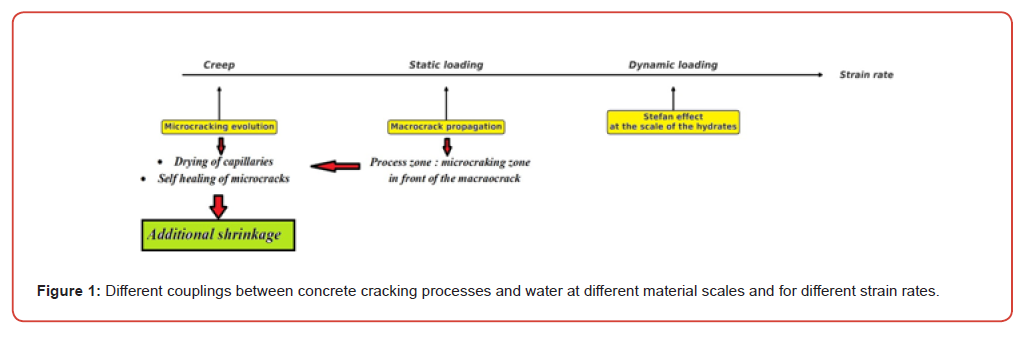
In the following (Figure 1), a diagram is presented which synthesizes the different couplings mentioned previously as a function of the strain rate.
Conclusions
This article provides a comprehensive synthesis of previous and published research exploring the interactions between concrete cracking mechanisms and the physico-chemical processes associated with water at different scales of porosity within the material. The resulting synthesis offers a unified perspective on these interactions, encompassing the full spectrum of mechanical behaviors, from creep to dynamic loading. The key physicochemical mechanisms identified include:
a. The transfer of water and water vapor,
b. Capillary tension governed by Laplace’s law,
c. Self-healing of microcracks through continued hydration,
d. Stefan effect, which influences crack resistance at the
nanoscale.
Beyond presenting a coherent framework linking these behaviors, the primary contribution of this work lies in its potential to inform the development of more accurate micromechanical and macroscopic models of concrete behavior. Accurate modeling requires a deep understanding of the underlying physical phenomena, something that purely empirical approaches cannot achieve. This unified view helps bridge that gap, providing essential insights for future research and modeling efforts in structural and materials engineering.
References
- Acker P (1988) Comportement mécanique du béton: apport de l’approche physico- chimique, LPC research report 152, LCPC.
- Rossi P, Godart B, Robert JL, Gervais JP, Bruhat D (1994) Investigation of basic creep of concrete by acoustic emission technics. Materials and Structures 27: 510-514.
- Rossi P, Tailhan JL, Le Maou F, Gaillet L, Martin E (2012) Basic creep behavior of concretes investigation of the physical mechanisms by using acoustic emission. Cement and Concrete Research 42(1): 61-73.
- Tailhan JL, Boulay C, Rossi P, Le Maou F, Martin E (2012) Compressive, tensile and bending basic creep behaviours related to the same concrete. Structural Concrete 14(2): 124-130.
- Rossi P, Tailhan JL, Le Maou F (2013) Comparison between concrete creeps in tension and in compression: influence of the concrete age at the loading and of the drying conditions. Cement and Concrete Research 51: 78-84.
- Rossi P (1989) Coupling between the crack propagation velocity and the vapour diffusion in concrete. Materials and Structures 22: 91-97.
- Rossi P (2022) Influence of the loading rate on the cracking process of concrete in quasi- static loading domain. Civil Eng Journal 4(1): 1-11.
- Rossi P, Boulay C, Tailhan JL, Martin E (2014) Macrocrack propagation in a concrete specimen under sustained loading: study of the physical mechanisms. Cement and Concrete Research 63: 98-104.
- Rossi P (1991) Physical phenomena which can explain the mechanical behavior of concrete under high strain rates. Materials and Structures 24: 422-424.
- Rossi P (1994) Dynamic behaviour of concrete: from material to the structure. Materials and Structures 27: 319-323.
-

This work is licensed under a Creative Commons Attribution-NonCommercial 4.0 International License.