

 Research Article
Profile-Guided Slow Intralipid Infusion in Infertile Patients with An Overactive or Mixed Endometrial Immune Profile: A Retrospective Cohort Study
Received Date: October 27, 2026; Published Date: November 06, 2026
Abstract
Objective: To assess reproductive outcomes following profile-guided slow intravenous Intralipid infusion in infertile patients with an overactive
or mixed endometrial immune profile.
Design: Retrospective cohort study.
Setting: Tertiary reproductive medicine center with centralized endometrial immune profiling.
Patient(s): One hundred and seven infertile women with an overactive or mixed endometrial immune profile identified between 2016 and
2022, who underwent 134 fresh or frozen embryo-transfer attempts under profile-guided Intralipid treatment.
Intervention(s): Profile-guided slow intravenous Intralipid infusion, with individualized adjunctive treatments according to the endometrial
immune profile and response to previous therapeutic testing.
Main Outcome Measure(s): The primary outcome was cumulative live birth rate (CLBR) per patient within 11 months of endometrial immune
assessment. Secondary outcomes included cumulative clinical and ongoing pregnancy rates and changes in endometrial immune biomarkers following
the Intralipid therapeutic test.
Result(s): The CLBR was 43.9% (47/107), with cumulative clinical and ongoing pregnancy rates of 57.0% and 48.6%, respectively. CLBR did not
differ between patients with mixed and overactive immune profiles (45.0% vs. 43.3%; P = .864) or according to the indication for immune assessment
(P = .521). In contrast, CLBR was markedly lower in women aged ≥41 years (10.0%; P = .006) and in those with diminished ovarian reserve
(12.5%; P = .004). Among the 19 patients with paired endometrial samples, the IL-18/TWEAK ratio decreased significantly following the Intralipid
therapeutic test (median, 0.53 to 0.32; P = .0008), whereas the TWEAK/reference-gene ratio increased (1.43 to 2.08; P = .0108). Intralipid was well
tolerated.
Conclusion(s): In this retrospective cohort, profile-guided Intralipid treatment was associated with a relatively high cumulative live birth rate
in infertile patients with an overactive or mixed endometrial immune profile. The concomitant changes observed in selected endometrial immune
biomarkers provide biological support for an immunomodulatory effect of treatment. However, the absence of a control group precludes determining
whether the observed reproductive outcomes were attributable to Intralipid treatment. Prospective randomized controlled trials are warranted.
Keywords: recurrent implantation failure; endometrial immune profiling; uterine natural killer cells; Intralipid; live birth rate; in vitro fertilization.
Introduction
Despite continuous advances in assisted reproductive technology (ART), a large proportion of embryo transfers still fail to result in a live birth. It has been estimated that 70–80% of transferred embryos do not ultimately lead to a live birth, and a substantial proportion of these failures occurs despite the transfer of embryos considered to be of good quality [1]. Successful implantation requires not only a competent embryo but also a receptive endometrium and a synchronized embryo–endometrium dialogue [2].
The endometrial immune environment is an important component of this dialogue. During the peri-implantation period, decidualization is accompanied by profound changes in the composition and function of endometrial immune cells, including the recruitment and maturation of uterine natural killer (uNK) cells [3, 4]. Appropriate regulation of local immune activity contributes to trophoblast invasion and spiral-artery remodelling, whereas disturbances in the intensity or balance of this response may be associated with impaired implantation and pregnancy establishment [5]..
Based on this concept, an endometrial immune profile can be established from a mid-luteal endometrial biopsy by assessing the expression of immune-related markers involved in local immune regulation [6]. The profile used in the present study combines the IL-18/TWEAK mRNA ratio, the IL-15/Fn-14 mRNA ratio, and CD56 expression, with reference ranges established in a fertile population [7]. Four profiles have been described: balanced activation, underactivation, over-activation, and a mixed profile. Observational studies have suggested that individualized management based on endometrial immune profiling may be associated with improved reproductive outcomes [8].
In patients with recurrent implantation failure (RIF), the identification and management of potential endometrial factors remain challenging. The 2023 European Society of Human Reproduction and Embryology (ESHRE) good-practice recommendations emphasize the lack of a universally accepted definition of RIF and the limited evidence supporting many proposed diagnostic and therapeutic approaches. Endometrial immune testing is therefore considered an investigation of potential interest, but its clinical utility remains insufficiently established [9]
In patients with an overactive or mixed endometrial immune profile, glucocorticoids (GCs) have been used as a first-line immunomodulatory treatment [10]. However, previous studies have shown that the endometrial immune profile may remain abnormal or may worsen despite GC treatment in a substantial proportion of patients, suggesting that a single immunomodulatory approach may not be effective for all patients [11]. This observation provides a rationale for individualized treatment strategies based on the patient’s immune profile and, where available, on the biological response to treatment.
Slow intravenous infusion of Intralipid, a lipid emulsion containing soybean oil, has been proposed as an alternative immunomodulatory approach in reproductive medicine, particularly in patients with an overactive immune profile or apparent resistance to glucocorticoids [12]. Its proposed effects include modulation of inflammatory pathways and natural killer (NK)-cell activity, although the mechanisms underlying its potential reproductive effects remain incompletely understood [13-18]. Importantly, evidence from randomized trials evaluating Intralipid in recurrent implantation failure (RIF) or recurrent pregnancy loss (RPL) remains conflicting [19-24]. A major limitation of these studies is that Intralipid has generally been administered empirically, without biological selection of patients according to a defined endometrial immune profile.
We hypothesized that selecting patients according to their endometrial immune profile and tailoring Intralipid treatment to their previous therapeutic response could identify a population in whom this intervention may be clinically relevant. We therefore conducted a retrospective cohort study to evaluate reproductive outcomes in infertile women with an overactive or mixed endometrial immune profile who received profile-guided slow intravenous Intralipid treatment. As a secondary objective, we assessed changes in endometrial immune biomarkers in patients for whom paired endometrial samples obtained before and after the Intralipid therapeutic test were available.
Materials and Methods
Study Design and Population
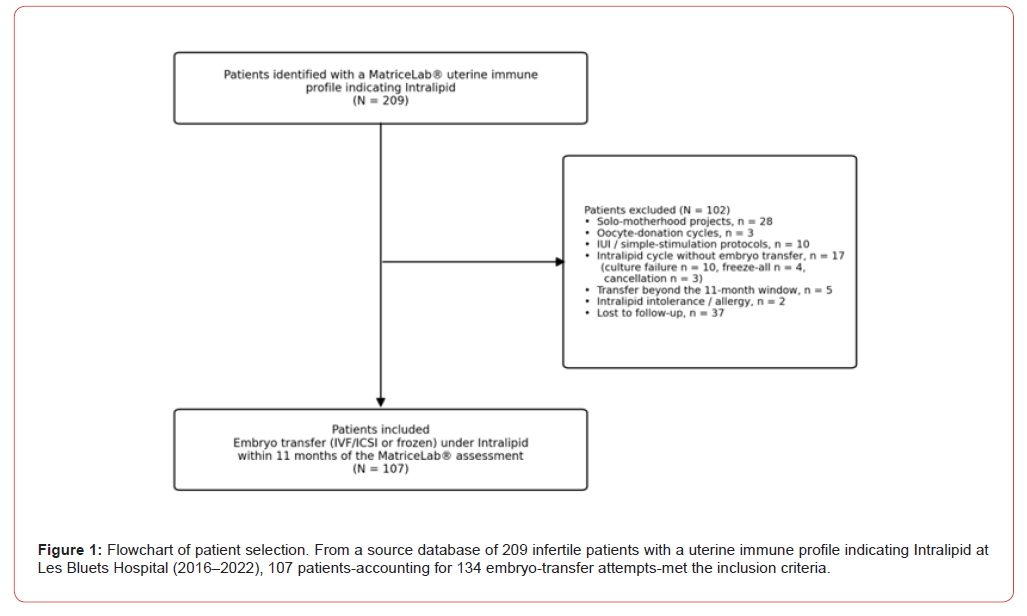
We conducted a retrospective cohort study of infertile women who underwent embryo transfer under profile-guided Intralipid treatment at Les Bluets Hospital, Paris, France. Patients were identified from a database of 209 women who underwent endometrial immune profiling between 2016 and 2022 and whose immune profile led to an indication for Intralipid treatment. Of these, 107 patients, accounting for 134 fresh or frozen embryotransfer attempts, met the eligibility criteria (Figure 1).
Eligibility Criteria
Women were eligible if they underwent a fresh embryo transfer following IVF/ICSI or a frozen embryo transfer under Intralipid treatment within 11 months of an endometrial immune assessment performed between 2016 and 2022. Patients were excluded if they were pursuing solo motherhood, underwent an oocyte-donation cycle, intrauterine insemination or simple ovarian stimulation, or received Intralipid during a cycle that did not result in embryo transfer because of culture failure, a freeze-all strategy, or cycle cancellation. Transfers performed more than 11 months after the immune assessment were also excluded, as were patients with known intolerance or allergy to Intralipid and those lost to followup.
Endometrial Immune Profiling
Endometrial immune profiling was performed during the midluteal phase of a monitored natural or hormonally substituted cycle. Endometrial tissue was obtained by aspiration using a Cornier Pipelle. Histologic dating was performed to confirm the mid-luteal phase. RNA was extracted from the endometrial biopsy using the RNeasy Plus kit (Qiagen, Courtaboeuf, France) and reverse-transcribed into cDNA using the Transcriptor First Strand cDNA Synthesis Kit (Roche Diagnostics, Meylan, France). The IL- 15/Fn-14 and IL-18/TWEAK mRNA ratios were quantified by real-time quantitative PCR using the Light Cycler 480 SYBR Green I Master system (Roche Diagnostics). Uterine NK-cell mobilization was assessed by RT-qPCR. Reference ranges had previously been established in a fertile population.
An overactive immune profile was defined by a high IL-18/ TWEAK ratio and/or a high IL-15/Fn-14 ratio. A mixed profile was defined by a high IL-18/TWEAK ratio combined with a low IL-15/ Fn-14 ratio.
An initial endometrial immune profile was obtained for each patient. When clinically indicated, immune profiling was subsequently repeated during treatment to assess the biological response to therapy. Glucocorticoids were used as first-line treatment, with Intralipid and/or low-molecular-weight heparin (LMWH) subsequently introduced according to the immune profile and the response to previous treatment. Resistance to a given treatment was defined as persistence or worsening of the immune profile despite treatment and was assessed using a therapeutic-test approach.
Treatment Algorithm
Treatment was individualized according to the endometrial immune profile and the response observed during therapeutic testing. In patients with an overactive profile, an isolated elevation of the IL-18/TWEAK ratio was initially treated with oral glucocorticoids (20 mg). Intralipid was subsequently introduced in cases of treatment failure or documented glucocorticoid resistance. When elevation of the IL-15/Fn-14 ratio or CD56 was also present, glucocorticoids were combined with LMWH, with Intralipid subsequently used as second-line treatment.
In patients with a mixed profile, oral glucocorticoids (10 mg) were used as first-line treatment. In cases of treatment failure, mid-luteal endometrial scratching during the preceding cycle was combined with Intralipid and luteal hCG.
Intralipid Administration
Intralipid 20% was diluted to 4% (100 mL Intralipid 20% in 400 mL normal saline) and administered by slow intravenous infusion over 90 minutes around day 8 of the transfer cycle. In patients who became pregnant, the infusion was repeated at 5 and 9 weeks of gestation. Known soy or egg allergy and severe hepatic insufficiency were considered contraindications to Intralipid administration.
Outcomes
The primary outcome was cumulative live birth rate (CLBR) per patient within 11 months following the endometrial immune assessment. CLBR was defined as the proportion of patients who achieved at least one live birth from embryo-transfer attempts performed under the study treatment during the predefined 11-month period. Secondary reproductive outcomes were cumulative clinical pregnancy and ongoing pregnancy rates during the same period. A secondary biological analysis was performed in patients for whom paired endometrial samples obtained before and after the Intralipid therapeutic test were available. Changes in endometrial immune biomarkers between the two time points were assessed. Treatment tolerance and adverse events occurring during Intralipid administration were also recorded.
Statistical analysis
Continuous variables were summarized using the median and interquartile range (IQR), and categorical variables using numbers and percentages. Cumulative live birth rates were described overall and according to predefined patient and treatment characteristics. Comparisons of categorical variables were performed using the chi-square test or Fisher’s exact test, as appropriate. Changes in endometrial immune biomarkers before and after the Intralipid therapeutic test were assessed using the Wilcoxon signed-rank test for paired observations. All statistical tests were two-sided, and a P value ≤ .05 was considered statistically significant. Statistical analyses were performed using Medcalc software.
Ethics
This study was conducted in accordance with Article L.1121-1 of the French Public Health Code (Jardé Law) and was classified as research involving routine care. Therefore, it did not fall within the scope of interventional research requiring approval by a national ethics committee. The study protocol was reviewed by the local institutional ethics committee. Patients were informed about the use of their clinical data for research purposes through an information notice displayed in the waiting area, and were given the opportunity to object. All data were processed in compliance with the General Data Protection Regulation (EU 2016/679). The manuscript was written according to Strengthening the Reporting of Observational studies in Epidemiology (STROBE) guidelines.
A subset of patients underwent endometrial immune profiling within the PRECONCEPTIO trial (NCT02262117), whereas the remaining data were collected as part of routine clinical care.
Results
Study Population
Of the 209 patients identified in the source database, 102 were excluded: 28 for solo-motherhood projects, 3 for oocyte-donation cycles, 10 for intrauterine insemination or simple-stimulation protocols, 17 for Intralipid cycles that did not result in embryo transfer (10 culture failures, 4 freeze-all cycles, and 3 cycle cancellations), 5 for transfers performed beyond the 11-month predefined window, 2 for Intralipid intolerance or allergy, and 37 because of loss to follow-up. The final cohort therefore comprised 107 patients and 134 embryo-transfer attempts performed under Intralipid treatment within 11 months of the endometrial immune assessment (Figure 1).
Among the 107 patients, 84 (78.5%) underwent one embryotransfer attempt, 21 (19.6%) underwent two, and 2 (1.9%) underwent three. The median age was 37 years (IQR, 34–40). The median AMH level was 2.0 ng/mL, the median antral follicle count was 14, the median number of previously transferred embryos was 4, and the median attempt rank was 2. Infertility etiologies are detailed in (Table 1).
Table 1: Baseline characteristics of the study population (N = 107). IQR, interquartile range (25th–75th percentile).
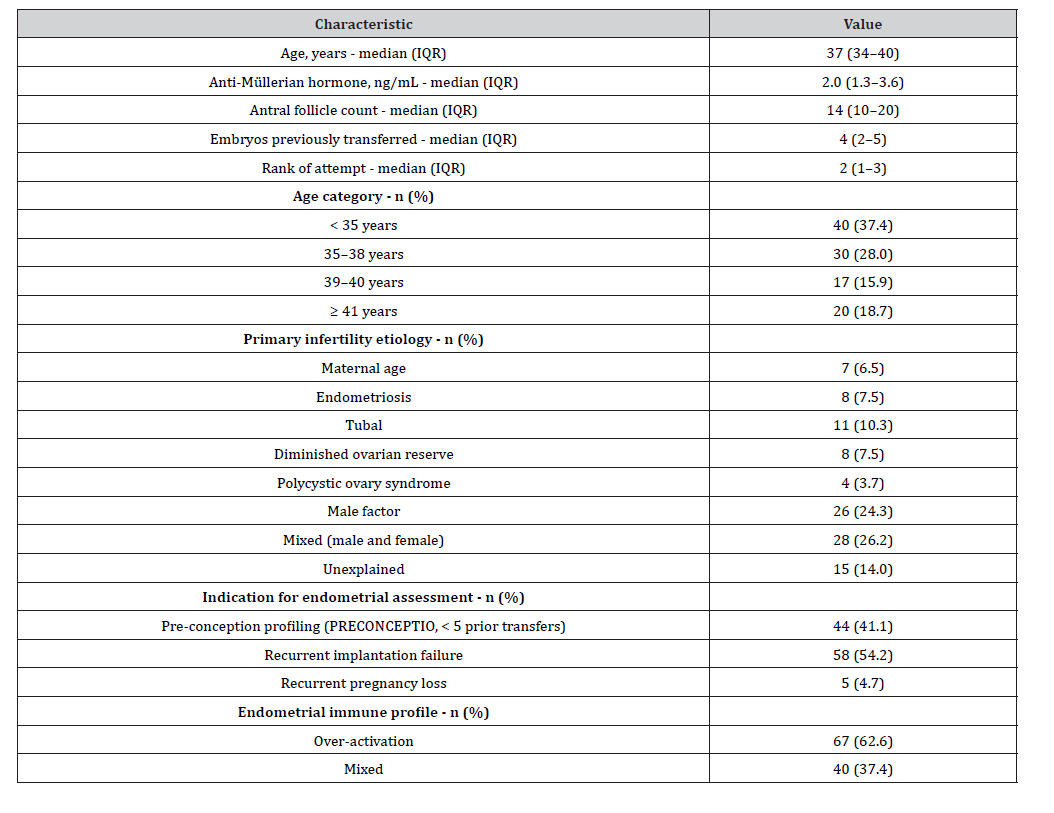
Endometrial immune assessment was performed in the context of recurrent implantation failure (RIF) in 54.2% of patients, pre-conceptionally within the PRECONCEPTIO setting (<5 previous transfers) in 41.1%, and for recurrent pregnancy loss (RPL) in 4.7%. The endometrial immune profile was classified as over-activated in 62.6% of patients and mixed in 37.4%. A profile obtained during treatment was available for 83.2% of patients; glucocorticoid resistance was documented in 78.5%, and a favorable response to Intralipid was documented in 18.7% (Table 2).
Table 2: Response to therapeutic testing and treatment administered at transfer (N = 107).
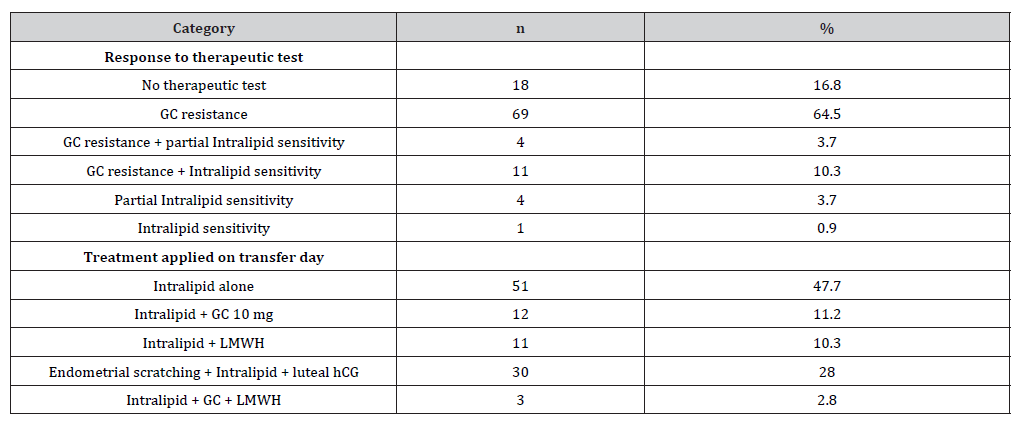
GC, glucocorticoids; hCG, human chorionic gonadotropin; LMWH, low-molecular-weight heparin. A profile under therapy was available for 83.2% of patients; GC resistance was documented in 78.5% (n = 84) and a favorable Intralipid response in 18.7% (n = 20).
Reproductive Outcomes
The cumulative live birth rate (CLBR) was 43.9% (47/107). The cumulative clinical pregnancy and ongoing pregnancy rates were 57.0% and 48.6%, respectively (Table 3).
Table 3: Cumulative pregnancy outcomes (107 patients; 134 transfer attempts).

National reference (French Biomedicine Agency, 2017): cumulative delivery rate per oocyte retrieval (fresh and frozen transfers combined) = 28.4%.
For descriptive comparison, the national cumulative delivery rate per oocyte retrieval, including fresh and frozen embryo transfers, was 28.4% in 2017 according to data from the French Biomedicine Agency.
CLBR did not differ significantly according to the indication for endometrial immune assessment (p = 0.521). CLBR was 43.2% in the PRECONCEPTIO group, 46.6% among patients assessed for RIF, and 20.0% in the RPL group (n = 5).
CLBR differed according to age (p = 0.006). It was 47.5% in patients younger than 35 years, 56.7% in those aged 35–38 years, 52.9% in those aged 39–40 years, and 10.0% in those aged ≥41 years. CLBR also differed according to infertility etiology (p = 0.004), ranging from 0% among patients whose primary indication was maternal age to 80.0% among those with unexplained infertility (Table 4).
CLBR was similar between patients with mixed and overactivated immune profiles (45.0% vs. 43.3%, respectively; p = 0.864). No significant association was observed between CLBR and therapeutic-test response (overall p = 0.218), glucocorticoid therapeutic testing (p = 0.962), or Intralipid therapeutic testing (p = 0.153). CLBR also did not differ according to the treatment administered at embryo transfer (p = 0.927) (Table 4).
Table 4: Cumulative live birth rate according to patient and treatment subgroups.
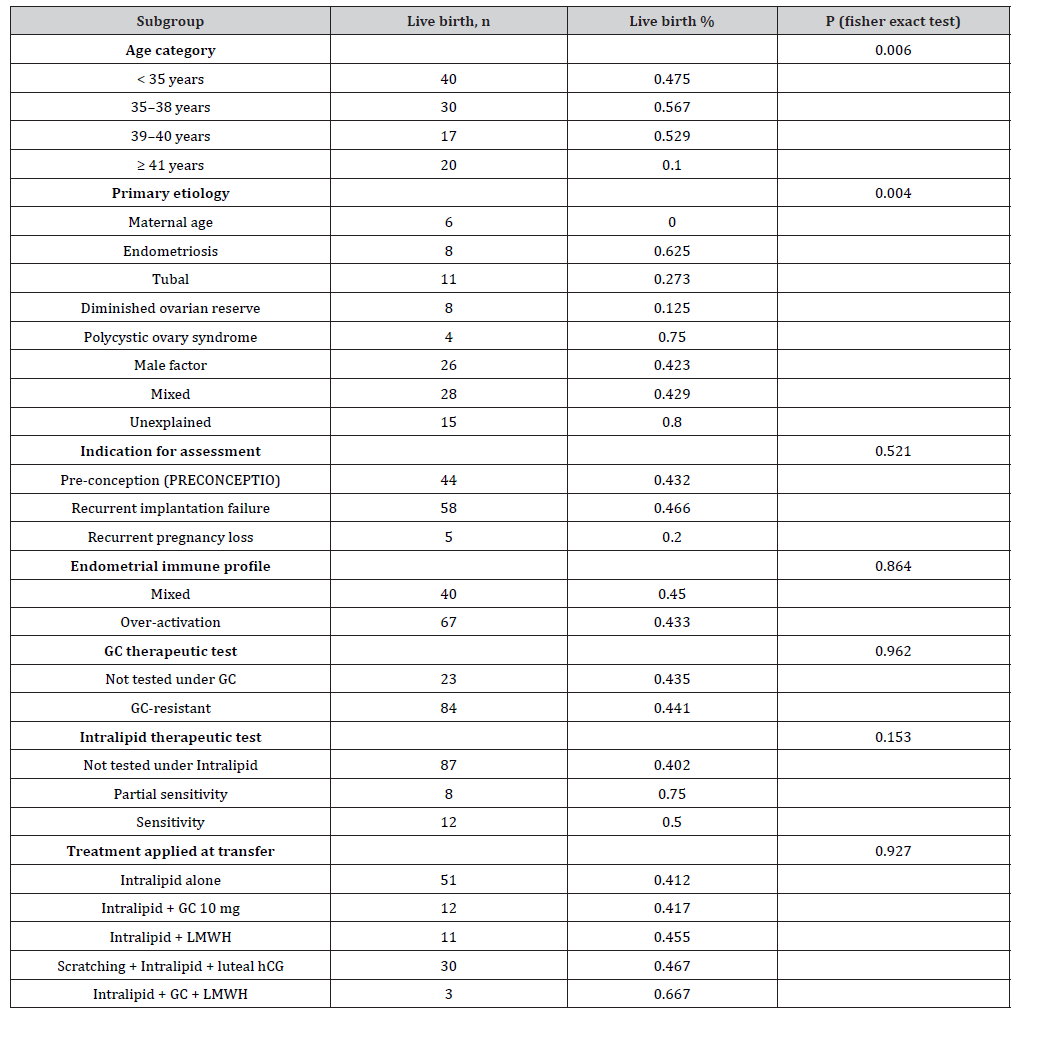
CLBR, cumulative live birth rate; GC, glucocorticoids; hCG, human chorionic gonadotropin; LMWH, low-molecular-weight heparin. The CLBR (mean) is the proportion of patients with a live birth within each subgroup.
Endometrial Immune Biomarkers
Paired endometrial samples obtained before and after the Intralipid therapeutic test were available for 19 patients. The IL- 18/TWEAK ratio decreased significantly after the therapeutic test (median, 0.53 to 0.32; p = 0.0008), while the TWEAK/referencegene ratio increased (median, 1.43 to 2.08; p = 0.0108).
The IL-18/reference-gene ratio showed a non-significant decrease (p = 0.0546). No significant changes were observed in IL-15-related parameters or in uNK-cell mobilization assessed by CD56 (Table 5).
Treatment tolerance
Two patients were excluded following adverse events during Intralipid administration: one experienced a vasovagal episode and one developed a cutaneous allergic reaction. Among the 107 patients included in the final analysis, no additional clinically significant tolerance issues were reported.
Discussion
In this retrospective cohort of infertile women with an overactivated or mixed endometrial immune profile, profile-guided Intralipid treatment was associated with a cumulative live birth rate of 43.9% within 11 months of immune assessment. This outcome was observed in a population with a median age of 37 years, in which more than half of the patients were assessed for recurrent implantation failure. Live birth rates were broadly similar across immune-profile categories and according to the clinical indication for immune assessment.
The observed cumulative live birth rate was higher than the 28.4% national cumulative delivery rate reported by the French Biomedicine Agency in 2017. However, this comparison should be interpreted cautiously, as the two populations were not comparable and the national registry rate was not derived from a matched control group. In particular, the present cohort was selected for specific clinical and immunological characteristics and included repeated embryo-transfer attempts within the predefined 11-month period. Therefore, the present data do not allow the reproductive outcome attributable to Intralipid treatment to be determined.
An important finding was the association between age and cumulative live birth. Rates remained above 45% in patients younger than 40 years but decreased to 10% among those aged ≥41 years. CLBR also varied according to infertility etiology, with lower rates observed in patients whose infertility was attributed to maternal age or diminished ovarian reserve. These findings are consistent with the fact that modulation of the endometrial environment cannot overcome limitations related to oocyte or embryo competence. Conversely, the similar outcomes observed between mixed and over-activated immune profiles suggest that the presence of different forms of immune dysregulation did not, in this cohort, identify clearly distinct reproductive outcomes when treatment was individualized.
The biological analysis provides additional information regarding the potential effect of Intralipid on the endometrial immune environment. Among the 19 patients with paired samples, the IL-18/TWEAK ratio decreased significantly following the Intralipid therapeutic test, while the TWEAK/reference-gene ratio increased. No significant changes were observed for the IL-15- related parameters or CD56. Taken together, these findings suggest that Intralipid may modify selected components of the endometrial immune profile, particularly those related to the IL-18/TWEAK axis. However, the paired analysis included only 19 patients and was exploratory; these biological changes cannot be assumed to mediate the reproductive outcomes observed in the cohort.
The absence of a clear association between therapeutic-test response and cumulative live birth should also be interpreted in the context of the study design. Therapeutic testing was not performed systematically, and treatment decisions were individualized according to the initial immune profile and the patient’s previous response to treatment. Consequently, the groups defined by therapeutic-test status were clinically heterogeneous and cannot be interpreted as comparative treatment groups. In particular, the small number of patients who underwent an Intralipid therapeutic test limits any inference regarding the predictive value of this test.
The present approach differs from empirical use of Intralipid described in previous studies of recurrent implantation failure or recurrent pregnancy loss, because treatment was integrated into an endometrial immune profiling strategy. In the present cohort, Intralipid was introduced after assessment of the immune profile and, in some patients, after evaluation of the response to previous treatment. This profile-guided approach may provide a framework for investigating whether immunological characterization can identify patients in whom an Intralipid-containing strategy is biologically relevant. This hypothesis requires prospective comparative evaluation.
Treatment tolerance was generally favorable in the present cohort. Two patients experienced adverse events leading to exclusion from the study, including one vasovagal episode and one cutaneous allergic reaction. These observations do not establish the safety profile of Intralipid more broadly but provide descriptive information regarding its use in this clinical setting.
This study has several limitations. First, its retrospective design and the absence of a control group prevent any causal inference regarding the effect of Intralipid on reproductive outcomes. The comparison with national registry data is therefore only descriptive. Second, treatment was individualized and several adjunctive treatments were used, making it impossible to isolate the contribution of Intralipid from that of glucocorticoids, LMWH, endometrial scratching, luteal hCG, or their combinations. Third, the cohort was derived from a single center and included a relatively small number of patients in some clinical subgroups, particularly those with recurrent pregnancy loss. Finally, the biological analysis was based on a limited number of paired samples.
Despite these limitations, this study provides real-world data on a profile-guided strategy incorporating Intralipid in women with documented endometrial immune dysregulation. The relatively high cumulative live birth rate observed in this cohort, together with changes in selected endometrial immune biomarkers, provides a rationale for further comparative studies. A matched comparison with patients receiving glucocorticoid-based treatment without Intralipid therapeutic testing would be a relevant next step to determine whether an Intralipid-containing strategy is associated with improved reproductive outcomes in this selected population.
Conclusion
In this retrospective cohort of infertile women with overactivated or mixed endometrial immune profiles, a profile-guided Intralipid-containing treatment strategy was associated with a cumulative live birth rate of 43.9% within 11 months of immune assessment. Selected changes in the IL-18/TWEAK axis following Intralipid therapeutic testing provide biological evidence of an effect on the endometrial immune environment. However, the absence of a control group and the individualized use of concomitant treatments preclude any conclusion regarding the specific efficacy of Intralipid. These findings support further comparative studies to determine the clinical relevance of profile-guided Intralipid treatment in women with endometrial immune dysregulation.
Acknowledgment
The authors would like to thank the medical and laboratory teams at Les Bluets Hospital for their contribution to patient care and endometrial immune profiling. The authors also thank all the patients whose clinical data contributed to this study. This work was conducted as part of the medical thesis of Ruth Stiou at Universié Paris Cité.
Funding
None
Disclosure Statement
N.L. founded MatriceLab Innove through a valorization agreement with Université Paris-Saclay (UVSQ – UFR Simone Veil – Santé) and is named as inventor on patents (PCT/EP2013/065355) as Method for increasing implantation success in assisted fertilization and (PCT/FR2025/050250) as compounds and methods for decreasing the risk of miscarriage. All other authors declare no competing interests.
Clinical Trial Registration
A subset of patients was assessed within the PRECONCEPTIO trial (ClinicalTrials.gov NCT02262117).
References
- Wyns C, De Geyter C, Calhaz-Jorge C, Kupka MS, Motrenko T et al. (2022) ART in Europe, 2018: results generated from European registries by ESHRE. Hum Reprod Open 2022(3): hoac022.
- Robertson SA, Moldenhauer LM, Green ES, Care AS, Hull ML (2022) Immune determinants of endometrial receptivity: a biological perspective. Fertil Steril 117(6): 1107-1120.
- Gellersen B, Brosens IA, Brosens JJ (2007) Decidualization of the human endometrium: mechanisms, functions, and clinical perspectives. Semin Reprod Med 25(6): 445-453.
- Zhang J, Chen Z, Smith GN, Croy BA (2011) Natural killer cell-triggered vascular transformation: maternal care before birth? Cell Mol Immunol 8(1): 1-11.
- Liu Y, Gao S, Zhao Y, Wang H, Pan Q et al. (2021) Decidual Natural Killer Cells: A Good Nanny at the Maternal-Fetal Interface During Early Pregnancy. Front Immunol 12: 663660.
- Baharaghdam S, Karimi S, Farahani ME, Aghebati-Maleki L, Yousefi M (2025) Endometrial immune profile: A predictor of pregnancy success. Reprod Biol 26(1): 101174.
- Ledee N, Petitbarat M, Chevrier L, Vitoux D, Vezmar K et al. (2016) The Uterine Immune Profile May Help Women with Repeated Unexplained Embryo Implantation Failure After In Vitro Fertilization. Am J Reprod Immunol 75(3): 388-401.
- Ledee N, Petitbarat M, Prat-Ellenberg L, Dray G, Cassuto GN et al. (2020) Endometrial Immune Profiling: A Method to Design Personalized Care in Assisted Reproductive Medicine. Front Immunol 11: 1032.
- Failure EWGoRI, Cimadomo D, De Los Santos MJ, Griesinger G, Lainas G et al. (2023) ESHRE good practice recommendations on recurrent implantation failure. Hum Reprod Open 2023(3): hoad023.
- Eddy JL, Krukowski K, Janusek L, Mathews HL (2014) Glucocorticoids regulate natural killer cell function epigenetically. Cell Immunol 290(1): 120-130.
- Ledee N, Prat-Ellenberg L, Petitbarat M, Chevrier L, Simon C et al. (2018) Impact of prednisone in patients with repeated embryo implantation failures: Beneficial or deleterious? J Reprod Immunol 127: 11-15.
- Ledee N, Vasseur C, Petitbarat M, Chevrier L, Vezmar K et al. (2018) Intralipid(R) may represent a new hope for patients with reproductive failures and simultaneously an over-immune endometrial activation. J Reprod Immunol 130: 18-22.
- Granato D, Blum S, Rossle C, Le Boucher J, Malnoe A et al. (2000) Effects of parenteral lipid emulsions with different fatty acid composition on immune cell functions in vitro. JPEN J Parenter Enteral Nutr 24(2): 113-118.
- Roussev RG, Acacio B, Ng SC, Coulam CB (2008) Duration of intralipid's suppressive effect on NK cell's functional activity. Am J Reprod Immunol 60(3): 258-263.
- Roussev RG, Ng SC, Coulam CB (2007) Natural killer cell functional activity suppression by intravenous immunoglobulin, intralipid and soluble human leukocyte antigen-G. Am J Reprod Immunol. 57(4): 262-269.
- Meng L, Lin J, Chen L, Wang Z, Liu M et al. (2016) Effectiveness and potential mechanisms of intralipid in treating unexplained recurrent spontaneous abortion. Arch Gynecol Obstet 294(1): 29-39.
- Shreeve N, Sadek K (2011) Intralipid therapy for recurrent implantation failure: new hope or false dawn? J Reprod Immunol 93(1): 38-40.
- Canella P, Barini R, Carvalho PO, Razolli DS (2021) Lipid emulsion therapy in women with recurrent pregnancy loss and repeated implantation failure: The role of abnormal natural killer cell activity. J Cell Mol Med 25(5): 2290-2296.
- Dakhly DM, Bayoumi YA, Sharkawy M, Gad Allah SH, Hassan MA (2016) et al. Intralipid supplementation in women with recurrent spontaneous abortion and elevated levels of natural killer cells. Int J Gynaecol Obstet 135(3): 324-327.
- Karimi A, Dadgar A, Saffari H, Vahedi N, Saket S et al. (2026) Evaluation of intralipid effect on pregnancy outcomes in women with recurrent implantation failure: A retrospective cohort study. Int J Reprod Biomed 24(6): 517-526.
- Kumar P, Marron K, Harrity C (2021) Intralipid therapy and adverse reproductive outcome: is there any evidence? Reprod Fertil 2(3): 173-186.
- Martini AE, Jasulaitis S, Fogg LF, Uhler ML, Hirshfeld-Cytron JE (2018) Evaluating the Utility of Intralipid Infusion to Improve Live Birth Rates in Patients with Recurrent Pregnancy Loss or Recurrent Implantation Failure. J Hum Reprod Sci 11(3): 261-268.
- Attieh P, Chendab S, Ghaleb J, Katrib N, Ghadieh HE et al. (2026) Intravenous intralipid therapy in recurrent implantation failure: Biological rationale, clinical evidence, and ongoing controversies. J Gynecol Obstet Hum Reprod 55(9): 103251.
- Xiao H, Zhang F, Wu Y, Lian R, Diao L et al. (2025) The Effect of Immunotherapy on Natural Killer Cells Level/Activity in Recurrent Pregnancy Loss (RPL) Patients: A Systematic Review and Meta-Analysis. Am J Reprod Immunol 94(1): e70118.
-

This work is licensed under a Creative Commons Attribution-NonCommercial 4.0 International License.