


 Short Communication
Standardizing Mesotherapy in Rheumatology: From Technical Definitions to Integrated Pain Care Pathways
Received Date: January 14, 2026; Published Date: February 18, 2026
Abstract
Mesotherapy is increasingly used as a complementary approach for managing musculoskeletal and rheumatologic pain, yet its integration into evidence-based rheumatology remains limited due to heterogeneity in terminology, injection techniques, depth of administration, and pharmacological strategies. Recent international guidelines have addressed these limitations by introducing standardized definitions and recommendations. This short communication highlights the importance of standardization in mesotherapy, focusing on injection depth as a clinically and biologically relevant variable. The transition from empirically heterogeneous practices to a reproducible framework is discussed in the context of rheumatologic pain care. A retrospective experience in patients with carpal tunnel syndrome treated using a mesotherapy-oriented subcutaneous protocol is presented as a clinical model supporting depth-specific standardization, demonstrating significant pain reduction and functional improvement without clinically relevant adverse events. These findings suggest that therapeutic efficacy may depend less on injection depth or drug complexity than on repeated low-volume local administration, a core principle of mesotherapy. Standardized techniques and outcome measures may enhance safety, reproducibility, and comparability, facilitating the integration of mesotherapy into multimodal rheumatologic care pathways.
Introduction
Why Standardization Is Needed in Mesotherapy
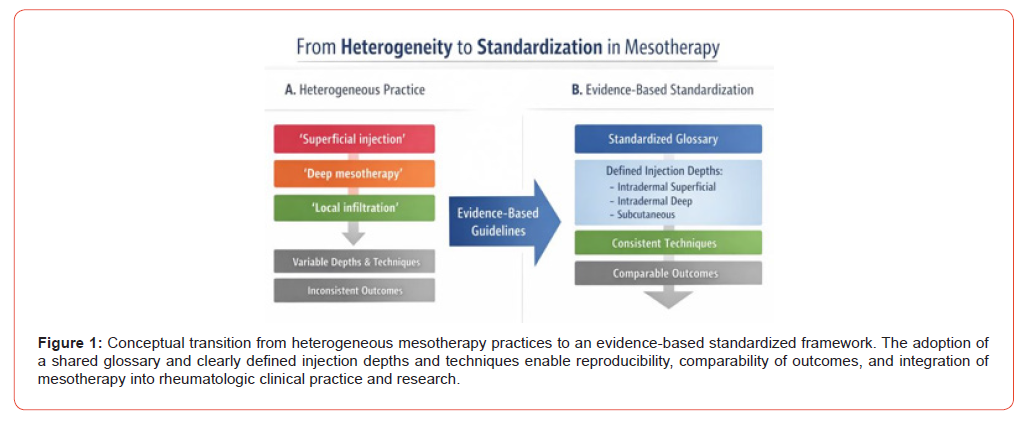
Mesotherapy has been increasingly employed as a complementary therapeutic option in the management of musculoskeletal and rheumatologic pain [1]. Despite its widespread clinical use, the integration of mesotherapy into evidence-based rheumatology has remained limited. This gap is largely attributable not to a lack of clinical experience or published data, but to substantial heterogeneity in terminology, injection techniques, depth of administration, pharmacological strategies, and outcome definitions. Historically, mesotherapy has been described using inconsistent and often ambiguous language, leading to difficulties in interpreting clinical results, comparing studies, and conducting meaningful evidence synthesis. As a consequence, its potential role in rheumatology has frequently been underestimated or viewed with scepticism from both clinical and regulatory perspectives. Recently, international evidence-based standardization initiatives have addressed these limitations by providing shared definitions and structured recommendations for mesotherapy practice [2]. This short communication aims to discuss how such standardization efforts may facilitate the integration of mesotherapy into rheumatologic pain care, repositioning the technique from an empirically heterogeneous procedure to a structured, reproducible, and clinically accountable intervention. From a rheumatologic standpoint, standardization represents a prerequisite for appropriate clinical integration, robust research design, and alignment with modern, multimodal pain management strategies (Figure 1).
Evidence-Based Standardization: Depth of Injection and Technique
Injection depth and technique are critical determinants of mesotherapy outcomes, yet they have long been treated as secondary procedural details. In reality, these variables directly influence tissue distribution, local pharmacokinetics, biological response, and safety [3]. Recent evidence-based guidelines clearly distinguish between superficial intradermal, deep intradermal, and subcutaneous approaches, providing operational definitions that enable reproducibility across clinical settings [4]. This clarification is particularly relevant in rheumatology, where even minor variations in technique may result in significant differences in analgesic response or adverse event profiles. Standardization of injection depth and technique improves procedural safety by reducing inappropriate depth selection and minimizing the risk of vascular, neural, or infectious complications. From both clinical and research perspectives, recognizing these parameters as biologically active variables rather than technical formalities allows mesotherapy to align with contemporary principles of procedural medicine and evidence-based care.
Peripheral Neuropathic Pain as a Model for Depth- Specific Mesotherapy
In a retrospective study, 45 patients with unilateral or bilateral carpal tunnel syndrome (CTS), clinically diagnosed and confirmed by electromyography, were analysed, for a total of 66 treated limbs. All patients underwent a standardized protocol consisting of five weekly subcutaneous infiltrations along the course of the median nerve, with a total volume of 2 mL per limb divided into four injection points. Patients in Group A received local infiltrations of betamethasone 4 mg (1 mL) combined with mepivacaine 1% 10 mg (1 mL) only. In Group B, the same infiltrative treatment was combined with systemic therapy with oral L-acetylcarnitine at a dose of 500 mg twice daily for 60 days. Patients in Group C received, in addition to betamethasone and mepivacaine, L-acetylcarnitine 500 mg added directly to the infiltrative mixture, together with oral L-acetylcarnitine administered according to the same regimen as in Group B. In patients with bilateral CTS belonging to Groups B and C, the two limbs were treated with different protocols, allowing for an intra-subject comparison. At baseline, mean scores for static pain, neuropathic pain, and paerestesia were high and comparable among groups (NRS approximately 6-7). At the end of the treatment cycle and at the two-month follow-up, all groups showed a significant reduction in static and neuropathic pain as well as paraestesias (p < 0.001), with final mean values around 1.7-1.8, and no statistically significant differences among the different therapeutic regimens. Post-treatment electromyographic evaluation demonstrated improvement or stabilization of median nerve conduction parameters in a substantial proportion of patients, particularly in mild and moderate cases. All treatments were well tolerated, with no clinically relevant adverse events reported. It should be emphasized that this study was conducted according to a protocol based on repeated low-volume local micro-infiltrations performed on a weekly basis, consistent with the principles of mesotherapy, differing from classical mesotherapy solely in terms of injection depth. This methodological choice was driven by the need to ensure an adequate safety profile for corticosteroid use, which is not recommended for intradermal administration. The findings suggest that the observed efficacy is attributable less to injection depth or the complexity of the pharmacological combination than to mechanisms of local modulation induced by the repeated administration of low drug doses, a core principle of mesotherapy. In this context, the reported experience strengthens the rationale for the use of intradermal mesotherapy in the management of peripheral neuropathic pain, supporting the hypothesis that intradermal protocols, in line with current recommendations [2], may achieve comparable outcomes with a further optimized safety profile. These findings should be interpreted as hypothesisgenerating and supportive of standardization principles rather than as definitive comparative efficacy data.
Drug-Sparing Effect and Local Pharmacological Modulation
One of the most clinically relevant aspects of mesotherapy in rheumatology is its potential drug-sparing effect. Patients with chronic rheumatologic conditions are frequently exposed to polypharmacy, systemic anti-inflammatory drugs, and analgesics, often with cumulative adverse effects [1,2]. Mesotherapy offers a locally targeted pharmacological strategy that may reduce systemic drug exposure while maintaining clinical efficacy [5]. The guidelinebased interpretation emphasizes that this effect should not be viewed as empirical “micro-dosing,” but rather as optimization of local tissue concentrations with reduced systemic dissemination. By delivering pharmacological agents directly to the site of pain or inflammation, mesotherapy may support individualized treatment strategies, particularly in patients who are elderly, fragile, or intolerant to systemic therapies. In this context, the drug-sparing effect aligns with broader principles of precision and personalized medicine increasingly adopted in rheumatology.
Analgesic Effects and Mesodermal Modulation
The analgesic efficacy of mesotherapy cannot be attributed solely to local drug delivery. Increasing attention has been directed toward the concept of mesodermal modulation, which encompasses the interaction between mechanical stimulation, local inflammatory pathways, peripheral nociceptors, and pharmacological agents. The act of intradermal injection itself may induce neuromodulator and microcirculatory effects, contributing to pain modulation independently or synergistically with the injected substances [4]. This multifactorial mechanism is particularly relevant in rheumatologic pain, which often involves a complex interplay between inflammatory, mechanical, and neuropathic components. The standardized framework provided by recent recommendations allows these mechanisms to be explored more systematically, avoiding over-simplified explanations and facilitating hypothesisdriven research. Recognizing mesotherapy as a combined pharmacological and biological intervention strengthens its conceptual foundation within modern pain science.
Impact on Pain Management and Functional Outcomes
Pain control remains a central therapeutic goal in rheumatology, directly influencing functional outcomes, quality of life, and adherence to long-term treatment plans. Mesotherapy, when standardized and appropriately indicated, may contribute to pain reduction and functional improvement in selected musculoskeletal and rheumatologic conditions [6]. Importantly, standardized terminology and procedural definitions enable the use of shared outcome measures and validated pain scales, improving data quality and comparability. This is essential for assessing not only analgesic efficacy but also functional recovery and patient-reported outcomes. By potentially reducing reliance on systemic analgesics, mesotherapy may also contribute indirectly to improved tolerability and long-term management strategies, particularly in chronic pain settings.
Integration of Mesotherapy into Rheumatologic Care Pathways
Standardization enables the transition of mesotherapy from an isolated or empirically applied procedure to a structured component of integrated rheumatologic care pathways. Clear definitions of indications, techniques, and limitations allow mesotherapy to be positioned appropriately within multimodal pain management strategies. Rather than replacing diseasemodifying or systemic therapies, mesotherapy may serve as a complementary option at specific stages of care, such as early pain control, flare management, or rehabilitation support [7]. Its integration requires interdisciplinary collaboration among rheumatologists, pain specialists, and rehabilitation professionals. The guideline-based framework provides a shared language that facilitates clinical governance, improves communication among stakeholders, and supports patient education. Within this structured context, mesotherapy can be evaluated, applied, and monitored in accordance with evidence-based rheumatologic practice.
Future Directions and Guideline Updates
The standardization of mesotherapy represents a foundation rather than an endpoint. Future research should focus on welldesigned clinical trials using shared definitions, standardized techniques, and comparable endpoints. Continuous data generation will support periodic guideline updates, ensuring alignment with emerging evidence and clinical needs. From a rheumatologic perspective, ongoing collaboration between scientific societies will be essential to refine indications, optimize protocols, and further clarify the role of mesotherapy within evidence-based pain management.
Conclusion
Standardization transforms mesotherapy from a heterogeneous and difficult-to-evaluate practice into a reproducible, analysable, and clinically integrable intervention in rheumatology. Evidencebased definitions of injection depth, technique, pharmacological strategy, and analgesic mechanisms are essential for robust research, regulatory clarity, and meaningful clinical application. Within this framework, mesotherapy may contribute to integrated, patient-centred pain care pathways and support future advances in rheumatologic pain management.
Acknowledgement
We would like to thank Ennio Sarli for his assistance.
Conflict of Interest
The authors received no specific funding for this work.
References
- Mammucari M, Gatti A, Maggiori S, Sabato AF (2012) Role of mesotherapy in musculoskeletal pain: opinions from the Italian Society of Mesotherapy. Evid Based Complement Alternat Med 436959.
- Mammucari M, Russo D, Maggiori E, Rossi M, Lugli M, et al. (2025) On behalf of the International Expert Panel. International consensus guidelines on the safe and evidence-based practice of mesotherapy: a multidisciplinary statement. J Clin Med 14(13): 4689.
- Mammucari M, Gatti A, Maggiori S, Bartoletti CA, Sabato AF (2011) Mesotherapy: definition, rationale and clinical role. A consensus report from the Italian Society of Mesotherapy. Eur Rev Med Pharmacol Sci 15(6): 682-694.
- Mammucari M, Maggiori E, Russo D, Giorgio C, Ronconi G, et al. (2020) Mesotherapy: from historical notes to scientific evidence and future prospects. ScientificWorldJournal 3542848.
- Bifarini B, Gori F, Russo D, Mammucari M, Maggiori E, et al. (2022) Intradermal therapy (mesotherapy): the lower the better. Clin Ter 173(1): 79-83.
- Paolucci T, Bellomo RG, Centra MA, Giannandrea N, Pezzi L, et al. (2019) Mesotherapy in the treatment of musculoskeletal pain in rehabilitation: the state of the art. J Pain Res 12: 2391-2401.
- Mammucari M, Russo D, Maggiori E, Di Marzo R, Rossi M, et al. (2026) Consensus statement on mesotherapy for clinical and regulatory practice. Rheumatol Int 46(2): 39.
-

This work is licensed under a Creative Commons Attribution-NonCommercial 4.0 International License.