


 Case Report
Rapid Progression of Late Onset Non–Specific Interstitial Pneumonia in a Patient with Systemic Sclerosis
Received Date: November 13, 2024; Published Date: November 27, 2024
Abstract
Patients with systemic sclerosis (SSc) often present with lung manifestations of the primary illness. Fibrotic non- specific interstitial pneumonia (NSIP) is the most common cause of diffuse parenchymal lung disease in these patients. In an appropriate clinical setting with adequate high resolution computed tomography (HRCT) findings, lung biopsy is not needed to confirm the interstitial lung disease (ILD). The general radiological findings of NSIP include: subpleural reticulations, ground glass opacification, thickening of bronchovascular bundles and traction bronchiectasis., and in advanced forms of the disease consolidations and microcystic honeycombing are expected. We report on male patient, previously diagnosed with systemic sclerosis, who had respiratory symptoms and spirometry restriction thus a HRCT of the lungs was requested but revealed only nonspecific findings, with no criteria for ILD. A follow up was advised, however due to COVID 19 epidemic, the first control HRCT was performed after two years and the diagnosis of NSIP was made with typical findings, leading to antifibrotic therapy. The patient had a poor reaction to immune and antifibrotic therapy, and the next HRCT revealed disease progression due to reticulations, but also bronchiectasis development which is atypical for NSIP.
Keywords: CT; NSIP; Bronchiectasis; ILD
Abbreviations: SSC: Systemic Sclerosis; NSIP: Non- Specific Interstitial Pneumonia; ILD: Interstitial lung Disease; HRCT: High Resolution Computed Tomography; PAH: Pulmonary Arterial Hypertension; UIP: Usual Interstitial Pneumonia; DLCO: Diffusing Capacity for Carbon Monoxide; FVC: Forced Vital Capacity; FEV1: Forced Expiratory Volume in 1 Second; GGO: Ground Glass Opacities
Introduction
Systemic sclerosis or scleroderma (SSc) is an uncommon immune-mediated rheumatic disease, with high morbidity and mortality, characterized by cutaneous and organ fibrosis as well as vasculopathy [1]. More than one-third of patients present with lung manifestations of the disease, the main ones including pulmonary arterial hypertension (PAH) and interstitial lung disease (ILD), which significantly reduce survival rates compared to patients free of these complications [2,3]. The most common imaging pattern on HRCT is non- specific interstitial pneumonia (NSIP), which is seen in more than 80% of patients, followed by usual interstitial pneumonia (UIP) [4]. NSIP is classified as cellular or fibrotic. The fibrotic type is commonly related with SSc and characteristic HRCT features include diffuse, mostly bilateral and peripheral distribution of ground glass opacities with immediate subpleural sparing as a relatively specific sign, reticular opacities including broncho vascular bundle thickening, traction bronchiectasis, as well as lung volume loss in advanced forms. Less common features include parenchymal consolidation and microcystic honeycombing.
Case Presentation
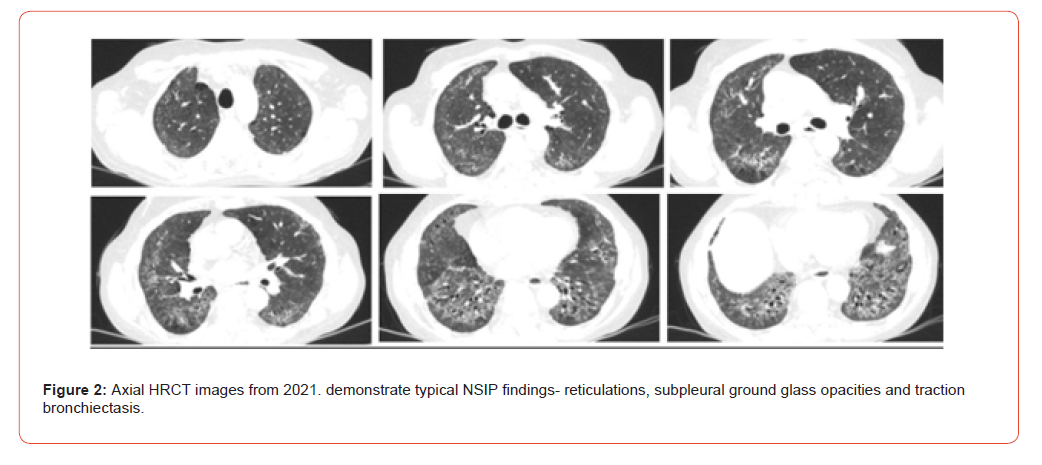
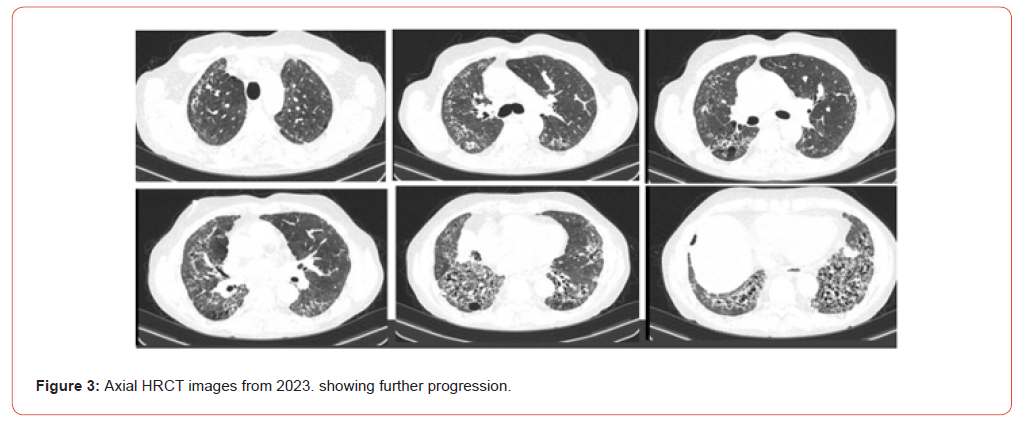
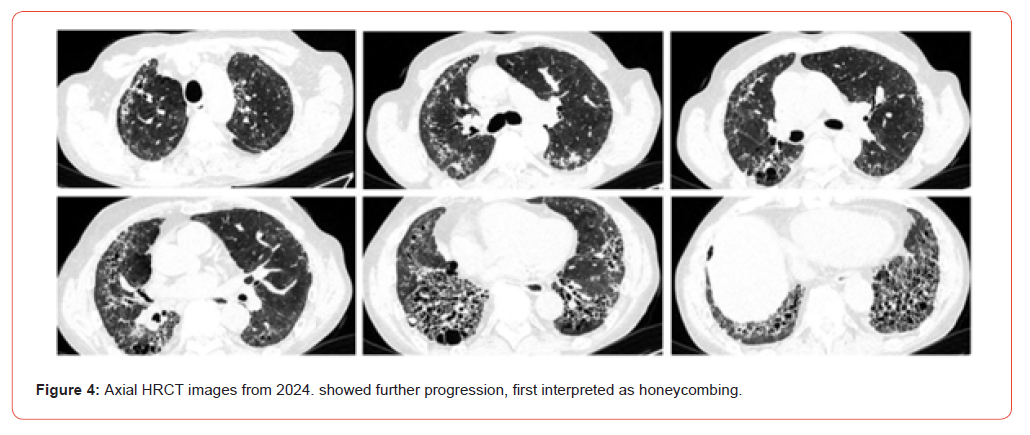
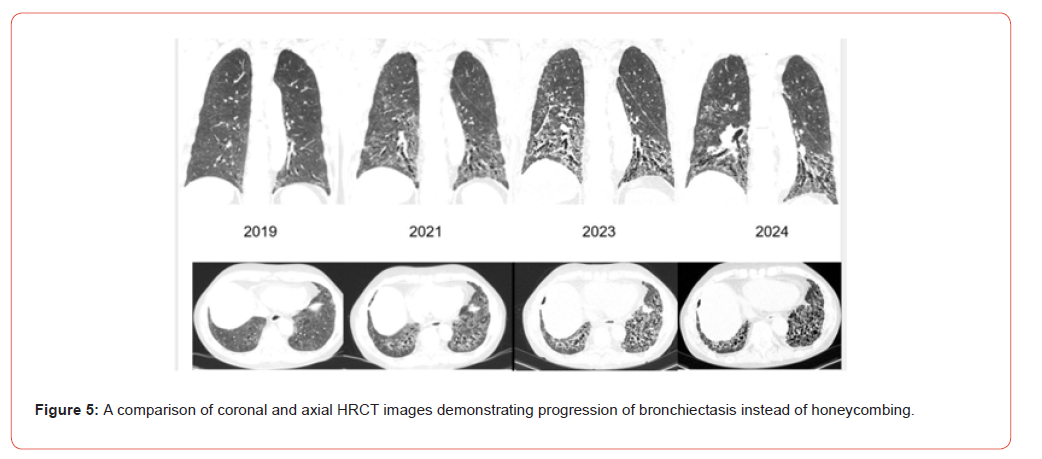
A 65-year-old male patient with previously diagnosed SSc presented to the Pulmonology Clinic, University Clinical Center of Serbia, complaining of dyspnoea, dry cough and fatigue. Upon physical examination he had inspiratory crackles basally, and laboratory findings were normal. Pulmonary function tests showed a restrictive pattern with a reduced FVC 61%, FEV1 65% and DLCO 21%. The first HRCT was performed in September 2019 (Figure 1) and revealed only non- specific findings such as discrete ground glass opacities (GGO). Due to COVID 19 epidemic, the patient did not undergo regular follow ups, and the next HRCT was done in September 2021 (Figure 2), showing progression of the disease with now present typical NSIP findings predominantly in lower lobes, such as reticulations, progression and extension of previous ground glass opacities and traction bronchiectasis. The patient was continuously on corcitosteroid therapy due to his primary disease, and after making the diagnosis of NSIP, antifibrotic therapy (Nintedanib) was included. He presented for a regular checkup in October 2023., showing progression of clinical signs and symptoms: pulmonary function tests revealed further dropping of FVC which was 53%, FEV1 60% and DLCO was immeasurable, as well as significant progression of HRCT radiological findings (Figure 3). After twenty-eight cycles of antifibrotic therapy, in October 2024 a regular control HRCT (Figure 4) showed further progression, at first wrongly interpreted as honeycombing. Due to this, an expert review of the HRCT was requested, and the progression was confirmed in favour of traction bronchiectasis predominance instead of honeycombing (Figure 5).

Discussion
SSc can affect multiple organ systems, including the lungs and it can damage all aspects of the respiratory tract: the parenchyma, vasculature and musculature, with the usual onset in the first 5 years following the diagnosis of SSc5. This was not the case with our patient, as he was diagnosed with SSc around twenty years ago.
As was demonstrated in this case, SSc is typically characterized by a restrictive ventilatory defect with FVC < 70% and forced expiratory volume in 1 second (FEV1): FVC ratio of >0.8, with both FVC and DLCO being prognostic factors in these patients [6].
The gold standard for diagnosing ILD associated with SSc is pulmonary biopsy, however HRCT has a sensitivity of 90–100%, thus allowing biopsies to be performed only in certain cases [7]. Typical radiological fidnings on HRCT include ground glass opacities, intralobular opacities, interlobular septal thickening, distortion of lung architecture, honeycombing and traction bronchiectasis. with ground glass and honeycomb being the most frequent changes [8]. The most common patterns of disease in ILD SSc are NSIP and UIP, followed by organizing pneumonia, which is in accordance with our patient who developed NSIP. The radiological features of NSIP include mostly bilateral ground-glass opacities with immediate subpleural sparing, reticular opacities, and thickening of bronchovaslucar bundles accompanied by traction bronchiectasis. The main differential diagnosis is UIP, characterized by macrocystic honeycombing. In our case a junior radiologist wrongly interpreted advanced bronchiectasis as honeycombing, which can be a common rookie mistake, which is why we highlight the importance of an experienced radiologist when it comes to these patients, because the presence and severity of traction bronchiectasis is the most influential factors for predicting worse overall survival [9]. For systemic sclerosis-associated ILD and its most common pattern NSIP, corticosteroids are often the firstline medication in stabilizing pulmonary function. For patients who suffer from progression regardless of treatment, antifibrotic agents are the next choice of treatment [10]. However, to our knowledge, there are no studies available to confirm the exact dose and duration of medication. Clinical and pulmonary function reassessment is recommended in 3-12 months and follow-up CT at 12 months for progression, which emphasises the importance of communication between radiologists and a multi-disciplinary team of pulmonologists and pathologists.
Acknowledgements
None.
Conflict of interest
The authors have no financial interest or any other conflict of interest to declare.
References
- Denton CP, Khanna D (2017) Systemic sclerosis. The Lancet 390(10103): 1685-1699.
- Konopka KE, Myers JL (2021) Interstitial lung disease pathology in systemic sclerosis. Therapeutic Advances in Musculoskeletal Disease.
- Hassoun PM (2011) Lung involvement in systemic sclerosis. La Presse MeIdicale 40(1): e25-e39.
- Perelas A, Silver RM, Andrea V Arrossi, Kristian B highland (2020) Systemic sclerosis-associated interstitial lung disease. The Lancet respiratory medicine 8(3): 304-320.
- Distler O, Assassi S, Cottin V, Cutolo M, Danoff KS, et al. (2020) Predictors of progression in systemic sclerosis patients with interstitial lung disease. European Respiratory Journal 55(5): 1902026.
- Schoenfeld SR, Castelino V (2017) Evaluation and management approaches for scleroderma lung disease. Therapeutic advances in respiratory disease 11(8): 327-340.
- Morales-CaIrdenas A, PeIrez-Madrid C, et al. (2016) Pulmonary involvement in systemic sclerosis. Autoimmunity reviews, 15(11): 1094-1108.
- Patiwetwitoon S, Wangkaew S, Juntima Euathrongchit, Nuntana Kasitanon, Worawit Louthrenoo (2012) High resolution computed tomographic findings in systemic sclerosis- associated interstitial lung disease: comparison between diffuse and limited systemic sclerosis. Journal of Clinical Rheumatology 18(5): 229-233.
- Putman RK, Gudmundsson G, et al. (2019) Imaging patterns are associated with interstitial lung abnormality progression and mortality. American journal of respiratory and critical care medicine 200(2): 175183.
- Hino T, Lee KS, Hongseok Yoo, Joungho Han, Teri J Franks, et al. (2021) Interstitial lung abnormality (ILA) and nonspecific interstitial pneumonia (NSIP). European journal of radiology open 8: 100336.
-

This work is licensed under a Creative Commons Attribution-NonCommercial 4.0 International License.