

 Research article
Osteoarthritis Pain, Muscle and Muscle Mass Attributes: Possible Interactions and Disease Drivers
Received Date: June 18, 2025; Published Date: June 26, 2025
Abstract
Osteoarthritis, a widespread chronically painful joint disease affecting the majority of aging adults is strongly associated with various degrees of disability and high health costs. Commonly deemed largely incurable and progressive, most interventions focus on pharmacologic and surgical approaches. These however, are not always efficacious, and can result in, or even foster adverse outcomes, especially if muscle and its contribution to the osteoarthritic disease process is not duly considered to be clinically significant or relevant. On the other hand, it appears physical activity enhancement that implicates muscle has a consistent mitigating effect on osteoarthritis disability, thus implying muscle may prove an upstream regulator of this disease. This mini review examines whether contemporary evidence supports treating or maximizing muscle strength both as the sole means of reducing osteoarthritic pain or as a supplementary strategy. To this end, research on osteoarthritis pain and its possible association with subnormal neuromuscular structure or function, especially that of sarcopenia, was sought. We found that regardless of joint examined a role for muscle in general in mediating or moderating osteoarthritis pain severity cannot be ruled out, and that muscle mass losses may provide the mechanistic explanation both for osteoarthritis in the frail as well as the obese.
Keywords: Aging; muscle; osteoarthritis; sarcopenia; outcomes; pain; treatment
Introduction
Osteoarthritis, a prevalent chronic disease affecting one or more freely moving joints and characterized by progressive bone remodelling, articular cartilage degeneration and soft tissue capsular and ligamentous alterations continues to induce appreciable levels of physical and socioeconomic disability in a high percentage of older adults no matter where they preside [1-4]. Strongly associated too with associated changes in the excitability of the nerve endings located in and around the diseased joint tissues, the disease is also well characterized by multiple muscle alterations including: muscle atrophy, muscle spasm, muscle contracture, muscle fibrosis and pathology. A condition uniformly associated with various degrees of unrelenting pain generated both at rest and on motion, osteoarthritis remains somewhat resistant to most relieving approaches despite current abilities to carefully study its molecular and genetic basis with high accuracy.
However, there is either an omission in what is studied that is transferable or a perpetuation of accepted past understandings that osteoarthritis is inevitable and a cartilage disease, rather than a more inclusive joint systems disease with multiple neural signalling implications. Moreover, while somewhat efficacious, a fair number of palliative approaches such as anti-inflammatory drugs to quell pain may yet prove noxious and unsafe when viewed in the wider context of the adult, for example if practitioners fail to appreciate the overall health status of the older adult. In addition, although muscle factors are clearly important disease correlates, they are not always seen as having significant pathogenic implications or relevance even in 2025 [e.g., 1,2], despite a host of muscle associated reports in the last decade, and signs physical activity enhancement or participation rather than rest, has a consistent mitigating effect on osteoarthritis disability that might be harnessed more routinely [5].
Moreover, attention to factors other than physical activity participation alone may be warranted [6], for example it may be possible to detect the presence of any identifiable or measurable muscle structural losses or abnormalities that could influence joint health, alignment and stability [7], muscle pain, and joint protective and reaction forces, adversely regardless of activity level or the application of any accepted or novel pharmacologic or ortho-biological approaches [1]. Similarly, if not sought, clearly understood and delineated, muscle use in the face of coordination and force generating deficits may yet evoke pain, or further an array of joint destructive processes, inadvertently and significantly.
To this end, this brief specially examines whether:
a) muscular features of osteoarthritis can produce pain or
exacerbate prevailing pain.
b) treatment of muscle in any form yields substantive
reductions in osteoarthritic pain.
c) the specific importance of sarcopenia identification and
intervention in older adults at risk for or diagnosed as having
osteoarthritis.
It was anticipated the literature would reveal a variety of muscular mechanisms with the potential to impact osteoarthritic pain both directly and indirectly, alone, or in combination. It was also believed that if this thesis was sound, a variety of muscle-related treatment approaches would be found to reduce osteoarthritis pain, including those that can seek to minimize sarcopenia or muscle mass losses that are age associated or reactive in the face of joint pathology and surgery.
Methodology
To examine works that might enlighten in the aforementioned regard, the PUBMED data bases largely extending from 2015-2025, but focusing on 2025 data, using the key words: osteoarthritis, pain, sarcopenia and muscle were sought. Only articles focusing on osteoarthritis and some form of muscle attribute and pain as related to osteoarthritis were selected for review. Described in narrative form, are some general ideas and results of therapeutic studies directed towards targeting osteoarthritic muscle. The specific topic of interest, sarcopenia was also reviewed. No systematic review was conducted, and topics that focused on invasive strategies or surgical strategies for treating osteoarthritis pain were not reviewed. The points made are those that have recently emerged and comport with the author’s 25 years of research on the current themes and aim to foster those that can be applied at low cost non-invasively. Accordingly, first I will highlight some general current 2025 evidence reports that allude to recently observed muscle influences or responses in the osteoarthritis disease cycle, rather than all those that have been published to date. The items chosen are those that have a bearing in the author’s view on pain the hallmark of osteoarthritis, namely cartilage shock absorbing tissue degeneration changes and destruction. Second, some emerging evidence of a key role for muscle atrophy as a mediating or moderating pathogenic factor is presented. Third, clinical implications, possible clinical directives, and future research ideas are presented.
Assumptions
a) Isolated muscle spasm and or muscular contractures may
adversely impact articular cartilage structural features.
b) The absence of adequate muscular contraction levels
affects cartilage nutrition as well as muscle support.
c) Poor muscular coordination, particularly a reduced
ability to generate eccentric muscle forces in a timely manner
will prove injurious to a joint.
d) Muscle imbalances may provoke and perpetuate an array
of unwanted joint functional outcomes and pain provoking
adaptations.
e) Evidence that muscle problems may generate pain in its
own right or heighten osteoarthritis progression is potentially
supported to date by a host of electromyographic, biopsy,
muscle composition and quality analyses, ultra sonography,
imaging studies, basic studies, and biomechanical approaches.
Current Specific Findings
While a role for muscle in the osteoarthritis pathogenic cycle is a relatively recent perspective, and increasing numbers of studies confirm its association with symptomatic osteoarthritis, a chronic disease strongly associated with aging and structural joint damage, the notion that joint and muscle pathological reactions are noteworthy disease mediators is not widely documented, or applied to a degree commensurate with these diverse disease manifestations and attributes, or as an accepted underlying pathogenic correlate. However, among the 314 related studies published in 2025 on PUBMED, the world’s largest medical science repository, a fair number focus on exercises of various sorts to mitigate the disease, thereby implying some degree of importance of muscle-associated osteoarthritis disability, and among these, a sub-group of studies has shown a role for physical activity [8] and an array of muscle-related structural and functional changes such as sarcopenia [a progressive muscle mass declining state], sleep disturbances and mobility declines plus subnormal proprioception that may well induce or raise pain levels additively [9].
Others show a role for deforming contractures, varying degrees of muscle spasm and subnormal vector influences, plus functional changes in muscle biochemistry that have a unique or collective bearing on cartilage viability [10-12]. Other data imply that there may be progressively harmful adverse degrees of joint loading that subsequently manifests as fully fledged osteoarthritis, as well as ensuing subnormal motor unit recruitment responses [11], various degrees of muscle pathology and chemical expression and/ or abnormal agonist/antagonist muscle balances, and/or Kinesio phobia or fear of moving [14]. The impact of one or more of these suboptimal disease features or states appears to have the further potential to foster unremitting pain, joint instability, subnormal joint contact pressures and cartilage nutrition, excess bone impacts and forces directed towards focal areas of the cartilage, often with dire far-reaching debilitating costly consequences. Other data reveal a possible cycle of progressive joint destruction and possible reactive inflammatory processes may elicit pain, while pain may also ensue in association with excessive stretching or compression of the diseased joint tissues, any prevailing or emergent metabolite muscle alterations, alterations in muscle quality, thickness, or myopathy of the surrounding muscles [13-22].
Additionally, in the presence of generalized sarcopenia an impact on overall physiological reserve and adaptability may lead to undue joint stresses [23], local signs of muscle weakness, muscle fat invasion and a change in muscle-fat ratios that have been reported. There may also be emergent indications of a gradually diminishing joint range of motion [24], and joint stiffness [25], plus abnormal degree of muscle related joint degrading biomechanics [10,24,26]. Moreover, it is conceivable that in the absence of effective interventions, as time proceeds muscle tension effects associated with modest intra articular pressure levels, hypoxia and short periods of synovial ischaemia may contribute to a disordered state of joint destruction and inflammation that causes widespread central pain sensitization states. As well, the diverse muscle-oriented interactions listed below may prevail and function independently or interactively to destroy the joint and the spread of joint damage to other sites as follows:
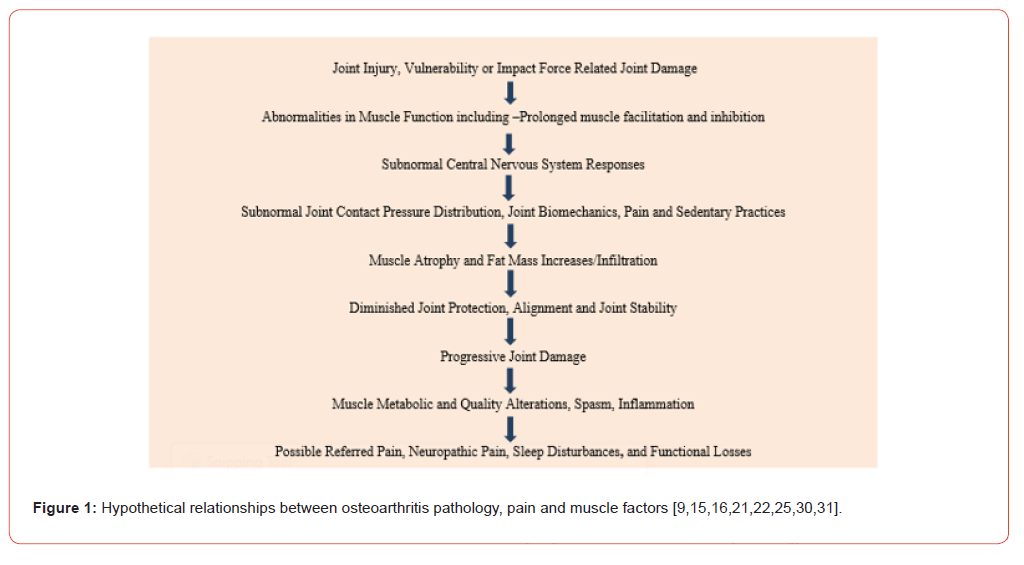
of a joint including heightened muscle strength and contractile abnormalities [26] and others shown in Box 1, which remains to be proven, is however, increasingly shown to be associated with subnormal joint biodynamical, structural and muscle adaptation mechanisms common to older adults [15]. As well, this idea is consistent with known age associated degrees of subnormal muscle metabolic physiological states, malnourishment, skeletal alignment issues, and possibly some neuromotor conditions.
Underlying local factors may also include possible muscle reactive adaptations due to persistent abnormal sensory inputs from one or more of the surrounding tissues, and the presence of an increased muscle fat mass and parallel declines in muscle mass [15- 20,30] that may impact strength and the ability to attenuate joint impact loads significantly and effectively with dire consequences [30], such as a possible myalgia depression disorder [33].
Indeed, not only do increasing numbers of studies show muscle weakness or movement limitations are indeed common correlates of osteoarthritis, but that these can predate osteoarthritis as well as heighten the pain experience if prolonged or progressive due to unresolved effusion, muscle protein degradation, type II or type I muscle fibre atrophy, muscle fat mass encroachment, muscle quality and architectural alterations, excessive, imbalanced or suboptimal muscle afferent and efferent reflexes, and flexion contractures [15]. Other research further suggests persistent muscle spasm resulting from excessive stretching of diseased tissues or abnormally stimulated muscle nociceptors, myokines. or adverse metabolites may also produce a state of ischemic pain in its own right, as well as a state of poor muscle endurance and disabling muscle fatigue that is hard to mitigate [31]. Others show the presence of muscle inflammation that may evoke muscle pain signals, elicit painful surrounding trigger points, bone and referred pain, bone attrition, and sensory sympathetic inputs that conduct pain and contribute to the arthritis disease and disability cycle [32].
Moreover, muscle pain and joint destruction may also derive from increasing evidence of intramuscular fat infiltration and the likelihood of excess impact loading on a vulnerable joint in the overweight adult [34]. It also appears that sensory inputs from osteoarthritis muscle may play a pathogenic role in osteoarthritis by having a bearing on ongoing emergent alterations in both muscle architecture [35], proprioception [36] as well as central feed forward and backward processing signalling mechanisms often associated with neuropathic or pain responses of long duration, plus exaggerated sympathetic reflex mechanisms [37,38]. As a result, it may be highly challenging to relieve longstanding pain or mitigate osteoarthritis spread and severity, especially if there is a progressive unwillingness on the part of the affected adult to move to counter increasing pain and stiffness, widespread reflex reorganization and muscle mass and fibre atrophy. In addition, with marked or complete stiffening, the abnormal and awkward movements used by the individual to avoid pain may throw strain on other joints, causing further pain, and/or muscle imbalances and slower than desirable reflex reactions that enhance the risk of incurring more extensive joint pathology and pain.
For example, noxious stimulation from diseased joints causing extensor weakness at the knee, the most commonly affected joint, could result in a state of joint effusion, reflex response abnormalities, cartilage nutrition deficits, and underuse or subnormal joint use with consequent abnormal cartilage impacts that undermines its integrity. This set of events may also reduce muscle shock absorbing capacity and reactivity, thereby exposing the underlying bone to abrasion, possible heightened excitation of bone nerves and potent or aching pain. Coupled with flexion contractures of the antagonists, the presence of any ensuing extensor muscle weakness may induce a state of multiple subnormal posture and movement patterns, and a cycle of pain not easily reversed. If pain is relentless and becomes widespread as a result, it can be anticipated that an overweight/underweight status may be heightened or forthcoming and sarcopenia wherein associated muscle mass losses, muscle weakness and slower than desirable movements may raise the risk of further joint destruction and pain [45], even in the face of joint replacement surgery [51,58].
Recent evidence also shows a possible role for osteoarthritis associated neuromuscular modelling alterations, muscle gene and protein metabolic alterations [52], widespread atrophic muscle weaknesses and asymmetries and volume deficits [53] muscle inflammation [54] and muscle architecture alterations in various osteoarthritis contexts [55] including cases exhibiting recurrent falls and erosive osteoarthritis who are sarcopenic [59,60]. In sum, osteoarthritic pain may originate in several ways that involve muscle especially in the presence of muscle atrophy, wasting, or sarcopenia [39,40]. Other muscle-based determinants include possible degrees of reactive muscle spasm, muscle contractures, muscle fibrosis, muscle inflammation, joint instability, and altered cartilage calcium presence, functional ability, disability, and impaired muscle coordination and weakness and muscle fat infiltration [45-50]. While mechanical injury is the most likely cause of osteoarthritis in most instances, malnutrition or undernourishment may play a role as well [39] especially in the realm of advancing a state of local or systemic sarcopenia.
Emerging evidence showing muscle signalling impacts on cartilage viability [57] suggests more be done in this regard to avert any probable osteoarthritis sarcopenic or maladaptive muscle responses due to joint malalignment or muscle mass declines or both [35,58,62]. This is because it is increasingly observed that there is a form of cross-talk between muscle and bone, and adipose tissue that may play a major role in this regard. In addition, other related work implies a role for the tendency towards either an acute onset or a comorbid increase in muscle and biomechanical dysfunction as an osteoarthritis outcome, including a situation where muscle atrophy and pain may be heightened in those who exhibit avoidance behaviours or fears of moving. As well, those displaying atrophic muscle weakness are also found to display disruptions in muscle genetics, muscle inflammation, and joint instability [39,52-54], that may progress to more detrimental muscular alterations such as declines in muscle force capacity and responsiveness [44].
Possible central processing neural mechanistic changes that occur over time may further serve to amplify the pain attributable to the local condition even after surgery in the absence of salient timely targeted intervention that embraces efforts to mitigate sarcopenia or sarcopenic neuropathic influences and tendencies [2]. Although more translational research is indicated on diverse joints other than the hip and knee joints that predominate in order to identify common denominators for the management of osteoarthritis, multiple measurable biological joint alterations may clearly stem from one or more forms of muscle dysfunction rather than age alone. These muscle correlates may include extensive alterations in neural signalling at multiple levels, cognitive responses that impact pain, as well as joint biomechanics, protection, and function, poor muscle proprioception and balance.
Fortunately, it appears that even if this is only due to publication bias, multiple diverse intervention modes directed at osteoarthritis muscle targets do generally yield clinically as well as statistically significant benefits, regardless of mode e.g., [63-65]. Even then, their application must be carefully construed in light of the many disease variations that prevail and that must be acknowledged and treated accordingly and may well prove to have even more profound benefits than those identified in restricted studies. In the meantime, the fact is, most physical therapies that address muscle are shown to be efficacious and safe, as well as essential. This topic and viewpoint moreover appears to be increasingly supported by growing evidence pointing to the likelihood that the osteoarthritis process may indeed extend from a single affected joint to an unaffected joint or joints in the absence of:
a) weight control and/or strengthening exercises [4,40].
b) muscle protein supplements [41].
c) other strategies directed towards preventing or mitigating
sarcopenia [14,26,40-44].
d) efforts towards avoidance of repetitive bouts of fatiguing
exercises, excess stretching, or suboptimal joint loading
activities, and every effort should be made to prevent all of these
risky albeit remediable pathogenic processes from emerging or
summating [62].
Moreover, in those who are frail Park et al. [5] emphasize the importance of attending to the likely degree of physical resilience that appears to preside in the affected individual, rather than assuming a one size fits all intervention approach will prove beneficial, especially in the frail older adult where excess poorly titrated joint loads may prove injurious. Depression and motor imagery cognitions, both presumptive muscle correlates may warrant attention. In the interim, it appears most clinical researchers currently assume muscle problems underlie some features of osteoarthritis and if minimized will prove to have a bearing on osteoarthritis outcomes. Multiple non-invasive biomechanical therapies, bracing, moderate pressure massage, vibration and foam rolling, graded motor imagery approaches, the promotion of optimal body postures, muscle coordination, flexibility, strength, and endurance, and balancing rest and activities, while minimising joint effusion and fat infiltration all appear favourable. Similarly, careful functional exercises, interventions to enhance muscle control, balance and coordination efforts plus those addressing strategies to maintain or normalize joint range of motion and avert joint alignment problems appear valuable as well [7,63-66,68,70].
Discussion
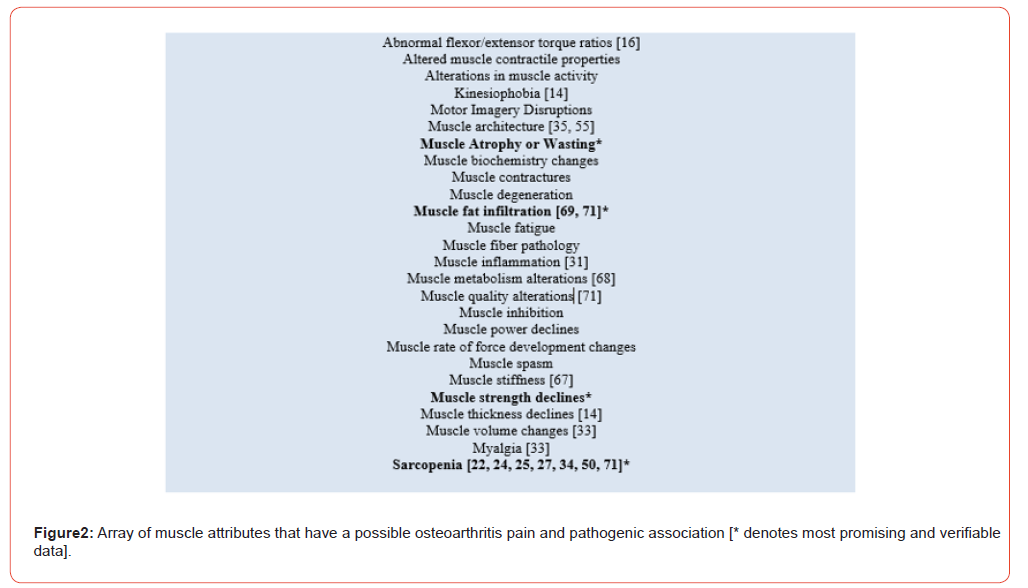
Although osteoarthritis is currently deemed a chronic disabling disease with no cure, research over the past 10 years or more has indicated that there is strong possibility that an array of muscle related factors can contribute to the osteoarthritis pain and disease cycle. These include, but are not limited to items in Figure 2 below. Conversely, a diverse array of intervention approaches that focus on maximizing muscle structure and function appear to greatly reduce the degree of pain encountered by this population, and to foster desirable outcomes, regardless of joint site and disease severity. This latter approach however may also yield further improvements if it is increasingly contingent on an insightful well founded comprehensive evaluations of each at risk or suffering older adult, plus the recognition of the possible role of malnutrition as a contributing factor to the osteoarthritis pain experience, an area of promise currently poorly studied at best and rarely studied prospectively [56,57].
Applying what we do know towards primary prevention of injuries, and the adoption of active living rather than sedentary behaviours by many will likely foster a role for more targeted secondary prevention strategies against osteoarthritis, while helping to reduce enormous public health resource demands from depletion, even in the face of surgical solutions and among those in advanced disease stages. Key supportive approaches such as enabling sound dietary practices, electrical muscle stimulation, massage, sensory motor training, and Tai Chi, are likely to prove efficacious for many as well. To achieve optimal results, however, a role for cognitions cannot be ignored, given the fact that pain is widespread and fear is readily provoked among those with osteoarthritis. Additionally, cases need to be carefully educated as to the considerable care they must take however, to avoid overexertion and repetitive movements, which can heighten muscle pain inputs and accelerate cartilage destruction.
Applying what we do know towards primary prevention of injuries, and the adoption of active living rather than sedentary behaviours by many will likely foster a role for more targeted secondary prevention strategies against osteoarthritis, while helping to reduce enormous public health resource demands from depletion, even in the face of surgical solutions and among those in advanced disease stages. Key supportive approaches such as enabling sound dietary practices, electrical muscle stimulation, massage, sensory motor training, and Tai Chi, are likely to prove efficacious for many as well. To achieve optimal results, however, a role for cognitions cannot be ignored, given the fact that pain is widespread and fear is readily provoked among those with osteoarthritis. Additionally, cases need to be carefully educated as to the considerable care they must take however, to avoid overexertion and repetitive movements, which can heighten muscle pain inputs and accelerate cartilage destruction.
Alternately, it seems plausible to suggest that the osteoarthritis sufferer’s wellbeing can be effectively mitigated if not reversed by the application of carefully integrated interventions to offset the varied muscular deficits that may accompany osteoarthritis, especially if tailored to the overall health status and needs and abilities of the individual. In particular, to avert rapid or excess disease progression and disability, and its association with prefrailty and frailty, as well as work-related losses, and comorbid illnesses [5] such as depression and obesity, there appears to be an increasing body of research that supports the view that sarcopenia is especially important in magnifying osteoarthritis disease cofactors, if not the key pathogenic cause, and that treatment of muscle in addition to the application of medication and surgery is of paramount importance in minimizing osteoarthritic joint pain and dysfunction. However, since this is by no means a universally accepted idea or practice, more studies that tease out the possible relationship between muscle factors and osteoarthritic pain along with central factors that affect pain and sarcopenic encroachment would clearly be beneficial.
Carefully controlled intervention studies with larger samples with similar muscular and disease related characteristics conducted over extensive time periods utilizing a variety of possible interventions could prove insightful as well. In addition, as per a recent study [71] that strove to characterize lower limb muscle quality in cases with knee osteoarthritis, the authors found the associated hip muscles to have a higher degree of fat infiltration and lower normal-density than the knee extensors [commonly targeted in isolation] and the ipsilateral calf muscles. Another recent study concluded that knee osteoarthritis cases may suffer in part due to associated altered levels of hip abductor and external rotator muscle metabolism, not the knee extensors [72]. Another that assessed muscle cross-sectional areas, echo intensity, and shear modulus in the rectus femoris, vastus lateralis, vastus medialis, biceps femoris long head, and semitendinosus of 24 knee osteoarthritis cases and 24 controls indicated osteoarthritis muscle and strength losses, poor flexibility and increased passive tension, and possibly reductions in its contractile components and muscle force generating capacity [73].
Another revealed high levels of intramuscular fat and poorer function than controls [74]. In our view, these findings strongly highlight the degree to which muscle may be dysfunctional in knee osteoarthritis sufferers, as well as the key salience and value of exploring muscle associated osteoarthritis correlates in the realm of osteoarthritis at the knee. They also imply that muscle responses to knee osteoarthritis pathology may not be localized solely to the target joint, nor uniform or consistent, unimodal or unique and may all play a disabling role at the knee, as well fostering multiple levels of disablement. Moreover, a failure to appreciate and understand the importance of muscle factors in the realm of both osteoarthritis research and the design of optimal osteoarthritis rehabilitation plans and their scope and sequence as outlined and implied recently by Al Amer et al. [75] may help to increase, rather than decrease, the immense projected world-wide osteoarthritis epidemic.
Key Conclusions
While recognizing the limitations of this line of inquiry and
analysis we tend to conclude:
a) High degrees of osteoarthritis impairment and suffering
will persist among older adults if myths about the condition
and sub optimal intervention approaches remain entrenched.
b) Efforts to unravel the profound impact of muscle on joint
health will prove beneficial.
c) Targeted and tailored interventions based on quite varied
current studies are all highly promising.
d) Research that examines joints other than the hip and knee
are indicated.
e) Sarcopenia and obesity/frailty prevention is indicated
among all aging adults.
f) A study of disease-free older adults would be revealing.
As a whole though it seems possible that a variety of subnormal bone-muscle presence/response interactions can impact joint biomechanics as well as structure with possible increases in disordered neuromotor signalling and reactive dysfunction that fails to attenuate joint loading aberrations that lead to cartilage failure.
Final Remarks
In addressing the growing burden of osteoarthritis, conceptually modelling the true nature of the condition from its outset and through a holistic neuromuscular lens warrants study.
Acknowledgement
None.
Conflict of Interest
No conflict of interest.
References
- Leszczyński P, Lisiński P, Kwiatkowska B, Blicharski T, Drobnik J, et al. (2025) Clinical expert statement on osteoarthritis: diagnosis and therapeutic choices. Reumatologia 63(2): 104-115.
- Iordache SA, Cursaru A, Serban B, Eremia IA, Vrancianu CO, et al. (2025) Unveiling prognostic and diagnostic biomarkers in knee and hip osteoarthritis: a targeted review. Discovery Medicine 37(197): 960-975.
- Ma W, Chen H, Yuan Q, Chen X, Li H (2025) Global, regional, and national epidemiology of osteoarthritis in working-age individuals: insights from the global burden of disease study1990-2021. Sci Rep 15(1): 7907.
- Wang F, Cao Y, Lu H, Pan Y, Tao Y, et al. (2025) Osteoarthritis incidence trends globally, regionally, and nationally, 1990-2019: An age-period-cohort analysis. Musculoskeletal Care 23(1): e70045.
- Park J, Lee J, Lee H, Kim S, Kim OC, et al. (2022) Physical resilience as a moderator of the relationship between frailty and disability in older adults with osteoarthritis. J Adv Nurs 78(7): 2085-2094.
- Tak ECPM, Van Meurs JB, Bierma-Zeinstra SMA, Hofman A, Rock MH, et al. (2017) Changes in disability in older adults with generalized radiographic osteoarthritis: a complex relationship with physical activity. Musculoskeletal Care 15(4): 364-372.
- Sutalangka C, Chamnan P, Namkorn P, Sitthipornvorakul E, Atsawakaewmongkhon S, et al. (2025) Enhancing postural stability in knee osteoarthritis patients through targeted training: a randomized control trial using the WOMAC assessment tool. Phys Act Nutr 29(1): 38-46.
- He J, Zhang C, Yang L (2025) Association between sedentary behavior, physical activity, and osteoarthritis: results from NHANES 2007-2020 and Mendelian randomization analysis. Front Public Health 12: 1454185.
- Whibley D, Shieu MM, Dunietz GL, Braley TJ (2024) Sleep disturbances and progression of mobility disability: longitudinal findings from the Nurses' Health Study. Sleep Epidemiol 4: 100071.
- Tiwari PR, Patil DS, Sasun AR, Pratik P (2023) The novelty of orthopedic rehabilitation after conservative management for patellar dislocation with partial tear of medial meniscus and early osteoarthritis in a 31-year-old female. Cureus 15(9): e46298.
- Schröter V, Könczöl C, Anders JO (2024) Comparison of pre- and postoperative motor-proprioceptive abilities in patients with gonarthrosis. Z Orthop Unfall 162(5): 479-486.
- Gan L, Deng Z, Wei Y, Li H, Zhao L (2023) Decreased expression of GEM in osteoarthritis cartilage regulates chondrogenic differentiation via Wnt/β-catenin signaling. J Orthop Surg Res 18(1): 751.
- Bokor DJ, Arenas-Miquelez A, Axford D, Graham PL, Ferreira LM, et al. (2022) Does the osteoarthritic shoulder have altered rotator cuff vectors with increasing glenoid deformity? An in silico analysis. J Shoulder Elbow Surg 31(12): e575-e585.
- Sakulsriprasert P, Bunprajun T, Hengsomboon N, Hengsomboon P, Harutaichun P, et al. (2025) Structural equation model of knee pain in individuals with knee osteoarthritis-associated knee pain, based on functional capacity, kinesiophobia, muscle thickness, and joint position sense. Knee 54: 199-208.
- Wu Q, Henry JL (2010) Changes in Abeta non-nociceptive primary sensory neurons in a rat model of osteoarthritis pain. Mol Pain 6: 37.
16. Vodička T, Bozděch M, Gimunová M, Svobodová L, Zháněl J, et al. (2021) Could the evaluation of muscle strength imbalances be used as a predictor of total hip arthroplasty?. Int J Environ Res Public Health 18(10): 5082.17. O'Neill DC, Christensen GV, Hillyard B, Kawakami J, Tashjian RZ, et al. (2020) Glenoid retroversion associates with deltoid muscle asymmetry in Walch B-type glenohumeral osteoarthritis. JSES Int 5(2): 282-287.18. Han SW, Sawatsky A, Jinha A, Herzog W (2020) Effect of vastus medialis loss on rabbit patellofemoral joint contact pressure distribution. J Appl Biomech 36(6): 390-396.19. Wang Z, Huang J, Feng Y, Li Z, Ge H, et al. (2025) HBP-a attenuates knee osteoarthritis progression via mlk3/p38/hdac4 axis-mediated dual protection of articular cartilage and quadriceps. J Cell Mol Med 29(9): e70577.20. Li L, Zhong J, Wang Z, Li Z, Liu X, et al. (2025) Chest CT-determined sarcopenia is associated with poorer functional outcomes in osteoarthritis patients undergoing total knee arthroplasty: a retrospective cohort study. Sci Rep 15(1): 18272.
- Dang Q, Hong Z, Zeng D, Cao P, Li S, et al. (2025) MRI-based radiomics to determine the role of thigh muscle quality in the development of knee osteoarthritis: a discovery and validation study. J Adv Res.
- Tuna S, Kavukçu E, Balcı N (2025) Relationship between sarcopenia, femoral cartilage thickness, and knee osteoarthritis: case-control study. Int J Rheum Dis 28(3): e70179.
- Augusto L, Bastone A, Soares, Maria MFSM, Nobre JN, et al. (2025) Physical and inflammatory aspects associated to respiratory sarcopenia in community-dwelling older women. Sci Rep 15(1): 18310.
- Negm A, Roberts B, Vette AH, Jones A, Beaupre L, et al. (2025) The effect of sarcopenic obesity on knee biomechanics in individuals with end-stage knee osteoarthritis. Gait Posture 119: 118-126.
- Ziegelmayer S, Häntze H, Mertens C, Busch F, Lemke T, et al. (2025) Intermuscular adipose tissue and lean muscle mass assessed with MRI in people with chronic back pain in Germany: a retrospective observational study. Lancet Reg Health Eur 54: 101323.
- Wu T, Wang X, Cai Z, Cao P, Dang Q, et al. (2025) Longitudinal associations between baseline sarcopenia and knee osteoarthritis progression and risk of knee replacement. Arthritis Rheumatol.
- Gao J, Yesihati M, Cheng H, Li T, Ding R, et al. (2024) Association of sarcopenia and its prognostic value in symptomatic knee osteoarthritis among older people in China: the first longitudinal evidence from CHARLS. BMC Geriatr. 24(1): 977.
- Kwak MK, Baek JY, Park SJ, Jung HW, Lee E, et al. (2024) Higher circulating resistin levels linked to increased sarcopenia risk in older adults. J Clin Endocrinol Metab 25: dgae894.
- Vieira FT, Godziuk K, Barazzoni R, Batsis JA, Cederholm T, et al. (2025) Hidden malnutrition in obesity and knee osteoarthritis: assessment, overlap with sarcopenic obesity and health outcomes. Clin Nutr 48: 111-120.
- Straatman L, Ivanochko NK, Maciukiewicz JM, Cowbrough B, Marriottet KA, et al. (2025) Interaction of obesity and systemic inflammation with knee extensor strength in knee osteoarthritis. Clin Biomech 127: 106569.
- George TB, Keret S, Pillai AC, Moghadam-Kia S, Oddis CV, et al. (2025) Fatigue is common in myositis and is associated with disease activity. Semin Arthritis Rheum 73: 152730.
- Cairns BE (2025) Contribution of sympathetic sensory coupling to craniofacial nociception. Orthod Craniofac Res.
- Wei X, Zhou T, Wei X, Wang H (2025) Causal association between depression and myalgia-related disorders: A bidirectional mendelian randomization study. J Affect Disord 386: 119450.
- Weng Q, Jiang T, Yang T, Zhang Y, Zhang W, et al. (2025) Association of thigh intramuscular fat infiltration with incident knee and hip osteoarthritis: a longitudinal cohort study. Arthritis Rheumatol.
- Çiftçi R, Kurtoğlu A, Eken Ö, Aldhahi MI (2025) Gonarthrosis related changes in quadriceps muscle architecture and physical function outcomes in women. Sci Rep 15(1): 10282.
- Cudejko T, van der Esch M, van der Leeden M, Holla J, Roorda LD, et al. (2018) Proprioception mediates the association between systemic inflammation and muscle weakness in patients with knee osteoarthritis: results from the Amsterdam Osteoarthritis cohort. J Rehabil Med 50(1): 67-72.
- Mansfield CJ, Culiver A, Briggs M, Schmitt LC, Grooms DR, et al. (2022) The effects of knee osteoarthritis on neural activity during a motor task: A scoping systematic review. Gait Posture 96: 221-235.
- Mathieu S, Fayet F, Salembien MH, Rodere M, Soubrier M, et al. (2025) Grip strength impairment and neuropathic-like pain as predictors of functional decline in hand osteoarthritis. Open Access Rheumatol 17: 47-56.
- Aslan SG, Genç H (2023) Sarcopenia in knee osteoarthritis: the association with clinical and sonographic findings, physical function, and nutrition. Ir J Med Sci 192(3): 1231-1239.
- Shorter E, Sannicandro AJ, Poulet B, Poulet B, Goljanek-Whysall K (2019) Skeletal muscle wasting and its relationship with osteoarthritis: a mini-review of mechanisms and current interventions. Curr Rheumatol Rep 21(8): 40.
- Liao CD, Wu YT, Tsauo JY, Chen PR, Tu YK, et al. (2020) Effects of protein supplementation combined with exercise training on muscle mass and function in older adults with lower-extremity osteoarthritis: a systematic review and meta-analysis of randomized trials. Nutrients 12(8): 2422.
- Wang X, Liu Y, Lin Y, Liu Y, Guan L, et al. (2025) Association between sarcopenic obesity and the risk of knee osteoarthritis in the middle-aged and elderly Chinese population: a 7-year cohort study. Clin Nutr ESPEN.
- Hall M, Dobson F, Plinsinga M, Mailloux C, Starkey S, et al. (2020) Effect of exercise on pain processing and motor output in people with knee osteoarthritis: a systematic review and meta-analysis. Osteoarthritis Cartilage 28(12): 1501-1513.
- Tayfur B, Charuphongsa C, Morrissey D, Miller SC (2023) Neuromuscular joint function in knee osteoarthritis: a systematic review and meta-analysis. Ann Phys Rehabil Med 66(2): 101662.
- Li A, Pang T, Yang J, Wang Y, Dong L, et al. (2025) Mitochondrial electron transfer chain activation in atrophic muscle: implications for calcium signaling and chondrocyte apoptosis in osteoarthritis. Free Radic Biol Med 237: 285-299.
- Timofte DV, Tudor RC, Mocanu V, Labusca L (2024) Obesity, osteoarthritis, and myokines: balancing weight management strategies, myokine regulation, and muscle health. Nutrients 16(23): 4231.
- Qian Y, Wang X, Zhu C, Tong Q, Zhang J, et al. (2025) Causal association between chronic inflammatory arthropathies and sarcopenia and the mediation role of inflammatory factors. Int J Rheum Dis 28(2): e70100.
- Hussain I, Kim SE, Kwon C, Hoon K, Kim HC, et al. (2024) Estimation of patient-reported outcome measures based on features of knee joint muscle co-activation in advanced knee osteoarthritis. Sci Rep 14(1): 12428.
- Wu Y, Boer CG, Hofman A, Schiphof S, Middelkoopetal MV, et al. (2024) Weight-bearing physical activity, lower-limb muscle mass, and risk of knee osteoarthritis. JAMA Netw Open 7(4): e248968.
- Gorski T, Casartelli NC, Fitzgerald G, Horstman AMH, Masschelein E, et al. (2024) Intramuscular fatty infiltration and its correlation with muscle composition and function in hip osteoarthritis. Skelet Muscle 14(1): 32.
- Kim SY, Cho WS, Park CB, Kim BG (2025) Impact of sarcopenia and functional relationships between balance and gait after total hip arthroplasty. J Clin Med 14(6): 2036.
- Cunha JE, Barbosa GM, Castro PATS, Luiz BLF, Silva ACA, et al. (2019) Knee osteoarthritis induces atrophy and neuromuscular junction remodeling in the quadriceps and tibialis anterior muscles of rats. Sci Rep 9(1): 6366.
- Loureiro A, Constantinou M, Diamond LE, Beck B, Barrett R, et al. (2018) Individuals with mild-to-moderate hip osteoarthritis have lower limb muscle strength and volume deficits. BMC Musculoskelet Disord 19(1): 303.
- Drummer DJ, McAdam JS, Seay R, Aban I, Lavin KM, et al. (2022) Perioperative assessment of muscle inflammation susceptibility in patients with end-stage osteoarthritis. J Appl Physiol 132(4): 984-994.
- Cigercioglu NB, Bazancir-Apaydin Z, Apaydin H, Baltaci G, Guney-Deniz H, et al. (2024) Differences in ankle and knee muscle architecture and plantar pressure distribution among women with knee osteoarthritis. J Foot Ankle Res 17(2): e12028.
- Tunen JAC, Dell'Isola A, Juhl C, Dekker J, Steultjens M, et al. (2018) Association of malalignment, muscular dysfunction, proprioception, laxity and abnormal joint loading with tibiofemoral knee osteoarthritis - a systematic review and meta-analysis. BMC Musculoskelet Disord 19(1): 273.
- Li A, Pang T, Yang J, Wang Y, Dong L, et al. (2025) Mitochondrial electron transfer chain activation in atrophic muscle: implications for calcium signaling and chondrocyte apoptosis in osteoarthritis. Free Radic Biol Med 237: 285-299.
- Bhasin S, Travison TG, Manini TM, Patel S, Pencia KM, et al. (2020) Sarcopenia definition: the position statements of the sarcopenia definition and outcomes consortium. J Am Geriatr Soc 68(7): 1410-1418.
- Iijima H, Aoyama T (2021) Increased recurrent falls experience in older adults with coexisting of sarcopenia and knee osteoarthritis: a cross-sectional study. BMC Geriatr 21(1): 698.
- Moradi K, Kwee RM, Mohajer B, Guermazi A, Roemer FW, et al. (2024) Erosive hand osteoarthritis and sarcopenia: data from Osteoarthritis Initiative cohort. Ann Rheum Dis 83(6): 799-806.
- Grosman Y, Kalichman L (2025) The Intersection of sarcopenia and musculoskeletal pain: addressing interconnected challenges in aging care. Int J Environ Res Public Health 22(4): 547.
- Pickering ME, Chapurlat R (2020) Where two common conditions of aging meet: osteoarthritis and sarcopenia. Calcif Tissue Int 107(3): 203-211.
- Ikutomo H, Nakamura M, Okamura K, Togomori K, Nagai K, et al. (2025) Effects of local vibration and foam rolling on hip pain and function in mild to moderate hip osteoarthritis: a randomized controlled trial. Cureus 17(5): e83674.
- Pan J, Xie Z, Ye S, Shen H, Huang Z, et al. (2025) The effects of Tai Chi on clinical outcomes and gait biomechanics in knee osteoarthritis patients: a pilot randomized controlled trial. Sci Rep 15(1):18495.
- Yoon SW, Kim SY (2025) Effect of neuromuscular control exercise program using non-elastic taping on the knee joint in patients with knee osteoarthritis. Medicine 104(17): e42173.
- Kızkın ZY, Oğuz S, Ak S (2025) The effect of graded motor imagery on pain and function in individuals with knee osteoarthritis: a comparative randomized controlled trial. Am J Phys Med Rehabil 104(6): 534-543.
- Dieterich AV, Skerl K, Paskali F, Gizzi L, Azan, M et al. (2025) Longitudinal and transverse muscle stiffness change differently with knee osteoarthritis and do not align with stiffness sensation. Front Physiol 16: 1593851.
- Yanatori Y, Oshima T, Takata Y, Taki J, Sengoku T, et al. (2025) Evaluation of skeletal muscle metabolism during walking in symptomatic and asymptomatic patients with osteoarthritis of the knee joint using positron emission tomography. J Orthop Sci.
- Luo J, Xiang Q, Lin T, Liang R, Dai Y, et al. (2025) Associations between total and regional fat-to-muscle mass ratio and osteoarthritis incidence: a prospective cohort study. Osteoarthritis Cartilage.
- Gayretli Atan S, Pehlivan E, Bağçcı S (2025) Evaluation of the effectiveness of proprioceptive training according to radiological stages in patients with knee osteoarthritis. Medicina 61(3): 546.
- Kitamura G, Nankaku M, Kawano T, Kuriyama S, Nakamura S, et al. (2025) Characteristics of skeletal muscles in lower limb from the perspective of muscle quality in patients with knee osteoarthritis. J Orthop Res.
- Yanatori Y, Oshima T, Takata Y, Aki J, Sengoku T, et al. (2025) Evaluation of skeletal muscle metabolism during walking in symptomatic and asymptomatic patients with osteoarthritis of the knee joint using positron emission tomography. J Orthop Sci.
- Liu T, Xie H, Yan S, Zeng J, Zhang K (2025) Thigh muscle features in female patients with severe knee osteoarthritis: a cross-sectional study. BMC Musculoskelet Disord 26(1): 206.
- Aily JB, de Noronha M, Ferrari RJ, Mattiello SM (2025) Differences in fatty infiltration in thigh muscles and physical function between people with and without knee osteoarthritis and similar body mass index: a cross-sectional study. BMC Musculoskelet Disord 26(1): 109.
- Al Amer HS, Sabbahi MA, Alrowayeh HN, William J Bryan, Sharon L Olson (2025) Electromyographic analysis of thigh muscle activity in arthritic knees during sit-to-stand and stand-to-sit movements: effects of seat height and foot position. Healthcare 13(8): 920.
-

This work is licensed under a Creative Commons Attribution-NonCommercial 4.0 International License.