

 Mini Review
Does The Non-Operative Realignment of Deformities Resulting from Herberden’s Nodes by Low-Level Laser Therapy Throw Light on Its Pathogenic Mechanism?
Received Date: July 31, 2026; Published Date: August 05, 2026
Introduction
It has long been taught that Heberden’s nodes typically affecting the distal interphalangeal joint of fingers in middle to old age are the result of “simple osteoarthritis” is in fact an over simplification of the true state of affairs. OA typically occur in weight bearing joints of the body like the knee joint.
But then this phenomenon is occurring this time in the fingers even in ladies that do not work in hectic environment and we should note that fingers unlike the knee are non-weight bearing joints.
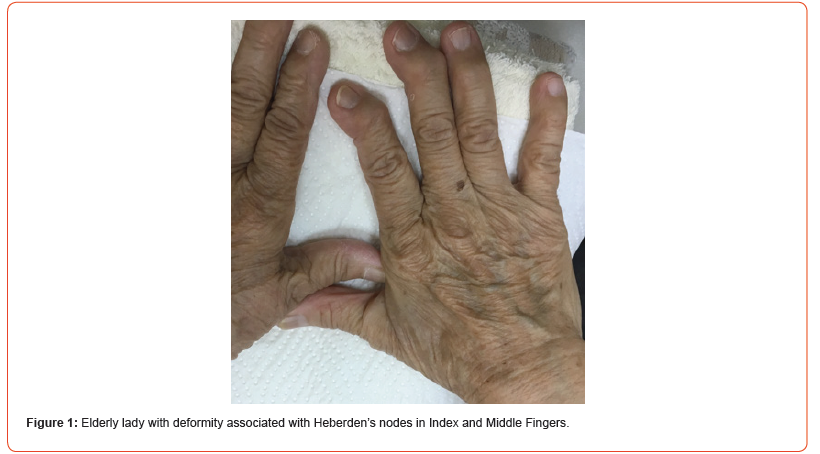
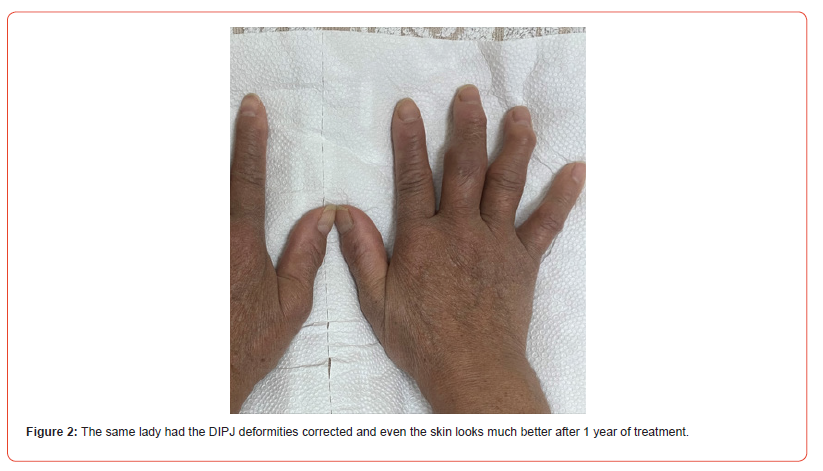
Recent studies by the author found that typical deformed malaligned Heberden’s nodes subjected under Low-level light therapy on a bi-monthly basis for over a year can re-align the deformed joint and decrease the nodules sizes as illustrated in Figures 1 and 2 without the use of medicine nor surgery.
But does this throw light on the pathogenesis of Heberden’s nodes?
The answer is affirmative. Recent ground breaking studies [1] showed the importance of ligaments in early hand OA by the use of high-resolution magnetic resonance imaging and histology examinations. The same applies to complex lower limb joints such as the knee [2] confirming the importance of intra-articular ligament degeneration with a key role to play in cartilage and bone destruction. The study on the use of LLLT improving joint deformity in hand OA throws supportive evidence that this is mediated via its anti-inflammatory and healing effects of the Ligaments and its Sites of Attachment of the distal interphalangeal joints of the hand. The figures attached showed illustrations that contrary to the popular belief that Heberden’s nodes represent simple OA and the subject should pose an interesting start for the scientific community to re-think the causation and treatment of malalignment in joints in middle to old age patients, a brief book written by the author can act as a start for the interested reader [3].
Acknowledgement
None.
Conflict of Interest
No conflict of interest
References
- Kuo HC, Yang KD, Chang WC, Ger LP, Hsieh KS (2012) Kawasaki Disease: An Update on Diagnosis and Treatment. Pediatr Neonatol 53(1): 4-11.
- Radosevich M, Burnouf T (2010) Intravenous immunoglobulin G: trends in production methods, quality control and quality assurance. Vox Sang 98(1): 12-28.
- Berg R, Shebl A, Kimber MC, Abraham M, Schreiber GB (2015) Hemolytic events associated with intravenous immune globulin therapy: a qualitative analysis of 263 cases reported to four manufacturers between 2003 and 2012. Transfusion 55(Suppl 2): S36-46.
- Luban NL, Wong EC, Henrich Lobo R, Pary P, Duke S (2015) Intravenous immunoglobulin-related hemolysis in patients treated for Kawasaki disease. Transfusion 55 (Suppl 2): S90-4.
- Berard R, Whittemore B, Scuccimarri R (2012) Hemolytic anemia following intravenous immunoglobulin therapy in patients treated for Kawasaki disease: a report of 4 cases. Pediatr Rheumatol Online J 10(1): 10.
-

This work is licensed under a Creative Commons Attribution-NonCommercial 4.0 International License.