




 Research Article
The Effects of Kinesio Tape on Throwing Accuracy and Velocity in Collegiate Softball Players
Received Date:April 09, 2024; Published Date:April 16, 2024
Abstract
The act of overhead throwing is a complex task that encompasses multidirectional movements with excessive physiological forces on many musculoskeletal units [1]. Success of any overhead throwing sport like softball, from a defensive standpoint comes from two main attributes of overhead throwing, velocity and accuracy. Kinesio tape has been reported to have multiple benefits related to athletic recovery and performance. Purpose: The aim of this study was to investigate the effects of Kinesio taping on throwing accuracy and velocity in collegiate softball players. Methods: Subjects (n=9) for this study were rostered NCAA DII softball players, each player was evaluated for throwing accuracy and velocity under both a Kinesio taped condition and a no-tape control condition. Results: Velocity and accuracy showed a non-statistically significant increase between conditions (velocity +.65m/s, accuracy +92.78 points). Conclusion: There was a trend in the data of improved throwing velocity and accuracy with Kinesio taping in DII softball players, although no statistical difference was found, practically even small increases in performance may have a profound effect on the outcome of a contest.
Keywords:Throwing Accuracy; Throwing Velocity; Softball Performance
Introduction
Overhead throwing is a multidirectional movement with excessive physiological forces and involves multiple joints in which success comes from a combination of velocity and accuracy. There are six phases of the overhead throwing sequence; wind-up, early cocking, late cocking, acceleration, deceleration and follow through [2]. During each of the phases of throwing, proper scapular movement is crucial for glenohumeral joint function and normal mechanics [3]. The four main roles of the scapula are to (1) move in conjunction with the humerus (scapulohumeral rhythm), (2) adapt to the required task my moving along the thoracic wall, (3) elevate the acromion process to allow movement of the rotator cuff, which helps prevent impingement and compression, and (4) link the transfer of energy from the body to the distal appendages [2]. Changes or alterations in scapular kinematics is known as “scapular dyskinesia” is mainly seen to be the cause of most shoulder injuries. This alteration in kinematics can be seen with the fatigue, impingement and instability that come with overuse and participation in overhead sports [2]. Improving scapular kinematics can be done in a variety of ways including sport specific practice, strength training, and through the use of external tactile cues like Kinesio tape. Kinesio tape is a light weight, water proof tape that is flexible and elastic; when applied to the skin it should provide continued muscular and joint support. This tape has been designed to both facilitate recovery from injury by increasing lymphatic drainage and reduce inflammation and from a sport performance perspective Kinesio tape provides support for muscle elasticity and joint stability [4]. Muller & Brandes [5], studied the effect of Kinesio tape on accuracy and velocity in amateur soccer and handball players. With the application of Kinesio tape the group of soccer players showed a significant increase in ball velocity and accuracy at shorter distances. When evaluating the handball players, throwing velocity also showed significant improvements, however accuracy decreased. The gain in ball velocity in amateur handball players may be at the expense of accuracy. Mulazimoglu O, Akif Afyon Y, Sayilir S, Salgin A [6], researched the effect of 4 weeks of training with Kinesio tape on accuracy in young archers. Similar to the task of throwing, archery has several distinct phases and similar musculature. The researchers found that the utilization of Kinesio tape along with practice significantly increased shooting accuracy. To date, there are mixed reviews on the benefits of Kinesio tape on sports performance variables, therefore further investigations need to be completed to look at the efficacy of using Kinesio tape with healthy athletes. The purpose of the current research was to investigate the effect of Kinesio tape on throwing accuracy and velocity in healthy NCAA DII softball players.
Methods
Nine NCAA Division II softball players (height 164.59 ± 5.79 cm, weight 69.1 ± 10.1 kg) participated in this study. Each subject reported no history of upper extremity injuries. The study was a randomized crossover design with 2 conditions, control (no tape) and experimental (Kinesio tape). In the Kinesio tape condition two strips of pre-cut tape were applied while the athlete stood and slightly retracted the shoulder blades. Reference points were marked at the acromioclavicular joint of the throwing arm, the inferior angle of the scapula, and then another in line with the previous two markers, just lateral to the spine, on the same side. The first strip of tape was anchored to the skin with no stretch at the reference point closest to the spine and then stretched at 25% and angled toward the reference point at the inferior angle of the scapula. The end of the tape was placed down with no stretch or tension, creating another anchor at the top of the strip. The second strip was anchored just above the first strip, and stretched to 50% and angled toward the reference point at the acromioclavicular joint. The end of the tape was placed following the same steps as the first, with no stretch. Following application of both strips, rubbing the tape creates friction which is what activates the adhesive of the tape. To ensure reliability, tape application was done by a NATA BOC certified Athletic Trainer with extensive experience in using Kinesio Tape.
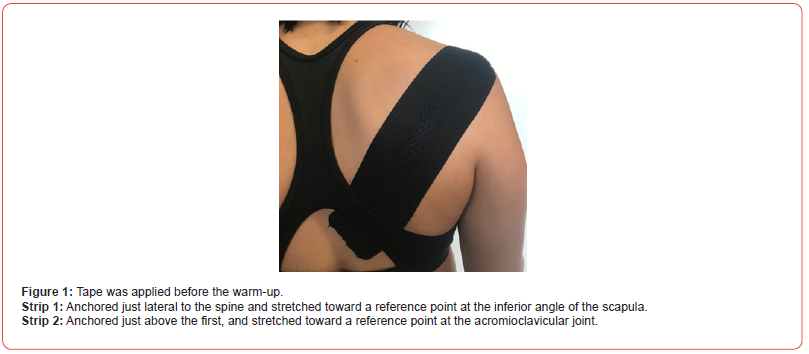
Each subject participated in a standardized dynamic warm-up after which they were randomly allocated to either the control or experimental group. Each subject was then asked to perform 3 sets of 5 overhead throws with 1 minute of recovery between each set. The throws were directed to a target consisting of 3 concentric numbered rings 6 meters away. Points were awarded as 25, 10, and 5 for the center, middle, and outside ring, with 0 points being awarded for missing the target. The only instructions given to the athletes were to throw has hard as possible while maintaining accuracy. Accuracy was based on the total accumulation of points on the target and velocity was measured with a radar gun (Bushnell Velocity Speed Gun, Model 101911). After a minimum of 48 hours of recovery subjects returned to the lab to participate in the opposite protocol. All data was analyzed using SPSS Version 21 statistical software.
Results
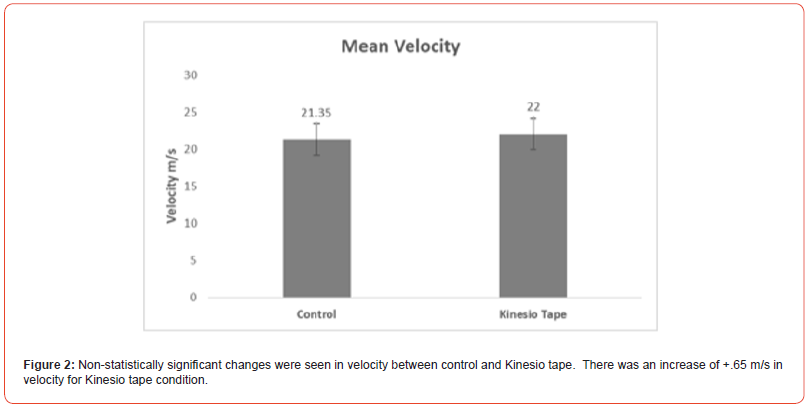
This study evaluated the effect of Kinesio tape on overhead throwing performance specifically looking at velocity and accuracy. For the variable of velocity, there was no statistically significant difference between the control and experimental groups (p=0.48). Descriptive analysis did show an increase in velocity when comparing the control and taped conditions, 21.35 ± 2.1m/s, 22.0 ± 1.69 m/s respectively.
Accuracy was measured using a static target, each subject’s total points for 15 throws were totaled to create a cumulative accuracy score. Results of this study demonstrated that Kinesio tape had no statistically significant impact on accuracy. Cumulative scores for the control condition was 81.11 ± 56.39, while the experimental group did perform better with a mean score of 173.89 ± 144.63. The exceptionally large standard deviations with the accuracy scores showed a great deal of variation within our 9 subjects.
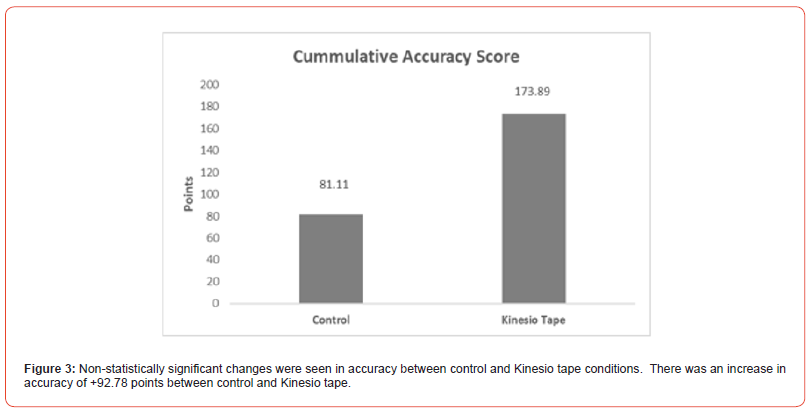
When analyzing the results from the current study, the addition of Kinesio Tape did not statistically change athletic performance in regards to throwing velocity or accuracy, however, when looking at each variable from a practical standpoint, the modest increases in throwing velocity and accuracy translate to real world increases in performance, increases in performance no matter how small, can impact the outcome of a competition.
Discussion
Overhead throwing is broken down into six phases; wind-up, early cocking, late cocking, acceleration, deceleration, and followthrough, each of these phases are effected by strong kinetic forces that impact overall performance and health of the athlete [1]. The scapula is the base for the upper extremity kinetic chain, scapular stability allows energy and force transfer from proximal to distal and transference of energy from the arm to the ball in overhead throwing sports. By introducing Kinesio tape to improve scapular stability, it was hypothesized that both throwing velocity and accuracy would be improved. The current research findings suggest that there is no significant effect of Kinesio tape on throwing velocity, these findings contrast the study conducted by Muller & Brandes, 2015 who reported that both kicking velocity in soccer players and throwing velocity in handball players improved with the use of Kinesio tape. The researchers also found that lower skill individuals benefited from Kinesio tape more than those with higher skill levels. However, more recent research conducted by Zerpa C, Harrison K, Sanzo P, Klarner T, [7], found similar results to the current study assessing throwing velocity in baseball players. When comparing a tape and no tape condition the authors found that muscle activation patterns and velocity did not change. Similarly, Harrison K, Zerpa, C, Sanzo P, [8], found no effect on throwing velocity in baseball players when using specific rotator cuff taping techniques, although there were changes in EMG muscle activity with tape. Clearly, there continues to be conflicting evidence when assessing the effect of Kinesio tape on throwing velocity. The interesting commonality between the above research is that the subjects have all been overhead throwing athletes that were free from upper extremity injury. Kinesio tape has been traditionally used as a treatment option for those suffering from injuries like scapular dyskinesia, it seems as though when using Kinesio tape with healthy individuals there is limited benefit relating to throwing velocity.
In addition to velocity, the second variable highly related to performance in overhead throwing is accuracy, the ability to get the ball to a specific target. The results of this study suggest that the use of Kinesio tape does not significantly improve throwing accuracy in healthy softball players. Our result agrees with research conducted by Muller & Brandes [6], that found gains in handball throwing velocity negatively impacted accuracy, the authors went on to conclude that handball players need to balance velocity and accuracy to maximize performance. The velocity-accuracy trade off was noted in the present study, all subjects were told to throw as hard as possible while still hitting the target, although these instructions seemed to take into account both velocity and accuracy it was quite clear during data collection that the velocity from the radar gun garnered more attention than the accuracy score. This attentional shift and allocation of thought geared more towards velocity may have impacted total scores as evidence by the large descriptive standard deviations.
Conclusion
Success of any overhead throwing sport, like softball, from a defensive standpoint comes from two main attributes, throwing velocity and accuracy. The purpose of this research was to assess the effectiveness of Kinesio tape on overhead throwing performance. NCAA DII softball players that were free form injury, possessed a high level of skill and had very proficient mechanics participated in this study. The results suggest that Kinesio tape has limited benefit with this group of athletes. Statistically, Kinesio tape had no effect on accuracy and velocity, however descriptively the data did trend towards small benefits in performance that could impact the outcome of a play. Future research may want to investigate the effect of Kinesio tape on athletes still developing their mechanics and need additional stability or those that are returning from injury.
Acknowledgements
None.
Conflict of Interest
The authors have no conflict of interest pertaining to this research.
References
- Neil, Bakshi, Freehold T Michael (2018) The Overhead Athletes Shoulder. Sports Medicine and Arthroscopy Review 26(3): 88-94.
- Forthomme B, Crielaard J, Croisier J (2008) Scapular Positioning in Athletes Shoulder. Sports Medicine 38(5): 369-383.
- Kristin M E, Saether E E, Soiney E K, Shebeck M S, Paddock K L, et al. (2008) Three-Dimensional Scapular Kinematics During the Throwing Motion. Journal of Applied Biomechanics 24(1): 24-34.
- About Us (n.d.) Retrieved from https://kinesiotaping.com/about/ Copyright 2016 Kinesio Holding Corporation.
- Muller C, Brandes M (2015) Effects of Kinesiotape Applications on Ball Velocity and Accuracy in Amateur Soccer and Handball. Journal of Human Kinetics 49: 119-129.
- Mulazimoglu O, Akif Afyon Y, Sayilir S, Salgin A (2018) The Effect of 4-Week Training with Shoulder Kinesio-Tape on Shooting Accuracy of Young Archers. International Journal of Sciences 4(6): 1-5.
- Zerpa C, Harrison K, Sanzo P, Klarner T (2021) The Effects of Taping on Muscle Activity and Throwing Velocity in Fatigued Baseball Players. International Journal of Extreme Automation and Connectivity in Healthcare 3(1): 18-29.
- Harrison K, Zerpa C, Sanzo P (2020) The Biomechanical Effects of Rotator Cuff Taping on Muscle Activation and Throwing Velocity in Baseball Players. International Society of Biomechanics in Sport Conference. Online Conference.
-

This work is licensed under a Creative Commons Attribution-NonCommercial 4.0 International License.




