



 Review Article
CD14+/16+ Monocytes as a Predictor of Chronic Pain Post Total Knee Arthroplasty
Received Date:March 18, 2024; Published Date:March 26, 2024
Introduction
Osteoarthritis is the most common form of arthritis in the world and the current curative treatment is total Knee Replacement (TKR) which is offered as final line therapy. However, the procedure is not curative for all patients as many patients experience chronic pain post surgery This is estimated to be between 10-50% of TKR patients [1]. Studies have shown that the proportion of patients experiencing post-operative pain lessens but remains changes over time but remains significant. The incidence of chronic pain occurs in up to 44% of patients at 3 months [2] and drops to 13.1% at 12 months [3]. When these patients’ knees were examined post- TKR, signs of inflammation, including erythema, swelling and warmth on palpation were evident. These findings prompted us to question the pro-inflammatory nature in this subgroup of patients.
Despite the cause of osteoarthritis being predominantly mechanical, there is underlying inflammation as part of the remodelling of the joint. It is known there is increased monocyte activation systemically before they are recruited into the synovium [4]. Analysis of synovial fluids of osteoarthritic knees demonstrates an elevated level of most monocyte associated chemokines and cytokines [5] and animal trials has shown depletion synovial macrophages causes significant reduction of osteophyte formation [6]. This underlying inflammatory change could potentially be the driver of the chronic pain post- TKR with chronic pain post- TKR pain being predominantly inflammatory in nature [7], but with nociceptive and neuropathic and neuropathic pains being recognized contributors [2].
Multiple studies in the past has attempted to characterise the population of individuals who are predisposed to chronic pain post TKR. Majority of these are patient factors such as presence of diabetes [8], female gender [9], lack of physical activity and genetic predisposition [10]. Surgeon factors such as perceived failure of prior surgery are thought to suggest a need for additional patient psychological preparation [11]. Increased levels of circulating IL- 1β, TNF-⍺, IL-6 and CCL4 (MIP-1β) have independently correlated with post TKR chronic pain [7]. Interestingly, these cytokines act in a sequential activation manner whereby TNF-⍺ drives expression of CCL4 by macrophage/ monocytes which stimulates further propagates the activation cascade of monocytes and serves as the primary source of serum IL-6 and IL-1β [12-14].
Monocytes are characterised by the ratio of their cell surface molecules. The human monocyte population is comprised of 3 subsets. The majority are considered to be “classical” CD14+/ CD16- monocytes but there are also lesser numbers of minority subsets, the “intermediate” CD14++/CD16+ monocytes and the “non- classical” CD14+/CD16++ monocytes. This “intermediate” population is known to be pro-inflammatory in a number of clinical situations [15]. Compared to classical monocytes, they also have a significant increased capacity to produce proinflammatory cytokines (TNF-⍺, IL-1 β, IL6) and a reduced capacity to produce anti-inflammatory cytokines (IL10) [16]. Given its proinflammatory nature, the CD14+/CD16+ monocyte population has been shown to be significantly elevated in a variety of inflammatory states. These include a number of autoimmune conditions such as rheumatoid arthritis [17], Kawasaki’s disease [18] and sarcoidosis [19] as well as infections [16].
In rheumatoid arthritis, objective measures of inflammation including, Disease Aactivity Score 28 DAS28and Ultrasound 7 (US7) were found to have significantly expanded CD14+/CD16+ monocyte population [17]. Biochemical measures of inflammation such as the acute phase reactant CRP was also noted to be positively correlated to CD14+/CD16+ monocyte population [18]. Monocyte numbers are also reduced significantly by immunosuppressive therapy such as glucocorticoids [20] and IVIg [21]. Interestingly, it has been noted that patients with complex regional pain syndrome (CRPS) were also found to have expanded CD14+/CD16+ monocyte population. However, there was no correlation between and pain severity, nor the identification of potential fibromyalgia patients in this subset [22].
Fibromyalgia is a condition of chronic non- inflammatory pain due to central sensory sensitization. Diagnosed fibromyalgia patients are known to be less satisfied with surgical results after TKR compared to non-fibromyalgia patients [23]. The ACR fibromyalgia survey score has been studied as a measure of the level of “subclinical fibromyalgia” and this. has been found to directly correlate with the amount of acute post- operative opioid consumption [24] as well as chronic pain at six months post- TKR [25]. Hence it can be inferred that the level of subclinical fibromyalgia directly correlates with non- inflammatory chronic pain post-TKR. To the authors knowledge, no previous literature have studied the nature application of the CD14+/CD16+ monocyte population in the context of predicting chronic pain post-TKR. In this proof-of-concept observational study, our objective is to assess verify the possibility of using the CD14+/CD16+ monocyte population as a predictor of chronic inflammatory pain post-TKR. As noted from above, it will be necessary to adjust for subclinical fibromyalgia given that it is a recognized major confounder of noninflammatory pain post- surgery.
Methods
Subjects
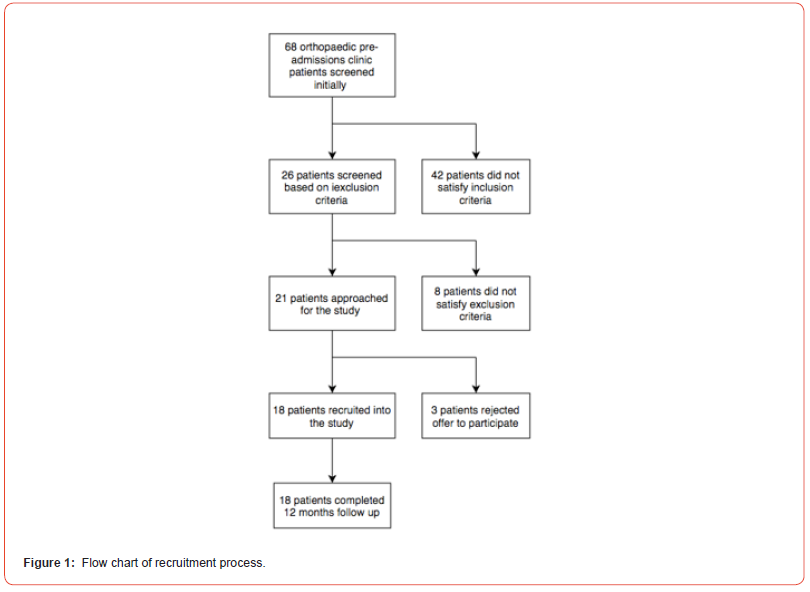
A total of 68 orthopaedic patients were screened who were due to be seen in the Orthopaedic Unit pre-admission clinics. 26patients satisfying both the inclusion and exclusion criteria were approached for the study. Three patients declined to participate with 18 patients being recruited Figure 1 outlines the flowchart or participant recruitment All patients as a minimum had a previous X- ray showing osteoarthritis in the kneeplanned for a unilateral TKR. The exclusion criteria focused on conditions and concurrent treatment which may alter pain perception and baseline body inflammation, including current diagnosis of inflammatory or autoimmune disease, other pain syndromes, active malignancy and immunosuppressive medication. We did not selectively recruit patients from a particular demographic background. There was no financial incentive or compensation for patients to participate in the study. Patients were offered referral to Rheumatology Out patient’s clinic if pain persisted at 12 months post-TKR (Figure 1).
Experimental Design
This is a prospective observational study. Participants are followed up for a minimum of three months to satisfy the diagnosis of chronic pain i.e.to confirm the pain is persistent. A 100- point numerical pain score the ACR fibromyalgia survey (Widespread Pain Index and Symptom Severity Score) and Chronic Pain Grade Scale (CPGS) were completed at the time of recruitment to assess both baseline function and current pain. As per the grading of CPGS, 100point chronic pain and disability scores were derived from the collected CPGS data. Blood samples were taken on the same day for CRP and monocyte population analysis. Patients then awaited for their surgery dates based on their urgency category, the majority of the patients recruited being category two or three The pain level measured by 100- point numerical scale was also obtained at day one of surgery. Numerical pain scores and CPGS were again recorded through phone call at 12 months post-surgery. Individual follow-upis completed at the conclusion with a phone call at 12 months post- TKR.
The study protocol was approved by the local ethics committee.
CD14+/16+ Monocyte Population
3ml of fresh blood sample was collected per participant on the day of enrolment into the study and shared evenly between heparin and EDTA tubes. Samples were transferred to the Immunology Laboratory within four hours of blood testbeing taken. If the testing occurred on a Friday, blood sample was frozen to be analysed on the following Monday. CD14+/16+ monocyte population were measured using flow cytometry and results were represented as the percentage of CD14+ monocytes which also expressed the CD16+ marker. No further blood tests were conducted for the purpose of the study.
Statistician Methods
Data was analysed using RStudio version 1.1.442. Welch’s T test was conducted to measure the significance of pain and disability change between pre-and three months post- TKR. Pearson’s correlation coefficients were computed for various variables within the study and linear regression models were also created. Likelihood ratios were utilised to compare the significance of linear regression models. All plots were also generated using RStudio. A p value of less than 0.05 was considered significant.
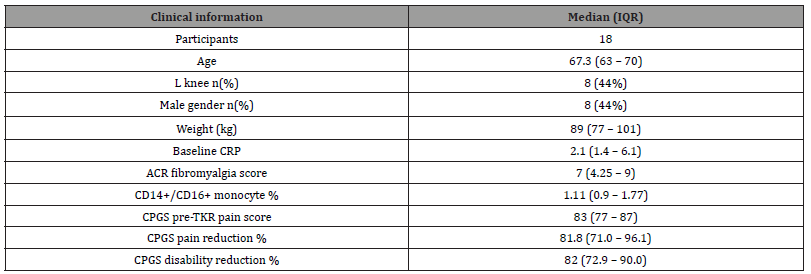
A total of 18 patients (10 females, 8 males) have been recruited into the study,8 patients for left and 10 for right TKR The median age of the participants was 67.3 (IQR 63 - 70). At the time of writing, only 8 participants (44% of the study population) have completed the 3 months post-TKR follow up and therefore could have their chronic pain scores measured.
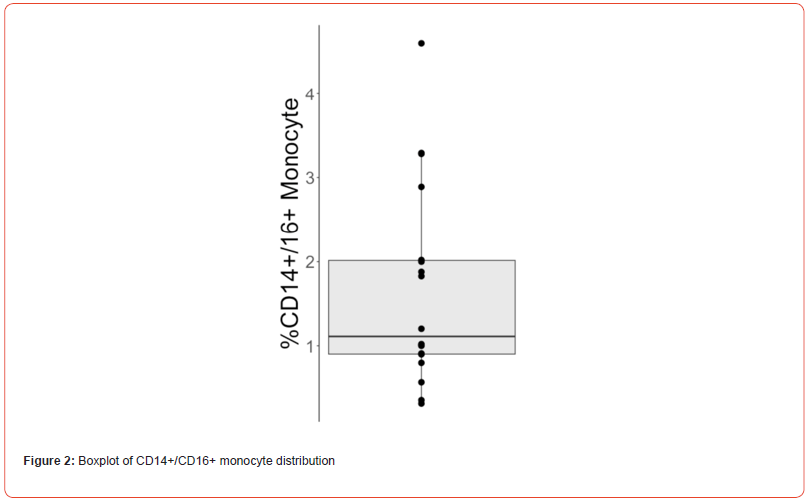
Participants’ median pre- TKR CPGS pain score was 83 (IQR 77- 83) and median pre- TKR CPGS disability score was 67 (IQR 67-82). The median percentage of CD14+/ CD16+ monocytes in peripheral blood of the participants was 1.11% (IQR 0.9-1.77) and the median pre-TKR CRP was 2.1 (IQR 1.4-6.1). The median ACR Fibromyalgia Survey score was 7 (IQR 4.25-9).
Table 1:Basic Participant Information.
We computed Pearson’s correlation coefficients using participants’ baseline pre- TKR CPGS scores and other variables. There was a strong significant positive correlation between the pain and disability scores (r = 0.73, p < 0.001). A weakly positive and insignificant correlation was found between fibromyalgia scores and both pre- TKR chronic pain (p = 0.21) and disability scores (p = 0.34). A weak negative and insignificant correlation was found between CRP and pre- TKR chronic pain but a significant correlation coefficient of -0.53 was demonstrated between CRP and pre- TKR disability score (p < 0.05). No significant correlation coefficients were found between fibromyalgia scores and both chronic pain and disability scores (Figure 2).
Paired test was carried out to measure the difference of means for both CPGS pain and disability scores between pre-and 12 months post- TKR. There was a statistically significant reduction in chronic pain score, with a mean reduction of 66.6 points measured using the CPGS (p < 0.001). CPGS disability score was also noted to be significantly reduced by 56.3 points at 12 months post- TKR (p < 0.001).
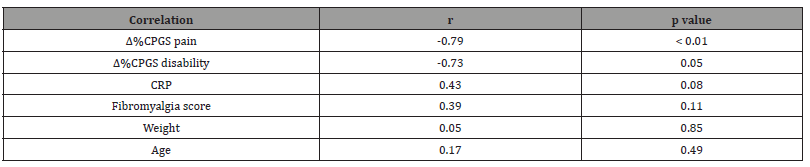
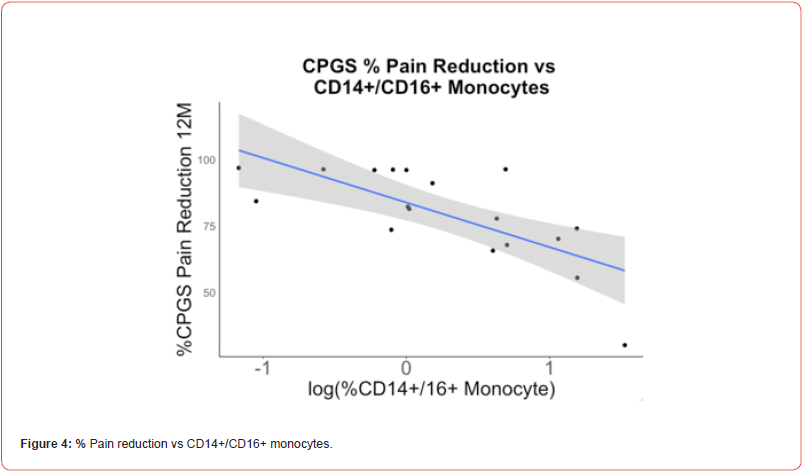
Percentage reduction in chronic pain and disability scores at 12 months post- TKR was used to compute Pearson’s correlation coefficients. CD14+/CD16+ monocyte population was found to be strongly correlated with both percentage chronic pain and disability reduction, correlation coefficient was -0.79 (p < 0.01) and -0.46 (p = 0.05), respectively. Baseline fibromyalgia score also correlated with a reduced chronic pain improvement (r = -0.52, p < 0.05) and trend towards disability improvement (r = -0.4, p = 0.09). Baseline CRP correlates with a lack of CPGS pain (r = -0.53, p = 0.03). and disability reduction (r = -0.49, p < 0.01) at 12 months.
Table 2:Correlation to CD14+/16+ monocyte population.
Linear regression models were created to predict the pain reduction at 12 months post TKR. The base model predicts pain reduction from log transformed CD14+/16+ monocyte population and pre TKR CPGS pain scores to adjust for bias in the form of regression to the mean. Base model shows that on average, at 12 months post TKR, each patient should experience a baseline CPGSpain reduction of 91.9% (p < 0.05), however, for every 10-fold increase in CD14+/16+ monocytes, there is a 17% less reduction in pain at 12 months (p < 0.05). On the basis of the base model, we attempted to adjust for subclinical fibromyalgia by the inclusion of the sum of Widespread Pain Index and Symptom Severity Score as an independent variable into the linear regression. The adjusted model shows a baseline CPGS reduction of 82.8% at 12 months (p < 0.05) and for every 10-fold increase in the CD14+/16+ monocytes, there is a 14.7% less reduction in CPGS reduction (p < 0.05) (Figure 3). Each point increase in the fibromyalgia score also reduces pain reduction by 1.3%. Statistical significant is maintained for CD14+/16+ monocytes despite the addition of our major confounder into the regression model (Table 2).

Discussion
CD14+/16+ monocyte population has been well characterised in the inflammatory and autoimmune diseases, however their impact in osteoarthritis have not. This minority monocyte population may become a biomarker in identifying those with predisposition for a pro-inflammatory immune system. To our surprise, CD14+/CD16+ monocyte did not have a positive correlation with baseline CRP which has been demonstrated widely in previous studies [17, 18]. However, a trend towards correlation was demonstrated (p = 0.08) and given the selection of patients lacking baseline inflammation, a narrow distribution of CRP was present. It is conceivable that CD14+/16+ monocytes are predisposed to an exaggerated inflammatory response once stimulated compared to classical monocytes but are not constitutively activated at baseline. Given the similar baseline CPGS pain scores, despite widely distributed monocytes they are unlikely to contribute directly to osteoarthritic pain in native joints.
There was a wide range of distribution of CD14+/16+ monocyte population within our cohort and previous studies has shown this population can be up to 10-fold of health controls in those with inflammatory disorder [17]. To date, no reference ranges exist for the CD14+/16+ monocyte population and variations exist in its reporting format – as percentage of total CD14+ expressing monocyte or as cells/ml. While we did not have the BMI of the patients, patient weight and age did not correlate with the monocyte population size. This study could be further perfected by the isolation of “intermediate” (CD14++/16+) which are known to be the most inflammatory subtype.
Our study is the first to evaluate CD14+/CD16+ monocytes in post-TKR for osteoarthritis patients. A consistently negative correlation between CD14+/CD16+ monocyte population and percentage of chronic pain reduction at 12 months post- TKR was found in our study despite addition of subclinical fibromyalgia as a confounder. Subclinical fibromyalgia is confirmed to further decrease pain reduction, however its lack of correlation with CD14+/16+ monocytes allude that they likely act on unrelated pathways. Despite the small range in baseline CRP, a significant correlation with pain improvement was demonstrated, denoting that an inflammatory component exists in chronic pain post TKR. Given the predisposition CD14+/16+ monocytes to produce pro-inflammatory cytokines [16], we would suggest that an inflammatory pain component is present in those suffering from chronic pain post TKR, likely triggered by the surgical insult to tissue and involves these monocytes.
Chronic pain post TKR may be linked with cytokine expression of CD14+/16+ monocytes post-surgical insult to the tissue. Both TNF-⍺ and IL-1 are cytokines overexpressed by the monocyte population and are involved within the post-operative pain pathways. Use of TNF-⍺ antagonist can improve function and tissue injury related neuropathic pain [26]. IL-1 signalling is also critical in allodynia and hyperalgesia which could be prevented by administration of IL-1 antagonist [27].
We are aware that there are potential confounders for this study that we have not accounted for in our exclusion criteria, majority of which are associated with changes in CD14+/CD16+ monocytes numbers. Past literature has described potential correlation between elevation in CD14+/CD16+ monocyte population with exercise [28] but the level of activity prior to attending clinic and blood test was unable to be documented and can be varied. Poor cardiovascular health [29] and peripheral vascular disease [29, 30] are both known causes of chronically elevated CD14+/CD16+ monocyte population, although no participants had a known history of ischaemic heart disease. To our knowledge, no previous study has examined the predictive ability of CD14+/CD16+ monocytes for post- TKR chronic pain. Our results demonstrates the potential for CD14+/16+ monocyte population to act as a biomarker in predicting chronic pain post TKR. Further prospective studies are needed to verify the potential for clinical application of CD14+/ CD16+ monocytes as a screening test to identify patients who are likely to suffer chronic pain post TKR.
Conclusion
In conclusion, we do not yet fully understand the roles of CD14+/CD16+ monocytes in inflammation, but it is clear that they are intricately related to it and potentially contribute to inflammatory pain. A strongly negative correlation is observed between CD14+/CD16+ monocyte population and percentage of pain and disability reduction at three months post- TKR. However, the contribution of subclinical fibromyalgia is unclear from our study. A larger and adequately powered study which samples more independent variables is needed to determine the utility of this monocyte population. A larger regression model containing more independent variables will assist in the pre-operative identification of patients who are likely to suffer from chronic pain post-TKR.
Acknowledgement
None.
Conflict of Interest
No conflict of Interest.
References
- Wylde V, Dennis J, Beswick AD, Bruce J, Eccleston C, et al. (2017) Systematic review of management of chronic pain after surgery. Br J Surg 104(10): 1293-1306.
- Vikki Wylde, Sarah Hewlett, Ian D Learmonth, Paul Dieppe (2011) Persistent pain after joint replacement: prevalence, sensory qualities, and postoperative determinants. Pain 152(3): 566-572.
- Victoria A Brander, S David Stulberg, Angela D Adams, R Norman Harden, Stephen Bruehl, et al. (2003) Predicting total knee replacement pain: a prospective, observational study. Clin Orthop Relat Res (416): 27-36.
- Loukov D, Karampatos S, Maly MR, Bowdish DME (2018) Monocyte activation is elevated in women with knee-osteoarthritis and associated with inflammation, BMI and pain. Osteoarthritis Cartilage 26(2): 255-263.
- Sohn DH, Sokolove J, Sharpe O, Erhart JC, Chandra PE, et al. (2012) Plasma proteins present in osteoarthritic synovial fluid can stimulate cytokine production via Toll-like receptor 4. Arthritis Res Ther 14(1): R7.
- van Lent PL, Blom AB, van der Kraan P, Holthuysen AE, Vitters E, et al. (2004) Crucial role of synovial lining macrophages in the promotion of transforming growth factor beta-mediated osteophyte formation. Arthritis Rheum 50(1): 103-111.
- Rajiv Gandhi, David Santone, Mark Takahashi, Omar Dessouki, Nizar N Mahomed (2013) Inflammatory predictors of ongoing pain 2 years following knee replacement surgery. Knee 20(5): 316-318.
- Rajamaki TJ, Jamsen E, Puolakka PA, Nevalainen PI, Moilanen T (2015) Diabetes is associated with persistent pain after hip and knee replacement. Acta Orthop 86(5): 586-593.
- Spencer S Liu, Asokumar Buvanendran, James P Rathmell, Mona Sawhney, James J Bae, et al. (2012) A cross-sectional survey on prevalence and risk factors for persistent postsurgical pain 1 year after total hip and knee replacement. Reg Anesth Pain Med 37(4): 415-422.
- Josephine Thomazeau, Alexandra Rouquette, Valeria Martinez, Christophe Rabuel, Natalie Prince, et al. (2016) Predictive Factors of Chronic Post-Surgical Pain at 6 Months Following Knee Replacement: Influence of Postoperative Pain Trajectory and Genetics. Pain Physician 19(5): E729-E741.
- Alison E Jeffery, Vikki Wylde, Ashley W Blom, Jeremy P Horwood (2011) "It's there and I'm stuck with it": patients' experiences of chronic pain following total knee replacement surgery. Arthritis Care Res (Hoboken) 63(2): 286-292.
- Rasheed Ahmad, Shihab Kochumon, Betty Chandy, Steve Shenouda, Merin Koshy, et al. (2019) TNF-alpha Drives the CCL4 Expression in Human Monocytic Cells: Involvement of the SAPK/JNK and NF-kappaB Signaling Pathways. Cell Physiol Biochem 52(4): 908-921.
- Bystry RS, Aluvihare V, Welch KA, Kallikourdis M, Betz AG (2001) B cells and professional APCs recruit regulatory T cells via CCL4. Nat Immunol 2(12): 1126-1132.
- Guillermo Arango Duque, Albert Descoteaux (2014) Macrophage cytokines: involvement in immunity and infectious diseases. Front Immunol 5: 491.
- Ziegler Heitbrock HW, Strobel M, Fingerle G, Schlunck T, Pforte A, et al. (1991) Small (CD14+/CD16+) monocytes and regular monocytes in human blood. Pathobiology 59(3): 127-130.
- Ziegler Heitbrock HW (1996) Heterogeneity of human blood monocytes: the CD14+ CD16+ subpopulation. Immunol Today 17(9): 424-428.
- Angela Amoruso, Daniele Sola, Luca Rossi, Joyce Afrakoma Obeng, Luigia Grazia Fresu, et al. (2016) Relation among anti-rheumatic drug therapy, CD14(+) CD16(+) blood monocytes and disease activity markers (DAS28 and US7 scores) in rheumatoid arthritis: A pilot study. Pharmacol Res 107: 308-314.
- Katayama K, Matsubara T, Fujiwara M, Koga M, Furukawa S (2000) CD14+CD16+ monocyte subpopulation in Kawasaki disease. Clin Exp Immunol 121(3): 566-570.
- Hiroyuki Okamoto, Kana Mizuno, Takeshi Horio (2003) Circulating CD14+ CD16+ monocytes are expanded in sarcoidosis patients. J Dermatol 30(7): 503-509.
- Fingerle-Rowson G, Angstwurm M, Andreesen R, Ziegler-Heitbrock HW (1998) Selective depletion of CD14+ CD16+ monocytes by glucocorticoid therapy. Clin Exp Immunol 112(3): 501-506.
- Maciej Siedlar, Magdalena Strach, Karolina Bukowska-Strakova, Marzena Lenart, Anna Szaflarska, et al. (2011) Preparations of intravenous immunoglobulins diminish the number and proinflammatory response of CD14+CD16++ monocytes in common variable immunodeficiency (CVID) patients. Clin Immunol 139(2): 122-132.
- Ritz BW, Alexander GM, Nogusa S, Perreault MJ, Peterlin BL, et al. (2011) Elevated blood levels of inflammatory monocytes (CD14+ CD16+) in patients with complex regional pain syndrome. Clin Exp Immunol 164(1): 108-117.
- Del Gaizo DJ (2013) Total hip or knee replacement in patients with chronic pain. N C Med J 74(3): 218-220.
- Chad M Brummett, Allison M Janda, Christa M Schueller, Alex Tsodikov, Michelle Morris, et al. (2013) Survey criteria for fibromyalgia independently predict increased postoperative opioid consumption after lower-extremity joint arthroplasty: a prospective, observational cohort study. Anesthesiology 119(6): 1434-1443.
- Chad M Brummett, Andrew G Urquhart, Afton L Hassett, Alex Tsodikov, Brian R Hallstrom, et al. (2015) Characteristics of fibromyalgia independently predict poorer long-term analgesic outcomes following total knee and hip arthroplasty. Arthritis Rheumatol 67(5): 1386-1394.
- Iwatsuki K, Arai T, Ota H, Kato S, Natsume T, et al. (2013) Targeting anti-inflammatory treatment can ameliorate injury-induced neuropathic pain. PLoS One 8(2): e57721.
- Gilly Wolf, Dina Livshits, Benzion Beilin, Raz Yirmiya, Yehuda Shavit (2008) Interleukin-1 signaling is required for induction and maintenance of postoperative incisional pain: genetic and pharmacological studies in mice. Brain Behav Immun 22(7): 1072-1077.
- Steppich B, Dayyani F, Gruber R, Lorenz R, Mack M, et al. (2000) Selective mobilization of CD14(+) CD16(+) monocytes by exercise. Am J Physiol Cell Physiol 279(3): C578-C586.
- Urbanski K, Ludew D, Filip G, Filip M, Sagan A, et al. (2017) CD14(+)CD16(++) "nonclassical" monocytes are associated with endothelial dysfunction in patients with coronary artery disease. Thromb Haemost 117(5): 971-980.
- Moritz Wildgruber, Teresa Aschenbrenner, Heiko Wendorff, Maria Czubba, Almut Glinzeret al. (2016) The "Intermediate" CD14(++) CD16(+) monocyte subset increases in severe peripheral artery disease in humans. Sci Rep 6: 39483.
-

This work is licensed under a Creative Commons Attribution-NonCommercial 4.0 International License.




