

 Research Article
Retrospective Evaluation of Surgical Site Infections for Liver Transplant Recipients Receiving Rabbit Antithymocyte Globulin Induction
1Clinical Pharmacy Specialist Methodist University Hospital Memphis, TN 38104
2Oncology Pharmacist Gritman Medical Center Moscow ID 83843
3Diabetes Medical Liaison Novo Nordisk Cabot, AR 72023
4Clinical Pharmacy Specialist Methodist University Hospital, TN 38104 and Assistant Professor, Department of Clinical Pharmacy and Translational Science University of Tennessee Health Science Center College of Pharmacy, Memphis, TN 38163
5Adjunct Assistant Professor, University at Buffalo School of Pharmacy and Pharmaceutical Sciences, Buffalo, NY 14214
6Associate Professor, Department of Clinical Pharmacy and Translational Science, University of Tennessee Health Science Center College of Pharmacy, Memphis, TN
Received Date:September 29, 2025; Published Date:Decemer 01, 2025
Abstract
Background:The development of a surgical site infection (SSI) after liver transplantation (LT) has been associated with adverse outcomes.
The purpose of this study was to evaluate the incidence of SSI after LT for recipients receiving rabbit antithymocyte induction (RATG), along with
its clinical impact.
Methods:A retrospective review of patients receiving an orthotopic liver transplant (OLT) with RATG induction was conducted. Patients with SSI
were compared to those without SSI to identify intraoperative and postoperative events after liver transplantation. Culture and susceptibility results
for isolated pathogens were collected. Post-transplant outcomes were evaluated including hospital length of stay (LOS), number of readmissions
during the study period, one-year graft loss, and mortality.
Results:Of the 200 patients included, 23 were in the SSI group. The evaluation of demographics showed that an increased incidence of
retransplantation, higher MELD score, and younger age were significant differences identified between groups. The 23 SSI events (11.5%) included
19 organ/space, 2 deep, and 2 superficial infections. Significant intraoperative and postoperative events identified for SSI included an increased
operative duration, requiring an exploratory laparotomy, and drain placement post-transplant. There were 34 isolated pathogens including 18 (53%)
gram-positive cocci, 11 (32%) gram-negative bacilli, and (5) 15% Candida spp. Compared to the no SSI group, patients with SSI had a significantly
longer LOS (p<0.001), as well as higher graft loss (p<0.001) and mortality (p=0.001). However, there was no significant difference in the number of
hospital readmissions.
Conclusions:Except for acute rejection, results from the utilization of RATG induction in LT recipients emanated similar incidence and posttransplant
events for SSIs as cited in previous literature. Future studies are needed to validate risk stratification and create quality improvement
measures to prevent SSI in LT recipients.
Keywords:Surgical Site Infection; Liver Transplantation; Rabbit Antithymocyte Globulin
Introduction
Surgical site infections (SSI) are one of the most frequently reported healthcare-associated infections. In addition to increased healthcare costs, SSIs are associated with higher patient morbidity and mortality in the general population [1-4]. Liver transplant (LT) recipients are susceptible to SSI due to surgical complexity and manipulation of the hepatobiliary system [5, 6]. For prevention, evidence-based guidelines recommend routine use of perioperative antimicrobial prophylaxis [7]. After LT, the risk of various infections changes over time and correlates with the net state of immunosuppression [5, 8]. The reported SSI incidence ranges from 10% to 40% with the highest risk within the first month after LT [9-16]. In addition, SSIs have been associated with a significant increase in graft loss and death at one-year post-transplant, as well as healthcare costs [11, 17].
While pre-transplant risk factors should be considered, evidence suggests that intraoperative and post-transplant events may be more closely related to the development of SSI [16]. Previous studies have identified crucial risk factors for SSI including: retransplantation, increased operative time, higher blood transfusion volumes, longer cold ischemia time, cytomegalovirus (CMV) infection, renal replacement therapy (RRT), muromonab-CD3 administration within 7 days of LT, and recent antibiotic therapy [10-20]. Surgeon-specific practice was shown to affect the incidence of SSIs, highlighting the importance of surgical technique [21]. The biliary tract is a frequent infection source, particularly in patients requiring choledochojejunostomy (RY) biliary reconstruction [15-20].
Early postoperative infections are attributed primarily to bacterial pathogens with isolated organisms including Staphylococcus aureus, coagulase negative staphylococci, Streptococcus, Enterococcus, and gram-negative bacilli [5, 9]. Fungal infections also contribute to SSI with Candida species most commonly identified. The prevalence of SSIs due to multi-drug resistant (MDR) bacteria continues to rise [10, 14, 16, 22]. It is currently unclear how this potential shift will influence clinical outcomes. Given the substantial impact of SSIs, we evaluated the incidence, risk factors, pathogens, and clinical outcomes in LT recipients receiving rabbit antithymocyte globulin (RATG).
Methods
A retrospective study of orthotopic liver transplant (OLT) recipients receiving RATG induction between January 2008 and December 2013 was conducted. These patients were identified from the Methodist University Hospital Transplant Institute database. All data were collected through a review of patient electronic medical records and TeleResults®. Patients at least 18 years of age who received a liver or simultaneous liver-kidney transplant were included. Reasons for exclusion were death within 72 hours of OLT and insufficient follow-up data within one year after transplantation.
Laboratory data from the date of transplant were collected to calculate a Model for End-Stage Liver Disease (MELD) score [23]. Baseline patient characteristics were documented including: liver disease etiology, diabetes mellitus, body mass index ≥30, CMV risk status, spontaneous bacterial peritonitis (SBP) within 14 days, other preoperative infections within 7 days, and antimicrobial therapy within 30 days. History of prior LT and/or abdominal surgery was noted. Perioperative variables including cold ischemia time, surgery duration, and blood product transfusion were collected. Post-transplant non-SSI infection and rejection events within 60 days were recorded.
During the study period, our standard antimicrobial prophylaxis regimen was intravenous ampicillin-sulbactam 3 g, followed by 1.5 g every 6 hours for 48 hours. Patients with a penicillin allergy were prescribed intravenous clindamycin 600 mg and aztreonam 2 g, followed by clindamycin 600 mg and aztreonam 1 g every 8 hours for 48 hours. The initial antibiotic dose in both cases was to be administered within one hour of the incision time. Protocol induction therapy included methylprednisolone 500 mg and two doses of RATG (1.5 mg/kg/dose) administered intraoperatively and on postoperative day 2. Postoperatively, patients received a steroidfree maintenance regimen. Our initial standard therapy consisted of mycophenolate mofetil 1 g twice daily and tacrolimus, everolimus, or sirolimus with a goal trough concentration of 6-8 ng/mL. Tacrolimus was the standard maintenance immunosuppressant utilized whereas everolimus and sirolimus were reserved for LT recipients with hepatocellular carcinoma and renal dysfunction, respectively. Valganciclovir 450 mg daily (adjusted for renal function) was prescribed for cytomegalovirus prophylaxis. Sulfamethoxazole-trimethoprim 400-80 mg daily (adjusted for renal function) was prescribed for pneumocystis pneumonia prophylaxis. Nystatin 500,000 four times daily was prescribed for fungal prophylaxis. Prophylaxis was continued for a duration of 6 months post-transplant.
For each patient, the electronic medical record was reviewed for documentation of SSI within 60 days of transplant. Interventions including exploratory laparotomy and procedures (biliary drain and/or stent placement) were noted. SSI events were classified according to the Centers for Disease Control and Prevention surveillance definitions [1]. For patients with more than one SSI, data was recorded for the most severe infection (organ or space>deep incisional> superficial incisional). Culture and susceptibility results were obtained from the initial SSI culture and repeat surgical cultures within 30 days as available. We defined MDR bacteria to include methicillin-resistant Staphylococcus aureus (MRSA) or S. epidermidis (MRSE), vancomycin- resistant Enterococci (VRE), extended spectrum beta-lactamase (ESBL)- producing Enterobacteriaceae, and carbapenem resistant Enterobacteriaceae. Postoperative hospital length of stay (LOS), number of readmissions during the study period (60 days), and graft loss and mortality at one-year post-transplant were compared between the SSI and no SSI patients. Graft loss as documented from center data was defined as the need for liver re-transplantation or death. All data collected were entered into an Access database (Microsoft, Seattle, WA). Categorical variables were compared using Chi-square or Fisher’s exact test. Continuous data were evaluated using the student’s t-test or Mann-Whitney U test as appropriate. A p-value <0.05 was determined to represent statistical significance. Statistical analyses were conducted using SPSS software (IBM Corp. Released 2012. Version 21.0. Armonk, NY). This study protocol was approved by the University of Tennessee Health Science Center Institutional Review Board. Confidentiality of all sensitive patient information was maintained.
Results
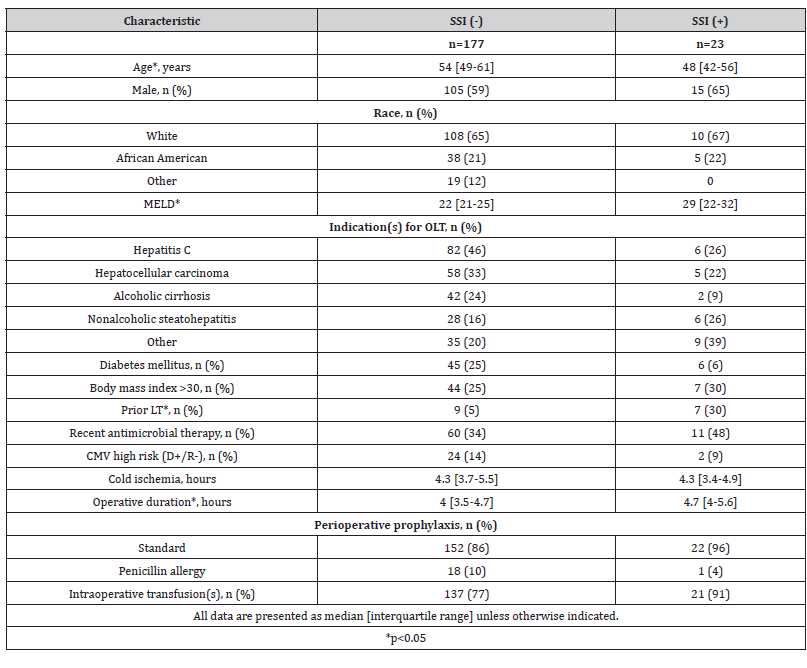
A total of 729 patients with an OLT performed during the study period were identified from transplant registry data (Figure 1). After exclusion of 18 patients, a random number generator was used to select 200 patients from the list for study inclusion. Patient demographics, pre- transplant, and perioperative characteristics are shown in Table 1. The overall population was predominantly male (60%) and white (67%) with hepatitis C (44%) as the most common indication for LT. Only about 4.5% of patients in each group received a simultaneous liver- kidney transplant (SSI-; n=8 vs. SSI+; n=1). For the primary objective, SSI was identified in 23 (11.5%) OLT patients. Of these SSI events, 19 were classified as organ or space, 2 as deep incisional, and 2 as superficial. The time of occurrence was often within 3 weeks after surgery (mean 13.3 ± 11.5 days). Only two patients were diagnosed with SSI at 31- and 56-days post-transplant. Compared to patients with no SSI, patients who developed SSI were significantly younger (p=0.006), with a higher MELD score (p=0.011), and a history of prior LT (p=0.001). Surgical risk factors for SSI included longer operative time (p=0.007) and RY biliary reconstruction (p=0.009). The choice of perioperative antimicrobial agent(s) was comparable with the majority of patients in each group receiving standard prophylaxis. All antibiotic doses were administered within one hour of incision. There was no significant difference in backbench or attending surgeons between the two groups.

Table 1: Demographic, pre-transplant, and perioperative patient characteristics.
Thirty-four organisms were recovered from 15 of 19 available SSI cultures as shown in Table 2. Of the 15 positive cultures, 6 (40%) were polymicrobial. Pathogens recovered included: 53% gram-positive cocci, 32% gram-negative bacilli, and 15% Candida spp. The most frequently isolated pathogens were Enterococcus spp. with VRE predominant in the E. faecium strain. Other observed MDR bacteria were MRSE, MRSA, carbapenem-resistant P. aeruginosa and E. coli, and ESBL-producing K. pneumoniae. For antimicrobial therapy, commonly prescribed agents were carbapenems (n=15), vancomycin (n=11), piperacillin-tazobactam (n=9), daptomycin (n=9), and linezolid (n=6). Echinocandins (n=16) were the most commonly prescribed antifungal. The median treatment duration was 20 days and included 7 patients with organ or space SSI treated for at least 30 days.
Table 2:Pathogens recovered from deep and organ/space surgical site infections after liver transplantation.

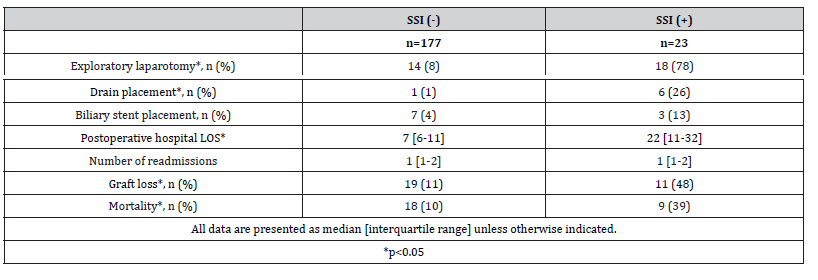
Post-transplant interventions within 60 days and clinical outcomes are shown in Table 3. Compared to patients without SSI, a significant number of individuals in the SSI group required exploratory laparotomy (p<0.001) and/or drain placement (p<0.001). Although the number of readmissions was similar, patients with SSI had a significantly longer postoperative hospital LOS (p<0.001). At one-year post-transplant, the incidence of graft loss (p<0.001) and mortality (p=0.001) were significantly higher in the SSI group. However, none of the patients with only superficial or deep-incisional SSI episodes experienced either graft loss or mortality.
Table 3:Pathogens recovered from deep and organ/space surgical site infections after liver transplantation.
Discussion
In the present study, SSI occurred in 11.5% of OLT patients compared to only 2% to 5% in the general surgical population [3]. However, this observed incidence is relatively low in comparison to prior studies in LT patients [9]. Furthermore, this was noted, despite our study population receiving RATG induction which further suppresses the immune response and may increase the likelihood of infection. To date, RATG induction has not been reported as a risk factor for SSI in LT unlike muromonab-CD3 administration within 7 days of LT [11, 24].
Variability in the reported rate of SSI may be largely due to differences in case definitions for identification, particularly in the timing of infection onset. One previous study with an SSI rate of nearly 38% included episodes up to one year after transplant [11]. Other similar studies that also used standard SSI criteria reported an incidence ranging from 10% to 24% [12, 15-17, 20, 21]. The majority of SSI episodes in our study occurred within the first few weeks after transplant. This early onset is consistent with prior data, as well as, the guidelines and may be associated with bacterial contamination during the surgery [12-14, 16, 19, 20, 24].
Demographic, intraoperative, and postoperative factors for SSI in our study that were previously identified in the literature include: higher MELD score, history of prior LT, longer operative time, need for an exploratory laparotomy, and drain placement posttransplant [11-13, 15-21]. In contrast to the guidelines, a longer operative time referred to > 8 hours whereas in our study operative times were noted as < 6 hours [24]. The majority of SSI episodes were caused by gram- positive cocci with Enterococcus as the most frequent pathogen. Our standard antimicrobial prophylaxis regimen, ampicillin-sulbactam provides coverage for Enterococcus and is considered a preferred alternative per guidelines [24]. In addition, re-dosing of every 2 hours for ampicillin- sulbactam is recommended per guidelines. Unfortunately, re-dosing administration was not collected, so we are not able to ascertain if this was a contributing factor to development of SSI. Our antimicrobial prophylaxis regimen, clindamycin and aztreonam, for penicillin-allergic patients provides no coverage for this organism and is not a preferred antibiotic selection per the guidelines [24]. However, there was no significant difference noted in the rate of SSI in this subset. The most prevalent MDR bacteria identified was VRE, which may warrant VRE-active agents.
Notably, both linezolid and daptomycin have formulary restrictions at our institution. However, implementing the utilization of VRE-active agents for prophylaxis is challenging because this could also result in the emergence of additional MDR bacteria [25]. A limited number of studies have evaluated both the LOS and readmission along with the clinical impact of SSIs in LT recipients. Patients in the SSI group had a significantly longer post- transplant LOS as reported in previous studies [10, 11, 26]. This is likely the reason there was no difference in the number of readmissions during the study period between the two groups. Furthermore, higher resource utilization in these patients has been shown to increase overall healthcare costs [3, 11].
Other potential complications such as CMV infection and acute rejection were not significantly different between groups. Considering the utilization of CMV prophylaxis for 6 months posttransplant in our protocol, this may have contributed to our low incidence of CMV infection and it not being identified as a risk factor for SSI as listed in a previous study [16]. On the other hand, our study population received RATG induction which increases the risk of CMV infection; however, valganciclovir prophylaxis has been shown to counteract this risk. Utilization of RATG induction for LT recipients may have prevented the ability to identify acute rejection as a risk factor for SSIs as noted in the guidelines [25]. The clinical impact of SSIs in our study was significant for both increased graft loss and mortality at one-year post-transplant. Prior studies also support this association, especially in patients with organ or space SSI [11, 14, 17, 26, 27].
Limitations for this study include the single center, retrospective design and the lack of assessment of perioperative practices such as surgical site hair removal, skin antiseptics, and timing of antimicrobial prophylaxis were not assessed. Other intraoperative environmental variables and glycemic control were also not evaluated. Although antimicrobial prophylaxis use was examined, the number and timing of repeat doses during surgery was not collected for analysis. Even though this was not collected, our overall incidence of SSI in our study population was 11.5% which is considered to be on the lower end of the range when compared to the reported range per the guidelines of 10-37% in liver transplant recipients [24]. Another limitation is that several studies have shown links between recipient colonization pre-transplant and infections with MDR organism’s post-transplant; however, this was not evaluated routinely in the recipients herein [28-32].
Despite these limitations, this study has the potential to identify patients at higher risk for SSI and assist with individualization of antibiotic selection for liver transplant recipients that receive rabbit antithymocyte globulin induction. Consistent application of standardized SSI definitions and prospective surveillance is necessary to risk-stratify patients and support implementation of quality improvement initiatives for liver transplant recipients.
Acknowledgement
None.
Conflict of Interest
No conflict of interest.
References
- Mangram AJ, Horan TC, Pearson ML, Silver LC, Jarvis WR (1999) Guideline for prevention of surgical site infection, 1999. Hospital Infection Control Practices Advisory Committee. Infect Control Hosp Epidemiol 20(4): 250-278.
- Anderson DJ, Kaye KS, Classen D, et al. (2008) Strategies to prevent surgical site infections in acute care hospitals. Infect Control Hosp Epidemiol 29 Suppl 1: S51-S61.
- Anderson DJ, Podgorny K, Berrios-Torres SI, et al. (2014) Strategies to prevent surgical site infections in acute care hospitals: 2014 update. Infect Control Hosp Epidemiol 35(6): 605-627.
- Zimlichman E, Henderson D, Tamir O, et al. (2013) Health care-associated infections: a meta-analysis of costs and financial impact on the US health care system. JAMA Intern Med 173(22): 2039-2046.
- Fishman JA (2007) Infection in solid-organ transplant recipients. N Engl J Med 357(25): 2601-2614.
- Eghtesad B, Kadry Z, Fung J (2005) Technical considerations in liver transplantation: what a hepatologist needs to know (and every surgeon should practice). Liver Transpl 11(8): 861-871.
- Bratzler DW, Dellinger EP, Olsen KM, et al. (2013) Clinical practice guidelines for antimicrobial prophylaxis in surgery. Am J Health Syst Pharm 70(3): 195-283.
- Blair JE, Kusne S (2005) Bacterial, mycobacterial, and protozoal infections after liver transplantation-- part I. Liver Transpl 11(12): 1452-1459.
- Kim SI (2014) Bacterial infection after liver transplantation. World J Gastroenterol 20(20): 6211- 6220.
- Garcia Prado ME, Matia EC, Ciuro FP, et al. (2008) Surgical site infection in liver transplant recipients: impact of the type of perioperative prophylaxis. Transplantation 85(12): 1849-1854.
- Hollenbeak CS, Alfrey EJ, Souba WW (2001) The effect of surgical site infections on outcomes and resource utilization after liver transplantation. Surgery 130(2): 388-395.
- Asensio A, Ramos A, Cuervas-Mons V, et al. (2008) Effect of antibiotic prophylaxis on the risk of surgical site infection in orthotopic liver transplant. Liver Transpl 14(6): 799-805.
- Iinuma Y, Senda K, Fujihara N, et al. (2004) Surgical site infection in living-donor liver transplant recipients: a prospective study. Transplantation 78(5): 704-709.
- Reid GE, Grim SA, Sankary H, et al. (2009) Early intra-abdominal infections associated with orthotopic liver transplantation. Transplantation 87(11): 1706-1711.
- Avkan-Oguz V, Ozkardesler S, Unek T, et al. (2013) Risk factors for early bacterial infections in liver transplantation. Transplant Proc 45(3): 993-997.
- Freire MP, Soares Oshiro IC, Bonazzi PR, et al. (2013) Surgical site infections in liver transplant recipients in the model for end-stage liver disease era: an analysis of the epidemiology, risk factors, and outcomes. Liver Transpl 19(9): 1011-1019.
- Hellinger WC, Crook JE, Heckman MG, et al. (2009) Surgical site infection after liver transplantation: risk factors and association with graft loss or death. Transplantation 87(9): 1387-1393.
- Kusne S, Dummer JS, Singh N, et al. (1988) Infections after liver transplantation. An analysis of 101 consecutive cases. Medicine (Baltimore) 67(2): 132-143.
- Arnow PM, Zachary KC, Thistlethwaite JR, et al. (1998) Pathogenesis of early operative site infections after orthotopic liver transplantation. Transplantation 65(11): 1500-1503.
- Shah H, Hellinger WC, Heckman MG, et al. (2014) Surgical site infections after liver retransplantation: incidence and risk factors. Liver Transpl 20(8):930-936.
- Hellinger WC, Heckman MG, Crook JE, et al. (2011) Association of surgeon with surgical site infection after liver transplantation. Am J Transplant 11(9): 1877-1884.
- Kawecki D, Pacholczyk M, Lagiewska B, et al. (2014) Bacterial and fungal infections in the early post- transplantation period after liver transplantation: etiologic agents and their susceptibility. Transplant Proc 46(8): 2777-2781.
- Freeman RB, Wiesner RH, Harper A, et al. (2002) The new liver allocation system: moving toward evidence-based transplantation policy. Liver Transpl 8(9): 851-858.
- Abbo LM, Grossi PA (2019) AST ID Community of Practice. Surgical site infections: Guidelines from the American Society of Transplantation Infectious Diseases Community of Practice. Clin Transplant 33(9): e13589.
- Santoro-Lopes G, de Gouvêa EF (2014) Multidrug-resistant bacterial infections after liver transplantation: an ever-growing challenge. World J Gastroenterol 20(20): 6201-6210.
- Cockbain AJ, Goldsmith PJ, Gouda M, et al. (2010) The impact of postoperative infection on long-term outcomes in liver transplantation. Transplant Proc 42(10): 4181-4183.
- Pungpapong S, Alvarez S, Hellinger WC, et al. (2006) Peritonitis after liver transplantation: incidence, risk factors, microbiology profiles, and outcome. Liver Transpl 12(8): 1244‐1252.
- Chapoutot C, Pageaux GP, Perrigault PF, et al. (1999) Staphylococcu aureus nasal carriage in 104 cirrhotic and control patients. A prospective study. J Hepatol 30(2): 249‐253.
- Bert F, Galdbart JO, Zarrouk V, et al. (2000) Association between nasal carriage of Staphylococcu aureus and infection in liver transplant recipients. Clin Infect Dis 31(5): 1295‐1299.
- Hashimoto M, Sugawara Y, Tamura S, et al. (2007) Impact of new methicillin‐resistant Staphylococcu aureus carriage postoperatively after living donor liver transplantation. Transplant Proc 39(10): 3271‐3275.
- Bert F, Larroque B, Dondero F, Durand F, et al. (2014) Risk factors associated with preoperative fecal carriage of extended-spectrum β-lactamase-producing Enterobacteriaceae in liver transplant recipients. Transplant Infect Dis 16(1): 84-89.
- Logre E, Bert F, Khoy-Ear L, Janny S, et. al. (2021) Risk factors and impact of perioperative prophylaxis on the risk of extended-spectrum β-lactamase-producing Enterobacteriaceae -related infection among carriers following liver transplantation 105(2):338-345.
-

This work is licensed under a Creative Commons Attribution-NonCommercial 4.0 International License.