

 Research Article
From Concept to Clinical Competence: Ernest Cook University’s Integrated Model for Anatomy Education in Medical Imaging in a Resource Constrained Setting
Received Date:February 18, 2026; Published Date:February 23, 2026
Abstract
Background: The evolution of diagnostic imaging demands a paradigm shift in anatomy education, moving from passive memorization to
the active cultivation of spatial reasoning and three-dimensional (3D) visuospatial skills. In Sub-Saharan Africa (SSA), this need is acute, where
traditional, lecture-heavy pedagogies often fail to equip graduates with the practical competencies required for independent clinical practice amidst
significant resource limitations. This paper presents and rationalizes a conceptual model for an integrated, competency-based anatomy curriculum
implemented at Ernest Cook University (ECU), Uganda, designed specifically for non-physician imaging students.
Methods: The model employs a multimodal educational framework, synergistically combining four core modalities: cadaveric dissection, plastic
anatomical models, 3D virtual dissection (Anatomy table), and live ultrasound scanning in a dedicated skills laboratory. Guided by Competency-
Based Medical Education (CBME) principles, the curriculum is structured to manage cognitive load through staged learning. A blueprint-driven
assessment system prioritizes practical competence, with 70% of the final course grade derived from multi-station Objective Structured Practical
Examinations (OSPEs) in a “steeplechase” format.
Results: This integrated approach creates a scalable, hands-on learning ecosystem that bridges theoretical knowledge and clinical application.
The heavy weighting of practical assessment aligns student effort with demonstrable skill acquisition in anatomical identification, image
interpretation, and procedural ultrasound competency.
Conclusion: The model demonstrates that high-fidelity, clinically relevant anatomy education is achievable in resource-constrained settings
through the strategic integration of traditional and digital tools. It offers a sustainable template for training imaging professionals in SSA, directly
enhancing graduate readiness for clinical practice. Future research must evaluate its long-term impact on diagnostic accuracy, patient outcomes, and
its applicability to other allied health disciplines.
Keywords:Anatomy education; Competency-based medical education; Medical imaging; Radiography; Sonography; Sub-saharan africa; Resourcelimited; Multimodal learning; Ultrasound; Virtual dissection; Ernest cook university
Introduction
Anatomy forms the cornerstone of clinical reasoning in diagnostic medical imaging, where the interpretation of twodimensional shadows and sonographic echoes necessitates a profound, three-dimensional understanding of human structure [1]. Effective practice requires more than factual recall; it demands advanced spatial reasoning, the ability to mentally rotate structures, and correlate cross-sectional anatomy with dynamic, real-time imaging [2,3]. Globally, anatomy education is undergoing a significant transformation, driven by technological advancements, pedagogical shifts towards active learning, and the widespread adoption of Competency-Based Medical Education (CBME), which prioritizes observable, measurable outcomes over time-based progression [4,5].
However, this evolution is markedly uneven. In many highincome countries, curricula are increasingly enriched with sophisticated digital tools, simulation, and early clinical immersion [6,7]. In contrast, institutions across sub-Saharan Africa frequently grapple with profound challenges that impede educational modernization: chronic shortages of cadavers, limited access to digital infrastructure, high student-to-faculty ratios, and curricula overburdened with theory at the expense of practice [8,9]. For non-physician imaging professionals such as radiographers and sonographers who constitute the backbone of diagnostic services in the region this gap is particularly critical. Their education must fuse deep anatomical knowledge with precise technical skill, preparing them for autonomous decision-making in often highvolume, poorly resourced clinical environments [10].
While the literature extensively documents innovative anatomy teaching tools and CBME frameworks, there is a paucity of models demonstrating their effective, contextualized integration within the unique constraints of SSA’s health professions education [11,12]. Most reports focus on singular interventions (e.g., standalone ultrasound or virtual reality) rather than coherent, multimodal curricula designed for systemic implementation. This paper addresses this gap by presenting a detailed conceptual model of an integrated, competency-based anatomy curriculum for imaging students at Ernest Cook University (ECU) in Kampala, Uganda. We describe its design principles, multimodal structure, and assessment strategy, arguing that it represents a viable, scalable blueprint for enhancing imaging education in resource-constrained settings across the region.
METHODS
Study setting and institutional context
This curriculum model is operationalized within the Bachelor of Medical Radiography, Bachelor in Diagnostic Ultrasound and Diploma in Medical Radiography programmes at Ernest Cook University (ECU), Kampala, Uganda. ECU is a nationally recognized leader in imaging education, producing both undergraduates and postgraduates who serve within Uganda, across Sub-saharan Africa and internaltionally to other parts of the world. The programmes are explicitly designed to align with the human resource priorities of the Ugandan Ministry of Health, focusing on generating clinically competent, practice-ready radiologists and imaging technologists.
Curriculum design and pedagogical framework
The anatomy curriculum is structured on foundational educational principles. It adopts a spiral curriculum approach, where key anatomical concepts are revisited at increasing levels of complexity and clinical integration throughout the programme [13]. Instructional design is informed by cognitive load theory, sequencing activities from simple (concrete models) to complex (live scanning) to optimize working memory and schema construction [14]. The overarching framework is CBME, ensuring all learning objectives and assessments are mapped to the essential competencies required for entry-level imaging practice [4].
The multimodal learning environment
Teaching occurs in a purpose-designed anatomy complex
comprising four integrated zones:
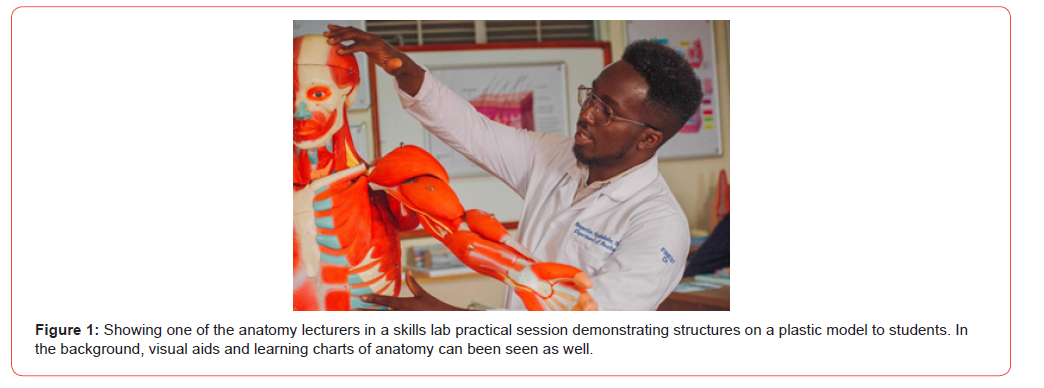
a. Physical model section: Housing prosected specimens,
osteological models, and plastic organ systems for repetitive,
tactile learning (Figure 1).
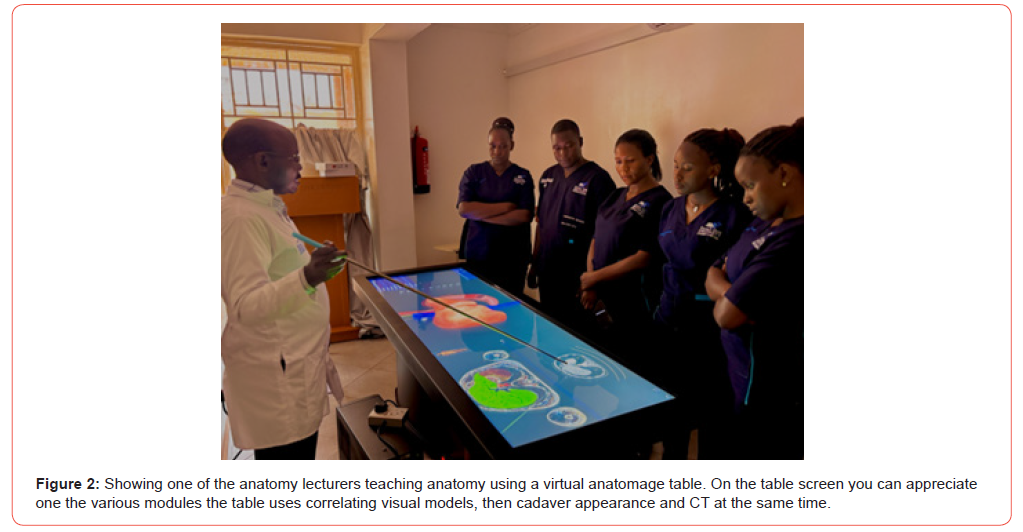
b. Virtual anatomy section: Centered on an anatomage table,
enabling 3D visualization, virtual dissection, and the correlation
of anatomy with imported CT and MRI datasets (Figure 2).
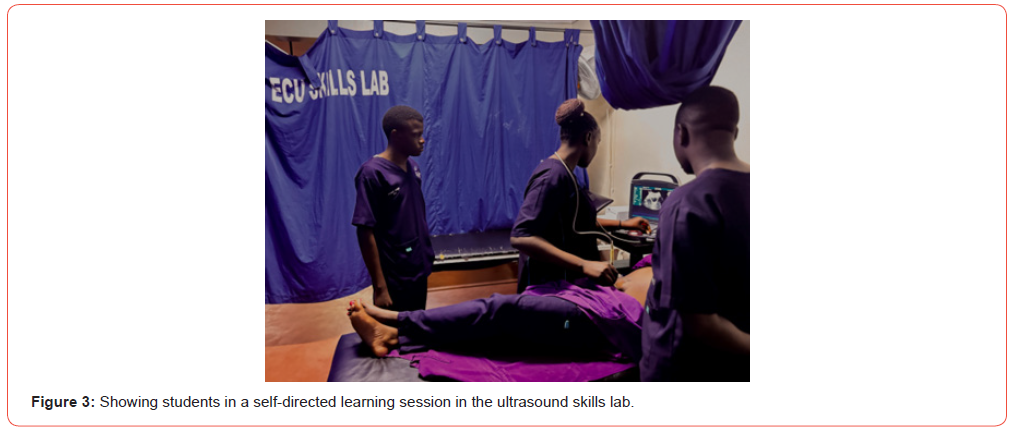
c. Ultrasound skills laboratory: Equipped with multiple
ultrasound machines for students to practice scanning on
peer models, translating anatomical knowledge into real-time
sonographic image acquisition and interpretation (Figure 3).
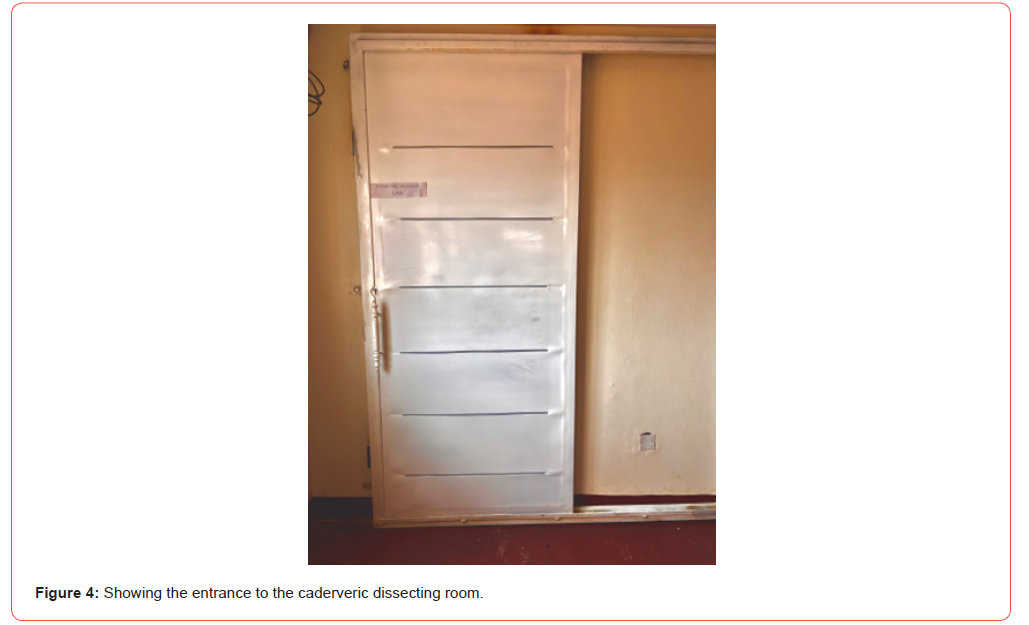
d. Cadaveric dissection section: For hands-on exploration of
real tissue planes, anatomical variation, and depth relationships
(Figure 4).
Organization of Integrated Learning Sessions
Following a one-hour physical lecture, student cohorts (divided into groups of ~10) rotate through scheduled practical sessions. Each session is objective-driven and the objectives are gotten from the physical lecture, requiring students to investigate the same anatomical region using all four modalities. For example, when studying the hepatobiliary system, students would: identify structures on plastic models, dissect and explore relationships in a cadaveric specimen, perform a virtual dissection and correlate with CT anatomy on the Anatomage table, and finally, identify the liver, gallbladder, and portal vasculature using live ultrasound on a peer. Faculty an interdisciplinary team of anatomists, practising radiologists and radiographers, and sonographers supervise each station, providing immediate feedback and reinforcing clinical relevance.
Competency-driven assessment strategy
Assessment is blueprint-aligned and heavily weighted towards practical skill demonstration [15]. Each module concludes with a formative, multi-station Objective Structured Practical Examination (OSPE) contributing 40% to the module mark. The summative endof- semester examination comprises a 30% theoretical component and a 30% comprehensive practical OSPE. Consequently, 70% of the final course grade is derived from practical assessments. The OSPE “steeplechase” format requires students to sequentially perform tasks such as identifying a structure on a cadaver and or plastic model, then interprete its appearance on a provided radiograph or CT slice, ultrasound image and/or demonstrating its location with an ultrasound probe under timed conditions.
DISCUSSION
The ECU curriculum model represents a deliberate and structured response to the dual imperative of modernizing anatomy education and addressing region-specific resource constraints. By integrating four complementary learning modalities within a CBME framework, it fosters a robust, clinically-relevant anatomical understanding essential for imaging professionals.
Advantages of this model over traditional learning and textbooks
This integrated approach offers several distinct advantages
over traditional, textbook-centric models:
a. Development of robust visuospatial skills: The repeated,
multi-platform engagement with anatomical structures from
handling a physical model to manipulating a 3D virtual model
to locating it in a living body forces cognitive integration that
is impossible from textbooks alone. This is crucial for building
the mental “library” of cross-sectional anatomy required for
interpreting diagnostic images [3,16].
b. Early and authentic clinical correlation: Embedding live
ultrasound training within the core anatomy curriculum breaks
down the traditional preclinical-clinical barrier. Students learn
anatomy not as an abstract science but as a living, dynamic
system they can visualize in real-time, directly mirroring their
future professional tasks [7,17].
c. Enhanced learner engagement and depth of processing:
The active, hands-on, and varied nature of the sessions caters
to diverse learning styles and promotes deeper cognitive
processing compared to passive lecture attendance [18]. The
immediate application of lecture content in the lab reinforces
learning and motivates students.
d. Efficient use of limited resources: While cadaveric
material remains invaluable but scarce, its educational
impact is multiplied when used in concert with other tools. A
single cadaveric dissection is enhanced by pre-training with
models and virtual reality, allowing more focused, efficient
use of precious specimens. Digital tools provide unlimited
opportunities for repetition without consumable costs.
Limitations of this learning model
Despite its strengths, the model faces inherent challenges:
a. High initial and sustained costs: Although more scalable
than a pure cadaver-based programme, the acquisition and
maintenance of an Anatomage table and ultrasound machines
represent a significant investment for institutions in SSA.
Sustaining hardware, software updates, and equipment repairs
is an ongoing challenge.
b. Faculty development demands: Successful implementation
requires faculty who are not only experts in anatomy but also
proficient in digital technology and ultrasound. Continuous
professional development is essential, adding to institutional
workload and cost [19].
c. Scalability and time tabling: The small-group, rotationbased
model is resource-intensive in terms of faculty time and
physical space. Scaling this to larger student cohorts without
compromising the quality of hands-on interaction presents a
logistical challenge.
d. Dependence on stable infrastructure: The digital
components are vulnerable to power outages and unreliable
internet connectivity, common issues in many SSA settings,
which can disrupt planned teaching sessions.
AREAS OF FUTURE RESEARCH
This conceptual model opens several avenues for empirical
investigation:
a. Outcomes-based research: Longitudinal studies tracking
graduates from this curriculum against those from traditional
programmes are needed. Key metrics include clinical
supervisor ratings, objective structured clinical examination
(OSCE) performance, diagnostic error rates, and job readiness
confidence surveys.
b. Comparative efficacy of modalities: Research could
dissect the relative contribution of each modality (cadaver,
model, virtual, ultrasound) to specific learning outcomes. This
would help optimize resource allocation, determining the most
effective combinations for different anatomical regions or
competencies.
c. Cost-effectiveness and sustainability analysis: A detailed
analysis of the total cost of ownership, operational costs, and
educational return on investment compared to traditional
methods is crucial for informing policy and adoption by other
resource-constrained institutions.
d. Adaptation and implementation science: Research should
explore the adaptability of this model to other allied health
disciplines (e.g., physiotherapy, surgery) and in different
institutional contexts within SSA, identifying critical success
factors and common barriers to implementation.
CONCLUSION
The integrated, competency-based anatomy curriculum at Ernest Cook University provides a replicable model for transforming imaging education in sub-Saharan Africa. It demonstrates that strategic, context-sensitive integration of traditional and technological tools can overcome resource limitations to deliver high-quality, clinically focused education. By anchoring assessment in practical competence, the model ensures graduates are not merely knowledgeable but are proficient in the essential skills required for modern diagnostic practice. While challenges of cost and sustainability remain, this approach offers a promising pathway to closing the gap between anatomical science and clinical imaging practice, ultimately contributing to stronger healthcare systems through better-trained professionals. Its continued evaluation and refinement are imperative.
DECLARATIONS
Acknowledgements
The authors gratefully acknowledge the dedicated support of the teaching and non teaching staff at the Department of Anatomy, Ernest Cook University (ECU), for their technical expertise and facility support. Our appreciation also extends to the adminstrators, colleagues and mentors at ECU, whose invaluable feedback enhanced this publication.
Funding
The authors declare no funding for this manuscript
Conflict of interests.
The authors declare no conflict of intrest.
Data Availability Statement
The data that supports the findings of this manuscript are available from the corresponding author upon reasonable request.
Ethics approval
Informed consent was obtained from the department for this publication.
Data Analysis
Data were analyzed using SPSS software, version 25.0. Qualitative variables were described using frequencies and percentages. Normality of quantitative data distributions was assessed using the Shapiro–Wilk test. Intersegmental comparisons were performed using the Wilcoxon signed-rank test for paired data. Correlations were analyzed using Spearman’s rank correlation coefficient. Comparisons according to sex were conducted using the Mann–Whitney U test. Multiple linear regression analysis, adjusted for the number of arterial trunks, was used to identify determinants of intersegmental diameter variations. The level of statistical significance was set at 5%.
- Drake RL, McBride JM, Lachman N, Pawlina W (2009) Medical education in the anatomical sciences: The winds of change continue to blow. Anat Sci Educ 2(6): 253-259.
- Nguyen N, Nelson AJ, Wilson TD (2012) Computer visualizations: Factors that influence spatial anatomy comprehension. Anat Sci Educ 5(2): 98-108.
- Tripodi N, Kelly K, Husaric M, Wospil R, Fleischmann M, et al. (2020) The Impact of Three‐Dimensional Printed Anatomical Models on First‐Year Student Engagement in a Block Mode Delivery. Anat Sci Educ 13(6): 769-777.
- Frank JR, Snell LS, Cate O Ten, Holmboe ES, Carraccio C, et al. (2010) Competency-based medical education: theory to practice. Med Teach 32(8): 638-645.
- Yan J, Ding X, Xiong L, Liu E, Zhang Y, et al. (2018) Team-based learning: assessing the impact on anatomy teaching in People’s Republic of China. Adv Med Educ Pract 9: 589-594.
- McBride JM, Drake RL (2018) National survey on anatomical sciences in medical education. Anat Sci Educ 11(1): 7-14.
- Kenny EJG, Makwana HN, Thankachan M, Clunie L, Dueñas AN (2022) The Use of Ultrasound in Undergraduate Medical Anatomy Education: a Systematic Review with Narrative Synthesis. Med Sci Educ 32(5): 1195-1208.
- Hortsch M, Girão‐Carmona VCC, Leite ACR de M, Nikas IP, Gatumu MK, et al. (2026) A global overview of anatomical science education and its present and future role in biomedical curricula. Anat Sci Educ 19(1): 5-45.
- Chang Chan AYC, van Leeuwen M, Custers E, Bleys R, ten Cate O (2025) Anatomy education in low-resourced countries: What are challenges and effective and affordable educational strategies? A qualitative study. Med Teach 47(5): 883-893.
- Mwabaleke J, Usman I, Tito A, Edet Obeten K, Umar Isyaku M, et al. (2023) Perceptions and Challenges Faced by Undergraduate Medical Students in Studying Anatomy: A Case Study at Kampala International University-Western Campus, Uganda. Adv Med Educ Pract 14: 1129-1135.
- Brenner E (2022) Anatomy in Competencies-Based Medical Education. Educ Sci (Basel) 12(9): 610.
- Omotoso D (2025) Online Anatomy Education in a Nigerian University-Overview of the challenges encountered by the basic medical trainees during coronavirus disease 2019 pandemic. Malta Medical Journal 37(4): 52-58.
- Harden RM (1999) What is a spiral curriculum? Med Teach 21(2): 141-143.
- Sweller J (2020) Cognitive load theory and educational technology. Educational Technology Research and Development 68(1): 1-16.
- Sales D, Sturrock A, Boursicot K, Dacre J (2010) Blueprinting for clinical performance deficiencies-Lessons and principles from the General Medical Council’s fitness to practice procedures. Med Teach 32(3): e111-e114.
- Dornan T, Tan N, Boshuizen H, Gick R, Isba R, et al. (2014) How and what do medical students learn in clerkships? Experience based learning (ExBL). Advances in Health Sciences Education 19(5):721-749.
- Swamy M, Searle RF (2012) Anatomy teaching with portable ultrasound to medical students. BMC Med Educ 12(1): 99.
- Bergman EM, Van Der Vleuten CPM, Scherpbier AJJA (2011) Why don’t they know enough about anatomy? A narrative review. Med Teach 33(5): 403-409.
- Sagoo MG, Vorstenbosch MATM, Bazira PJ, Ellis H, Kambouri M, et al. (2021) Online Assessment of Applied Anatomy Knowledge: The Effect of Images on Medical Students’ Performance. Anat Sci Educ14(3): 342-351.
-

This work is licensed under a Creative Commons Attribution-NonCommercial 4.0 International License.