




 Mini Review
The Recent Theory of Cycles of Climatic Change and its Implications for Oceanography given the Commencement of A New Precession Cycle
Received Date: February 14, 2024; Published Date: February 20, 2024
Abstract
The theory of cycles of climatic change involves cold events lasting about 90 ka alternating with warmer interglacials last about 10 ka since 800 ka B.P. This is controlled by four precession 23 ka cycles listed by Milankovitch. Evidence for the start of a new climatic cycle representing the start of a new cold event is presented together with the probable environmental consequences to be expected in the next 11.5 ka. The IPCC theory does not explain the evidence available from the history of the climate of the Earth during the last 550 Ma. If the atmospheric carbon dioxide content of the atmosphere becomes too low, photosynthesis by plants will cease during a subsequent cold event and the Earth will become as barren as most of the other planets.
Keywords: Climatic change; oceanography; atmosphere; carbon dioxide
Introduction
The Earth is essentially a closed energy system, with a continuous supply of solar radiation supplied from the Sun making up over 99.9% of the heat from elsewhere [1]. The Milankovitch cycles are critical in determining the amount of solar radiation arriving at a given location on the surface of the Earth over long periods of time [2]. They are the shape of the Earth’s orbit (eccentricity, a 100,000-year cycle), the angle of tilt of the Earth’s axis relative to the Earth’s orbital plane (obliquity, from 21.1–24.5° in a 41,000-year cycle), and the direction of the Earth’s axis of rotation is pointing (precession, in a 23,000-year cycle). Due to its shape, the Earth receives far more solar energy in the Tropics than in the Polar regions. The oceans absorb five times as much solar energy as the land areas and warm ocean currents and hurricanes carry large quantities of heat polewards especially in the North Atlantic Ocean [3]. Shackleton [4] and others have described evidence for over 100 fluctuations in sea temperature recorded in fluctuations in oxygen isotope analyses of the shells of foraminifera in marine cores dating back to 3.5 Ma B.P. [5,6].
There, evaporation of water from the sea to the dry Arctic air results in the development of warm saline water which accumulates on the sea floor due to its higher specific gravity than fresh water. Periodically, this high-density water flows south as a warm bottom current which brings heat to the South Atlantic Ocean. This causes a surface return flow of cold Antarctic water to the North Atlantic seas. It has been suggested that this triggers a major cold event, but this does not match the available evidence. Milankovitch calculated that cold events might occur approximately every 41,000 years, and subsequent research suggests that they did occur at every other 41,000-year interval between one and three and a half million years ago. By about 1 Ma B.P., the cycle of Ice Ages abruptly lengthened to 100,000 years, matching four of the Earth’s eccentricity cycles [7]. Comparison of these cycles shows that the cold event lasts about 90 ka (three and a half precession cycles) compared to the interglacial lasting about 10 ka. (about half a precession cycle).
Importance of Atmospheric Carbon Dioxide Content
The IPCC proposed in 1988 that the activities by humans have resulted in increasing atmospheric carbon dioxide causing an increase in global temperature that overrides all other causes. It is assumed that the increase in atmospheric carbon dioxide since the beginning of the industrial revolution is the cause of the warming [8]. This theory has been supported by the media and politicians and forms the basis of public policy. However, when the data for mean air temperature over the last 600 Ma are plotted against atmospheric carbon dioxide (Figure 1), it is clear that the data do not support the theory proposed by IPCC. Carbon dioxide first appeared in large quantities in the atmosphere after the first appearance of abundant marine animals about 600 Ma B.P. It reached a maximum atmospheric concentration during the Cambrian Period (Figure 1). It is unusual because it becomes more soluble at lower temperatures, forming carbonic acid, so that atmospheric carbon dioxide increases in amount in the oceans moving from the air to the water during a cold event.
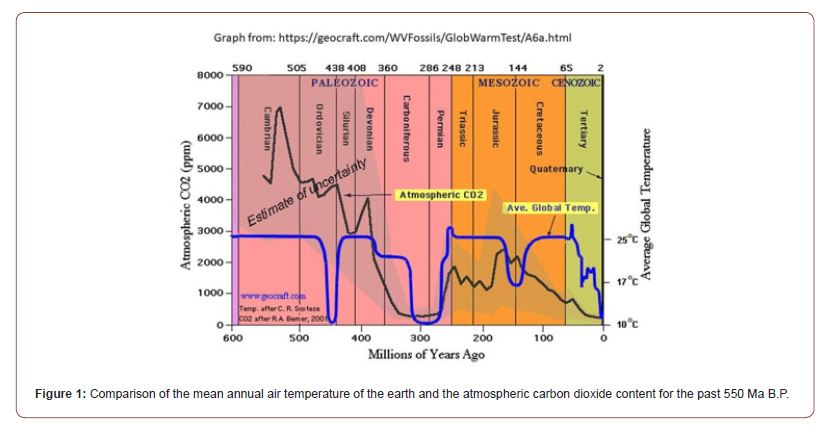
Calcium ions resulting from weathering of basaltic rock over a period of 3 billion years had been stored on the exchange complex of the clays and silts on the ocean floor. During the latter part of the Palaeozoic Era, ocean temperatures became cooler due to the Karoo glaciation in South Africa and Australia, and the carbonic acid reacted with the calcium ions resulting in the formation of massive limestone and dolomitic rocks on the sea floor in large areas of the world. This depleted the atmospheric carbon dioxide from c.20% down to almost nothing from which it has never really recovered. During each subsequent glacial event, a similar migration of the gas has occurred, and during the last two glacial events, the atmospheric concentration fell to within 100 ppm. of the lower limit required for photosynthesis by plants [9]. If its concentration becomes lower during the next cold event so that photosynthesis ceases, this Planet could become as barren as the other planets [10].
Seasonal Solar Radiation Reaching the Surface of the Atmosphere above Salt Lake City, Utah
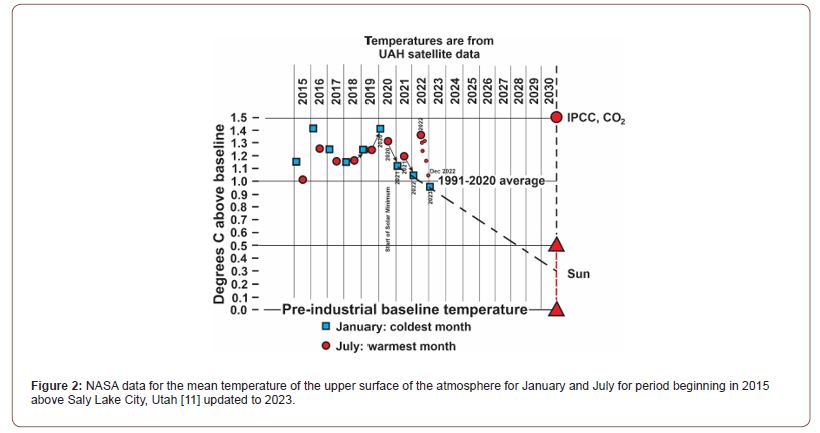
The calculations of Milankovitch suggested that the precession cycle change to the tilt of the Earth moving south in about 2016 A.D. NASA commenced satellite measurements of the maximum and minimum temperatures at the outer parts of the atmosphere over Salt Lake City in 2015. The results obtained so far are shown in Figure 2. There appears to have been a major change commencing in 2020. The summer (in red) and winter temperatures (in blue) are behaving differently. The source of the Arctic Air is in Siberia at a high latitude whereas the Subarctic air mass is still increasing. The reason for the latter is uncertain although the source of the Subtropical Air mass lies south of the Tropic of Cancer. The summer warming may continue until the location of overhead heating in the source area of the Subtropical air mass moves south. The summer and winter temperatures are diverging resulting in increasingly more violent weather when surface masses collide. The Rossby waves are developing considerably greater amplitudes while tornadoes and hurricanes are becoming much more frequent and violent. The west is suffering from droughts and forest fires and water rationing is being imposed throughout the Prairies. In the east, heavy snowstorms have created havoc in the Maritimes together with serious coastal erosion by storms in Summer. We are seeing the beginning of the next cold event since the heaviest snowstorms are in the same areas as the first ice caps developed during the beginning of the Wisconsin glaciation (see [3] Figure 2).
Probable Implications for Climatic Change
The western part of Canada will experience severe drought except for the western slope of the Cordillera This will result in severe forest fires altering the vegetation zones and agriculture especially in areas using irrigation. Water conservation will be essential, and the population density may decrease. In the east, a drastic change from a relatively of hot, moist Tropical air with the cold Arctic air will produce heavy winter snowfalls such as those that have affected the Maritime Provinces. Glaciers may reform in the mountainous areas to the north which will offset the effects of melting glaciers elsewhere. As the temperatures drop, ice caps will start to form in the northeast and sea level will start to drop. Coastal areas will experience a change from rising sea level to a situation where the seas are receding. By about 11 ka after the onset of the Wisconsin glaciation, the sea level had dropped about 30 m, although the actual change varies considerably from one glaciation to another. This will cause obvious disruption to ports and coastal population centres and the shallower parts of the continental shelves will become dry land, e.g., the Grand Banks, parts of the Northwest Passage, etc. Rivers will start to regrade their channels which will cause considerable problems for land transportation. The distribution of people will have to change, and local economies will be severely affected.
Conclusion
The climate is going through a drastic change from a relatively benign Interglacial climate to one that appears to be the start of the next cold glacial event. This will have severe changes to the weather and all aspects of the use of the surface of this planet by Humans, especially in the Northern Hemisphere. There is little historical data to indicate what is coming, but governments and the population at large are in for enormous changes in the environment around them.
References
- Kathagat G, Cheng H, Sinha A, Yi L, Li X, et al. (2017) The Indian Monsoon variability and civilization changes in the Indian Subcontinent. Sci Adv 3(12): e1701296.
- Milankovitch M (1941) Canon of Insolation and the Ice-Age Problem. Belgrade, Yugoslavia: Royal Serbian Academy.
- Harris SA (2019) The relationship of sea level changes to climatic change in northeast Asia and northern North America during the last 75 ka B.P. climate; Arctic air mass; sea level changes and climate. AIMS Environmental Science 6(1): 14-40.
- Shackleton N, Hall M, Pate D (1995) Pliocene stable isotope stratigraphy of site 846. Proceedings of the Ocean Drill Program: Scientific Results 138: 337-353.
- Raymo ME (1992) Global climate change: A three-million-year perspective. Kukla GJ, Went E, (Eds.,), Start of a glacial. NATO ASI Series, Series 1. Global Environmental Change 3: 207-223.
- Cande SC, Kent DW (1995) Revised calibration of the geomagnetic polarity timescale for the Late Cretaceous and Cenozoic. Journal of Geophysical Research 100: 6093-6095.
- Lisiecki LE, Raymo ME (2005) A Pliocene-Pleistocene Stack of 57 globally distributed benthic δ18O records. Paleoceanography 20(1).
- IPCC (2018) Special Report on the impacts of global warming of 1.5°C above pre-industrial levels.
- Harris SA (2023) Evolution of the climate of the Earth. Journal of Civil Engineering Research and Technology 5(2): 1-15.
- Harris SA (2023) Atmospheric carbon dioxide, climate change, and the survival of the Earth’s biota. Journal of Juniper Horticulture and Arboriculture 4(1): 555626.
- Pangburn D (2022) Theory of redirected energy.
-

This work is licensed under a Creative Commons Attribution-NonCommercial 4.0 International License.




