




 Research Article
Palynological Zonation and Age Dating of The Gamba (Middle Eocene) and Kalambaina (Early Maastrichtian-Paleocene) Formations, Sokoto Basin, Northwestern Nigeria
Received Date: April 04, 2024; Published Date: May 08, 2024
Abstract
Lithostratigraphy of Kalambaina Quarry was studied for determination of the geologic age and paleoenvironment of deposition of the sediments. The litho-description was undertaken by noting the colour, composition, textural parameters, fossil content, structure, and bioturbation. Palynological sample preparation involved decarbonization, digestion with hydrofluoric acid, sieving with 10 μm mesh, oxidation, heavy liquid separation of the maceral by floatation and mounting on the slides. The lithostratigraphy of the Kalambaina mine section is composed of various lithofacies. Stratigraphic section was divided into two: Kalambaina and Gamba Formations. The Kalambaina Formation underlies the Gamba Formation. The Kalambaina Formation is composed of basal fossiliferous limestone overlain by the intercalated light grey fissile shale and at the top is the fossiliferous limestone. The Gamba Formation unconformably overlies the Kalambaina with sandstone facie at the bottom, overlain by marlstone and micaceous shale respectively. The Kalambaina Formation belongs to Proxapertites operculatus Assemblage Zone, dated Early Maastrichtian to Paleocene based on co-occurrence of Milfordia jardinei, Foveotrilites margaritae, Retibrevitricolporites triangulatus, Syncolporites subtilis, Syncolporites marginatus Mauritiidites crassieximinus and Buttinea andreevi.
The overlying Gamba Formation was dated Middle Eocene age of Monoporites annulatus Zone (Zone P400, Subzone P430), characterized by first up hole occurrence of Monoporites annulatus, Margocolporites foveolatus, Ctenolophonidites costatus, Anacolocidites luicoides, and Cicatricosisporites dorogensis. The paleoenvironment of deposition of the Kalambaina Formation is marine and the Gamba Formation is marginal marine due to admixture of terrestrially derived miospores and marine dinoflagellate cysts occurrences. The Gamba (Middle Eocene) and Kalambaina (Early Maastrichtian-Paleocene) Formations do not belong to the same geologic age (Paleocene) as posited by earlier workers, therefore, they are here emphasized that they do not belong to the same stratigraphic Sokoto Group (Paleocene age) in Sokoto Basin, Nigeria, therefore, the terminology is invalid for further usage.
Keywords: Kalambaina quarry; gamba formation; kalambaina formation; middle eocene; early maastrictian-paleoecene
Introduction
The formations studied are Kalambaina and Gamba Formations. The two formations constitute the upper part of the Sokoto Group. The Sokoto Group was described to have been deposited during the second phase of the Sokoto Basin evolution. The Sokoto Basin was formed as a result of rifting between the South American and African land masses, which resulted to marine incursion of the Mediterranean Sea from the north and the Gulf of Guinea from the southern Nigeria [1]. The evolution of the Sokoto Basin was described and documented in the works of [2,3]. The Kalambaina is soft, white highly fossiliferous marlstone with carbonaceous mudstone intercalations and limestone nodules [4,5]. However, Assez and Foyose [6] described the limestone to contain nodules, and concretions of phosphate materials. Kogbe [7] opined that the Kalambaina Formation consists of white limestone with crevices filled with non-fossiliferous clay. Other workers were of the opinion that the Kalambaina Formation consists of marine white limestone and shales with the type of section at the Kalambaina Quarry. The formation is rich in invertebrate fossils such as echinoids, corals, nautiloids, lamellibranchs, gastropods and microfossils like foraminifer and ostracods [8-10].
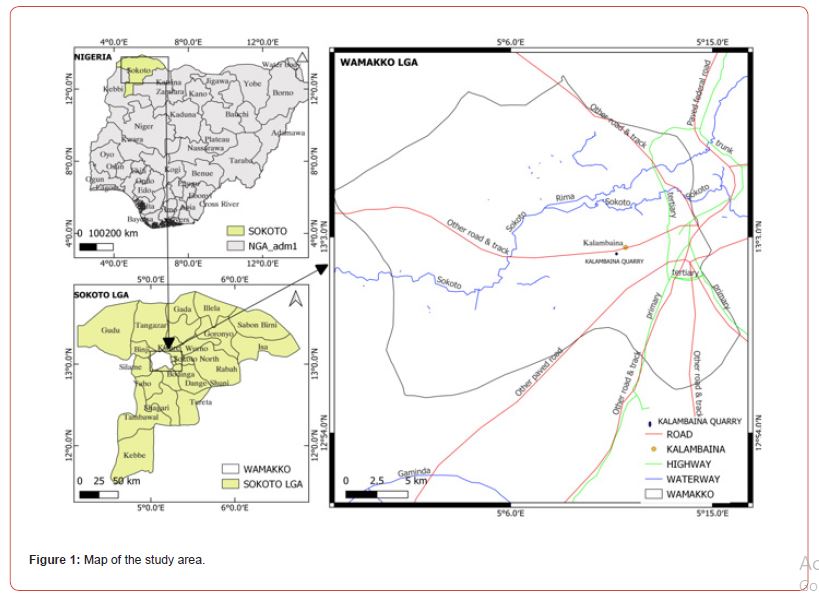
The Kalambaina Formation was dated Paleocene age along with other formations such as the underlying Dange Formation and the overlying Gamba Formation. As a result of the cotemporaneous Paleocene deposition of the three formations, formed the basis of regarding to them collectively as Sokoto Group. The Gamba Formation overlies the Kalambaina Formation. The Gamba Formation was lithologically described to be predominantly shaly, succeeded by band of phosphate pellets and coprolites, which are overlain by grey laminated shale with iron concretions at the top [11]. The Gamba Formation is also rich in foraminifera as found in the Kalambaina Formation; also dated Paleocene age. The present study was based on the premise of investigating the lithostratigraphic sequence of both the Kalambaina and Gamba Formations in the Kalambaina Quarry and to determine the veracity of the relative ages based on recovery of pollen, spores, and dinoflagellates cysts, and to validate the correctness of the application of the stratigraphic nomenclature Sokoto Group ascribed to the formations. The study area is Kalambaina Quarry site, located in Wammako Local Government Area of Sokoto State, northwestern Nigeria. The area lies between latitude 12o 3I 4II N and longitude 5o 9I 21II E as shown in Figure 1.
Methodology
The outcrop layers were distinguished lithologically based on colour, composition, texture, fossil content, structure, and effect of post depositional diagenetic effect. The claystone samples were prepared into palynological slides by processing the samples following laboratory procedures. The samples were crushed with mortar and pestle in order to enhance chemical decarbonization and digestion with dilute hydrochloric acid (HCl). The samples were later digested with hydrofluoric acid (HF) for a complete breakdown of the claystone particles by soaking them overnight but stirred intermittently in order to achieve complete digestion [12]. The next stage of the preparation was sieving, using 10μm sieve mesh. Clay particles were washed away to permit concentration of organomacerals. The recovered organic debris was later bleached by treatment with concentrated nitric acid (HNO3) in order to enhance sculptural elements of the palynomorphs. This process is important because it helps in enhancing the identification of the miospores, dinoflagellates and other stratigraphically important forms present in the slide during the petrographic view. Further laboratory procedures involved separation of macerals from the organic debris using heavy liquid such as zinc bromide. The floated maceral was separated, rinsed with ethanol (alcohol) before it was finally mounted on glass slides, then ready for analyses after being allowed to core for about two days. The microscopic analysis was carried out with OPTICA B-150 model.
Result and Interpretation
Field and Lithological Description
The study area is Kalambaina Quarry site, located in Wammako Local Government Area of Sokoto State, northwestern part of Nigeria. The overview of the study outcrop was presented in Plate 1.
The open section of the mine was described as follows:
Location: Kalambaina Quarry
Coordinate: Latitude 12o 3I 4II N and Longitude 5o 9I 21II E
Elevation: 260 m
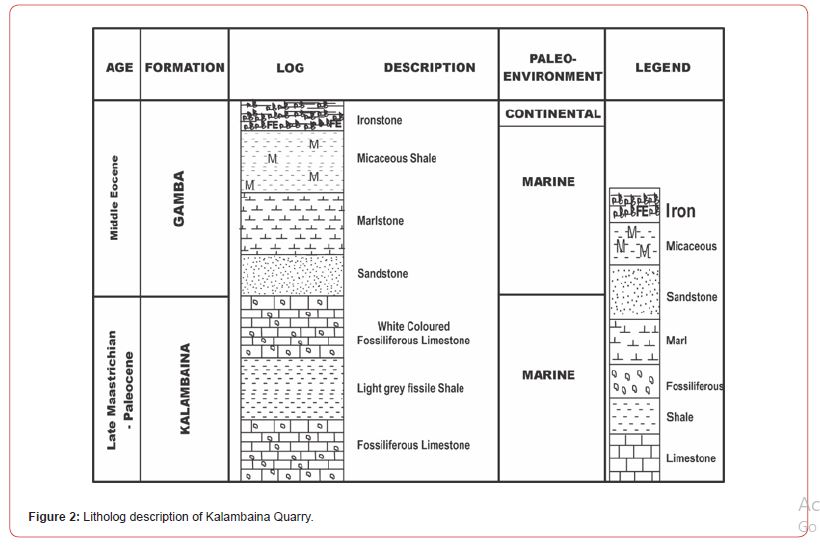
Litho-description: The basal bed of the outcrop is composed of sparsely fossiliferous white colored, lithified limestone. The overlying bed is a light grey fissile shale. The light grey fissile shale is overlain by non-fossiliferous limestone. The shale is intercalated between the limestone beds. It separates the fossiliferous limestone and the non-fossiliferous marlstone.
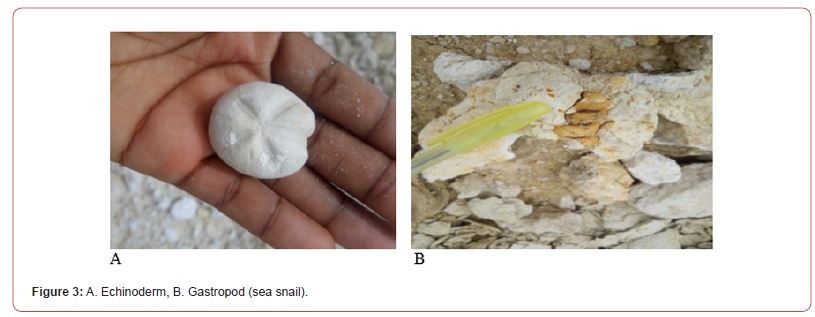
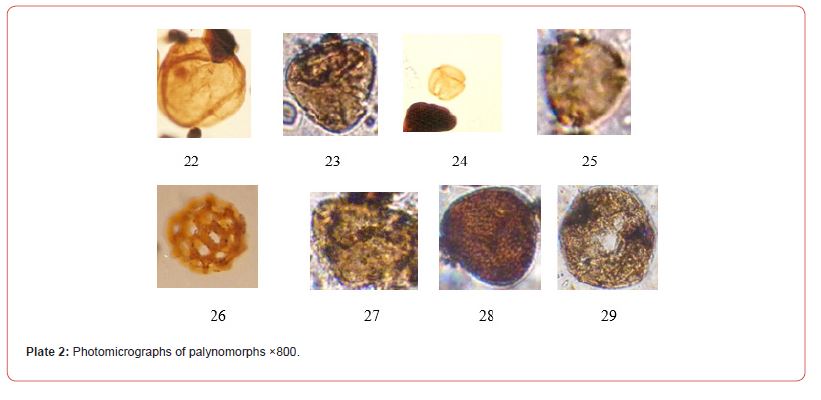
The middle section of the outcrop is marked by an unconformity where the marlstone is overlain by sandstone. The occurrence of sandstone within the Kalambaina Formation is reported here for the first time. The sandstone is overlain by marlstone. Overlying the marlstone at the upper part of the section is a micaceous shale bed. The micaceous shale is uncomfortably overlain by conglomeratic ironstone of continental origin. Important stratigraphic lithofacies capping of a conglomeratic ironstone is also reported here, because it is widely believed that ironstone capping is only synonymous with Gwandu Formation in Sokoto Basin. The litho-log description was presented in Figure 2. The specimens of a few fossils recovered from the Kalambaina Quarry are shown in Plates 1&2, Figure 3.
Palynology
Palynological study was carried out on Kalambaina quarry. Six samples were collected from the outcrop in sequential order. Sample T1 was collected at the bottom of the outcrop, while Samples T2, T3, T4, T5 and T6 were collected at the middle and upper parts of the outcrop respectively. The sampling interval is irregular; this is as a result of irregular positions of the shale, limestone and marlstone beds in the mine sequence.
Palynozonation
The stratigraphic interval of the analyzed samples for this study is classified into two on the basis of the palynomorph abundance and diversity. The upper part of the interval is relatively rich in pollen, spores and dinoflagellate cysts compared with the lower part. The amount of pollen and spores recovered tend to decrease with increase in depth. The palynological interpretation of the analyzed interval was based on the comparison of the pollen, spores, dinoflagellates, and algae recovered in the analyzed samples with documented literature by earlier researchers in Nigeria, West Africa, and Southern America. This study was compared with work of Germeraad, Evamy, Lawal, Lawal and Moullard, and Ola-Buraimo [13-18]. The various fossil assemblages and their relationship with different zones, ages of different formations and their environments of deposition were described below:
Sample: T1-T3
Zone: P400
Subzone: P430
Zone: Monoporites annulatus
Age: Middle Eocene
Formation: Gamba Formation
Characteristics: The interval is composed of micaceous shale, marlstone, and basal sandstone. The sandstone sits unconformably on the underlying limestone of a Kalabambaina Formation. The erection of the zone was based on the basal occurrence of Monoporites annulatus in the interval and cooccurrence of Margocolporites foveolatus, Cicatricosisporites dorogensis, Lycopodium sp., high abundance of Monosulcites sp., and first uphole occurrence of Ctenolophonidites costatus and Anacolocidites luicoides. The interval is further marked by the co-association of important miospores such as Retimonocolpites sp., Araucariacites sp., Buttinea andreevi, Tricolporopollenites sp., Trichotomosulcites sp. in fairly rich amounts. Other forms present include Verrucatosporites usmensis, Peregrinipollis nigericus, Retidiporites magdalenensis, Cingulatisporites ornatus, Lycopodium sp., Ctelophonidites costatus, and Praedapollis sp. The pollen and spores present are diagnostic and similar to those used by Germeraad, Salard-Cheboldaeff, Ola-Buraimo [19] for Kerrikeri Formation in Bornu Basin, northeastern Nigeria, and Ola-Buraimo (2020 on the Nzam-1 well, in Anambra Basin, southeastern Nigeria. Therefore, the interval was conveniently dated Eocene age and corresponded to the Gamba Formation, Sokoto Basin.
The new age established for the Gamba Formation in this study is in contrast with the earlier established undifferentiated Paleocene age upheld by Kogbe and Obaje. Therefore, the Gamba Formation does not belong to the Sokoto Group which was described to have evolved during the third phase of sedimentation in Sokoto Basin. The time and processes that led to sedimentation of Gamba Formation was different from those of the older and the underlying Kalambaina Formation. This difference is substantiated in the erosional and uncomfortable contact between the Gamba Formation and the Kalambaina Formation. The sandstone facies encountered in the Kalambaina Quarry here described in this research has never been reported to exist between the Gamba and the Kalambaina Formations. The paleoenvironment of deposition of the Gamba Formation is marginal marine. This is characterized by the co-recovery of terrestrially derived miospores and the dinoflagellate cysts. The co-occurrence of such had been described by Ola-Buraimo (2020) to belong to the marginal marine setting. The organic wall organism present in the interval are the undifferentiated dinoflagellate cysts, Batiacasphaera sp., Senegalinium sp., and Andalusiella polymorpha of peridinacean type.
The basal part of this interval (Sample T3) is marked by quantitative occurrence of dinoflagellate cysts, Spinidinium sverdrupianum and substantial quantity of Botryococcus braunii (algae). This interval belongs to the basal sandstone facies of the Gamba Formation, described as carbonaceous marine sandstone.
Sample: T4-T5
Zone: P200
Subzone: P200
Zone: Proxapertites cursus
Age: Paleocene
Formation: Kalambaina Formation
Characteristics: The upper part of the interval is quantitatively rich in pollen, spores, and organic wall organism. The basal part of the interval is characterized by paucity of pollen abundance. The poor recovery is usually associated with Paleocene age sediments in Nigeria. The lower part is further marked by the continuous occurrence of Syncolporites sp., Syncolporites subtilis, Syncolporites marginatus. The upper segment of the interval is characterized by the basal occurrence of Mauritiidites crassieximinus, rare occurrence of Buttinea andreevi, Retibrevitricolporites triangulatus, Monoporites sp., Cingulatisporites ornatus, Stephanoporites sp., Longapertites marginatus, Retimonocolpites sp., and Syncolporites subtilis.
The interval belongs to the substantial part of Kalambaina Formation, containing more of the marlstone and the nonfossiliferous limestone. The established age here is like earlier age given by previous research. The paleoenvironment deduced is fluviomarine based on the incursion of fluvial and terrestrial materials into the marine. The influx of fresh water into the shallow marine is responsible for the presence of sand particles mixed with the precipitated carbonate, this resulted to the formation of the marlstone. The dinoflagellates that dominate the interval are the undifferentiated peridinacean forms and Andalusiella spp.
Sample: T6
Zone: P100
Subzone: P190
Zone: Proxapertites cursus
Zone: Foveotriletes margaritae Assmeblage Zone
Age: Early Maastrichtian
Formation: Kalambaina Formation
Characteristics: The interval is defined on the basis of the co-occurrence of Milfordia jardinei, Foveotrilets margaritae, and Retibrevitricolporites triangulats. The interval is fairly populated with pollen, spores, and dinoflagellate (Figure 2). The interval corresponds to the basal part of the entire stratigraphic interval investigated. The age adduced to this interval is Early Maastrichtian based on the presence and the association of the typical known Maastrichtian forms such as Foveotrilets margaritae, Retibrevitricolporites triangulatus [20] and rare occurrence of Milfordia sp. [21-23]. The interval belongs to the Kalambaina Formation. The paleoenvironment of deposition was marginal marine setting.
Table 1: Stratigraphic succession ages and paleoenvironment of deposition in Sokoto Basin.
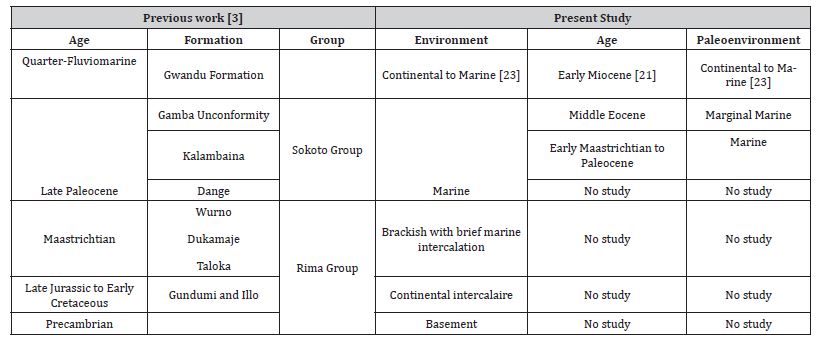
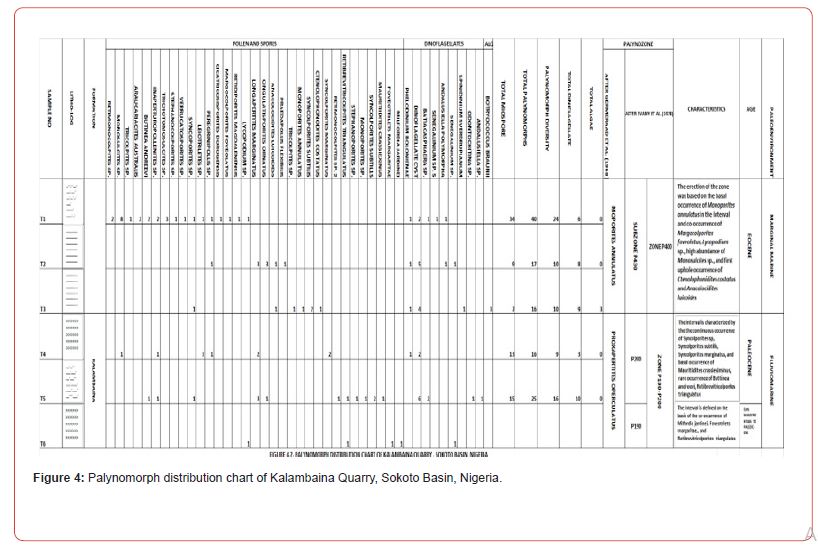
Therefore, the Gamba Formation is here date Middle Eocene age and marginal marine environment of deposition (Table 1). The Kalambaina Formation is here dated to range from Early Maastrichtian to Paleocene age, unlike the earlier age given to it to be strictly Paleocene (Table 1). This also brings the assertion that the third phase of sedimentation in Sokoto Basin started in the Paleocene to be wrong and should be discarded in order to avoid continuous misinformation. Furthermore, the stratigraphic nomenclature Rima Group should be reconsidered and should be dropped because the formations that constituted the group were not deposited under same conditions and geologic age time as earlier emphasized (Figure 4).
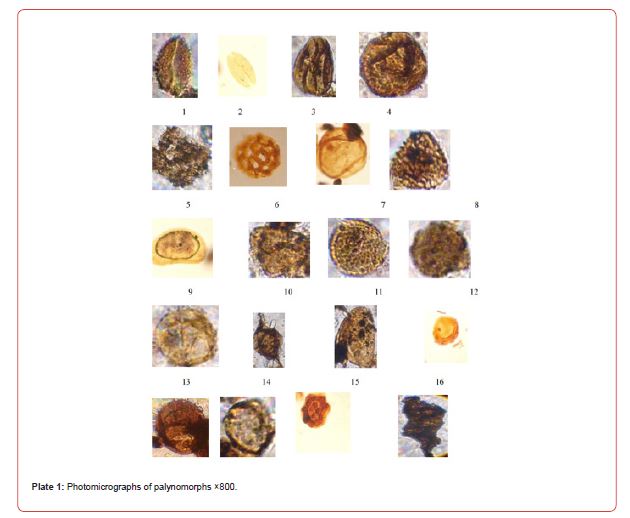
Photomicrographs Interpretation
1. Retimonocolpites sp.
2. Monosulcites sp.
3. Tricolpites sp.
4. Araucariacites australis
5. Phelodinium bolonienae
6. Buttinea andreevi
7. Inaperturopollenites sp.
8. Trichotomosulcites sp.
9. Verrucatosporites usmensis
10. Syncolporites sp.
11. Cicatricosisporites dorogensis
12. Retidiporites magdalenensis
13. Batiacasphaera sp.
14. Andalusiella polymorpha
15. Longapertites marginatus
16. Cingulatisporites ornatus
17. Monoporites annulatus
18. Syncolporites subtilis
19. Ctenolophonitides costatus
20. Botryococcus braunii
21. Inaperturopollenites sp.
22. Cyathidites sp.
23. Cyncolporites marginatus
24. Syncolporites marginatus
25. Retibrevitricolporites triangulatus
26. Buttinea andreevi
27. Syncolporites sp.
28. Foveotriletes margaritae
Conclusion
The lithostratigraphy of the Kalambaina mine section is composed of Kalambaina and Gamba Formation. The Kalambaina Formation underlies the Gamba Formation. The Kalambaina Formation consists of the fossiliferous limestone at the base, overlain by light grey fissile shale at the middle and at the top is the fossiliferous limestone. The Gamba Formation unconformably overlies the Kalambaina with a marine sandstone facie at the bottom, followed by marlstone and micaceous shale respectively. The Kalambaina Formation stratigraphic section belongs to Proxapertites operculatus zone, dated Early Maastrichtian to Paleocene on the basis of co-occurrence of Milfordia jardinei, Foveotrilites margaritae, Retibrevitricolporites triangulatus, Syncolporites subtilis, Syncolporites marginatusi, Mauritiidites crassieximinus and Buttinea andreevi. The overlying Gamba Formation was dated Eocene age, belonging to Monoporites annulatus zone (Zone P400, Subzone P430), characterized by occurrence of Monoporites annulatus, Margocolporites foveolatus, Ctenolophonidites costatus and Anacolocidites luicoides, Cicatricosisporites dorogensis. The depositional environment of the Kalambaina and the Gamba Formations is marginal marine due to admixture of terrestrially derived miospores and marine dinoflagellate cysts occurrences. The Gamba and Kalambaina Formation are here asserted that they do not belong to the same Paleocene age of deposition, and they are suggestive not to also belong to the same Sokoto Group. Therefore, the Sokoto Group ascribed to them is invalid and its usage and application has become misappropriation.
Acknowledgement
The authors are grateful to the Palynological Laboratory of the Department of Geology, Federal University Birnin Kebbi, Nigeria for granting us permission to use the facilities for preparation of sample slides and the use of the microscope for palynomorphs identification. The team is also grateful to Palystrat Limited for providing the literatures used for interpretation.
References
- Ola-Buraimo AO, Oladimeji RG, Faruk AK (2022) Palynology, paleoenvironment and stratigraphy relationship of Tungan Buzu Hill with adjacent valley Gwandu Formation, Sokoto Basin, Northwestern Nigeria. International Journal of Innovative Environmental Studies Research 10(3): 39-55.
- Kogbe CA (1989) Geology of Nigeria. 2nd Edition, Rock view Nigeria Limited, Jos, pp. 538.
- Obaje NG (2009) Geology and Mineral Resources of Nigeria. Springer, Heildelberg, pp. 221.
- Petters SW (1978) Maastrichtian-Paleocene foraminifera from NW Nigeria and their Paleogeography. Acra Paleon. Polonia, 23: 131-152.
- Petters SW (1979) Stratigraphic History of the South-central Saharan Region. Geological Society of America Bulletin 90(8): 753-760.
- Asseez LO, Fayose EA (1972) Biostratigraphy of the Lower Paleogene calcareous unit in Sokoto area, Northwestern Nigeria. Department of Geology, University of Ibadan, pp. 281-289.
- Kogbe CA (1974) Paleo-ecologic significance of vertebrate fossils in the Dukamaje and Dange Formation (Masstrichtian and Paleogene) of northwestern Nigeria. Journal of Mining and Geology (Nigeria) 8: 49-55.
- Reyment RA (1965) Aspects of the Geology of Nigeria. Ibadan University Press, pp. 133.
- Kogbe CA (1976) The cretaceous and tertiary of Iullemmeden Basin in Nigeria. Elizabethan Publishing Company, Lagos, PP. 377-421.
- Petters SW (1976) The marine Maastrichtian and Paleocene sediments of Northwestern Nigeria. The Dukamaje Formation and the Sokoto Group. Geological guide to some Nigeria Cretaceous-Recent localities.7th African Micropal. Coll. Ile-Ife, Nigeria, pp. 75-87.
- Kogbe CA (1972) Geology of the upper cretaceous and lower tertiary sediments of the Nigerian sector of the Iullemmeden Basin (West Africa). Geologische Rundschan, Stuttgart 62: 197-211.
- Ola-Buraimo AO (2020) Palynozonation Chronostratigraphy of deposition of the Albian to Pliocene Sediments of the Nzam-1, Umuna-1, and Akukwa-2 wells Anambra Basin, Southwestern Nigeria. University of Ibadan, PhD thesis, pp. 182.
- Germeraad JH, Hoppings CA, Muller J (1968) Palynology of Tertiary Sediments from tropical areas. Review of Palynology 1: 189-348.
- Evamy DD, Heremboue J, Kemeling P, Knaap WA, Morlly FA, et al. (1978) Hydrocarbon habit of Tertiary Niger Delta. American Association of Petroleum Geologists Bulletin 62: 1-39.
- Lawal O (1982) Biostratigraphie palynologique es paleoenvirunmens des formations Cretacee de la Haute- Benoue, Nigeria mord-oriental. These-3cycle, Univ. Nice, pp. 218.
- Lawal O, Moullade M (1986) Palynological biostratigraphy of the Creteceous sediments in the upper Benue Basin, N.E. Nigeria. Revue micropaleontologie 29(1): 61-83.
- Ola-Buraimo AO (2012) Lithostartigraphy and palynostratigraphy of Tuma -1 well, Bornu Basin, Northeastern Nigeria. Journal of Biological and Chemical Research 29(2): 206-223.
- Ola-Buraimo AO (2013b) Biostratigraphy of section of Murshe-1 well, Bornu Basin, northeastern Nigeria. British Journal of Applied Science and Technology 3(2): 361-375.
- Salard-Cheboldaeff M (1981) Palynologie Maestrichtien et Tertiare du cameroun; Resultants botaniques. Rev Palaebot Palynol 32(4): 401-439.
- Jardine S, Magloire I (1965) Palynologie et stratigraphic du Cretace des Basins du Senegal et de Cote d’ Ivoire ler Coll. Memoire du. Bureau Recherches Geologiques et Minieres 32: 187-245.
- Ola-Buraimo AO, Haidara N (2022) Pollen and Spores Recovery in Tunga Buzu Carbonaceous Shale Type Section Member: Significance in Sequence Stratigraphy, Age Dating and Paleoenvironment Deduction of the Early Miocene Gwandu Formation, Sokoto Basin, Northwestern Nigeria. British Journal of Earth Sciences Research 10(3): 16-25.
- Ola-Buraimo AO, Oladimeji RG, Adamu KW (2023) Palynological study and age dating of the Early Miocene Dukku Claystone Type Section of Gwandu Formation, Sokoto Basin, Northwestern Nigeria. African Journal of Environment and Natural Science Research 6(1): 9-18.
- Ola-Buraimo AO, Ologe O, Benemaikwu DO (2018) Field geology and microbiological investigation of Borehole, Public Tap Water and Hand-dug wells in some parts of the Birnin Kebbi, Kebbi State, Northwestern Nigeria. Nigerian Journal of Scientific Research 17(3): 322-333.
-

This work is licensed under a Creative Commons Attribution-NonCommercial 4.0 International License.




