




 Review article
Island Operation with Distributed Generation - Tidal Turbine
Received Date: February 12, 2024; Published Date: February 28, 2024
Abstract
The overall aim of this project was to meet the energy demand of a future estate in the UK, in a seaside village in Scotland, with a suitable mix of technologies and a system of decentralized generation. Two considerations are considered. Firstly, the power generation works in “island operation”, which means without connection to the electrical network, the only external supply is gas. Secondly, renewable energies should be used as far as possible. Also, the planned facility has faithfully met demand without loss of energy. This study is conducted at a power production plant that combines gas turbine generation, tidal turbines, hot water tanks, absorption units, solar panels, and heat pumps. Combined Heat and Power (CHP or Cogeneration) is one of the basic technologies of DG. Conventional ways of generating electricity lose large amounts of thermal energy in the process, since exhaust gases suppose high-grade of wasted heat output. However, Combined Heat and Power (CHP or cogeneration) systems provide waste-heat recovery for applications such as steam generation (combination of Bryton and Rankine cycle) or warming water. CHP power plants can reach more than 30% the efficiency of the ordinary ones, up to 85%.
Keywords: Decentralized power generation; renewable and sustainable energy; tidal turbines; trigeneration (CHP); energy optimization
Introduction
The increases in the emission of gases, the concern about oil reserves and the threats of climate change make the agreements of the Kyoto Protocol even more actual. In this context, sustainable urban development plays a key role in this context. World energy consumption has growth dramatically in the last two decades [1] and 52.1% of world population live in cities [2]. Due to these demographic changes, it is relevant to transform the cities into resource- efficient and low carbon emitting places. The European Union is promoting the replacement of conventional Centralized Energy systems to Decentralized Energy [3]. In principle, the main advantages are power generation is located much closer to users than in the case of conventional distribution networks, and on the other hand, it is based on distributed generation, energy storage and not passive customers. This means that the primary energy source is often renewable and deals with a bidirectional generation (producer-end user). Combined Electricity and Heat (CHP or Cogeneration) is one of the basic technologies of distributed generation (DG). The combination of Bryton and Rankine cycles can achieve more than 30% efficiency on thermal energy losses, 60% of the energy used for electricity production by conventional systems in the UK is lost to heat systems [4]. By recovering this heat and making the distance between generation and consumption (DG) smaller, much greater energy uses can be achieved than centralized production systems [5].
Experimental Data
The graphs below illustrate the estimated energy demand per hour in winter and summer of the future seaside village in Scotland of approximately 2500 residents.
Three main objectives are defined to meet the demand for electricity, heating, and cooling:
a) Study the load profile for a winter and summer day in terms of electricity, heating, and cooling.
b) Identification of maximum demands and comparison of different energy requests depending on the hours.
c) Design a distributed generation system so that connection to a power grid is not necessary.
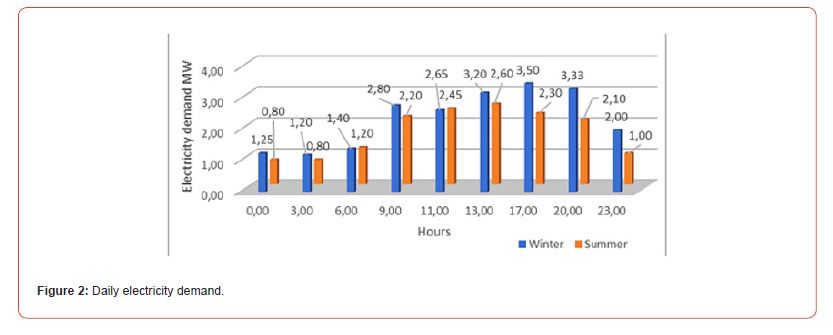
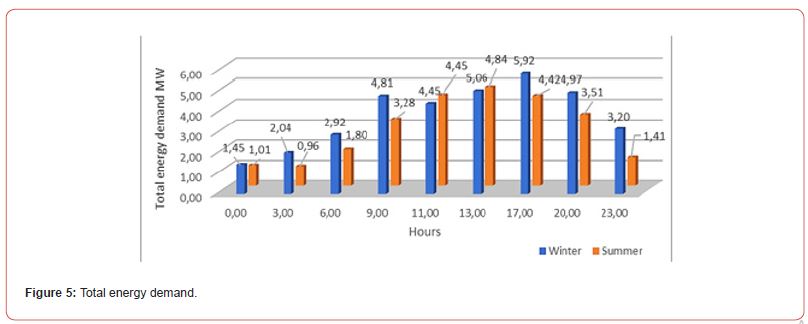
The hourly energy demand in winter and summer is analyzed according to Figures 2-4 [6]. The highest electricity demand corresponds to 3,50 MW on a winter day at 17h. As for the heat demand, the consumption reaches 1,8 MW at 17h in winter, and the cold demand presents a maximum consumption of 1,10 MW at 17h, in summer. On the other hand, data on the percentage rate of solar radiation resources and tidal energy per hour in the situation of the study are available. It is relevant to point out that this request is generally between 20 and 30% lower in summer, Figure 2. This difference may be caused by longer daylight hours in summer and the necessity of specific electrical appliances in winter, such as dryers or electrical radiators. Electrical demand remains steady during the early hours in the morning and from 9 am to 4 pm for both winter and summer. It is worth mentioning that lighting and appliances accounted for 15% of total domestic energy consumption in 2018 in UK [7].
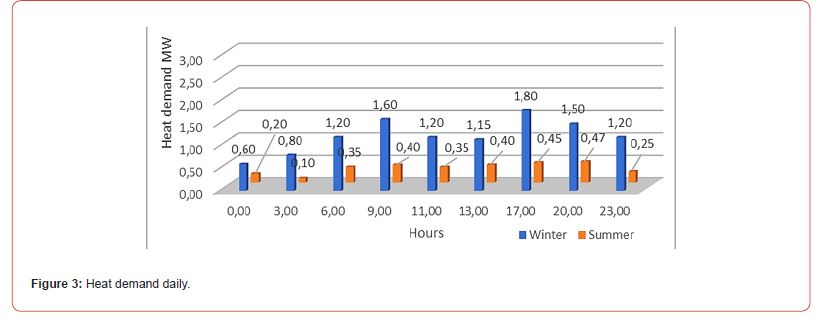
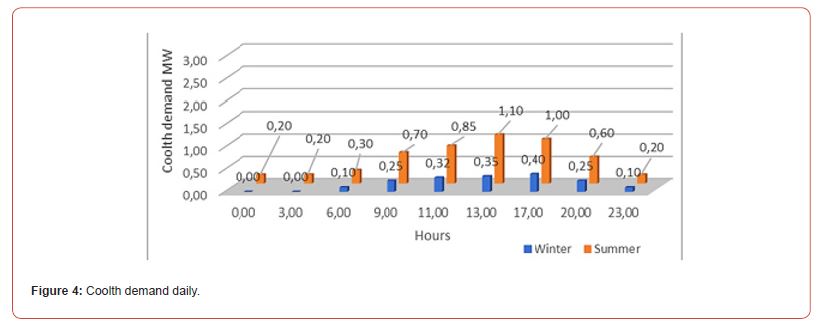
Regarding the heat demand, it is clear from Figure 3 undergoes two peaks a winter day. The consumption reaches 1,6 MW at 9 am. After that, it falls until stays constant from 11 am to 3 pm, when there is a recovery to 1,8 MW at 7 pm. These fluctuations are due to the warmest temperature around noon and the widespread habits of people. During summer these Figures stay constant with values considerably low, between 0,2 and 0,5 MW. Coolth requirement trend in summer is considerably different to heating in winter. As can be seen from Figure 4, this demand rises until peaks at 1,10 MW at 13h. The coolth demand in winter is as low as heating demand in summer, as expected. To summaries, the energy consumption on a summer day is from 35 to 45% below the winter demand. The main raison for that is the geographic location of the United Kingdom and its corresponding cold weather. It is worthwhile stressing that electrical demand overtakes the heating and cooling one all day long. The explanation is fundamentally that home computing, cooking, lighting, consumer electronics and appliances entail a greater consumption in the estate in question.
Distributed Generation Design
Table 1:Maximum energy demand.

Generation distribution
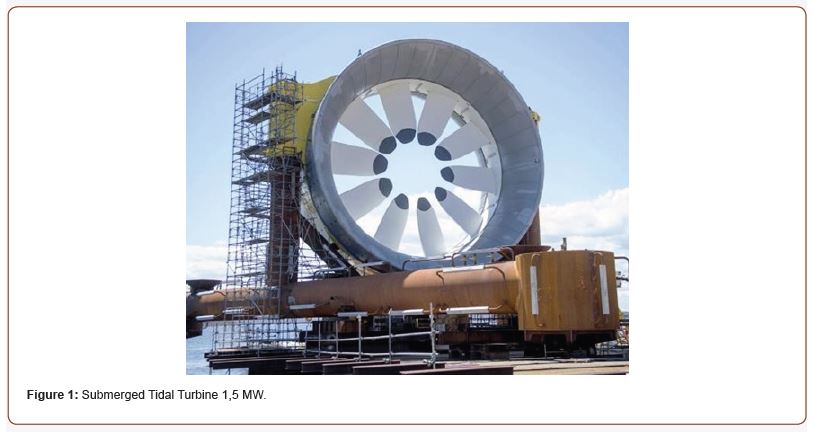
The power of the gas turbine is chosen according to the heat demanded, since it is the only installation that can provide it, considering a thermal efficiency of 50% and an electrical efficiency of 35%, according to the calculations in Annex A. On the other hand, efforts will be made to ensure that the gas turbine operates at the minimum load to optimize the cost of non-renewable energy, using tidal turbines to produce the maximum amount of electricity. Another situation that has not been considered, when determining the gas turbine, is the contribution of heat from the sun in solar panels. Its input is variable, depending on the weather, so that the turbine will be somewhat oversized, in principle, but depending on each solar input, its load will be regulated to lower values. First, and considering the percentage demand of the state, as well as the availability of wind and solar energy. Both, wind and solar energy are “disruptive” source, so they are subject to fluctuations and intermittent power, but not the energy coming from the tildes, which will be constant, therefore, the best tidal turbine is chosen, as it has a constant source of energy in this case (Figure 1).

Annex A
Table 2:
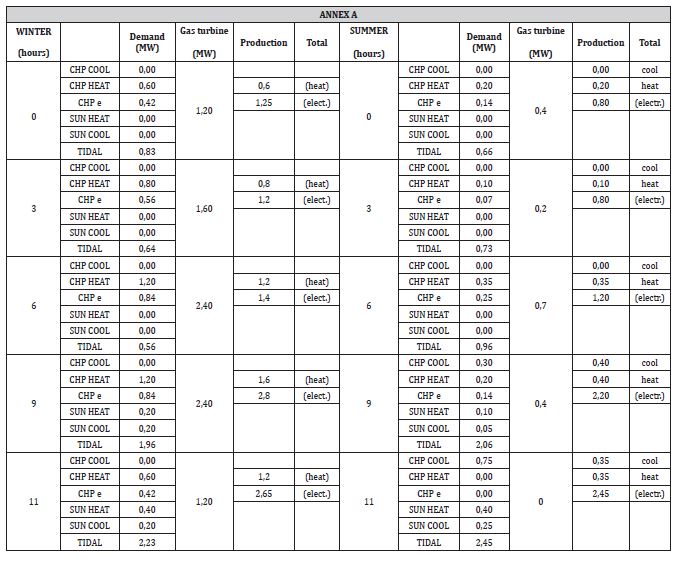
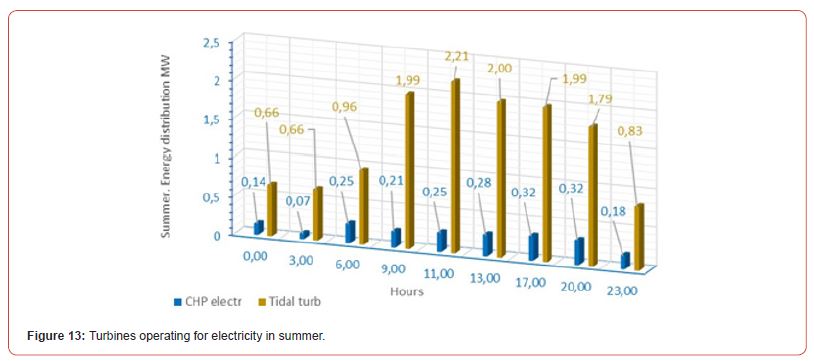
To summarize, we can see that the electricity consumption is supplied by tidal turbines with the support of the gas turbine. Heating/Cooling comes from the exhaust gases of the gas turbine and solar panels. Thermal storage is implemented. A Heat pump may be necessary. Finally, the remaining energy which has to be supplied by CHPC in winter and summer is shown in Figures 6&7 and is taken from annex A. Looking more closely at this Figure, on the winter night, the gas turbine must be started for the production of heat demanded and enhanced through the waste heat boiler, which is fed by the exhaust gases of this turbine. So, the turbine would not have to work if there was not heat demand. To optimize the system and to save costs, one of the tilde turbines can be switched off in winter months resulting in Figure 6. In contrast to this, the heating demand in summer is lower while the sun power is higher. Consequently, the gas turbine will have to assist the panels less.
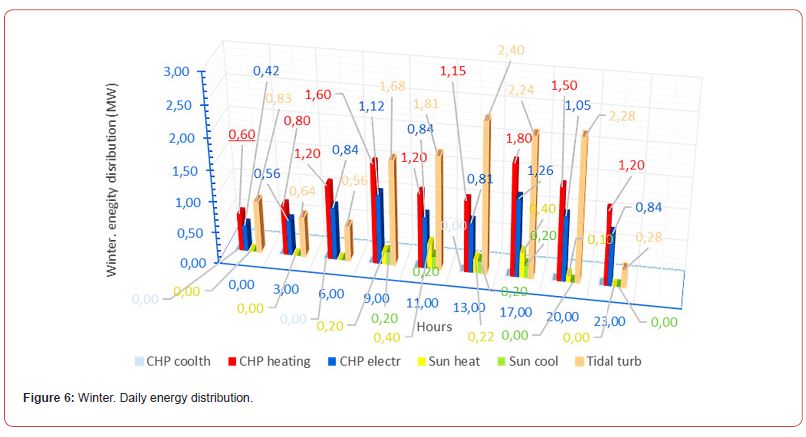
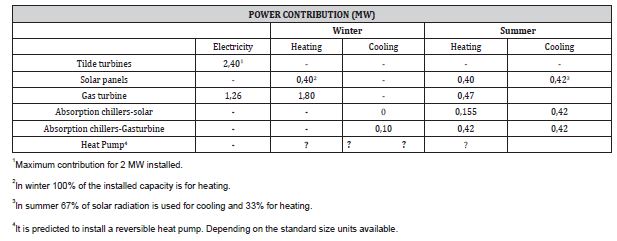
In the summer months, the heat demand is much lower, and the energy contribution of the spare tilde turbines in this season without the cogeneration system was much higher (Figure 7). In this way, there is no surplus of renewable energy in summer. An approximate efficiency of the gas turbine in cogeneration is considered, 35% for electricity and 50% for heat [8]. The estimated energy contribution from the different technologies is computed in Table 2. Consequently, two tidal turbines of 1,5 MW each (Open Hydro AR1500 tidal turbine, Figure 1), since the maximum electrical energy input of these tidal turbines is in winter, and their value is 2,40MW. However, two generators are chosen with the purpose of turning off one of them for low demand terms. In these periods maintenance tasks can be carried out. To capture solar radiation, evacuated tubes solar panels are proposed. The model is Suny system CPC 3.41, reflector:
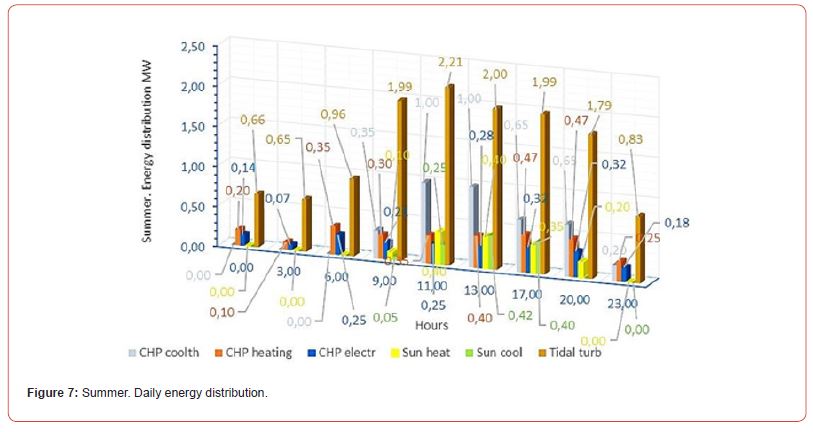
Table 3: Power contribution.
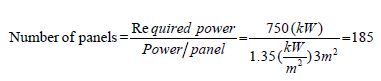
Their thermal yield is 1,350 kW/m2 and the surface 3 m2. Since we need 0,75 MW as minimum, 185 panel must be implemented. The maximum tidal turbine energy that would satisfy the total electricity demand is 2,40 MW. However, the aim is to design a mix of renewable and sustainable technologies in “island mode operation” and the values for both the energy and solar power are chosen to be combined with the CHP system, according Figures 6&7 and annex A. Solar power suggested for heating is 0,75 MW. This data is chosen after rejecting some solar power demand because of either we would need an incoherent number of panels, or the isolation is not enough.
Regarding solar radiation, three were compared:
a) Solar energy for electricity supply. This was rejected because tilde turbines energy is nearly always higher than solar energy for every day in the location in question.
b) All solar radiation to meet the heat demand. It was rejected because consequently, 100% of cooling demand would have to be supplied by other utilities. This would entail higher costs. Gas turbines have a great performance in this matter of heat, by means of exhaust gases.
c) Sharing out the solar radiation contribution between heating and cooling demand by means of an absorption chiller connected to solar panels or waste heat recovery Unit. To decide the balance of this distribution, thermal loads and the average value is considered:
c1) As an average, the cooling demand is 67% of heating demand in summer. Hence, the heat resulting from solar radiation supplies 33% of heating and 67% of cooling during this season.
c2) In winter, the isolation availability is considerably low, and it is therefore sent to provide just hot water. In fact, solar energy efficiency is not sufficient to produce cool in winter by means of absorption chiller. These devices require achieving temperatures between 55 and 95 0C. The waste-heat recovery system of CHP is expected to be sufficient to meet the heating demand.
As a result of the theoretical power capacity needed times the energy availability is designed according to the schematic diagram of the Figure 8, which would correspond to 5 p.m. on a summer day, according to Figure 7. An exhaustive demand control system must always be available so that an autonomous and intelligent system governs the production of each facility.
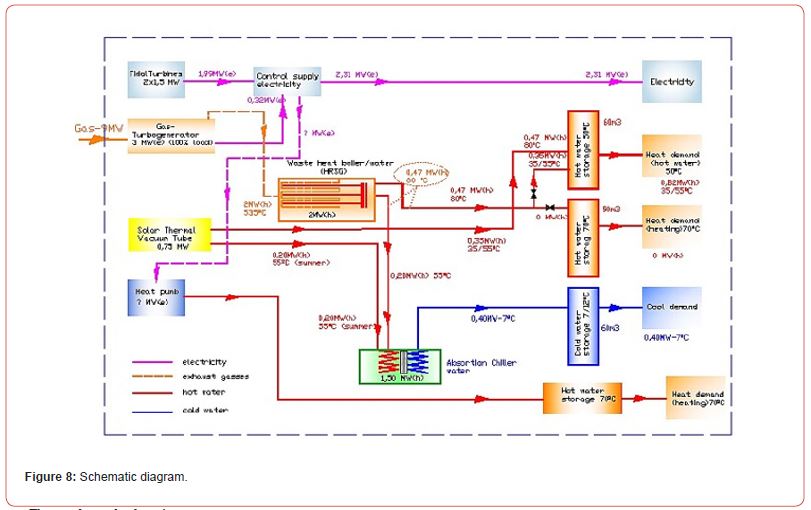
The used standards units were:
a) 2 Tidal turbines of 1,5 MW each, “Open Hydro”, diameter of 12 meters, 1000 tn.
b) 1 Gas Turbine of 3 MW(e) at 100% load, “Kawasaki”.
c) 1 Vacuum Tube Collectors of 3.41 m2, 0.75 MW, “Suny system”.
d) 1 Waste Heat Boiler (exhaust gases/hot water) of 3 MW, “Weissman”
e) 1 Water Absorption Chiller (hot water/chill water) of 3 MW, “Broad”.
f) 1 Buffer tank of chilled water: 60 m3, Ø = 3.5 m, height = 6.25 m.
g) 1 Buffer tank of hot water for heating: 60 m3, Ø = 3.5 m, height = 6.25 m.
h) 1 Buffer tank of hot water for domestic hot water: 90 m3, Ø = 4.0 m, height = 7.16 m.
Combined Heat and Power (CHP)
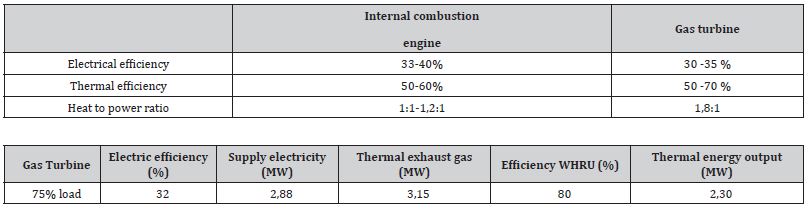
A gas turbine or an internal combustion engine are usually the motive power to drive the generator of a CHP system. Figure 9 illustrates how this technology produce both electricity and heating from the same fuel source. Although internal combustion engines have high electrical efficiency, they hold low thermal performance in comparison with gas turbines [9]. Furthermore, gas turbines’ heat to power ratio can be substantially higher than engines. This is a very helpful feature to know the quantity of heat recovered per unit of electricity and then to choose the best option (Table 3). According to the table above, it is therefore a CHP with Gas Turbine suggested must supply the maximum electricity and thermal demand considering the renewable contribution. These features are 3,50 MW for electricity and 1,80 MW for heating, as we can see from Figures 6&7. The turbo generator which fits the most to these values is Kawasaki Gas Turbine, turbine model M1T-21 and model generator GPS 3,5 MW(e) at 100% load with the following features for 15 0C of temperature air inlet, Thermal energy from exhaust gases of the turbine is above maximum demand, 1,80 MW, but the Waste Heat Boiler and the Absorption Chiller Water are still to be determined.
Waste Heat Recovery Unit (WHRU)
To produce the water heating system from the gas turbine´s exhaust gases, the following Waste Heat Recovery Unit is chosen, Viessmann model Vitomax 400-RW. Its power ranges from 1000 to 9000 kW with a maximum gasses temperature of 900 ºC. So, since exhaust gases heat is 3,15 MW at 75% load and the WHRU and efficiency is 80%, it is obtained 2,30 MW as heat output of the WHRU. This is higher than the maximum of 1,80 MW of heat demanded in winter.
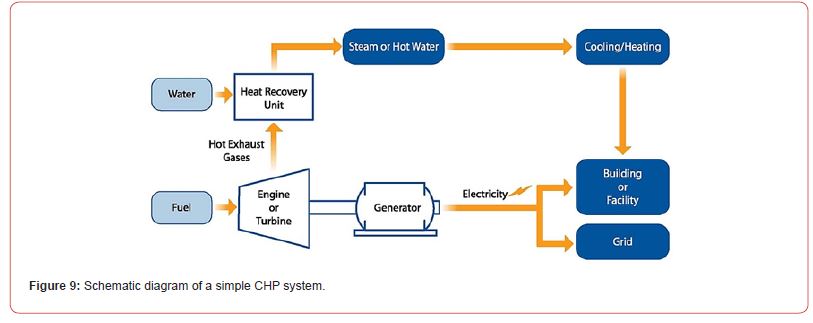
Table 4: Performance gas engine against gas turbine. Taken from Department of Energy and Climate Change UK [10].
Absorption Chiller
This device must be capable of supplying the maximum required chill water in summer, accounting for 1,10 MW, as can be seen from Annex A. “Broad WE model. BYD” is suggested with the following specifications.
Table 5:

At that point of maximum cool demand, 1,0 MW (Figure 4), it is important to mention that the warm water comes from solar radiation (0,42 MW, Figure 7) and from turbine cogeneration provides (1MW). Hence gas turbine operation can decrease until 30% of the load as shown table below (Table 4).
Table 6:Gas turbine specific features.
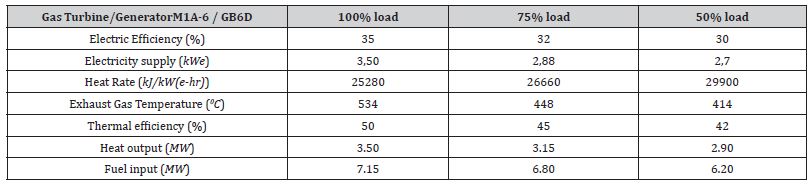
Table 7:

Thermal Storage
For the purposes of calculations of the thermal storage capacity and thus, always having heat energy supply, some assumptions taken from Iberdrola annual report [11] are considered. Otherwise, a detailed study of the load would be necessary. Consequently, and according to the Institute of Plumbing and Heating Engineering [12], the following buffer tanks are installed.
Water heating system
Table 8:

A Buffer tank bigger of 84843 l (33 l/person x 2571 people) is installed with specifications of 90 m3, 4 m diameter and 7,16 m height.
Heating
For a maximum rise temperature of 35 0C in winter (65 0C of extra water and 30 0C return water) the provided heat is given by
Q = m.Cp.ΔT [kcal]
Where m is the mass of water [kg], C is the Specific Heat (4,18 [kJ / kg0C]) and ΔT temperature raise between both systems. Maximum heat demand is 1,8 MWh in winter, which is equivalent to 1547721,41 Kcal, then 514936 kg of water are required. A Buffer tank of 514936 l is installed with specifications of 60 m3, 3,5 m diameter and 6,25 m height.
Cooling
The maximum cool demand is 1,10 MWh for summer which is equal to 946937,94 Kcal. Considering a rise temperature of 18 0C (70C of extra water and 25 0C return water). Likewise for heating, the volume of the tank is calculated, resulting in a Buffer tank of 52555 l. with specifications of 60 m3, 3,5 m diameter and 6,25 m height.
Results and Conclusions
To design a cogeneration plant is essential the heat to power ratio of the gas turbine or engine. This relation is remarkable bigger for gas turbines (1.8:2) than internal combustion engines. That is why it is decided to set up a Gas Turbine as turbo generator for the CHP system. In view of theoretical calculations, the available standard devices in market and the renewable generation detailed in section 3.1. and Figure 8.
Heating
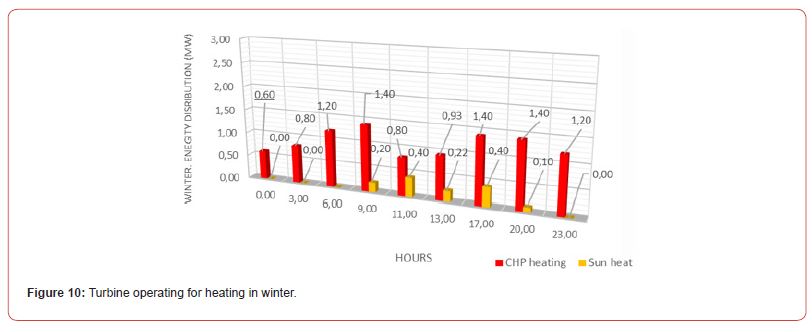
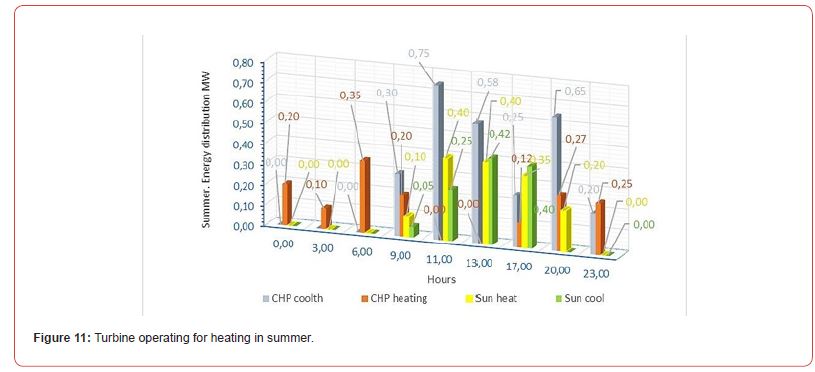
Heat output from the gas Turbine provides heat to the WHRU. In winter, this heat is sent to heat and domestic hot water to meet the overall demand of 1,80 MW (Figure 3) considering the solar contribution. It is clear from Figure 11 that the heat supplied by the turbine fits properly the remaining heat from solar energy. On the other hand, the heat from the exhaust gases in summer is significantly higher than required (Figures 10&11). This is due to the increased efficiency of solar panels, decreased heat demand, and increased cooling demand. The gas turbine could even be shut down at certain times, as shown in the Figure, so that renewables take over all the demand and the cost of gas fuel would be zero in those sections. If there is a surplus of this heat, it is properly sent to thermal storage. The supply of heat from solar panels, on the other hand, is a low contribution in winter, as shown in Figure 10.
Electricity
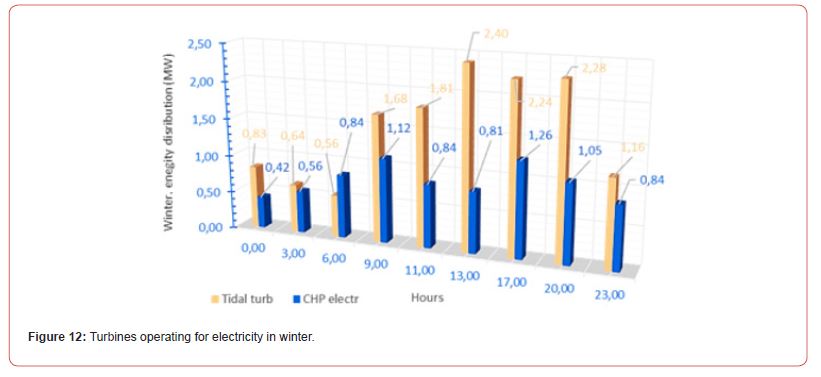
It can be seen in Figure 12, for example at 13 h, that the tidal turbines provide 2,40 MW and the gas turbine 0,81 MW, in total 3,21 MW meeting the electricity demand of 3,20 MW (Figure 2). This implies a gas turbine operation of 2,31 MW (for 35% electrical efficiency) and a ratio of 1,15 MW of exhaust gas heat (for 50% heat efficiency) that meets the heat demand at this time seen in the Figure 3. In this way, with the contribution of the tidal turbines and the match with the expected demands, the gas turbine can work at 30% of the load, with consequent fuel savings. In summer, in principle, the gas turbine is adjusted to produce the necessary heat, for example at 13h, 0,4 MW, which represents 0,8 MW of fuel gas (for the yields) and which represents a delivery of 0,28 MW of electricity. However, since the demand for electricity is 2,60 MW, at that time, according to Figure 2, the production of electricity by the tidal turbines must be increased to 2,40 MW, unless the solar production, always diverging, provides the heat necessary for the production of hot and cold water, in which case, according to the Figures 3&4, you could even shut down the gas turbine.
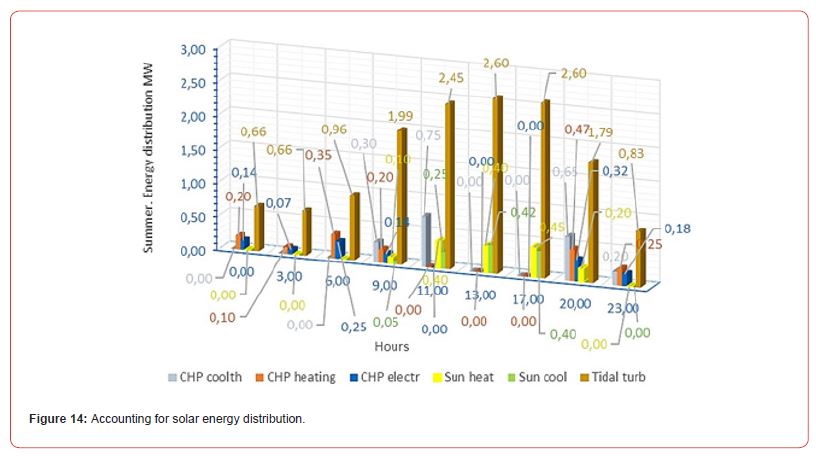
Overall, one can say that the gas turbine generates a surplus of electricity when it needs to produce the heat demanded and vice versa. In other words, electricity and heat supply work somehow against each other. Although a Trigeneration system has many advantages such as lower electrical usage during peak summer demand and high efficiency production of electricity, heat, and cooling; the fluctuations of the systems and the mix of technologies require an advanced automatic control. Figure 14 shows how if the contribution of solar energy is complete, the necessary heat and cold can be obtained in summer from this energy and it can even be possible to turn off the gas turbine between 11 a.m. and 5 p.m. in summer, so that the expenditure of gas fuel in that time slot would be zero [13-15].
Risk Assessment
A Risk Assessment for Decentralized Energy systems is entirely important since power generation, distribution network management and loads are not independent processes. The following risks should be managed:
a) Firstly, the need for forecasting: Renewable Energy intermittent leads to fluctuations to the electricity distribution. To manage this issue, effective prediction methods must be carried out, although in this case of choosing tidal turbines, and not wind generators, the only intermittency and uncertainty is that of solar generators, tidal turbines supply constant energy.
b) Modern automatic switch control: The use of a smart grid would lead to an increase of the reliability of the interconnection between suppliers and demand costumers. All the system has to be controlled by an advanced automatic control. Particularly, the Gas Turbine load is designed to work according to the demands and the tilde energy supply. The specific load range is 40%- 100% of the rated power. Although there is not energy demand enough, the turbine must work above 40% of the load due to technical specifications.
c) Excess of generation and energy storage: The gas turbine is considerably oversized for the generation of electricity in winter. Although all produced heat can be stored in the buffer tanks, the electricity is unfortunately missing because there is not possibility of store it. To manage this risk the following alternatives could be considered in depth:
a. Switching off the gas turbine in surplus periods such as between 0h and 8h in winter, or 11 h and 19h in summer. This solution would be feasible if a gas boiler is installed to meet the heat demand.
b. Using the spare electricity to heat water by means of heat pump or electrical boilers and then, it could be stored in tanks.
c. Managing the energy demand to soft the peaks and having a more constant demand.
d. Sharing the electricity if it is possible.
d) Failure of the turbine: In the case of any kind of failure, a replacement turbine must be available. Otherwise, the demand will not be satisfied.
References
- US Energy Information Administration (2018) Annual Energy Outlook with projections to 2040. Washington DC, USA.
- United Nations (2020) Department of Economic and Social Affairs. Population Division. World Urbanization prospects. New York, USA.
- European Parliament (2010) Policy Department Economic and Scientific Policy. Decentralized Energy Systems. Brussels, Belgium.
- Carbon Trust (2010) Introducing Combined and Heat Power. Department of Energy and Climate Change, the Department for Transport, the Scottish Government, the Welsh Assembly Government and Invest Northern Ireland, UK.
- London First (2018) Cutting the Capital’s Carbon Footprint Delivering Decentralized Energy.
- Department of Energy and Climate Change (2018) Energy consumption in the UK in 2018. Chapter 3. Domestic energy consumption in the UK between 1970 and 2018.
- Department of Energy and Climate Change (2018) Energy consumption in the UK in 2013. Chapter 3. Domestic energy consumption in the UK between 1970 and 2018.
- (2018) Combined Heat and Power Partnership. Environmental Protection Agency, New York, USA.
- (2018) United States Environmental Protection Agency. Technology Characterization: Reciprocating Engines. Washington DC, USA.
- (2018) Department of Energy and Climate Change, UK.
- Iberdrola (2020) Sustainability Report.
- Institute of Plumbing and Heating Engineering (IPHE) (2018) LOWHEAT. The Development of a New Domestic Heat Recovery. Technology for Low Grade Heat in Wastewater. European Commission. Research projects, United Kingdom.
- (2014) Combined Heat and Power Association.
- Fraga De Cal, P. Fraga López (2014) Urban Development with Distributed Generation. Dinamo Técnica 15: 15-19.
- Fraga (2014) Study and design of Distributed Generation for a new state in UK. Part I, London: Queen Mary University of London. Seminar: Systematic Modelling and Control of Multi-Vector Energy Systems in Microgrids.
-

This work is licensed under a Creative Commons Attribution-NonCommercial 4.0 International License.




