




 Review Article
Estuaries in Transition: The European Elbe between Major Harbor and NATURA 2000 Site
Received Date: March 07, 2024; Published Date: May 08, 2024
Abstract
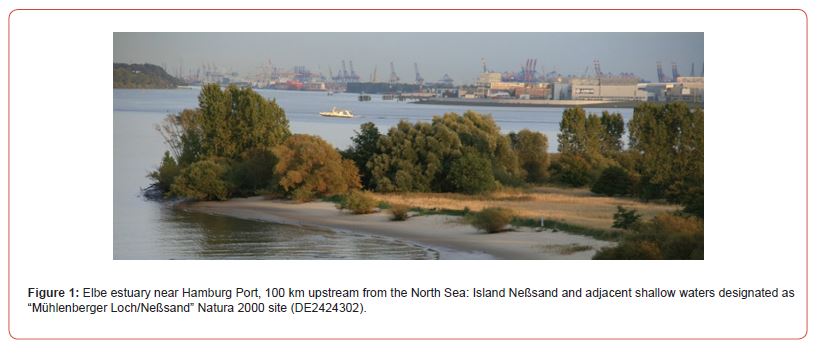
Estuaries are geomorphologically dynamic transition zones between the riverine and marine environment influenced by both sea and land forming a complex mosaic of different habitat types [1]. Within coastal plain estuaries in northwestern Europe and eastern North America where the tidal wave propagates far inland, tidal freshwater zones have been settled by humans and large cities with major harbors developed (e.g., Antwerp, Hamburg, Philadelphia, Rotterdam Washington) since ships could reach these sheltered locations connecting sea and upstream areas [2]. The Elbe estuary connects central Europe with the Atlantic via the North Sea and Hamburg Port comprising key shipping lines, major fishery but tidal freshwater wetland habitats are largely fragmented (Figure 1). Over 80% of European habitats are in poor shape according to European Parliament, which adopted the first law to restore at least 20% of the EU’s land and sea areas by 2030 and all ecosystems in need of restoration by 2050 (European Parliament 2024 www.europarl.europa.eu/news/en/press-room/20240223IPR18078/nature-restoration-parliament-adoptslaw- to-restore-20-of-eu-s-land-and-sea) which also includes estuarine habitats.
Keywords: Estuaries; habitats and species; anthropocene; integrated management
Introduction
Estuaries are geomorphologically dynamic transition zones between the riverine and marine environment influenced by both sea and land forming a complex mosaic of different habitat types. Within coastal plain estuaries in northwestern Europe and eastern North America where the tidal wave propagates far inland, tidal freshwater zones have been settled by humans and large cities with major harbors developed (e.g., Antwerp, Hamburg, Philadelphia, Rotterdam Washington) since ships could reach these sheltered locations connecting sea and upstream areas. The Elbe estuary is connecting central Europe with the Atlantic via the North Sea and Hamburg Port comprising key shipping lines, major fishery but tidal freshwater wetland habitats are largely fragmented (Figure 1). Over 80% of European habitats are in poor shape according to European Parliament, which adopted the first law to restore at least 20% of the EU’s land and sea areas by 2030 and all ecosystems in need of restoration by 2050 (European Parliament 2024 www. europarl.europa.eu/news/en/press-room/20240223IPR18078/ nature-restoration-parliament-adopts-law-to-restore-20-of-eu-sland- and-sea) which also includes estuarine habitats.
Changing conditions are common features in any estuarine system from the open sea to sheltered upstream stretches, with particular relevance for flooding, salinity and alterations in turbidity of the water column or in chemical composition [3]. A former definition of an estuary as “a semi-enclosed coastal body of water, which has a free connection with the open sea, and within which sea water is measurably diluted with fresh water derived from land drainage” [4] was extended to “an estuary is an inlet of the sea reaching into a river valley as far as the upper limit of tidal rise, usually being divisible into three sectors:
a) A marine or lower estuary, in free connection with the open sea.
b) A middle estuary subject to strong salt and freshwater mixing.
c) An upper or fluvial estuary, characterized by freshwater but subject to strong tidal action” [5].
This definition including tidal freshwater stretches has become the principle one, but the limits of an estuary continue to provoke debate, e.g. in the influence of European Union politics in estuarine ecology and estuarine conservation via the European Habitats Directive [6].
Estuarine habitats according to the European Habitats Directive
The European Habitats Directive (HD) (HD 1992; 92/43/EEC) aims to protect biodiversity on European level and EU member states were required to designate areas for conservation. Today, most of the European estuaries are designated as Natura 2000 sites, a legally binding network of Special Areas of Conservation (SACs) in EU member states. Within these Natura 2000 sites both habitat types (HD Annex I) and species (HD Annex II) are listed, for which the conservation or restoration of a good conservation status are intended [7] whereas Annex I lists in total 233 European natural habitat types, including “Estuaries” [8]. According to the Interpretation Manual of EU Habitats (European Commission 2013), an estuary is the “Downstream part of a river valley, subject to the tide and extending from the limit of brackish waters. River estuaries are coastal inlets where, unlike ‘large shallow inlets and bays’ there is generally a substantial freshwater influence.
The mixing of freshwater and sea water and the reduced current flows lead to deposition of sediments and often form intertidal sand and mud flats. Since the EU definition considers estuaries forming an ecological unit with the surrounding terrestrial habitat types, it is more accurate and closer to the definitions of Pritchard (1967) and Fairbridge (1980) than many other definitions. An estuary as a complex system can contain up to a dozen habitat types such as “Mudflats and sandflats” (1140), “Atlantic salt meadows” (1330), “Inland dunes with open grasslands” (2330), “Alluvial forests” (91E0), and estuaries are important habitats for species listed in the HD: e.g., the fish species twaite shad (Alosa fallax Lacépède), and the Elbe water dropwort (Oenanthe conioides Nolte ex Lange) which is an endemic plant species in tidal freshwater wetlands along the Elbe estuary.
Alteration of European estuaries: Elbe estuary in the Anthropocene
Estuarine transformation is an ongoing process since human settlement but has dramatically accelerated over the past millennia, destroyed more than half of the worldwide tidal wetland habitats and depleted species diversity [9]. Major hazards to estuarine systems can be categorized to (i) climate change (e.g. sea level), (ii) extreme events (e.g. storm surges), and (iii) human activities (e.g. deforestation, embankment, overexploitation) [10]. The human utilization of tidal freshwater wetlands for agriculture, industries and urbanization has resulted in estuarine degradation due to eutrophication, low dissolved oxygen, pollution with heavy metals and organic hydrocarbons and hydromorphological changes. Similar to other European major estuaries, the Elbe estuary has been subject to human hydromorphological changes. A weir limits the tidal stretch in 142 km distance of the North Sea since 1960. The port of Hamburg which was established 100 km upstream of the sea is in perpetual development (Figure 1).
To allow seawards access for increasingly larger vessels, deepening and widening of the fairway has been conducted. Fairway adjustment and flooding defense measures during the past decades (1870-2006) led to a about two meter increased tidal amplitude up to 360 cm at Hamburg Port [11,12] while increasing water volume and decreasing channel roughness has resulted in higher tidalfluvial energy and increased current velocities [13]. The increased tidal amplitude and pronounced flood tide led to “tidal pumping” with upstream directed sediment transport which challenge the fairway and Hamburg Port maintenance [14]. In comparison of six major European estuaries [15], the risk of sediment aggradation and contamination was classified as high for the Elbe estuary, whereas the flood risk was classified as moderate. However, the severe loss of shallow waters and foreshore as potential retention area due to embankments and disconnection of Elbe tributaries led to land subsidence behind dikes with increasing flood risk.
Land use change for agriculture further led to tidal wetland areal decrease in European coastal plain estuaries resulting in decreased services for flooding defense [16]. The term ‘Anthropocene’ underlines the increasing human impact on the environment, but it is difficult to distinguish accurately between natural variations of ecosystem states and human-induced changes in dynamic and naturally unstable estuaries. However, also fairway adjustment and flooding defense measures during the past decades (1870-2006) led to a about two meter increased tidal amplitude up to 360 cm at Hamburg Port. Transport network groups still claim, the HD leads to delayed Port projects, disadvantageous in contest for European port development [17]. Correspondingly, the most recent fairway adjustment of the Elbe Estuary was a highly contested planning process between Port and environmental interests, started in 2012 and led to delayed dredging works which started in 2019. Stakeholders have claimed dredging will lead to tidal wetland habitat loss, losses in fishery, and violates the HD [18].
Implementation of the European Habitats Directive in the Elbe estuary
Overview
The HD is a “Community legislative instrument in the field of nature conservation that establishes a common framework for the conservation” and provides the Natura 2000 site network, to “maintain and restore… natural habitats and species … of Community interest” (Interpretation Manual 2013). Ports as part of the community have particularly voiced concerns about ecosystem restoration regarding the interpretation of the HD. However, restoration of dynamics in European tidal freshwater wetlands is suggested to stimulate migrating fish species, reduce effects of tidal pumping and stimulate Nature-based flood protection e.g. in the Elbe and Rhine-Meuse estuaries [19]. The need for a strategic action plan encompassing aspects such as fisheries, navigation, nature conservation, tourism and economy led to concepts for sustainable development in the Elbe estuary. Management measures integrating port interests were proposed in the European Interreg IVB TIDE project based on the participation of four estuaries including the Elbe resulting in a toolbox for integrated estuarine management considering functioning, appropriate governance, and implementation of measures [20].
Currently, the Integrated Management Plan for the Elbe Estuary (2012) (IMP) is significant to implement measures in the Elbe estuary. The IMP is legally based on the HD and community based on the participation of stakeholders (e.g. Hamburg Port Authority; Northern Directorate for Waterways and Shipping) and the three resident federal states (Lower Saxony, Schleswig Holstein, Hamburg). The IMP was evolved to improve the conservation status of estuarine habitats, species and Natura 2000 sites along the Elbe estuary. The recently adopted Nature Restoration Law, aiming to restore at least 20% of the EU’s land and sea areas by 2030 and all ecosystems in need of restoration by 2050 [21], may strongly support these restoration efforts. The Elbe estuary as a whole, except Hamburg Port, is included in the Natura 2000 network. Impact assessments regarding the conservation objectives must be carried out for plans which may affect Natura 2000 sites considerably (Article 6, Parag. 3 HD). Moreover, management plans must be set up for each Natura 2000 site (Article 6, Parag. 1 HD), the conservation status of habitats and species must be monitored (Article 11 HD) and reported to the EU-Commission every 6 years (Article 17 HD).
Designation of Natura 2000 sites and measures along the Elbe estuary
The IMP (2012) is core for measures in Natura 2000 sites along the Elbe estuary. The plan proposes 200 measures and far more than half of them are implemented, in progress or in planning. The measures are implemented in the three resident federal states, most of them conducted by the Elbe Habitat Foundation, Hamburg Port Authority and Ministry for Environment. Downstream from Hamburg up to the North Sea, Natura 2000 sites are classified as “Estuaries” (1130) and extend continuously from the North Sea up to the Hamburg state border. In the federal state Hamburg, the Elbe estuary is not continuously covered by the HD but estuarine Natura 2000 sites are designated: e.g. “Mühlenberger Loch/Neßsand” stretches from the westernmost federal state border to the western border of Hamburg Port, the Natura 2000 site “Hamburger Unterelbe” extends from the eastern border of Hamburg Port up to the upper border of the estuary at the tidal limit. “Heuckenlock/ Schweenssand”, “Zollenspieker/Kiebitzbrack” and “Borghorster Elblandschaft” are further designated Natura 2000 sites in the context with “Hamburger Unterelbe” in Hamburg (European Union Environment Agency; http://natura2000.eea.europa.eu).
Diverse habitat types are present within these Natura 2000 sites: “Estuaries” (1130), “Inland dunes with open Corynephorus and Agrostis grasslands” (2330), “Xeric sand calcareous grasslands” (6120) and “Alluvial-Forest” (91E0) in Natura 2000 site “Mühlenberger Loch/Neßsand”; upstream of Hamburg Port the habitat types “Rivers with muddy banks with Chenopodion rubri pp and Bidention pp vegetation” (3270), “Hydrophilous tall herb fringe communities” (6430) and “Alluvial Forest” (91E0) are present, amongst others. The habitat type “Estuaries” (1130) occurs in the Natura 2000 site “Mühlenberger Loch” but not in the upstream from Hamburg Port located tidal freshwater stretch, corresponding to the definition of an estuary in the Habitats Interpretation Manual (2013) that tidal freshwater sites have not necessarily to be assessed as “Estuaries” (1130). However, according to the definition given by Fairbridge (1980) the tidal stretch comprises the whole tidal freshwater part of the Elbe estuary. Tidal freshwater wetlands are of high relevance: a priority species listed in Annex II and IV of the Habitats Directive, the Elbe water dropwort occurs only in tidal freshwater wetlands.
The species is endemic to the Elbe estuary but recently endangered by extinction due to the loss of tidal freshwater wetlands [22-24]. Neubecker et al. (2010) showed experimentally that the first establishment of the species by sowing seeds on bare flats and planting rosettes within competing herbs is generally possible. However, an estuary is a highly dynamic environment exhibiting diverse ephemeral habitats where physical disturbance is a common feature. Where the physic-chemical structure is modified, ecosystem recolonization by the biota and their structure and functioning can be expected in ecological engineering for estuarine restoration. Measures that allow the evolution of dynamic habitats for the establishment of the Elbe water dropwort in Natura 2000 sites along the tidal freshwater stretch in Hamburg (Figures 2&3) were applied by the Elbe Habitat Foundation, Hamburg Port Authority, and the Ministry for Environment according to the IMP (2012) for both the development of Alluvial Forests in the tidal expression and mud flats for the Elbe water dropwort. However, academic research is strongly suggested to evaluate the restoration success and the sustainability of measures via long-term monitoring on a scientific base.


Conclusion
The Elbe estuary is a navigation channel of global importance and a model system for estuarine transitions in the Anthropocene. The tidal stretch is severely altered due to fairway adjustment and flood defense measures further led to losses of former floodplains. Estuarine management to maintain or restore natural structures and functions for ecological and socio-economic needs is challenging. However, tidal wetlands in a good conservation status serve to protect biodiversity according to the European Habitat Directive (HD, 1992; 92/43/EEC) and contribute to ecosystembased coastal defense [25]. To recolonize degraded ecosystems by estuarine biota, the physical disturbance should be restored [26]. Estuarine restoration focused on priority habitats and species according to the HD should create bar ground: e.g. for disturbance adapted alluvial forests [27] and tidal flow creates mud flats e.g. for the endemic Elbe water dropwort [28]. Conservation measures should involve Natura 2000 sites (Article 6, Parag. 3 HD) and the conservation status of habitats and species should be monitored (Article 11 HD). Integrating navigation and economy, ecology and flood defense in adopted integrated estuarine management is mandatory, e.g. based on the Integrated Management Plan, 2012 [29] for the Elbe estuary. Implementing the Nature Restoration Law, the first law to restore at least 20% of the EU’s land and sea areas by 2030 and all ecosystems in need of restoration by 2050 (European Parliament 2024) could further enhance restoration in European estuaries in the Anthropocene.
Acknowledgement
Thanks to colleagues of the Department Estuarine and Delta Systems, Royal Netherlands Institute for Sea Research, NL, colleagues at the Ministry of Environment and Hamburg Port authority for discussions on the topic, and the invitation of the editor to contribute to this issue of AOMB.
References
- Meire P, Ysebaert T, Van Damme S, Van den Bergh E, Maris T, et al. (2005) The Scheldt estuary: a description of a changing ecosystem. Hydrobiologia 540(1): 1-11.
- Baldwin AH, Barendregt A, Whigham DF (2009) Tidal freshwater wetlands, an introduction to the ecosystem. Barendregt A, Whigham DF, Baldwin AH, (Eds.,), Tidal Freshwater Wetlands. Backhuys Publishers, Leiden pp. 1-10.
- Elliott M, McLusky DS (2002) The Need for Definitions in Understanding Estuaries. Estuarine, Coastal and Shelf Science 55(6): 815-827.
- Pritchard DW (1967) What is an estuary: physical viewpoint. Lauff GH (Ed.,) Estuaries. American Association for the Advancement of Science, Washington, DC, USA, pp. 3-5.
- Fairbridge RW (1980) The estuary: its definition and geochemical role. Olausson E & Cato I (Eds.,), Chemistry and geochemistry of estuaries, John Wiley, New York, PP. 1-35.
- European Habitats Directive (1992) Council Directive 92/43/EEC of 21 May 1992 on the Conservation of Natural Habitats and of Wild Fauna and Flora.
- Markus-Michalczyk H, Michalczyk C (2018) Make me a willow cabin at your gate: Legislation and implementation of tidal forest restoration. Estuar Coast Shelf Sci 210: 1-6.
- European Union Environment Agency. Natura 2000 Network Viewer.
- Lotze HK, Lenihan HS, Bourque BJ, Bradbury RH, Cooke RG, et al. (2006) Depletion, degradation, and recovery potential of estuaries and coastal seas. Science 312: 1806-1809.
- Jennerjahn TC, Mitchell SB (2013) Pressures, stresses, shocks and trends in estuarine ecosystems - an introduction and synthesis. Estuar Coast Shelf Sci 130: 1-8.
- Fickert M, Strotmann T (2007) Hydrodynamische Entwicklung der Tideelbe. Gönnert G, Pflüger B, Bremer JA, (Eds.,), Von der Geoarchäologie über die Küstendynamik zum Küstenzonenmanagement. Hamburg, pp. 59-68.
- Kappenberg J (2014) Das Elbe-Ästuar – Natürliche Entwicklung und menschliche Eingriffe. Ratter BMW, Holdschlag A, Das Elbe-Ästuar – Natur, Kultur- und Wirtschaftsraum unter Nutzungsdruck. Hamburg (Ed.,), Hamburger Symposium Geographie 6: 11-23.
- Kerner M (2007) Effects of deepening the Elbe Estuary on sediment regime and water quality. Estuar Coast Shelf Sci 75(4): 492-500.
- Freitag C, Ohle N, Strotmann T, Glindemann H (2007) Concept of a sustainable development of the Elbe estuary. Dohmen-Janssen CM, Hulscher SJMH, (Eds.,), River, coastal and estuarine morphodynamics: RCEM. Taylor & Francis, London, PP. 1085-1092.
- Rovira A, Ballinger R, Ibáñez C, Parker P, Xavier S, et al. (2014) Sediment imbalances and flooding risk in European deltas and estuaries. Journal of Solids and Sediments 14(8): 1493.
- Temmerman S, Meire P, Bouma TJ, Herman PMJ, Ysebaert T, et al. (2013) Ecosystem-based coastal defense in the face of global change. Nature 504: 79-83.
- Morris RKA (2011) The application of the Habitats Directive in the UK: compliance or gold plating? Land Use Pol 28(1): 361-369.
- Hein J, Thomsen J (2023) Contested estuary ontologies: The conflict over the fairway adaptation of the Elbe River, Germany. Environment and Planning E: Nature and Space 6(1): 153-177.
- Barendregt A (2009) Restoration of tidal freshwater wetlands. Barendregt A, Whigham DF, Baldwin AH, (Eds.,), Tidal Freshwater Wetlands. Backhuys Publishers, Leiden, pp. 223-232.
- Saathoff S, Knüppel J, Manson S, Boerema A (2013) Management Measures Analysis and Comparison. Investigation of Measures Planned and Implemented at the Estuaries of Weser, Elbe, Humber and Scheldt. Study Report in the Framework of the Interreg IVB Project TIDE. Oldenburg, Hamburg, Hull, Antwerp. www.tidetoolbox.eu.
- European Parliament (2024) Nature Restoration Law.
- Struyf E, Jacobs S, Meire P, Jensen K, Barendregt A (2009) Plant communities of European tidal freshwater wetlands. Barendregt A, Whigham DF, Baldwin AH, (Eds.,), Tidal Freshwater Wetlands. Backhuys Publishers, Leiden, PP. 59-70.
- Neubecker J, Kohler S, Obst G, Jensen K (2005) Der Schierlings-Wasserfenchel – erfolgreiche Ansiedlung einer prioritären FFH-Art an der Elbe Nat Landsch 37: 248-255.
- Jensen K (2014) Biodiversität und Ökosystemfunktionen von Vordeichflächen an der Tide-Elbe. Ratter BMW, Holdschlag A, Das Elbe-Ästuar – Natur-, Kultur- und Wirtschaftsraum unter Nutzungsdruck. Hamburger Symposium Geographie 6: 37-54.
- Bouma TJ, Temmerman S, van Duren LA, Martini E, Vandenbruwaene W, et al. (2013) Organism traits determine the strength of scale-dependent bio-geomorphic feedbacks: a flume study on three intertidal plant species. Geomorphology 180-181: 57-65.
- Elliott M, Mander L, Mazik K, Simenstad C, Valesini F, et al. (2016) Ecoengineering with Ecohydrology: successes and failures in estuarine restoration. Estuar Coast Shelf Sci 176: 12-35.
- Karrenberg S, Edwards PJ, Kollmann J (2002) The life history of Salicaceae living in the active zone of floodplains. Freshwater Biology 47(4): 733-748.
- Bouma TJ, van Belzen J, Balke T, Zhu Z, Airoldi L, et al. (2014) Identifying knowledge gaps hampering application of intertidal habitats in coastal protection: Opportunities & steps to take. Coast Eng J 87: 147-157.
- BU Netz, Guenther Eichweber, GM Heinze, B Hochfeld, E Klocke (2013) The integrated management plan for the Elbe estuary: An inter-state approach. Elbe estuary working group.
-

This work is licensed under a Creative Commons Attribution-NonCommercial 4.0 International License.




