




 Case Report
Unexplained Asymmetrical Sensorineural Hearing Loss in a Patient with Cerebral Small Vessel Disease: Plausible Association
Received Date: September 10,2025; Published Date: September 29, 2025
Keywords: Sensorineural hearing loss, white matter hyper-intensities, white matter disease, cerebral small vessel disease, atherosclerosis, ischemia, and infarction.
Clinical Image
Case presentation
We report a case of a 65-year-old female, who presented with unexplained unilateral sensorineural hearing loss (SNHL). Extensive ENT and neurological workup was negative except for the presence of several white matter hyper-intensities on the MRI (Magnetic Resonance Imaging) (Figure 1), characteristic of extensive white matter disease (WMD) or cerebral small vessel disease (CSVD).
Discussion
White matter (WM) is present beneath the gray matter (GM) in the brain. WM comprises of myelinated axons, dendrites and glial cells, thence allowing exchange of information for orchestrating various motor and cognitive functions [1]. Any course of action that causes ischemia of the microvasculature feeding the myelinated axons of WM can trigger the onset of CSVD or WMD [1]. The main risk factor that predispose to the manifestation of CSVD is atherosclerosis, thus advancing age, overweight, hypertension, diabetes, hyperlipidemia, smoking, alcohol, elevated homocysteine and proteinuria are commonly implicated [2]. CSVD is defined as atherosclerotic narrowing of the small vasculature, capillaries and venules of the brain, thus instigating various brain lesions noticeable on MRI (Magnetic Resonance Imaiging) [3]. The hallmarks signs of CSVD seen in MRI can range from white matter hyper intensities (WMH), vascular lacunae, micro-hemorrhages and micro- infarctions [4, 5]. Although these lesions are commonly seen in the elderly patients, their presence in the sizeable territory of the brain might portend the future risk of stroke, cognitive decline, dementia, and depression [6]. The prevalence of CSVD in the elderly population is estimated to be 20% at 60 years [7]. Although CSVD is commonly asymptomatic, in some instances it can present with cognitive decline, urinary incontinence, gait instability, and neuropsychiatric disorders [1]. However, its presentation with idiopathic sudden unilateral sensorineural hearing loss (SNHL) is very rare and unusual. The most common causes of SNHL include cochlear ischemia or infarction, pro-coagulant genes, vestibular schwannoma, and intralabyrinthine hemorrhage [8]. Our patient presented with unexplained SNHL and also had extensive WMD. Extensive work up including neurological and ENT (Ear-Nose-Throat) evaluation did not reveal any probable causes for her unilateral SNHL. Several studies performed so far did not reveal any conceivable relationship between WMD and SNHL [3, 9-12]. However, in patients with SNHL, the presence of severe white matter lesions, high neutrophil- to-lymphocyte ratio, high platelet-to-lymphocyte ratio and increased hearing in the normal ear are the harbinger for poorer prognosis[8]. With all the possible causes excluded in this patient, WMD with its heightened cardiovascular risk is likely a presumable hypothesis for inception of SNHL. Currently, there are no treatments available for SNHL in this patient. With that being said, treatment strategies that will mitigate the vascular impairment including systemic corticosteroids, hyperbaric oxygen therapy, prostaglandin E1, defibrinogenation therapy, and hydrogen inhalation therapy were previously tried with no definitive success [11]. Current evidence based studies suggest that life style changes including control of control of hypertension, diabetes and hyperlipidemia might might reduce the risk of WHD, thus lowering the onset of vascular impairment and subsequent SNHL
Case Highlights
In patient presenting with SNHL, a thorough evaluation of possible causes of SNHL including tumors, injury, hemorrhage and ischemia should be meticulously performed. Once all the causes are excluded, it might be attributed due to the presence of severe atherosclerotic microvasculature occlusion of cochlear circulation supplying the inner ear. WMD can present itself with dementia, functional decline, psychiatric disorders or stroke. WMD presenting itself with SNHL is not reported in the literature, although its presence might portend a poor prognosis due to the presence of vascular impairment (Figure 1).
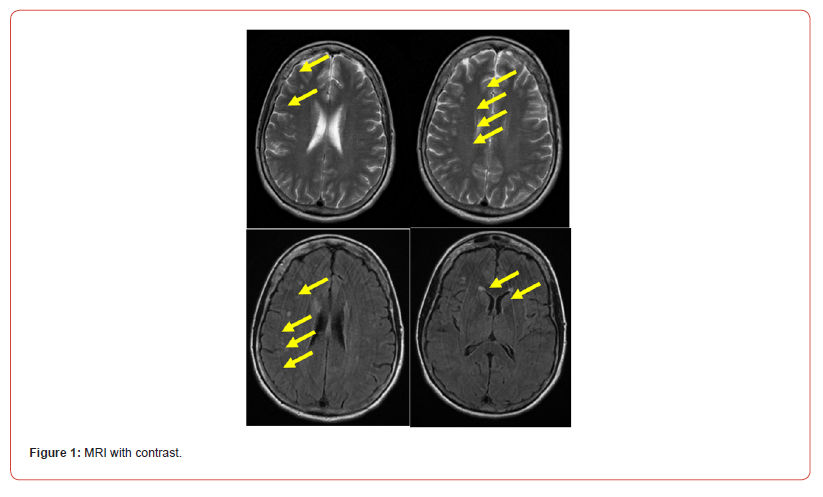
Ventricles are unremarkable in size and shape. No mass or mass effect. No evidence of hemorrhage. There are several punctate foci of demyelinization of the cerebral hemispheres bilaterally. No acute infarct identified. No abnormal enhancement noted. 7th and 8th nerve complexes are unremarkable bilaterally. The pituitary is unremarkable. Flow-voids are present in the major vessels. Orbits are unremarkable. Sinuses are clear.
Declarations:
- Ethical Approval and Consent to participate: Not Applicable
- Consent for publication: Consent taken
- Availability of data and materials: Not Applicable
- Competing interests: Not Applicable
- Funding: Not Applicable
- Acknowledgements: Not applicable.
Authors’ Contributions
Conceptualization, S.H.K & KM; Methodology, S.H.K & KM; Software, N.G.; Validation, N.A; Formal Analysis, N.A.; Investigation, S.H.K & VP.; Resources, N.A.; Data Curation, N.A.; Writing– Original Draft Preparation, S.H.K & KM.; Writing– Review & Editing, S.H.K.& KM.; Visualization, S.H.K.; Supervision, K.M..; Project Administration, K.M.
Acknowledgement
None.
Conflict of Interest
No Conflict of interest.
References
- Sharma R SS, Lui F, et al. (2025) White Matter Lesions, StatPearls Publishing [Internet].
- Zheng, K, et al. (2023) "Analysis of Risk Factors for White Matter Hyperintensity in Older Adults without Stroke." Brain Sci 13(5).
- Oussoren FK, et al. (2023). "Cerebral Small Vessel Disease in Elderly Patients with Sudden Sensorineural Hearing Loss." Otol Neurotol 44(3): e171-e177.
- Fazekas F, et al. (1987) "MR signal abnormalities at 1.5 T in Alzheimer's dementia and normal aging." AJR Am J Roentgenol 149(2): 351-356.
- Fazekas F, JM Wardlaw (2013) "The origin of white matter lesions: a further piece to the puzzle." Stroke 44(4): 951-952.
- Debette S, et al. (2010) "Association of MRI markers of vascular brain injury with incident stroke, mild cognitive impairment, dementia, and mortality: the Framingham Offspring Study." Stroke 41(4): 600-606.
- Smith EE, et al. (2017) "Prevention of Stroke in Patients With Silent Cerebrovascular Disease: A Scientific Statement for Healthcare Professionals From the American Heart Association/American Stroke Association." Stroke 48(2): e44-e71.
- Tsuzuki N, K Wasano (2024) "Idiopathic sudden sensorineural hearing loss: A review focused on the contribution of vascular pathologies." Auris Nasus Larynx 51(4): 747-754.
- Debette S, H Markus (2010) "The clinical importance of white matter hyperintensities on brain magnetic resonance imaging: systematic review and meta-analysis." Bmj 341.
- Ciorba A, et al. (2019). "White matter lesions and sudden sensorineural hearing loss." Journal of Clinical Neuroscience 65: 6-10.
- Fusconi M, et al. (2019). "Is there a relation between sudden sensorineural hearing loss and white matter lesions?" European Archives of Oto-Rhino-Laryngology 276(11): 3043-3049.
- Oussoren FK, et al. (2023) "Cerebral Small Vessel Disease in Elderly Patients With Menière’s Disease." Otology & Neurotology Open 3(2): e034.
-

This work is licensed under a Creative Commons Attribution-NonCommercial 4.0 International License.




