


 Case Report
The Influence of Baduanjin Intervention on the Health of College Students in Low-Temperature Environments
Received Date: July 01, 2026; Published Date: July 15, 2026
Abstract
Objective: This randomized controlled trial examined the effects of a 12-week Baduanjin intervention performed in a low-temperature environment (0–4°C) on resting heart rate (RHR), heart rate variability (RMSSD), blood pressure, and fasting glucose in college students. Eightyseven participants aged 18–20 were allocated to a control group (prolonged sitting), a regular exercise group (1 h, 5 times/week), or the Baduanjin group (low-temperature Baduanjin). RHR and RMSSD were measured daily (Polar H10); blood pressure and glucose were monitored with validated devices. In the Baduanjin group, RHR decreased significantly from 84.14±5.76 to 75.49±6.80 bpm, and RMSSD increased from 35.38±12.26 to 47.72±8.71 ms (P<0.05), with greater improvements than the regular exercise group (RHR: 83.93±6.71 to 76.88±6.07 bpm; RMSSD: 35.97±11.74 to 44.28±10.89 ms). The control group showed no significant changes. Systolic and diastolic blood pressure and fasting glucose did not change across groups (P>0.05). Thus, low-temperature Baduanjin effectively reduced RHR and enhanced RMSSD, outperforming regular free exercise and offering a practical health promotion strategy for college students in cold northern winters.
Keywords:Low-temperature environment; Baduanjin; College student; Resting heart rate; RMSSD
Introduction
The China Climate Bulletin (2024) indicates that winter in northern China has become characterized by elevated temperatures. In 2024, a total of 33 cold air processes will impact China, including 5 cold wave events. This figure represents an increase of 3.9 cold air processes compared to the historical average, while the number of cold wave processes remains consistent with the previus average at 5.4. The cold wave at the beginning of the year reulted in a marked decrease in temperatures and had a widespread effect. Although there is no extended period of extreme low tem peratures during the northern winter, regional low-temperature events occur with regularity. Additionally, due to the specific needs of college students, such as course schedules and outdoor physial activities, the average daily exposure to low temperatures can reach 2 to 3 hours. This makes college students a significant demographic exposed to low-temperature environments. Prior research has demonstrated that the duration of aerobic endurance exercise among college students in low-temperature settings is significantly longer than in normal-temperature conditions (Han et al., 2025). This finding indicates that moderate low-temperature environment training for college students may significantly enhance their sports performance in normal temperature conditions, thereby offering new insights for optimizing sports training programs [1].
Among the various exercise modalities suitable for integration into the low-temperature training regimen, the traditional Qigong exercise Baduanjin is particularly notable for its unique movements and health-promoting attributes. Baduanjin, a traditional Chinese qigong practice originating in ancient China, harmonizes the body and mind. It is characterized as a medium to low-intensity fitness method comprising eight distinct, gentle, and slow movements and postures (Koh, 1982) [2]. This practice emphasizes the coordination of physical and mental focus, the symmetry of postures and movements, and the harmony of breathing and meditation. Baduanjin not only facilitates the unblocking of meridians but also aids in regulating the balance of Yin and Yang and the circulation of qi and blood (An et al., 2013) [3].
College students are at a critical stage for acquiring knowledge and cultivating healthy behaviors, exhibiting significant plasticity (Hutchesson et al., 2021) [4]. Most health-related behaviors are established during late adolescence and early adulthood (Ballard et al., 2019) [5]. During this developmental phase, college students are particularly susceptible to metabolic diseases, such as obesity, potentially linked to the increasing integration of digital technology into daily life. A sedentary lifestyle has become increasingly prevalent among teenagers and college students globally (Castro et al., 2020) [6]. This trend has contributed to a decline in body size, physical function, and overall quality of life. Furthermore, due to limited rest periods and prolonged sitting, college students often experience reduced motor function, which is evident in body asymmetry and diminished trunk stability (Ge et al., 2021) [7]. An increasing body of evidence suggests that Baduanjin training offers significant benefits in enhancing physical functions, mental health, cognitive abilities, and reducing the risk of chronic diseases among the elderly with various health conditions(Cheng, 2015; Wang et al., 2021; Zou et al., 2018) [8-10],Additionally, a separate study has demonstrated that practicing Baduanjin at room temperature can improve proprioception, flexibility, and explosive power in the lower limbs of college students (Li et al., 2015) [11]. Nevertheless, there remains a paucity of research regarding the effects of Baduanjin practice on the physical fitness of college students in northern China during winter. Therefore, this experiment investigates the influence of Baduanjin in a low-temperature environment on the health of college students and posits the following hypothesis: Regular participation in Baduanjin practice in a low-temperature environment can significantly enhance the physical fitness levels of young college students.In this study, we categorized college students into three groups to investigate the effects of regular Baduanjin exercise in a low-temperature environment on their health indicators.
Research Methods and Design
Research Design
This parallel controlled trial evaluates the effects of Baduanjin exercise conducted in a low-temperature environment on the physical health indicators of college students. A total of 87 eligible students from Yulin University were recruited and assigned to the control group, the regular exercise group, and the experimental group in a 1:1:1 ratio. Relevant indicators were measured every Friday morning
Participants
A total of 87 college students, aged 18 to 20, were recruited from Yulin University for this study. Prior to participation in the relevant activities, each student underwent a physical examination, and their health histories were obtained from the university’s medical staff. The specific exclusion criteria included the following: (1) any diagnosed disability or disease that could influence training responses and heart rate (HR); (2) any medication that may affect HR; and (3) cardiovascular diseases, musculoskeletal disorders, or contraindications to exercise.
Intervention Methods
Experimental Group: Participants in the experimental group convened daily at 6 a.m. in an environment with a temperature ranging from 0°C to 4°C and a relative humidity of 30%, aligned with their habitual physical activity levels. They practiced Baduanjin exercise for one hour, five days a week, over a 12-week intervention period. The Baduanjin sessions were supervised by two qualified coaches with over five years of experience in physical education. The training program adhered to the “Health-Preserving Qigong - Baduanjin” guidelines issued by the General Administration of Sport of China, encompassing 10 postures, including both the starting and concluding positions. 2. Regular Exercise Group: Participants in the regular exercise group engaged in jogging for one hour each day, five days a week, for a duration of 12 weeks. 3. Control Group: This group consisted of college students who engaged in prolonged periods of sitting.
Test Indicators
Resting heart rate (RHR) refers to the heart rate of an individual while awake and at rest, serving as a fundamental indicator of cardiovascular system function. This measurement was obtained in a quiet sitting position. Subjects wore a Polar H10 sensor heart rate monitor to facilitate the collection and recording of relevant data. 2. RMSSD: This metric denotes the root mean square of the differences between adjacent normal cardiac cycles and serves as a primary time-domain indicator of Heart Rate Variability (HRV), measured concurrently with resting heart rate. 3. Blood pressure (BP): This includes systolic blood pressure, which represents the maximum pressure in blood vessels during the heart’s systolic phase, and diastolic blood pressure, which reflects the resistance in blood vessels during diastole. An Omron HEM-7132 upper arm electronic blood pressure monitor was utilized for these measurements. Prior to measurement, subjects remained seated and still for 15 minutes. Measurements were taken three times consecutively, with a one-minute interval between each, and the average value was calculated. 4. Fasting blood glucose (FBG) reflects the homeostasis of glucose metabolism. The Roche ACCU-CHEK Guide Me portable fingertip blood glucose meter was employed for measurement. Prior to measurement, the fingertip was disinfected with 75% alcohol, and the second drop of blood was collected for testing.
Statistical Analysis
Analyses were performed using SPSS (version 23.0; IBM Corp, Armonk, NY) and Microsoft Excel 2016 software.Descriptive statistics for all variables were computed, and values were reported as mean ± SD with a 95% confidence interval (CI). Sample distribution for resting heart rate (RHR) and root mean square of successive differences (RMSSD) in the afternoon was assessed using the Polar H10 sensor heart rate monitor. Blood pressure was measured with the Omron HEM-7132 upper arm electronic sphygmomanometer, while fasting blood glucose was assessed using the Roche ACCU-CHEK Guide Me portable fingertip blood glucose meter. To evaluate differences in measurements before and after the intervention, RHR, RMSSD, systolic blood pressure, diastolic blood pressure, and fasting blood glucose were determined on a weekly basis.
Results
The baseline resting heart rates of the three subject groups prior to the various activity interventions were comparable (87.97±9.13 bpm in the control group, 83.93±6.71 bpm in the conventional exercise group, and 84.14±5.76 bpm in the experimental group), with no significant differences observed between the groups (P > 0.05) (Table 1). This indicates that the baseline characteristics of the three groups are similar. Post-intervention heart rate changes revealed that the resting heart rate of the control group experienced a slight increase (93.21±8.67 bpm), although this change was not statistically significant (P = 0.0740). In contrast, the resting heart rates of both the conventional exercise group and the experimental group significantly decreased following the intervention, reaching 76.88±6.07 bpm and 75.49±6.80 bpm, respectively. These differences were highly significant compared to the pre-intervention values (all P < 0.0001). A two-factor analysis of variance indicated a significant main effect of time (F = 9.924, P = 0.0019), and the interaction effect between groups and time was also highly significant (F = 15.72, P < 0.0001). These findings suggest notable differences in the patterns of resting heart rate changes over time among the different groups. The results depicted in the box plot (Figure 1) aligned with the statistical analysis. The positions of the box plots for the three groups prior to the intervention were similar, indicating no difference in baseline levels. Following the intervention, the box plot for the control group showed no significant change, whereas the box plots for both the regular exercise group and the experimental group exhibited significant decreases (as indicated in the figure, * * and * * * correspond to P < 0.01 and P < 0.001, respectively). This visually illustrates the impact of exercise interven tion on reducing resting heart rate, with no significant difference - observed between the two exercise intervention methods (Figure 1 & Table 1).
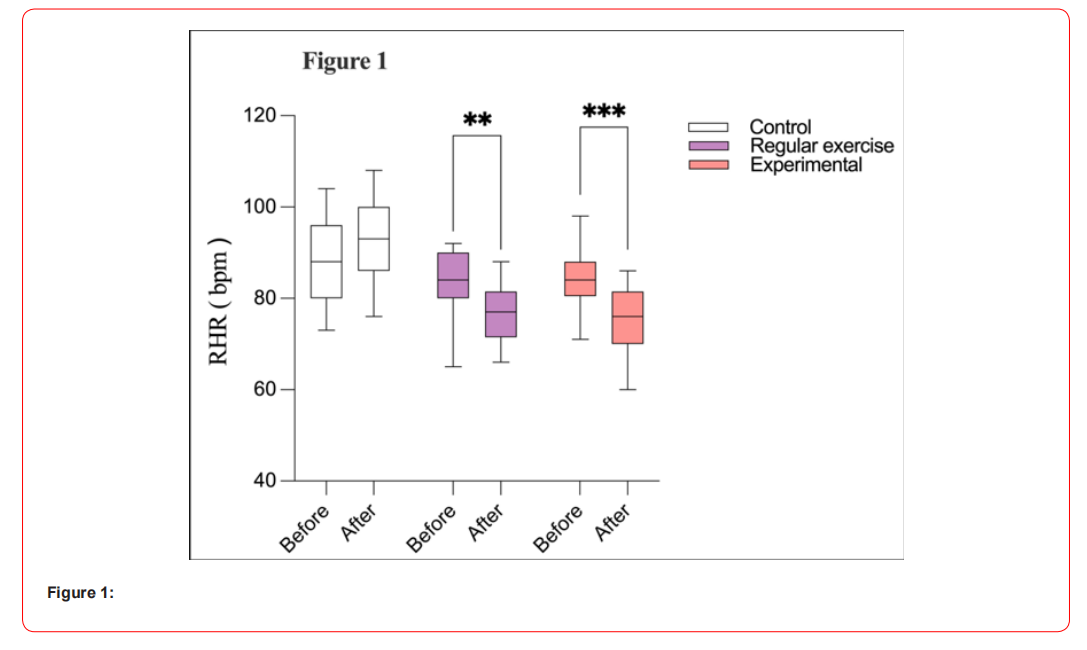
Table 1:

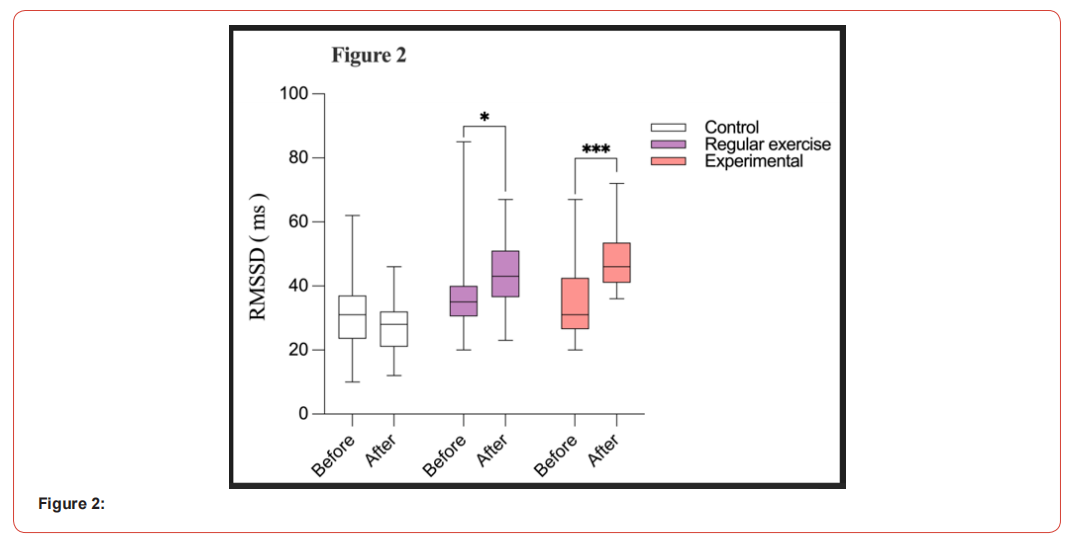
The baseline levels of RMSSD (Table 1) among the three subject groups prior to the various activity interventions were comparable, with values of 31.79±11.80 ms in the control group, 35.97±11.74 ms in the conventional exercise group, and 35.38±12.26 ms in the experimental group. Statistical analysis revealed no significant differences between the groups (P > 0.05), indicating that the baseline characteristics were similar across all groups. Post-intervention changes in RMSSD were observed as follows: in the control group, RMSSD exhibited a slight decrease to 27.41±9.62 ms, although this change was not statistically significant (P > 0.05). In contrast, RMSSD in both the regular exercise group and the experimental group increased significantly after the intervention, reaching 44.28±10.89 ms and 47.72±8.71 ms, respectively. These differences compared to baseline measurements were significant (P < 0.05 for the conventional exercise group and P < 0.001 for the experimental group). A two-factor analysis of variance indicated a significant main effect of time (F = 10.75, P = 0.0013), and the interaction effect between groups and time was also significant, suggesting notable differences in the patterns of RMSSD changes over time among the different groups.The results depicted in the box plot (Figure 2) aligned with the statistical analysis. The positions of the box plots for the three groups prior to the intervention were similar, indicating no significant difference in baseline RMSSD levels. Following the intervention, the box plot for the control group exhibited no significant change, while the box plots for both the conventional exercise group and the experimental group showed a marked upward shift (in the figure, * and * * * correspond to P < 0.05 and P < 0.001, respectively). This visually illustrates the positive impact of the exercise intervention on RMSSD, with the experimental group demonstrating a more pronounced improvement (Figure 2).
No statistically significant changes were noted in systolic blood pressure (SBP), diastolic blood pressure (DBP), or fasting blood glucose (FBG) before and after the intervention or between groups (Table 1) (SBP: F = 2.306, P = 0.1307; DBP: F = 2.137, P = 0.1457; FBG: F = 0.09788, P = 0.7548). Thus, the intervention plan did not significantly affect the blood pressure or fasting blood glucose levels of the subjects.
Discussion
The research findings indicate that both low-temperature Baduanjin intervention and simple regular exercise can enhance the resting heart rate (RHR) and root mean square of successive differences (RMSSD) in college students, with the low-temperature Baduanjin demonstrating a superior effect. However, neither intervention method produced a statistically significant impact on the blood pressure or fasting blood glucose levels of the participants.
In this study, no significant difference was observed in the baseline resting heart rate (RHR) among the three groups of subjects prior to the intervention, thereby ensuring the reliability of the intervention results. Following the intervention, the RHR of both the regular exercise group and the experimental group decreased significantly, whereas that of the control group exhibited a slight increase. Notably, the reduction in the experimental group was more pronounced. These findings suggest that exercise intervention effectively improves the resting heart rate of college students, and the combined effects of a low-temperature environment and Baduanjin may further enhance this regulatory effect. The primary mechanism underlying the substantial reduction of RHR in college students subjected to low-temperature Baduanjin intervention is the precise complementarity between physiological adaptation to mild cold stress and the characteristics of medium- and low-intensity exercises inherent in Baduanjin.From the perspective of low-temperature stress, mild cold exposure at temperatures ranging from 0 °C to 4 °C can activate the body’s cold adaptation mechanisms (Castellani & Young, 2016) [12,13].This exposure promotes an increase in nitric oxide release from the vascular endothelium, enhances vascular endothelial diastolic function, and reduces peripheral vascular resistance. Consequently, it significantly lowers the myocardial pumping load at rest, thereby satisfying the body’s blood oxygen supply requirements without necessitating a high heart rate (Flavahan & Flavahan, 2020) [14,15]. Additionally, low temperatures can stimulate the metabolism of brown adipose tissue (Cannon & Nedergaard, 2004) [16,17], optimizing the body’s energy distribution pattern and improving the energy utilization efficiency of myocardial cells. This further reduces the heart’s workload and establishes a physiological basis for the reduction of resting heart rate (RHR) (Marvanova et al., 2023) [18]. Considering the characteristics of Baduanjin exercise, which is recognized as a medium to low-intensity health-preserving activity standardized by the General Administration of Sport of China, its slow, symmetrical, and relaxed limb movements contrast sharply with the high-intensity stress associated with conventional exercise. This distinctive approach helps to mitigate the additional cardiovascular strain that can arise from abrupt increases in heart rate during physical activity(Chen et al., 2020) [19]. Additionally, the abdominal breathing emphasized in the training regimen can effectively increase thoracic volume, enhance pulmonary ventilation and gas exchange efficiency, and improve blood oxygenation. This, in turn, ensures a more adequate supply of oxygen to the myocardium, indirectly lowering the threshold for maintaining resting heart rate (RHR). This effect synergizes with cold acclimatization, ultimately leading to a significant reduction in RHR (Shi et al., 2024) [20]. In contrast, the control group, without any intervention, experienced a slight increase in RHR. This observation suggests that, during the northern winter, university students lacking targeted exercise interventions may face functional decline in their cardiovascular systems due to cold exposure and a sedentary lifestyle. This finding underscores the necessity of implementing winter exercise interventions for university students in cold regions(Chen et al., 2024) [21].
The experimental group exhibited a greater increase in RMSSD and statistical significance compared to the regular exercise group, whereas the control group experienced a slight decrease. These findings suggest that the Baduanjin intervention in a low-temperature environment has specific and synergistic effects on enhancing autonomic nerve function in college students, which represents a key advantage over regular exercise alone. The mechanism underlying the significant increase in RMSSD during low-temperature Baduanjin intervention involves the organic synergy between the activation of the vagus nerve by low temperatures and the precise regulation of autonomic nerve balance achieved through the integrated training of “body adjustment - breath adjustment - mind adjustment” inherent in Baduanjin.Short-term mild cold exposure transmits neural signals via peripheral cold receptors, activates the dorsal nucleus of the vagus nerve in the medulla oblongata, enhances the vagus nerve’s regulatory influence on the sinoatrial node of the heart, increases the variability of adjacent cardiac cycles, and provides a neurophysiological basis for the improvement of RMSSD (Jungmann et al., 2018) [22]. The integrated training model of Baduanjin is crucial for optimizing the balance between the sympathetic and vagus nerves. Focused meditation during the mental adjustment stage inhibits excessive excitation of the cerebral cortex and reduces central activation of the sympathetic nerve. Deep and slow abdominal breathing during the breathing adjustment phase enhances the cardiovascular regulatory effect of the vagus nerve and increases heart rate variability by modulating the respiratory rhythm (Wang et al., 2024) [23]. Meridian unblocking and limb coordination training in the body adjustment stage improve the peripheral conduction pathways of the autonomic nerve and enhance the efficiency of neural signal transmission (An et al., 2013) [4]. The interplay among the three factors causes the balance between the sympathetic and vagus nerves in the body to tilt toward vagal dominance, ultimately resulting in a marked increase in the RMSSD value. The primary reason for the superior improvement in RMSSD observed in the experimental group compared to the regular exercise group is the absence of standardized intensity and rhythm control in the latter.In this study, the regular exercise group allowed subjects to engage in physical activity based solely on their preferences, without standardizing the types and intensities of exercise. This approach likely resulted in repeated activation of the sympathetic nervous system due to fluctuations in exercise intensity, there-by disrupting the balance of the autonomic nervous system (Miki & Yoshimoto, 2018) [3], and limiting improvements in RMSSD. In contrast, the Baduanjin intervention for the experimental group was conducted under the guidance of professional coaches and adhered to the standardized protocol established by the General Administration of Sport of China. The consistent movement rhythm and controllable exercise intensity maintained a stable regulatory environment for the autonomic nervous system, thereby minimizing stress-induced fluctuations. Consequently, the enhancement of RMSSD was both more significant and sustainable. The RMSSD in the control group exhibited a slight decrease, suggesting that exposure to low temperatures and a sedentary lifestyle may contribute to a reduction in vagus nerve tension and diminished autonomic nerve regulatory function among college students(Chen et al., 2024).This finding further substantiates the protective and enhancing effects of low-temperature Baduanjin intervention on autonomic nerve function.
No statistically significant changes were observed in systolic blood pressure, diastolic blood pressure, and fasting blood glucose, both before and after the intervention and between groups. This finding sharply contrasts with the significant changes noted in resting heart rate (RHR) and root mean square of successive differences (RMSSD). The primary reasons for this discrepancy may be closely related to the physiological baseline characteristics of college students, the duration of the intervention cycle, and the inherent regulatory characteristics of the indicators themselves. Specifically, the baseline levels of blood pressure and blood glucose among college students are within normal physiological ranges, and the fluctuation of these indicators is relatively minor.All subjects selected for this study were healthy college students who did not have cardiovascular diseases or contraindications to exercise. Their blood pressure and fasting blood glucose levels were within the normal range, and no abnormal indicators were observed under pathological conditions. Consequently, significant statistical changes were challenging to detect through short-term exercise interventions (Medicine, 2013). In contrast to indicators such as resting heart rate (RHR) and root mean square of successive differences (RMSSD), which are highly sensitive to exercise interventions, blood pressure and blood glucose serve as indicators of homeostasis. Their regulation is governed by multiple systems, including the nervous, humoral, and endocrine systems, contributing to their strong stability. Significant physiological adjustments are likely to occur only under long-term and targeted interventions.The characteristics of the intervention cycle and the methods employed constrain the extent of changes observed in the indicators. The intervention period for this study spanned 12 weeks, representing a short-term intervention that had not yet achieved the threshold necessary for regulating blood pressure and glucose homeostasis. Furthermore, the combined effects of the low-temperature environment and Baduanjin create a “bidirectional balance” regarding blood pressure. While low temperatures exert a slight vasoconstrictive effect, potentially leading to a modest increase in blood pressure (Sun, 2010). The meridian unblocking effects of Baduanjin and abdominal breathing promote vasodilation. This interplay between the two factors contributes to the overall stability of blood pressure, resulting in no significant statistical changes.College students exhibit no insulin resistance, abnormal glucose metabolism, or other related issues concerning fasting blood glucose. Their daily dietary intake and energy expenditure are relatively balanced. While the intervention of low-temperature Baduanjin may exert a minor regulatory effect on glucose metabolism, it has not disrupted the homeostasis of glucose metabolism within the body. Consequently, only minor fluctuations are observed, which have not attained statistical significance.
Conclusions
We observed that in a low-temperature environment ranging from 0℃ to 4℃, Baduanjin intervention significantly reduced resting heart rate (RHR) and increased the root mean square of successive differences (RMSSD) among college students. The overall improvement was more pronounced than that achieved through regular exercise alone. Conversely, cardiovascular-related indicators among college students who remained sedentary without intervention exhibited a negative trend. Furthermore, none of the intervention methods employed in this study demonstrated a statistically significant effect on blood pressure or fasting blood glucose levels in healthy college students. This lack of effect may be attributed to the normal baseline of these steady-state indicators and the fact that the short-term 12-week intervention did not meet the regulatory threshold. Consequently, we have identified a method for implementing moderate low-temperature environment training for college students, thereby offering new insights for the optimization of sports training programs.
Acknowledgement
None.
Conflict of Interest
No Conflict of interest.
References
- An Bc, Wang Y, Jiang X, Lu Hs, Fang Zy, Wang Y, Dai Kr (2013) Effects of Baduanjin (八段锦) exercise on knee osteoarthritis: a one-year study. Chinese Journal of Integrative Medicine 19(2): 143-148.
- Ballard PJ, Hoyt LT, Pachucki MC (2019) Impacts of adolescent and young adult civic engagement on health and socioeconomic status in adulthood. Child development 90(4): 1138-1154.
- Cannon B, Nedergaard J (2004) Brown adipose tissue: function and physiological significance. Physiological reviews.
- Castellani JW, Young AJ (2016) Human physiological responses to cold exposure: Acute responses and acclimatization to prolonged exposure. Autonomic Neuroscience 196: 63-74.
- Castro O, Bennie J, Vergeer I, Bosselut G, Biddle SJ (2020) How sedentary are university students? A systematic review and meta-analysis. Prevention science 21(3): 332-343.
- Chen X, Hu N, Han H, Cai G, Qin Y (2024) Effects of high-intensity interval training in a cold environment on arterial stiffness and cerebral hemodynamics in sedentary Chinese college female students post-COVID-19. Frontiers in Neurology 15: 1466549.
- Chen X, Marrone G, Olson TP, Lundborg CS, Zhu H, et al. (2020) Intensity level and cardiorespiratory responses to Baduanjin exercise in patients with chronic heart failure. ESC Heart Fail 7(6): 3782-3791.
- Cheng FK (2015) Effects of Baduanjin on mental health: a comprehensive review. Journal of bodywork and movement therapies 19(1): 138-149.
- Flavahan S, Flavahan NA (2020) Cooling-induced dilatation of cutaneous arteries is mediated by increased myoendothelial communication. Am J Physiol Heart Circ Physiol 319(1) H123-h132.
- Ge S, Song C, Yao W (2021) The motor function evaluation of college students’ physical activity state from the perspective of educational psychology. Frontiers in psychology 12: 593285.
- Han P, Wang YR, Lyu YY, Zhao L (2025) Genders characteristics of aerobic endurance exercise performance and autonomic regulation in cold environments. Sheng Li Xue Bao 77(1): 25-34.
- Hutchesson MJ, Duncan M J, Oftedal S, Ashton LM, Oldmeadow C, et al. (2021) Latent class analysis of multiple health risk behaviors among Australian university students and associations with psychological distress. Nutrients 13(2): 425.
- Jungmann M, Vencatachellum S, Van Ryckeghem D, Vögele C (2018) Effects of Cold Stimulation on Cardiac-Vagal Activation in Healthy Participants: Randomized Controlled Trial. JMIR Form Res 2(2): e10257.
- Koh TC (1982) Baduanjin - An Ancient Chinese Exercise. The American Journal of Chinese Medicine 10(01n04): 14-21.
- Li M, Fang Q, Li J, Zheng X, Tao J, et al. (2015) The effect of Chinese traditional exercise-Baduanjin on physical and psychological well-being of college students: a randomized controlled trial. PloS one 10(7): e0130544.
- Marvanova A, Kasik P, Elsnicova B, Tibenska V, Galatik F, et al. (2023) Continuous short-term acclimation to moderate cold elicits cardioprotection in rats, and alters β-adrenergic signaling and immune status. Sci Rep 13(1): 18287.
- Medicine ACoS (2013) ACSM's guidelines for exercise testing and prescription. Lippincott williams & wilkins.
- Miki K, Yoshimoto M (2018) Exercise-induced modulation of baroreflex control of sympathetic nerve activity. Frontiers in Neuroscience 12: 493.
- Shi M, Wu Z, Zhou X, Fang, M, Zhu Q (2024) Influence of Baduanjin on cardiopulmonary function in long-term practitioners and beginners. Front Sports Act Living 6: 1440871.
- Sun Z (2010) Cardiovascular responses to cold exposure. Front Biosci (Elite Ed) 2(2): 495-503.
- Wang X, Wu J, Ye M, Wang L, Zheng G (2021) Effect of Baduanjin exercise on the cognitive function of middle-aged and older adults: a systematic review and meta-analysis. Complementary therapies in medicine 59: 102727.
- Wang Z, Zhang Z, Wu Y (2024) The effects of Baduanjin exercise on the psychological condition and heart rate variability of sports-disadvantaged college students: A randomised trial. Journal of Health Population and Nutrition 43(1): 203.
- Zou L, Yeung A, Quan X, Boyden SD, Wang H (2018) A systematic review and meta-analysis of mindfulness-based (Baduanjin) exercise for alleviating musculoskeletal pain and improving sleep quality in people with chronic diseases. International journal of environmental research and public health 15(2): 206.
-

This work is licensed under a Creative Commons Attribution-NonCommercial 4.0 International License.