


 Research Article
Resilience of Agricultural Production to The Effects of Climate Change Through Efficient Circularity Efficient
Received Date: November 03, 2025; Published Date: November 17, 2025
Abstract
The RECEC research project is based on the development of the POST LIFE plan of the LIFE AMDRYC4 project, led by the University of Murcia and completed in 2022. The main objective of this RECEC project was to achieve, through a series of agricultural practices, the absorption of CO2 from the atmosphere and its storage in plant material and soil organic matter (a process currently known as ‘carbon farming’) and is used as a synonym for the term ‘regenerative agriculture’ when it is explicitly based on improving soil fertility and farm productivity. To achieve this objective, this project developed different carbon quantification methodologies, using eco-efficient and eco-innovative methods. The project assessed the value of agricultural waste and OVA from the Mar Menor as organic fertilisers, representing an efficient and sustainable strategy for the management of agricultural by-products, promoting nutrient recirculation, improved soil health and carbon sequestration. Although the results obtained are considered preliminary, very positive trends can be seen in terms of the possibility of adapting Mediterranean rainfed soils to climate change, with the consequent fight against desertification. The environmental benefits are manifold, including climate change mitigation (carbon sequestration), fertility (increased macronutrients and micronutrients), moisture supply, reuse of plant waste/by-products, socio-economic benefits (valorisation of rainfed and irrigated plant waste, savings in fertilisers, reduction of carbon footprint, population retention in the territory). If 8 tonnes of RV were added, this would mean carbon capture equivalent to an average sequestration of around 36 tCO2/ha/year.
Keywords: Agroalnext; Carbon farming; Agriculture; Climate change; Circular economy
Introduction
Numerous studies show that agriculture is an industry that is sensitive to climate change [1-10]. Mitigation strategies have received a great deal of attention in terms of measures to tackle climate change [1-15]. Rainfed agricultural systems belong to what are known as arid zones and constitute extraordinary ecosystems [16] that can be severely affected by climate consequences [17]. The RECEC project was created with the aim of enabling Mediterranean rainfed agroecosystems to adapt to climate change: Resilience of agricultural production to the effects of climate change through efficient circularity Efficient
The RECEC research project is funded by AGROALNEXT. This Complementary Agri-Food Plan promotes the dual digital and sustainable transformation of the agri-food sector in order to increase its competitiveness and achieve the climate and environmental objectives set out in the Green Deal, while ensuring the supply of healthy, safe, sustainable and accessible food to the population, as pursued by the EU’s Farm to Fork Strategy. The Regional Government of Navarre (CNTA) coordinates the scientific and technical activities carried out by the seven regions participating in the programme (Aragon, Asturias, Navarre, Valencia, Extremadura, La Rioja and Murcia). The RECEC project is based on the development of the POST LIFE plan of the LIFE AMDRYC4 project, by the University of Murcia and completed in 2022, which determined that a combination of cultivation practices and organic fertilisers has a transformative impact of ΔC 0.4% - 0.65%/year, obtaining between 15-27 t C/ha/year on the experimental farms, i.e. exceeding the objectives of the 4X1000 Initiative. The main objective of this RECEC project was to use a series of agricultural practices to absorb CO2 from the atmosphere and store it in plant material and soil organic matter (a process currently known as ‘carbon farming’) and is used as a synonym for the term ‘regenerative agriculture’ when it is explicitly based on improving soil fertility and farm productivity (EU, 2021). To achieve this objective, this project developed different carbon quantification methodologies, using eco-efficient and eco-innovative methods, as well as obtaining the climate change adaptation indicator. RECEC is a research project that promotes climate change mitigation by harnessing the great potential of agricultural soils as carbon sinks, within the framework of the international 4x1000 initiative. It also promotes efficient circularity in agricultural production through the use of organic by-products. This paper presents the results of the carbon monitoring action carried out during the experiment.
Materials and Methods
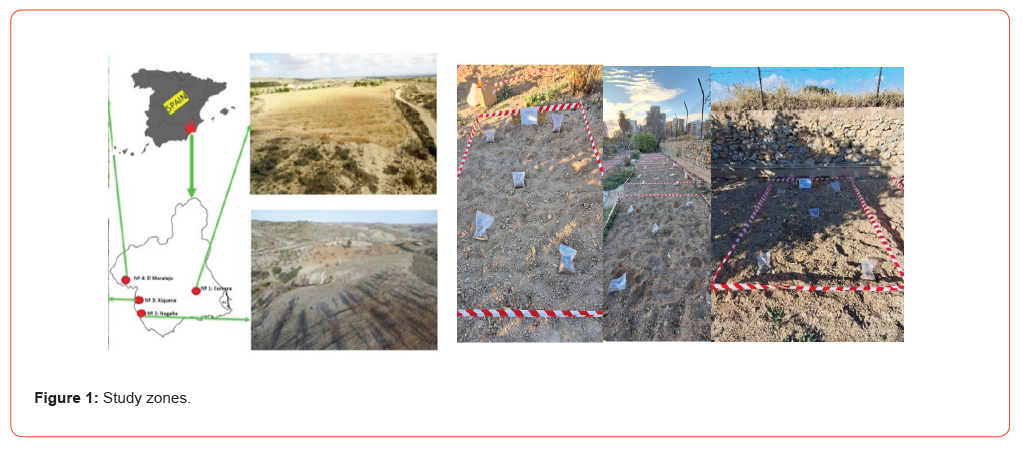
To carry out this study of soil organic carbon, on the one hand, the experimental plot in Corvera set up as part of the LIFE Project was used, and on the other hand, work was carried out on other new experimental plots (Figure 1), all located in the Region of Murcia. This project involved the recovery of agricultural waste and OVA from the Mar Menor as organic fertilisers, representing an efficient and sustainable strategy for the management of agricultural by-products, promoting nutrient recirculation, improving soil health and carbon sequestration. The suitability of plant biomass removd from the Ribera del Mar Menor was evaluated and determined to improve soil structure, increase its fertility and assess its capacity as a CO2 sink for these marine by-products. Data published by the Regional Ministry of the Environment of the Autonomous Community of Murcia (CARM) show that since the biomass removal brigades were implemented in 2022, a total of 40,324.77 tonnes of biomass have been extracted from the Mar Menor. with 26,054 tonnes removed in 2022 alone (representing 40 tonnes of nitrogen and 14 tonnes of phosphorus), and more than 4,959 tonnes of biomass in 2024. This work includes carbon monitoring. The potassium dichromate method was used to determine organic matter.
Results and Discussion
Baseline data and carbon monitoring at the Corvera Life AmdryC4 estate
To obtain the carbon baseline data, wet determinations were carried out using potassium dichromate, and comparative tests were also carried out with NIR in the laboratory in accordance with the model designed for the Corvera plot in the LIFE AMDRYC4 project. Given the short time frame, the need for extensive data, and the laborious nature of the sampling process, this comparative study was verified using some experimental data, and the following model was applied.

The results show that the method for determining organic carbon by NIR presents a correlation and a significant model (p-value <0.05) between the bands present for wavelengths from 900 to 950 nm. (Table 1) shows the results obtained for organic carbon from soil samples taken from plots in the LIFE AMDRYC4 project in Corvera.
Table 1: Organic carbon content in Corvera soils 2019-2025 in %.

The average carbon values in 2025 have increased slightly, as can be seen in (Figure 2). The overall carbon slope line for LIFE AMDRYC4 shows a greater slope than the line for the following three years studied in 2025, as the increase in carbon is lower because sheep manure fertiliser could not be applied, as this has been expressly prohibited by regional legislation in Murcia under the law on the Mar Menor watershed areas.
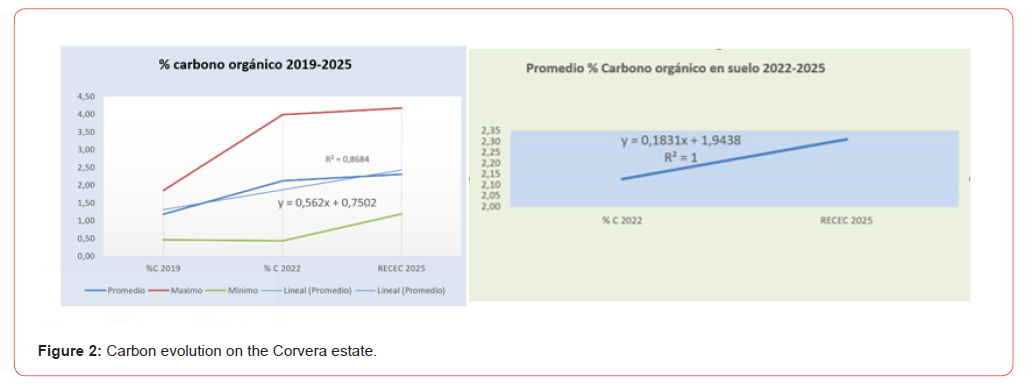
Table 2 summarises the descriptive statistics of the carbon mitigation indicator results for the Corvera plot between 2018 and 2022, under different types of rainfed crops: Crop 1, Almond tree with sheep manure and green manure; Crop 2, Olive tree with sheep manure; and Crop 3, Carob tree with sheep manure.
Table 2 summarises the descriptive statistics of the carbon mitigation indicator results for the Corvera plot between 2018 and 2022, under different types of rainfed crops: Crop 1, Almond tree with sheep manure and green manure; Crop 2, Olive tree with sheep manure; and Crop 3, Carob tree with sheep manure.
Table 2: Descriptive statistics Carbon increase in Corvera during the LIFE AMDRYC4 project period.

The results of soil samples taken currently on the plots of the LIFE AMDRYC4 project in Corvera (2017-2022), where no organic amendments have been applied as part of this project, show variations in carbon concentration that are lower than the average obtained in the plots, with less carbon sequestration than in the experimental plots studied, hence the effectiveness of the treatments with the by-products studied in this project. Table 3 details the carbon and CO2 contents for the years 2022-AMDRYC4 and 2025-RECEC, with an average increase of 20.22 over the three years that have passed. CO2 carbon sequestration t/ha/year was 6.74 t/ha/ year in the almond-growing soils of the Corvera living lab, despite not being able to incorporate more organic matter into the soil due to legal restrictions.
Table 3: Life Amdryc-Recec Mitigation Indicators.

Baseline data and carbon monitoring in RECEC 2025 experimental plots
Based on the carbon determination data and the amount of by-product added to each plot, as well as the surface area of the plots, the carbon increases between the baseline (M0 sampling) and M2 sampling (last sampling) were calculated. Table 4 shows the carbon increase per tonne/hectare per year resulting from the addition of the plant residues (also known as by-products) evaluated.
Table 4: Increase in C (ha-year-t RV) by crop.

Although the experiments have been conducted over a very short period of time, considering that soil processes in nature are very slow, the results obtained, although preliminary, show very positive trends in terms of the possibility of adaptation to climate change in Mediterranean rainfed soils, with the consequent fight against desertification. The environmental benefits obtained are manifold, such as climate change mitigation (carbon sequestration), fertility (increase in macronutrients and micronutrients), moisture supply, reuse of plant waste/by-products, socio-economic benefits (valorisation of rainfed and irrigated plant waste, savings in fertilisers, reduction of the carbon footprint, fixing the population to the territory).
The increase in carbon in the 10 plots, each measuring 6 m2, in the experiment carried out has an average value of 4.4 per 1000/ year, which exceeds the target of the 4 per thousand initiatives for increasing carbon in the soil, proposed at the 2015 Paris Climate Summit, with a range of 7.5-2.7 per 1000, depending on the types and tonnes of plant residues added (tRV).
Sequestrated carbon, expressed in t C/ha.year-t(RV), averages 1.23 t/ha.year.t RV, ranging from a maximum of 3.42 to a minimum of 0.27 t C/ha.year.t RV in almond and grapefruit residues, respectively. If 8 t of RV were added, this would result in carbon capture equivalent to an average sequestration of around 36 tCO2/ha/year.
The results of soil samples taken currently on the plots of the LIFE AMDRYC4 project in Corvera (2017-2022), where no organic amendments have been applied, show variations in carbon concentration that are lower than the average obtained in the plots, with lower carbon sequestration compared to the experimental plots studied, hence the effectiveness of the treatments with the by-products studied in this project.
Conclusion
The biochemical attributes, together with a high nutrient content, suggest a beneficial potential for the plant residues studied and marine biomass for use as organic soil amendments, contributing not only to improving soil fertility but also to promoting microbial activity and mitigating oxidative stress in the soil environment. The valorisation of this waste as organic amendments represents an efficient and sustainable strategy for the management of agricultural by-products, promoting circular agricultural practices that optimise nutrient recycling and improve long-term soil health.
Climate change is not only an environmental phenomenon but also one with profound economic and social consequences, hence the need to carry out adaptation projects such as the LIFE AMDRYC4 and RECEC projects. The main objective of this research is to promote and foster climate resilience in rainfed agriculture in Mediterranean areas and its sustainable, intelligent and integrated management as a basic tool for ecosystem-based adaptation (EbA) to climate change, and to strengthen its mitigating role as carbon sinks so that they are sustainable and persistent.
The results obtained from this research are extremely useful for collaborating in the governance of the implementation of the European Carbon Farming Strategy. These solutions provide a common framework for the entire national territory and other European regulations, contributing to the potential of Mediterranean rainfed agriculture to play a significant role as a carbon sink and provider of ecosystem services, as a tool for mitigating climate change. The benefits obtained from this project translate into agricultural tools for climate change mitigation and adaptation through, for example, the fight against desertification, biodiversity conservation and socio-economic benefits, which would slow down rural depopulation, in line with meeting the demographic challenge.
Acknowledgements
This work was funding by the project RECEC of the Agroalnext programme and was supported by MCIN with funding from European Union Next Generation EU (PRTR-C17. I1) and by the Comunidad Autónoma de la Región de Murcia-Fundación Séneca (Spain).
Conflict of Interest
The authors declare no conflicts of interest.
References
- Cui X (2020) Climate change and adaptation in agriculture: Evidence from US cropping patterns. Journal of Environmental economics and Management 101(6272): 102306-102310.
- Huang C, Ning Li, Zhengtao Zhang, Yuan Liu, Xi Chen, et al. (2020) Assessment of the economic cascading effect on future climate change in China: Evidence from agricultural direct damage. Journal of Cleaner Production 276(10): 123951-123955.
- Sabbaghi M A, Nazari M, Araghinejad S, Soufizadeh S (2020) Economic impacts of climate change on water resources and agriculture in Zayandehroud river basin in Iran. Agricultural Water Management 241(1): 106323-106325.
- Torres MAO, Kallas Z, Herrera SIO (2020) Farmers’ environmental perceptions and preferences regarding climate change adaptation and mitigation actions; towards a sustainable agricultural system in Mé Land Use Policy 99,105031.
- Li W, Ruiz Menjivar J, Zhang L, Zhang J (2021) Climate change perceptions and the adoption of low-carbon agricultural technologies: Evidence from rice production systems in the Yangtze River Basin. Science of the Total Environment 759(10): 143554-143556.
- Chowdhuri A, Manoj Chaudhary, Tapan Jyoti Purakayastha, Teekam Singh, Nishant Kumar Sinha, et al. (2025) Optimizing soil fertility and climate resilience: Superiority of organic farming in enhancing carbon sequestration and nitrogen supply. Journal of Environmental Management 393(10): 127131-127135.
- Debernardini M, Candel J, Schulte R P O (2025) From the ground up: Exploring European carbon farming through social practice theory. Journal of Rural Studies 120(12): 103850-103855.
- El Jamaoui I, Sánchez MJM, Sirvent CP, Mana AA, López SM, et al. (2024) Machine learning-driven modeling for soil organic carbon estimation from multispectral drone imaging: a case study in Corvera, Murcia (Spain). Modeling Earth Systems and Environment 10(3): 3473-94.
- El-Jamaoui I, Delgado-Iniesta MJ, Martínez Sánchez MJ, Pérez Sirvent C, Martínez López S (2025) Assessing Soil Organic Carbon in Semi-Arid Agricultural Soils Using UAVs and Machine Learning: A Pathway to Sustainable Water and Soil Resource Management. Sustainability (Switzerland) 17(8): 3440-3445.
- El-Jamaoui I, José Martínez Sánchez M, Pérez Sirvent C, Martínez López S (2025) A Comparative Assessment of Sentinel-2 and UAV-Based Imagery for Soil Organic Carbon Estimations Using Machine Learning Models Sensors 25(17): 5281-5285.
- Choon SW, Ong HB, Tan SH (2018) Does risk perception limit the climate change mitigation behaviors? Environmental Development and Sustainnability 21 (7): 1891-1917.
- Kuthe A, Lars Keller, Annemarie Körfgen, Hans Stötter, Anna Oberrauch, et al. (2019) How many young generations are there? e a typology of teenagers’ climate change awareness in Germany and Austria. The Journal of Environmental Education 50 (3): 172-182.
- Kwon SA, Kim S, Lee J (2019) Analyzing the determinants of individual action on climate change by specifying the roles of six values in South Korea. Sustainability 11 (7): 1834-1836.
- Kulmer V, Jury M, Wong S, Kortschak D (2020) Global resource consumption effects of borderless climate change: EU’s indirect vulnerability. Environmental and Sustainability Indicators 8(10): 100071-100075.
- Jakucionytè-Skodiené M, Liobikiené G (2021) Climate change concern, personal responsibility and actions related to climate change mitigation in EU countries: Cross-cultural analysis. Journal of Cleaner Production 281(25): 125189.
- Savin R, Mariano Cossani, Rachid Dahan, Jamal Y. Ayad, Rossella Albrizio, et al. (2022) Intensifying cereal management in dryland Mediterranean agriculture: Rainfed wheat and barley responses to nitrogen fertilisation. European Journal of Agronomy 137(7): 126518-126520.
- Sidibé Y, Foudib S, Pascualb U, Termansend M (2018) Adaptation to Climate Change in Rainfed Agriculture in the Global South: Soil Biodiversity as Natural Insurance. Ecological Economics 146(4): 588-596.
-

This work is licensed under a Creative Commons Attribution-NonCommercial 4.0 International License.