

 Research Article
Impact of Shale Compaction on Productivity of Marcellus Shale Horizontal Well with Multiple Hydraulic Fractures
Received Date: July 29, 2025; Published Date: August 11, 2025
Abstract
Marcellus shale, because of its mechanical properties, is sensitive to stress which leads to shale compaction as gas is produced from the shale.
Shale compaction impacts hydraulic fractures and fissures both of which play significant roles in well performance. This is particularly significant
for a Marcellus shale horizontal well with multi-stage hydraulic fractures. It is therefore necessary to couple the geomechanics and fluid flow
simulations to accurately predict the gas recovery from a horizontal Marcellus shale well. The intensity of effective stress increase depends on
the initial productivity of the well, which is influenced by the shale initial properties, hydraulic fracture properties, stage spacing, as well as the
operating conditions. The objective of this study was to investigate the impact of the shale properties (Initial fissure permeability, Young’s modulus
and Poisson’s ratio), the hydraulic fracture properties (length, initial conductivity, spacing), as well as operating conditions on the productivity of
a horizontal Marcellus shale well with multi-stage fractures. In this study, both individual and combined effects of fissures and hydraulic fracture
closures on gas recovery are investigated.
The advanced technical information available from the Marcellus shale horizontal wells located at the Marcellus Shale Energy and Environment
Laboratory (MSEEL) site provided an opportunity to investigate the impact of the shale compaction on gas recovery. The core, well log, well test,
completion, stimulation, and production data from the wells at MSEEL site were utilized to estimate the shale mechanical and petrophysical properties
as well as the hydraulic fracture characteristics. The results of the data analysis were then utilized to develop a reservoir model for a horizontal well
completed in Marcellus shale with multi-stage hydraulic fractures. A geomechanically with geomechanic module was coupled with reservoir model
to determine the effective stress and the shale compaction and its impact on the shale permeability and porosity. The impact of the shale compaction
on the permeability (for both matrix and fissure) and the conductivity of the hydraulic fractures were determined from the published measurements
on Marcellus shale core plug analysis as well as the propped fracture conductivity in Marcellus shale and were incorporated in the reservoir model.
The inclusion of the compaction in the reservoir model provided a more realistic simulated production profile. The gas recovery was found to
be adversely impacted by the compaction. The compaction impact on gas recovery was found to be more severe during the early production due
to higher production rates but diminishes as production time increases. The reduction in the conductivity of the hydraulic fractures due to the
compaction was found to have the most adverse effect on the gas recovery during the early production period. This confirms the major role that
fracture conductivity plays in early production. Finally, the model was employed to investigate the impact of the formation mechanical properties,
hydraulic fracture properties, and the operating conditions on the recovery of the gas. The higher values of the Young’s modulus and Poisson’s ratio
can mitigate the compaction impact and lead to improved recovery. Conversely, the higher values of the fracture half-length as well as the closer
fracture spacing will amplify the adverse impact of the compaction on the early gas recovery. However, these adverse impacts diminish with time.
The higher values of the initial hydraulic fracture conductivity can also mitigate the compaction impact.
Introduction
Reservoir rocks are subjected to the internal stress exerted by fluids in the pores (pore pressure) and to external stress which is exerted by the overlying rocks (overburden pressure). When the reservoir fluids are produced, the pore pressure decreases while the overburden pressure remain constant. Consequently, the reservoir rock is subjected to an increased and variable effective stress. The increase in the effective stress results in the reservoir rock compaction which may impact the production capacity of the reservoir. This is particularly significant for Marcellus shale due to its mechanical properties (low Young’s modulus and moderate Poisson’s ratio). Specifically, the gas recovery from the shale can be impacted by the decrease in shale porosity and permeability with increasing effective stress.
Shales are characterized by very low porosity (typically less than 5%) and extremely low permeability values (in order of nano- darcy). Therefore, economic hydrocarbon recovery from the shale formations is challenging. To achieve economic production from the shale reservoirs, two key technologies including horizontal drilling and hydraulic fracturing have been implemented. In hydraulic fracturing, a fluid carrying proppant (usually sand) is pumped into the formation at a pressure necessary to initiate the fracture in the formation. Proppant is necessary to assure the fracture remains open after pumping is stopped. A horizontal well completed with multiple transverse hydraulic fractures can create a high conductivity pathway (fracture network) for gas flow from the shale to the wellbore. The application of these technologies has led to a dramatic increase in economic gas recovery from the shale gas plays in the United States. Hydraulic fractures are the key component for economic gas production from the shale gas reservoirs. The efficacy of a fracturing treatment is determined by the properties of the induced fracture including conductivity and length. Shale compaction, due to increase in effective stress with the production, may cause proppant embedment or crushing and consequently impair the conductivity of the hydraulic fractures leading to lower ultimate gas recovery.
To accurately predict the gas recovery from a horizontal Marcellus shale well with multi-stage fractures, it is therefore necessary to account for the shale compaction associated with the gas production. The intensity of the shale compaction is influenced by the productivity of the well which depends on the number and properties of the hydraulic fractures, shale properties, and the operating conditions. The objective of this study is to investigate the impact of shale compaction on the shale porosity, permeability, and hydraulic fracture conductivity and, consequently, the productivity of a horizontal Marcellus shale well with multi-stage fractures.
Background
Marcellus shale is the most prolific shale gas play in the United States. It spans an area of approximately 95,000 square miles from New York through Pennsylvania, West Virginia and also extends into Ohio and Maryland (Bartuska, et al. 2012). Marcellus shale occurs at depths varying from 4000 to 8500 feet and its thickness varies from 50 and 200 feet. Marcellus Shale is a Middle Devonian-aged shale bounded above by shales of the Hamilton Group and below by the limestones of the Tristate’s. It is subdivided into Union Springs and Oatka Creek members, both being rich in organic matter. The average porosity in Marcellus Shale ranges between 2 and 5 percent with a total organic content (TOC) that varies between 5 and 30 percent (Glorioso and Rattia, 2012). It has been estimated that as much as 500 trillion cubic feet of gas may be present in the entire Marcellus play area (Englander and Lash, 2009). The natural gas in the Marcellus Shale has been produced most efficiently through horizontal wells completed with multi-stage hydraulic fracturing treatments. The common fracture treatment designs involve water with friction reducer or slickwater and approximately 40 precent 40/70 mesh sand and 60 percent 100 mesh sand (Mayerhofer et al., 2011; Shelley et al. 2014).
Shale is a naturally–fractured formation. However, the fissures (natural fractures) are believed to be mineralized and do not contribute to well productivity unless they are stimulated (Cipolla, et al. 2009b). The gas is stored both in the limited pore space of the shale matrix and adsorbed into the organic material (Cipolla, et al. 2009a). Adsorption occurs when gas is trapped on the surface of the solid organic matter, or kerogen, in shale due to its large surface area and the affinity for gas. The ability of a shale to adsorb gas depends on the TOC, the specific area of nanopores, and pore-size distribution (Wang, et al., 2017). The gas in the adsorbed state exhibits a higher (liquid-like) density than the free gas. This allows significantly more gas to be stored on the rock surface. The Marcellus shale wells in the areas with higher organic content in the Appalachian Basin, often exhibit better performance than those in the areas with poor organic content. The adsorption of a given gas on a particular solid is typically represented by an adsorption isotherm. The adsorption of natural gas on shale is commonly assumed to follow Langmuir type isotherm (Langmuir, 1916). Langmuir isotherm is characterized by two constants, Langmuir volume (VL) and Langmuir pressure (PL). According to the Langmuir isotherm model, gas desorption does not become significant until a considerable pressure deletion has been achieved. This concept is supported by the Marcellus and Barnett shales studies (Anderson, et al., 2014).
Marcellus shale, because of its mechanical properties, is sensitive to stress which leads to shale compaction as gas is produced from the shale. Shale compaction impacts hydraulic fractures and fissures both of which play significant roles in well performance. Therefore, the impact of the compaction must be considered in evaluating the productivity of Marcellus shale. Several research studies have investigated the impact of pressure depletion and stress on gas shale permeability (Al-Wardy and Zimmerman, 2004; Clarkson et al., 2012; Kang et al., 2011; Kwon et al., 2001; Luffel et al., 1993). Bustin et al. (2008) noted that the reduction in permeability due to confining pressure is more pronounced in shale compared to carbonate or consolidated sandstone formations. This permeability reduction has been attributed to fissure permeability decreases as effective normal stress increases. Cipolla et al. (2010) conducted numerical investigations to explore the effects of fissure closure on production. Their simulations indicated that well productivity in many shale gas reservoirs could be significantly compromised due to insufficient fissure conductivity. In formations with higher Young’s modulus, like the Barnett Shale, the ultimate gas recovery could decrease by as much as 10%. In contrast, shale reservoirs with lower Young’s modulus, such as the Marcellus and Haynesville formations, could experience even more substantial declines in ultimate gas recovery.
Elsaig et al. (2016 and 2017) measured the porosity and the absolute permeability of Marcellus shale core plugs at stress levels ranging from 1,300 to 7,000 psi. In their study, a fully automated laboratory set-up for measuring the shale petrophysical properties under the reservoir conditions was utilized to measure the porosity and permeability of the Marcellus shale core plugs. The core plugs were obtained from a well drilled specifically for research and scientific purposes. At each stress level, the permeability of the core plug was measured at four different pore pressures, and the absolute permeability was determined by applying the double slippage correction which accurately reflected the flow regime in the shale. Their investigations revealed the stress-sensitive nature of the Marcellus shale as the porosity and absolute permeability exhibited decreasing trends as the stress level increased. The absolute permeability exhibited two distinctive behaviours with respect to the stress highlighting the contributions of the fissures and the matrix to the shale permeability. Finally, the fissure closure pressures for the shale samples were estimated
Several research studies have investigated propped fracture behaviour under stress conditions (Huitt and McGlothlin,1958; Volk et al. ,1981; Lacy et al., 1997; Guo et al. ,2008; Pope et al. ,2009; Terracina et al. ,2010; Alramahi and Sundberg, 2012). These investigations indicated that higher stress leads to loss of the of hydraulic fracture conductivity primarily due to increased proppant embedment particularly in shales with low Young’s modulus. Zhang et al. (2013) examined both propped and unpropped fractures in Barnett Shale outcrop samples. Their studies revealed that higher proppant concentrations diminish the influence of rock properties on fracture conductivity. Subsequent experiments by Guzek (2014) and Briggs (2014) on Fayetteville Shale and Eagle Ford outcrop samples, respectively, reinforced Zhang et al.’s findings, underscoring the diminishing importance of rock properties as proppant concentration increases. McGinley et al. (2015) conducted a series of experiments on Marcellus shale core plugs, extracted from two locations (Elim sport and Allenwood, Pennsylvania), to measure propped fracture conductivity at different net stress values. They concluded that the rate of fracture conductivity decline with increasing stress is inversely related to Young’s modulus.
Objective And Methodology
The impact of shale compaction, as the net stress increases during production, is often neglected in production modelling and gas recovery prediction. To accurately predict the performance of Marcellus shale horizontal wells with multiple hydraulic fractures, however, it is essential to include the mechanisms which are affecting the production performance. The loss of the fracture conductivity and shale permeability are the major mechanisms that can cause significant reductions in production performances. It is therefore necessary to couple the geomechanics with production simulation. The objective of this study is to provide a better understanding of the impact of the shale compaction on productivity of the horizontal Marcellus shale well completed with multiple hydraulic fractures. The impacts of both natural and hydraulic fracture closures on productivity of the Marcellus shale horizontal well will be investigated.
In order to accomplish the objectives of this study, a numerical model coupled with geomechanics was employed to simulate the production profile for a horizontal well with multiple hydraulic fractures completed in Marcellus shale. The publicly available and published data for Marcellus shale were collected and analysed to establish the model’s parameters. The model was then utilized to examine the individual and combined effects of hydraulic fracture and fissure compaction on the gas recovery. The role that shale and hydraulic fracture properties play in the intensity of the shale compaction will be also investigated. The details on each step are provided in the following sections.
Data Collection and Analysis
The data used in this study was acquired from MSEEL, a Marcellus shale field laboratory. The site contains four horizontal wells (MIP-3H, MIP-4H, MIP-5H and MIP-6H) completed in the Marcellus shale. The site also contains a vertical observation well (MIP-SW) which was used for collecting subsurface samples and micro seismic monitoring.
The results of the core plug analysis (Elsaig et al., 2016 and 2017) from the vertical well as well as the hydraulic fracturing treatment and production records from the horizontal wells were collected. Well logs and diagnostic fracture injection test (DFIT) were available from MIP-3H. Marcellus shale petrophysical properties were determined from the results of the core plugs measurements. Young’s modulus and Passion’s ratio were estimated from the sonic scanner log measurements. The number and density of the fissures were estimated from the Quanta Geo and FMI logs (El Sgher et al., 2019). The overburden pressure, closure stress gradient, the minimum horizontal stress and the process zone stress were determined from the interpretation DFIT and well log data (El Sgher et al., 2021). The Langmuir constants, PL and VL, were obtained from the measurements conducted on a Marcellus Shale core plug (Zamirian et al. 2015).
A state-of-the-technology fracture simulator, GOHFER 3D, was employed to predict the hydraulic fracture properties. MIP-6H was stimulated with eight fracture stages over a lateral length of 2,380 feet. The hydraulic fracturing treatment data for each stage in MIP- 6H was entered in the simulator and the fracture properties, including fracture half-length and fracture conductivity, were predicted (El Sgher et al., 2019). A similar approach was implemented for MIP-3H which was stimulated with 28 fracture stages over a lateral length of 5800 feet. The comprehensive results for all the stages are published elsewhere (El Sgher et al., 2021).
Model Development
A reservoir simulation package (CMG-GEM, 2021) was employed to develop a numerical reservoir model to simulate the production from a horizontal well completed with several hydraulic fracture stage in Marcellus shale containing adsorbed gas. The results of data collection and analysis, summarized in Table 1, were used as the inputs to for the model. The model was then coupled with geomechanics to investigate the impact of compaction on gas recovery. The hydraulic fractures were assumed to have equal lengths and conductivity and are evenly spaced. To properly incorporate the transient gas production from hydraulic fractures of a horizontal shale well, a dual permeability system with logarithmic cell spacing and local grid refinement was implemented. This method is a customary approach in numerical simulations for accurately and efficiently modelling transient gas production (Yu and Sepehrnoori, 2014; Rubin, 2010). Wellbore pressure was set as a constraint in the model.
Table 1: Model Parameters

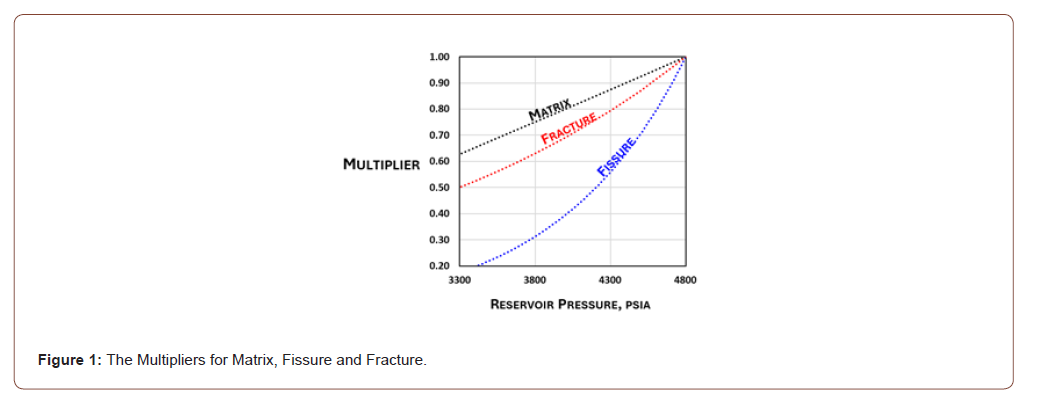
A number of methods has been introduced for coupling the production with geomechanics in a reservoir simulator. The two-way coupling, an iterative process, is considered to be the most flexible and highly reliable (Jalali and Dusseault, 2008). The reservoir model was coupled (two-way coupling) with a geomechanics module to evaluate the effective stress changes during production. Matrix porosity, matrix permeability, fissure permeability, and the hydraulic fracture conductivity are the main coupling variables that are directly related to the effective stress. The matrix porosity is determined by a formula (Tran et al., 2002) incorporated in the geomechanics module. The fissure permeability, matrix permeability, and the hydraulic fracture conductivity at any effective stress are determined according to experimental correlations (multipliers) which are incorporated in the reservoir model. The experimental results by Elsaig et al. (2016 and 2017) were utilized to derive the correlations for fissure and matrix permeability as function effective stress (Elsgher et al. 2018). The experimental results provided by McGinley et al. (2015) for samples obtained at Elimsport site were utilized to develop a correlation for hydraulic fracture conductivity as function effective stress. The results for Elimsport samples were used because the mechanical properties (Young’s module and Poisson’s ratio) were closer to those for typical Marcellus shale properties that are included in the reservoir model. The matrix permeability, fissure permeability, and hydraulic fracture conductivity values between initial and maximum effective stress were then normalized, converted to multipliers as a function of the reservoir pressure (pore pressure), and incorporated in the reservoir model. Figure 1 illustrates the different multipliers which were incorporated in the model.
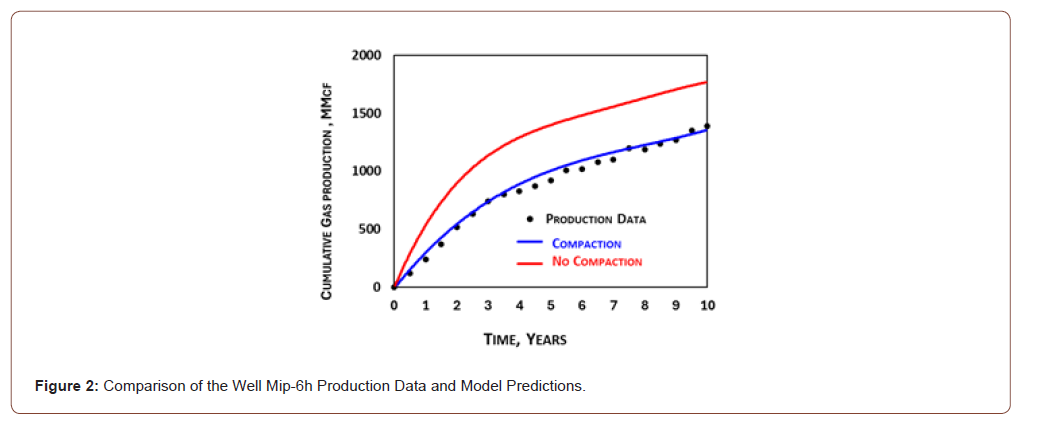
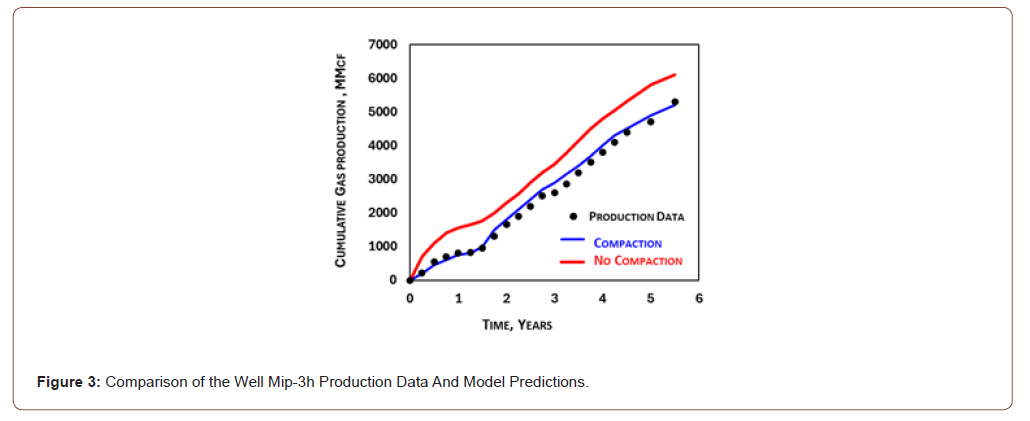
To evaluate the reliability of model, the simulated production profile was compared against field production data from MIP-6H and MIP-3H wells. The number of stages and properties of the hydraulic fractures were adjusted for each well according to the results of the fracture simulator model as mentioned previously. To evaluate the impact of the compaction on the gas recovery, two production profiles for each well were simulated. The first profile was simulated by the reservoir model coupled with geotechnic module. The second profile was simulated without the geomechanics module. Figures 2 and 3 compare the two simulated production profiles and the field gas production data for wells MIP-6H and MIP-3H. As can be observed, the predicted production profile by the coupled model is in close agreement with the production data for both wells. These figures confirm the reliability of the model and reflect the importance of including the compaction to achieve accurate production prediction.
Impact of Compaction on Gas Recovery
In order to investigate the impact of the compaction on gas recovery,
different scenarios were considered, and the production
profiles were generated by the model for comparison purposes as
follows:
1. compaction was ignored.
2. only matrix compaction (both porosity and permeability) was
included in the model.
3. only fissure permeability compaction was included in the
model.
4. only hydraulic fracture conductivity compaction was included
in the model.
5. All compaction components (matrix, fissure, and hydraulic
fracture) were included in the model.
Impact Of Shale and Hydraulic Fracture Properties
The intensity of the shale compaction depends on the magnitude of effective stress. the magnitude of effective stress depends on the number and properties of the hydraulic fractures, shale properties, and the operating conditions. To investigate the impact of shale properties (initial fissure permeability, Young’s modulus and Poisson’s ratio) and hydraulic Fracture properties (length and initial conductivity) on the gas recovery, the model parameters were varied according to Table 2. To evaluate the impact of each parameter on the shale compaction, the model was used to generate two production profiles (one with the coupled model and the other one with the model without coupling) for each case as described above.
Table 2: The Values of The Parameters

Results and Discussion
Figure 4 illustrates the percent change in gas recovery due to compaction when all components of compaction (matrix, fissure, and hydraulic fracture) are included in the model. As can be observed from Figure 4, the impact of compaction diminishes as the production time increases. This is because the gas production rates are higher during the early production which promote a steeper decline in pore pressure, mainly in areas between the fracture (the stimulated reservoir volume). The high initial flow rate are the results of the low wellbore pressure in the model. Figure 5 illustrates the percent change in gas recovery after 10 years due to compaction for different values of wellbore pressure. As can be observed from Figure 4, the impact of compaction diminishes as wellbore pressure is increased. Therefore, the negative impact of the compaction can be reduced by lowering the drawdown. However, reducing the drawdown leads to lower flow rates which is not economically desirable.
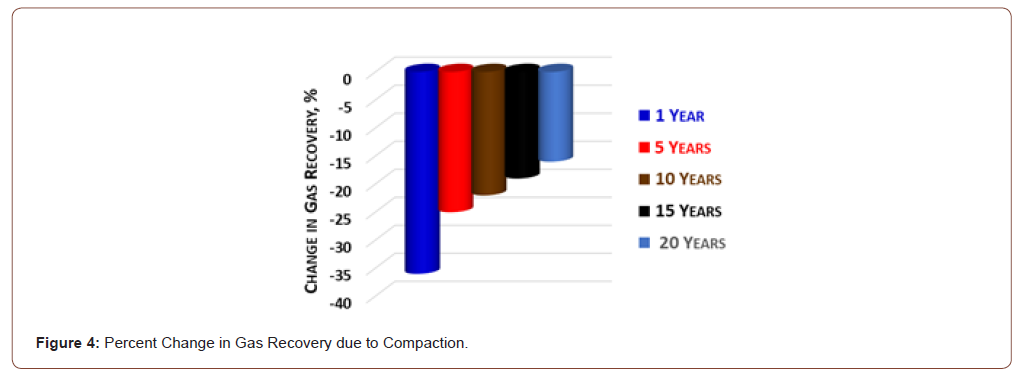
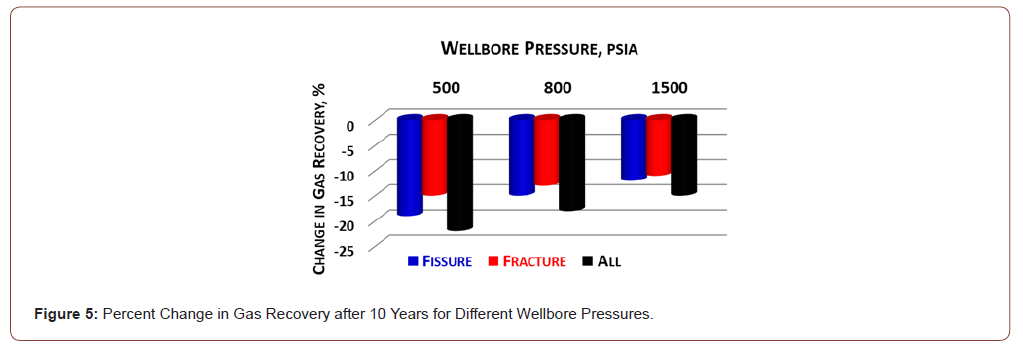
Figure 6 illustrates the percent change in gas recovery caused by different components of the compaction (i.e., fissure, fracture, and matrix) individually. Again, as can be observed, the impact of each component also diminishes with time. It is clear from Figure 6 that the compaction of the hydraulic fracture has the most adverse impact on the gas recovery during early stages (first year) of the production. The adverse impact of the fissure compaction appears to become more significant somewhat later (after 5 years). The matrix compaction appears to have a minor and insignificant impact. This is because the matrix is less compressible than fissures or hydraulic fractures. It should be noted that the matrix compaction is the results of two phenomena, i.e. porosity reduction and permeability reduction. The reduction in matrix permeability has a small negative impact while the reduction in matrix porosity has a small but positive impact on the gas recovery. It should be noted that the matrix shrinkage due to gas desorption can potentially lead to permeability and porosity enhancement. The data on matrix shrinkage in shale is non-existent. Furthermore, as mentioned earlier, substantial pressure depletion is required before desorption becomes significant.
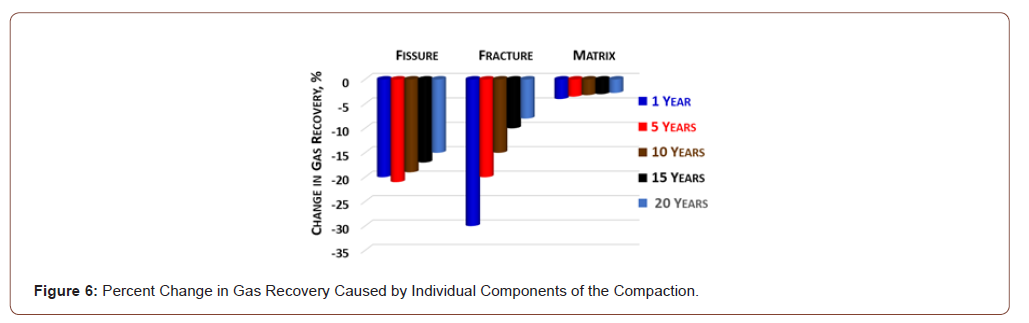
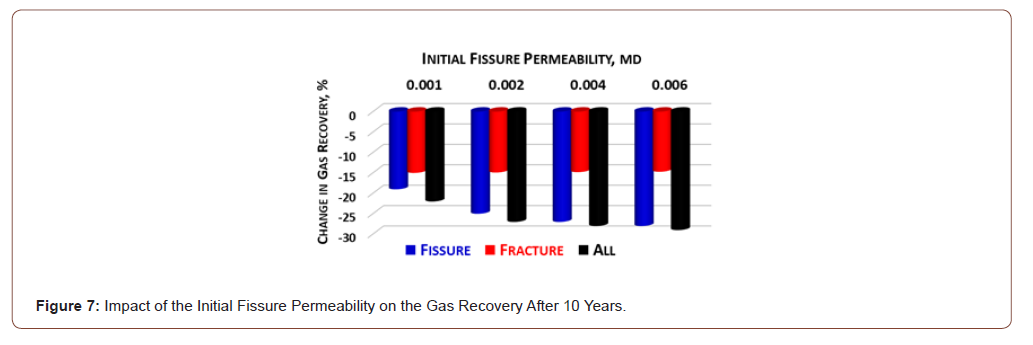
Figure 7 illustrates the impact of the initial fissure permeability on the percent change in gas recovery due to compaction after 10 years of production. The percent change in gas recovery caused by the fissure and fracture compaction individually are also illustrated. As can be observed, the adverse impact of compaction increases as the initial fissure permeability increases. Furthermore, the adverse impact of the fissure compaction also increases as the initial fissure permeability increases. However, the impact of fracture compaction does not appear to be affected by the initial fissure permeability. Therefore, the increase in total compaction impact is mainly due to increase of fissure compaction.
As discussed earlier, the mechanical properties of the shale can influence the degree of shale compaction. A shale with the higher values the Young’s modulus and the Poisson’s ratio would experience lower compaction. To investigate the impact of mechanical properties on the compaction, it is therefore necessary to adjust the correlations for each component of the compaction, i.e. matrix (porosity and permeability, fissure (permeability), and hydraulic fracture (conductivity) based on the mechanical properties. The porosity is determined by the geomechanics module which accounts for mechanical properties. Therefore, new multipliers for matrix, fissure, and hydraulic fracture must be derived to account for the mechanical properties. to derive. A new multiplier for hydraulic fracture conductivity was derived based on the published results by McGinley et al. (2015) for the sample at Allenwood site which had higher values of the Young’s modulus and the Poisson’s ratio. However, the experimental data for shale matrix and fissure permeability as function of stress by mechanical properties are not available. For the purpose of this study, the permeability multipliers for matrix and fissure are assumed not to be altered significantly with the change in the shale mechanical properties. Figure 8 compares the percent change in gas recovery due to compaction for the original and new fracture conductivity multipliers.
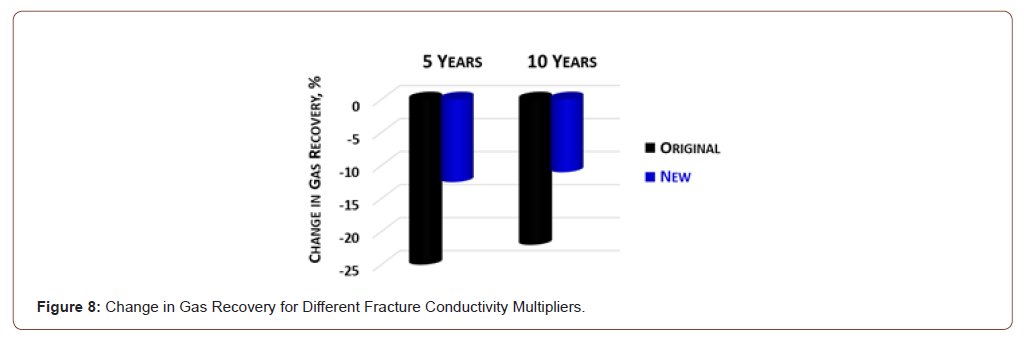
Figure 9 illustrate the impact of the fracture half-length on the percent change in gas recovery due to compaction after 10 years of production. The percent change in gas recovery caused by the fissure and fracture compaction individually are also illustrated. It is evident from this figure that as the fracture half-length increases, the impact of the propped hydraulic fracture compaction becomes increasingly more significant, and the impacts of the fissure compaction decrease. This occurs because the hydraulic fractures contribution to the production increases as the fracture half-length increases. Therefore, compaction of the fractures has a more pronounced impact on the production loss.
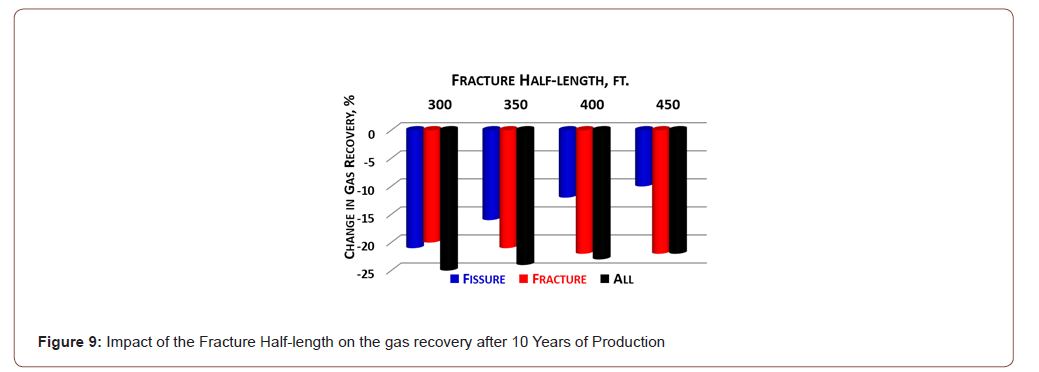
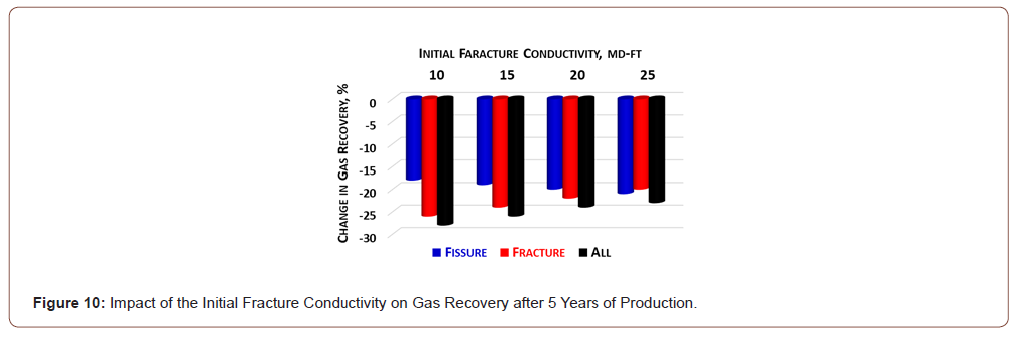
Figure 10 illustrate the impact of the initial fracture conductivity on the percent change in gas recovery due to compaction after 5 years of production. The percent change in gas recovery caused by the fissure and fracture compaction individually are also illustrated. It is evident from Figure 10 that as the initial fracture conductivity decreases, the impact of the propped hydraulic fracture compaction becomes more prominent. This is because the production rates during early production period are controlled by the hydraulic fracture conductivity.
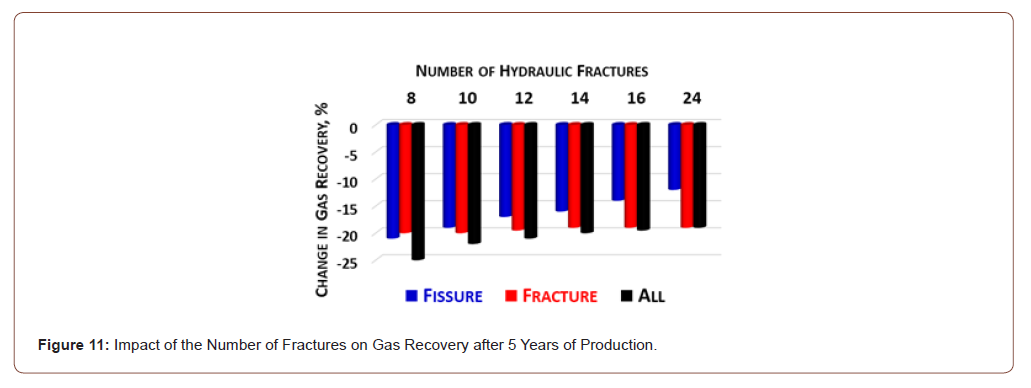
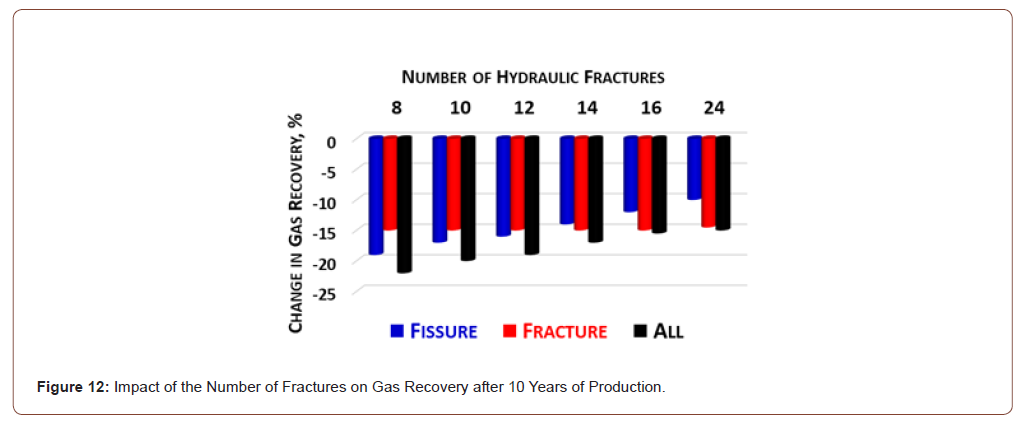
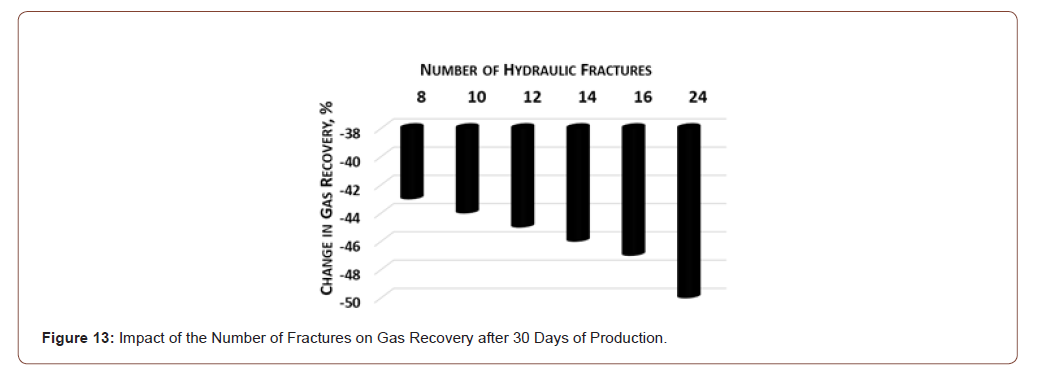
The hydraulic fracture compaction appears to have a more significant impact on the gas recovery during early production period which is critical to economic success of the well. As the number of fractures stage increases, the production increases and at the same time the magnitude of effective stress also increases, which leads to more compaction. Therefore, it is important to investigate the impact of number of fracture stage on the compaction and gas recovery. Figures 11 and 12 illustrate the impact of the number of fracture stages on the percent change in gas recovery due to compaction after 5 and 10 years of production. The percent change in gas recovery caused by the fissure and fracture compaction individually are also illustrated in these figures. As can be observed from these figures, as the number of stages increases the impact of fissure compaction decreases while the impact of hydraulic fracture compaction does not change significantly. The total compaction impact decreases slightly as the number of stages increases. These results are unexpected since the higher number of stages should lead to more stress increase. To investigate this issue further, the impact of the number of fracture stages on the percent change in gas recovery due to compaction after 30 days is considered as illustrated in Figure 13. Therefore, it can be concluded that initially as the number of stages increases leading to high flow rates, the impact of the compaction is more pronounced. However, as the production continues, the flow rates decline, and the impact of the compaction diminishes.
Conclusions
The following conclusions were reached during this study:
1. Marcellus shale because of its mechanical properties is more
susceptible to the adverse compaction impacts due to the increase
in the effective stress.
2. The increase in the effective stress during the production results
in the shale compaction and reduction in matrix porosity,
matrix permeability, fissure permeability, and hydraulic fracture
conductivity.
3. Coupling gas production with geomechanics provides a more
accurate prediction for gas recovery form a Marcellus shale
horizontal well with multiple hydraulic fractures.
4. Shale compaction due to the increase in the effective stress
during the production adversely impacts the gas recovery from
the Marcellus shale.
5. The adverse shale compaction impact is more pronounced
during the early production, due to the higher gas production
rates, and diminishes as the production time increases.
6. During early stage of the production, the reduction in hydraulic
fracture conductivity, due to shale compaction, has the highest
adverse impact on the gas recovery from the Marcellus shale.
7. The reduction in matrix porosity, due to increase in effective
stress, has a small but positive impact on the gas recovery from
the Marcellus Shale.
8. The higher values of Young’s modulus and the Poisson’s ratio
can dampen the adverse impact of the effective stress increases
on the gas recovery.
9. Higher hydraulic fracture half-lengths and lower fracture spacing
amplify the adverse impacts during the early production.
10. Higher values of initial hydraulic fracture conductivity can
lessen the adverse impacts.
11. Higher pressure-drawdowns amplify the adverse impacts.
References
- Alramahi B, undberg M I (2012) Proppant embedment and conductivity of hydraulic fractures in shales. The 46th US Rock Mechanics/Geomechanics Symposium, Chicago, IL ARMA 12-291.
- Bustin RM, Bustin AMM, Cui A, Ross D, Pathi VM, et al. (2008) Impact of Shale Properties on Pore Structure and Storage Characteristics. Presented at the 2008 SPE Shale Gas Production Conference, Fort Worth, Texas, USA. 16-18 November. SPE-119892-MS.
- Cipolla C L, Lolon E P, Erdle JC, Rubin B (2010) Reservoir modeling in Shale-Gas reservoirs. SPE Res Eval Eng 13(4): 638-653.
- CMG: GEM User's Guide, Computer Modeling Group Ltd., 2021.
- Davies JP, Davies DK (1999) Stress-Dependent Permeability: Characterization and Modeling. Presented at the 1999 SPE Annual Technical Conference and Exhibition. Houston, Texas 3-6.
- Elsaig M, Aminian K, Ameri S, Zamirian M (2016) Accurate Evaluation of Marcellus Shale Petrophysicl Properties. presented at the SPE Eastern Regional Meeting, Canton, Ohio, USA, 13-15.
- El Sgher, Mohamed, Kashy Aminian, Samuel Ameri (2019) The Stress Shadowing Impact on the Production Performance of Marcellus Shale. Paper presented at the SPE Annual Technical Conference and Exhibition, Calgary, Alberta, Canada.
- Guzek JJ (2014) Fracture Conductivity of the Eagle Ford Shale. M.S. Thesis, Texas A&M University, College Station, Texas.
- Guo J C, Lu C, Zhao JZ, et al. (2008) Experimental Research on Proppant Embedment. J China Coal Society 33(6): 661-664.
- Huitt J L, Mcglothlin BB (1958) The Propping of Fractures in Formations Susceptible to Propping-sand Embedment. presented at the spring meeting of the Pacific Coast District, Division of Production, Los Anpeles, California, USA, May. SPE 58-115.
- Lacy LL, Rickards AR, Syed AA (1997) Embedment and Fracture Conductivity in Soft Formations Associated with HEC, Borate and Water-Based Fracture Designs. presented at the 1997 SPE Annual technical Conference and exhibition, San Antonio, Texas, USA, 5-8 October.
- Lian P, Cheng L (2012) The Characteristics of Relative Permeability Curves in Naturally Fractured Carbonate Reservoirs. Society of Petroleum Engineers 51(2): 137-142.
- Jalali MR, Dassault M B (2008) Coupled Fluid-Flow and Geomechanics in Naturally Fractured Reservoirs. Paper presented at the ISRM International Symposium - 5th Asian Rock Mechanics Symposium, Tehran, Iran, November 2008.
- McGinley M, Zhu D, Hill A D (2015) The effects of fracture orientation and anisotropy on hydraulic fracture conductivity in the Marcellus Shale. Presented at the SPE Annual Technical Conference and Exhibition, Houston, Texas, USA, 28-30.
- Pope C, Benton T, Palisch T (2009) Haynesville Shale-One operator’s approach to well completions in this evolving play. SPE Annual Technical Conference and Exhibition, New Orleans, LA, 4-7.
- Pedrosa OA (1986) Pressure Transient Response in Stress-Sensitive Formation. Presented at the 56th California Regional Meeting of the Society of Petroleum Engineers, Oakland, California, USA, 2-4.
- Raghavan R, Chin LY (2002) Productivity Changes in Reservoirs with Stress-Dependent Permeability. Society of Petroleum Engineers.
- Raghavan R, Chin LY (2004) Productivity Changes in Reservoirs with Stress-Dependent Permeability. SPE Res Eval & Eng 7(4): 304-315.
- Settari AT, Sen V (2008) Geomechanics in Integrated Reservoir Modeling. OTC Paper No. 19530, Presented at Offshore Technology Conference, Houston, Texas, USA.
- Tran D, Settari AT, Nghiem L (2002) New Iterative Coupling between a Reservoir Simulator and a Geomechanics Module. Paper presented at the SPE/ISRM Rock Mechanics Conference, Irving, Texas, October 2002.
- Terracina JM, Turner JM, Collins DH, Sillars SE (2010) Proppant selection and its effect on the results of fracturing treatments performed in shale formations. SPE Annual Technical Conference and Exhibition, 19-22.
- Tao Q, Ehlig-Economides C A, Ghassemi A (2009) January 1. Investigation of Stress-Dependent Permeability in Naturally Fractured Reservoirs Using a Fully Coupled Poroelastic Displacement Discontinuity Model. Presented at SPE Annual Technical Conference and Exhibition, 4-7 October.
- Volk L J, Raible CJ, Carroll H B et al (1981) Embedment of High Strength Proppant into Low-Permeability Reservoir Rock. SPE/DOE Low Permeability Symposium, Denver, CO. 27-29.
- Zhang J, Kamenov A, Zhu D, Hill AD (2013) Laboratory Measurement of Hydraulic Fracture Conductivities in The Barnett Shale. SPE Hydraulic Fracturing Technology Conference, The Woodlands, Texas, USA.
- Zamirian M (2015) New Experimental Approach to Measure Petrophysical Properties of Organic-Rich Shailesh. Dissertation, West Virginia University, Morgantown.
-

This work is licensed under a Creative Commons Attribution-NonCommercial 4.0 International License.