


 Research Article
Application of Ecotoxicological and Geochemical Techniques in Marine Sediments
Received Date: August 04, 2025; Published Date: October 06, 2025
Abstract
Dredging is a critical activity in various domains, particularly in addressing environmental impacts resulting from anthropogenic activities. However, the management of dredged sediments is complicated by the presence of numerous pollutants. The primary aim of this study was to characterize the dredged sediments from Los Nieto’s (Murcia, Spain), a region of significant environmental impact within the Mar Menor coastal lagoon. Subsequently, the study assessed the risks associated with arsenic (As) and lead (Pb) to public health and ecosystems, with a view to utilizing the dredged material for beach regeneration and the production of construction materials. To achieve this, the dredged sediments were analysed in accordance with the current Spanish regulation, DCDM 2021. The bio accessibility of potentially toxic elements (PTEs) was determined through in vitro digestion methods and was employed to evaluate public health risks in line with standardized regulations, such as those of the USEPA. Additionally, the transfer of PTEs to the aquatic ecosystem was investigated through an ecotoxicological study involving oysters, chosen for their filtration capacity. These organisms were exposed to the contaminated dredged sediments, which were configured as beach sand and construction concretes. The findings indicated that marine sediments in proximity to pollution sources, such as ports and watercourses, exhibited the highest concentrations of total and bioavailable PTEs. Sediments from these areas also posed an unacceptable risk to human health and facilitated the transfer of PTEs to the aquatic ecosystem, whereas the health risk was deemed acceptable for the remaining surveyed areas. In summary, this study underscores the importance of employing geochemical, mineralogical, and ecotoxicological techniques in the analysis of marine sediments, highlighting the risks associated with PTEs to public health and ecosystems, in the pursuit of novel productive applications for dredged material.
Keywords: Marine sediment; dredged material; Mar Menor lagoon; human health risk; PTEs transference; Arsenic; Lead
Abbreviations: PTEs: Potentially Toxic Elements; DCMD: Guidelines for the characterisation of dredged material and its relocation in waters in the maritime-terrestrial public domain. Coastal Guidelines 2021; MITECO: Ministry for Ecological Transition and the Demographic Challenge
Introduction
Dredging involves the translocation of marine sediment form one place of the ocean to other ones [1] named as ocean dumping sites [2]. It has been improved while the development of the mari time transport, the principal transportation system of the international trade [3]. Nowadays, dredging is one of the most important not only in the maintaining of navigation channels, but also in flood control or environmental remediation [3,4]. In Europe, 300 million m3 of sediment is dredged annually as in USA, while 100 million m3 of sediment is dredged annually in China [5]. However, dredging has a major problem related to the management of dredged material. Dredged sediments are considered a toxic waste due to the number of pollutants contained including microplastics and Potentially Toxic Elements (PTEs) like arsenic (As) or lead (Pb) [1,2,6,7]. This supposes a huge environmental problem as it can cause a second contamination [1,3]. For that reason, recent research is aimed to reduce pollution and reuse de dredged material in other purpose like construction material and biofertilizer [1,8,9].
To ensure the proper management of the dredged material, various international conventions and national guidelines have been established [10]. In Spain, the current regulations governing dredging operations are called “Guidelines for the characterisation of dredged material and its relocation in waters in the maritime-terrestrial public domain, 2021” [6]. This regulation firstly makes a chemical characterisation according to the amount of total PTEs in the dredged sediment. However, some recent research show that the toxicity of PTEs not only depends on the total concentration in sediments, but also on the PTEs biodisponibility [10, 11, 12, 13, 14, 15]. The biodisponibility of PTEs is the part of the pollutant that arrives to the systemic circulation [7,11,16]. It is determined by in vivo methods, so it is usually replaced by bioavailability, which includes in vitro methods for analysing human health risk associated with PTEs [17, 18]. The increasing levels of PTEs, like As and Pb, in polluted soils of coastal areas influenced by mining activity, may pose a serious problem for human health and ecosystems [17, 18]. As and Pb can be found in nature in different states that determine bioavailability and toxicity [18,19]. Lead is considered a possible carcinogenic and a potent neurotoxic [18, 20, 21]. In nature, it usually appears as the insoluble state, Pb (II), but highly mobilisation which causes toxicity. In marine sediments, Pb concentration is increased by Fe and Mn hydroxides and organic matter [18]. Arsenic is a carcinogenic, teratogenic and mutagenic element [17]. It is highly distributed, and it appears in two oxidation states: As (III) and as (V). As (III) is more toxic than as (V) due to it can link to sulfhydryl groups and being introduced easily to organisms. As mobilization increases also in soils with high organic matter content but decreases with Fe and Mn oxides [19].
Mar Menor lagoon is a hypersaline lagoon located in the southeast of Spain. It is separated from the Mediterranean Sea by a sand barrier named La Manga (Murcia) [20]. Mar Menor is one of the largest coastal lagoons in Europe with a high tourist attraction and socio-economic value [11]. However, it has been altered by pollution from anthropogenic activities, like mining [20,21]. It has caused the sedimentation of metals from Sierra La Unión-Cartagena for 3000 years, with the Phoenicians [11]. Nowadays, high concentration of PTEs continues in the lagoon, especially in the mouth of the watercourses [22]. PTEs biodisponibility and the possible transference of PTEs to the organisms of Mar Menor has been studied [22]. Among these organisms are bivalve molluscs, which include oysters [23]. This group has an important role in toxicological studies and biomonitoring of pollutants as its biological characteristics such as widely distribution, abundance and filter feeding [23, 24, 25]. A particular case is the European flat oyster (Ostrea edulis), which lives in the Mar Menor lagoon and has an important gastronomic and ecological role worldwide [26,27].
The overall aim of this work is to study bioaccessibility of PTEs presented in dredged marine sediments from Los Nietos, a highly environmental impacted zone of Mar Menor (Murcia, Spain) and the possible transference to humans and aquatic ecosystems. The specific goals are: 1) dredged sediments characterisation 2) analysing the potential risk associated with PTEs for human health and 3) analysing the possible transference of PTEs from the dredged sediments to aquatic ecosystems.
Materials and Methods
Study area and sampling
The study area was Los Nieto’s, located to the south of Mar Menor lagoon (Murcia, Spain). It is one of the most affected zones, where there is one of the highest concentrations of PTEs. Twenty sampling stations were determined and one sample per station was taken with corer.
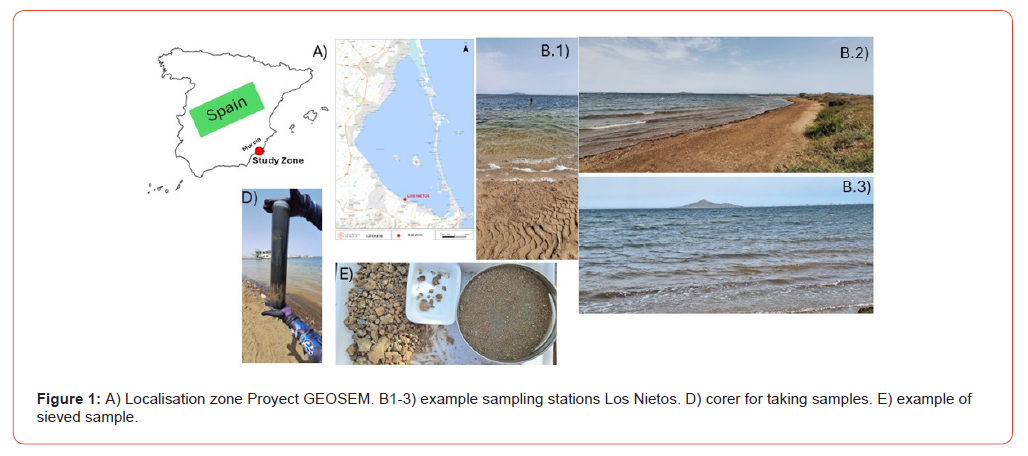
Sample treatment
The dredged sediment samples were air-dried and sieved to <2 mm granulometric fraction.
Characteristics of the Marine Sediments
Organic matter content (%) was determined by Page procedure [28]./p>
A semiquantitative estimation of the mineralogical composition of the samples was made by powder X-ray diffraction (XRD) analysis using Cu-Ka radiation with a PW3040 Philips Diffractometer (Amsterdam, The Netherlands). X-powder 12 software was used to analyse the X-ray diffractograms obtained [29]. The powder diffraction file (PDF2) database was used for peak identification.
PTEs bioaccesibility was analysed by in vitro digestion. For that purpose, the gastric solution was prepared according to the standard operating procedure developed by the Solubility/Bioavailability Research Consortium. Finally, two phases known as stomach and intestinal were established [17], from which the phase with the highest concentration was taken for the results.
PTEs total concentration
The samples were placed in Teflon containers together with 5 mL of concentrated acidic HF solution, consisting on 2 mL of concentrated acidic HNO3 solution and 5 mL of ultrapure water. The vessels were placed in an ETHOS laboratory microwave system [Milestone, Sorisole (BG), Italy] [17], where sample digestion was carried out. The samples were then transferred to a volumetric flask and made up to 50 mL. Finally, the samples were placed in additional Teflon containers for storage prior to measurement [11].
Dredged sediments classification was made by considering total concentrations of As and Pb and following article 22: levels of actin of the Spanish regulation [6].
Exposure assessment and characterization of public health risk associated with PTEs
Current standardized regulations (USEPA) were used to evaluate and characterize the human health total risk associated with As and Pb (carcinogenic risk and hazard index). Intake risk, inhalation risk and dermal adsorption risk were calculated and were joined to determine human health total risk.
Transference of PTEs to the aquatic ecosystem
An ecotoxicological bioassay was made to evaluate the possible transference of PTEs to the aquatic ecosystem. The ecotoxicological study was made in the aquariums of the Immunobiology for aquaculture research group, which were in the Animal House of the University of Murcia (Spain). A total of 49 individuals of European flat oyster (Ostrea edulis) were purchased (Fresco y del mar, Cambados, Galicia, Spain) were used. They were located in an acclimatation tank of 130 L for 10 days. The environmental conditions during the experiment were recorded daily. The temperature of the water was 20ºC, the salinity was 32 ppm, and the oysters were fed once a day with jelly phytoplankton (Easy booster).
Experimental design and sampling
The experimental design comprises four distinct groups, each with one replica, housed in 50 L saltwater recirculation tanks (Figure 2). The groups were as follows:
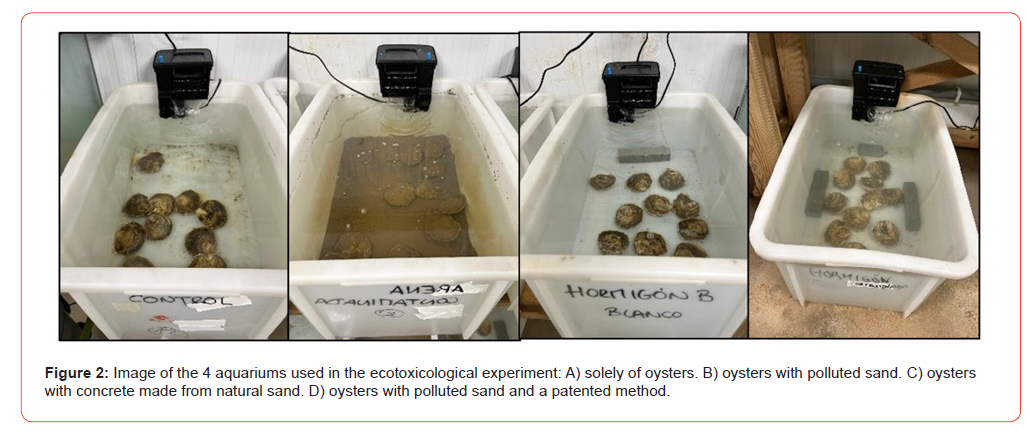
a. Control (n=9 individuals) consisting solely of oysters.
b. Polluted sand (n=11 individuals) containing oysters with
dredged marine sediments
c. Control concrete (n=12 individuals) featuring oysters with
concrete made from natural sand.
d. Polluted concrete (n=11 individuals), which includes oysters
with concrete made from polluted sand and a patented method
by the Soil Contamination Research Group for metal immobilization.
The duration of the experiment was 30 days, with sampling conducted on day 0 and day 30. Samples were collected from the meat and shell of oysters (6 individuals per experimental tank) and from water (2 replicates per experimental tank).
Sample treatment and analysis
Oyster samples (meat and shell) were air-dried y sieved. Then, two different digestions were made to determine EPTs concentrations in the different parts of the animals. For oyster meat (organic part) digestion, a high-pressure Milestone ETHOS PLUS microwave system was used. The meat was placed in Teflon tubes with 3 mL of milliQ water, 2 mL of H2O2 and 5 mL of concentrated HNO3. For oyster shell (inorganic matter), high pressure Milestone ETHOS PLUS microwave system was also needed. The shell was placed in Teflon tubes with 5 mL of concentrated hydrofluoric acid, 2 mL of concentrated nitric acid and 5 mL of milli water. Then, both parts of the oyster samples were brought to 50 mL and stored until analysis.
Water samples were filtered through 0.45 μm cellulose acetate filters and placed in 10 mL test tubes.
Transference Factor (TF) was calculated as the concentration relation between two parts of an organism following the equation:
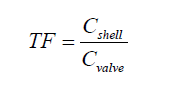
where Cshell is the total concentration of PTE (As or Pb) in the oyster´s shell, and Cvalve is the total concentration of PTE (As or Pb) in the oyster’s valves.
Statistics analysis. RStudio (version 4.4.2) and Excel (Microsoft 265) were used for the statistics analysis.
Results and Discussion
General characteristics of dredged materials
Results indicated that the dredged materials comprised minerals characteristic of marine environments [21, 30, 31], consistent with findings from previous studies conducted in the lagoon [11,30]. The predominant minerals identified were quartz, aragonite and calcite while muscovite, dolomite, halite and gypsum were present in smaller proportions. Notably, minerals indicative of mining contamination, such as goethite or pyrite, were absent [21]. These findings suggest an absence of mining waste inflow from the abandoned Sierra Minera de la Cartagena-La Unión.
The average carbon content was measured at 2.85%, with a minimum of 1.25% and a maximum of 16.01%, and the majority of samples exhibited levels below 2.77%. The mean organic matter content was 4.89%, with a range from 2.15% to 27.53%. Both organic matter and carbon content were lower compared to those reported [30] in areas of the lagoon adjacent to Los Nietos, with the proportion of organic matter exceeding 2%, which may indicate potential ecosystem degradation [31].
Total and bioccesible concentration of As and Pb
The total concentration of arsenic (As) ranged from 9 to 128 ppm, while lead (Pb) concentrations varied between 50 and 2014 ppm, with mean concentrations of 37.5 ppm and 560.7 ppm, respectively. Upon comparison of the results, it was evident that both the total and bioaccessible concentrations of Pb in sediments exceeded those of As. Notably, samples collected in proximity to contamination sources, such as ports (stations 11 and 12) and watercourses (stations 9 and 10), exhibited the highest levels of both total and bioaccessible Pb, as well as total As. The bioaccessible as concentrations were found to be between 2 and 13 ppm, with an average concentration of 4 ppm, and predominantly below 5 ppm. In contrast, bio accessible Pb concentrations ranged from 35 to 1203 ppm, with an average value of 317.2 ppm, and most samples exhibited concentrations below 313.3 ppm.
In accordance with the 2021 Guidelines, the dredged material was categorized based on the total concentrations of arsenic (As) and lead (Pb). All samples, except those from stations in close proximity to pollution sources, were classified as Non-Hazardous Sediment. The majority of these samples were designated as Action Level C (stations 1 to 6, 8, 13, 14, 16, and 17), while others were classified as Action Level B (stations 7, 18, 19, and 20). Certain samples were identified as Hazardous Sediment or category R (stations 9, 11, and 12). Additionally, two stations (10 and 15) were classified as Non-Hazardous Sediment, as they exceeded the threshold for category C but did not reach the levels of Hazardous Sediment. As none of the samples were classified at Action Level A, they are unsuitable for use in beach regeneration due to their potential biological risk to aquatic ecosystems [32]. It was observed that samples collected at the port (stations 11 and 12) and near the watercourse (station 9) exhibited the highest concentrations of environmentally persistent toxins (EPTs) and posed the greatest risk, in contrast to samples obtained from more distant locations (stations 18, 19, and 20).
Risk characterization of As and Pb
Results indicated that in the areas proximate to pollution sources (9, 11, and 12), the carcinogenic risk associated with arsenic (As) for both children and adults was deemed unacceptable (CR > 10- 05). Concerning the health risk associated with lead (Pb), only the Hazard Index for children in samples 9 and 11 was considered unacceptable.
A Pearson correlation analysis was conducted to examine the relationships between the general characteristics of marine sediments, bio accessible and total concentrations of As and Pb, and the total human health risk associated with As and Pb (HI and CR) (Table 1). A strong correlation was identified between the risks associated with As and Pb (RC and HI) and the bioaccessibility of Pb (r>0.7; p<0.05), as well as the total concentration of As and Pb in sediments (r>0.7; p<0.001). Additionally, a strong correlation was observed between bio accessible As and the risks associated with as (r>0.7; p<0.05), while a moderate correlation was noted with the risks associated with Pb (r>0.5; p<0.05). There is also a moderate positive correlation between the risk associated with As and the content of carbonates and organic matter (r>0.5; p<0.05). Regarding mineralogy, a moderate positive correlation exists between muscovite and the total risk associated with as (r>0.5; p<0.05), and a negative correlation is observed between dolomite content and the risks associated with As and Pb (r>0.5; p<0.05).
Table 1: Relation between human health risk associated with As and Pb, general characteristics of dredged materials and total and bioaccessible concentrations of PTEs.

*p<0,05 and **p<0,001
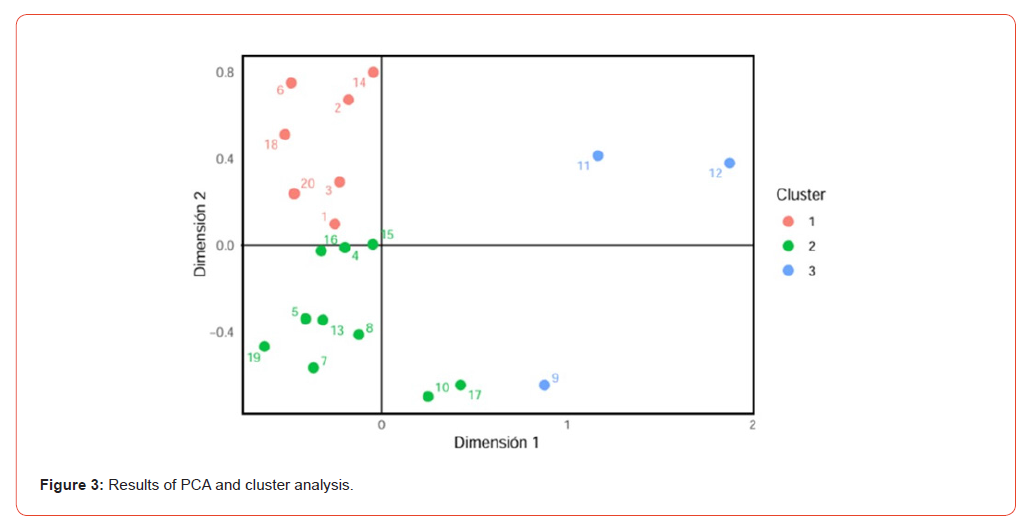
Principal component analysis (PCA) revealed that the first three components accounted for 80.37% of the total variance. The variables that predominantly contributed to dimension 1 included bio accessibility, total concentrations of As and Pb, muscovite content, and dolomite content. In dimension 2, aragonite content was the primary contributor, followed by quartz, dolomite, and calcite. Notably, no mining minerals such as goethite or pyrite were present [21]. Subsequently, cluster analysis (K-means) identified three distinct mineralogical groups, comprising seven samples in group 1, ten samples in group 2, and three samples in group 3 (Table 1). These groups exhibit differences in the bio accessibility of potentially toxic elements (PTEs), which can be attributed to the varying environmental geochemistry of the zones [10, 13, 18, 19, 33]. Both As and Pb are transported from the Sierra Minera La Unión-Cartagena [34] via watercourses to the lagoon [7], and in the port area, the elevated concentration of PTEs is attributed to ship fuels [35]. Quartz serves as an indicator of continental influence [31], being a resistant mineral that can impede the mobilization of PTEs [21,36]. Similarly, dolomite and calcite are formed in environments with high alkalinity, which neutralizes the acidity originating from mining waters [36,37].
Table 2: Mineralogical groups.

The Fischer test revealed a statistically significant association between mineralogical groups and the carcinogenic risk related to as for both children and adults, as well as the hazard index for Pb in children (p-value < 0.05) (Table 2). Moreover, the strength of this relationship is substantial in all instances (Cramér’s V, V > 0.7). The analysis of standardized residuals indicated that only group 3 contributed to an unacceptable human health risk associated with As and Pb (Figure 3). The dredged sediments from group 3, sourced from the port and the rambla, are environments with an anoxic tendency and are significantly influenced by anthropogenic factors such as maritime, mining, and agricultural waste, there by posing an unacceptable risk to human health. In contrast, zones less impacted by these factors, due to their mineralogical components that immobilize potentially toxic elements (PTEs), do not contribute to an unacceptable human health risk.
Transference of PTEs to aquatic ecosystems
The concentrations of As and lead Pb measured in the water samples were notably low, with values approaching or below the detection limit (< DL). A slight increase in as concentration was observed at the conclusion of the experiment (30 days) in the tank containing untreated dredged marine sediment samples. A significant transference of as was noted within the organism, which was more pronounced in polluted sand and polluted concrete. Conversely, the transference of Pb from water to the oyster’s body was only evident in the polluted sand group. In both instances, the transference of potentially toxic elements (PTEs) highlighted the substantial bioaccumulation capacity of oysters, attributable to their filter-feeding nature [38,39]. Furthermore, the greater transference of as to the organic component of the organism (flesh) compared to the inorganic component (shell), as opposed to Pb, suggested a higher mobilization and affinity of as than Pb in the organic parts of organisms [39].
Conclusion
The study identifies a significant correlation between the general characteristics of dredged sediments, the bio accessibility of PTEs such as as and lead Pb, and the associated human health risks and transference of PTEs to aquatic ecosystems. Although current legislation considers only the total concentration of PTEs in the productive use of dredged materials, this research confirms that total concentration is not the sole influencing factor. The toxicity of PTEs is also contingent upon their bio accessibility, which is affected by the geochemical characteristics of the area. Furthermore, dredged sediments from Los Nieto’s are deemed suitable for beach regeneration, except in areas proximate to pollution sources, as there is no unacceptable human health risk associated with As and Pb. Similarly, there is no transference of As and Pb to aquatic ecosystems, except in samples from zones near pollution sources. Finally, the analysis of human health risk and transference to ecosystems is an essential methodology for determining new productive uses of dredged materials. Determining the mineralogical composition of marine sediments is crucial in these marine areas near abandoned mining sites. These results are instrumental in ascertaining whether sediments with high concentrations of heavy and trace elements are attributable to the presence of mining residues or other anthropogenic activities.
Acknowledgements
This work was funding by the project GEOSEM of the ThinkInAzul programme supported by MCIN with funding from European Union Next Generation EU (PRTR-C17. I1) and by the Comunidad Autónoma de la Región de Murcia-Fundación Séneca (Spain).
Conflict of Interest
The authors declare no conflicts of interest.
References
- Beljin J, ArsenovD, Slijepčević N, Maletić, S, Đukanović N, et al. (2023) Recycling of polluted dredged sediment-Building new materials for plant growing. Waste Management 166(1): 13-24.
- Yi Y, Kong L, Wang X, Li Y, Cheng J, et al. (2023) Distribution and characteristics of microplastics in sediment at representative dredged material ocean dumping sites, China. Marine Pollution Bulletin 193(8): 115201-115210.
- Eke CC, Frank L, Ahaji UP, Ezeh V, Amadi CC, et al. (2023) Dredging of Harbours and Rivers: Review of Practices and Associated Environmental Impacts. IIARD INTERNATIONAL JOURNAL OF GEOGRAPHY AND ENVIRONMENTAL MANAGEMENT 9(5): 22-36.
- Đelović D (2024) Considerations on Prevention of Pollution from Ships in a Seaport. Sustainability 16(12): 5196-5199.
- Dorleon G Rigaud S, Techer I (2024) Management of dredged marine sediments in Southern France: Main keys to large-scale beneficial re-use. Environmental Science and Pollution Research 32(28): 16656-16679.
- DCMD (2021) Directrices para la characterization del material dragado y su reubicación en aguas del dominio público marítimo-terrestre 2021. Comisión Interministerial de Estrategias Marinas 1-173.
- Martínez-López S, Martínez-Sánchez MJ, Pérez-Sirvent C (2021) Do Old Mining Areas Represent an Environmental Problem and Health Risk? A Critical Discussion through a Particular Case Minerals 11(6): 594-600.
- Rozas F, Castillo Talavera A, Martínez Sierra I Castellote Armero M (2018) Protocolo de valorización de residuos en la fabricación de materiales de base cemento: Sedimentos dragados como componente de hormigón autocompactante. Libro de Comunicaciones / Livro das Comunicaçõ HAC2018 - V Congreso Iberoamericano de Hormigón Autocompactable y Hormigones Especiales 1-10.
- Loudini A, Ibnoussina M, Witam O, Limam A, Turchanina O (2020) Valorisation of dredged marine sediments for use as road material. Case Studies in Construction Materials 13(12): 00455-00460.
- MITECO (2025) Ministerio para la Transición Ecológica y el Reto Demográfico. www.miteco.gob.es
- Martínez-López S, Martínez-Sánchez M J, Gómez-Martínez MDC, Pérez-Sirvent C (2020) Assessment of the risk associated with mining-derived arsenic inputs in a lagoon system. Environmental Geochemistry and Health 42(8): 2439-2450.
- Benedicto J, Marín-Guirao L, Pérez J (2009) Capítulo VI Contaminación por metales y compuestos organoestánnicos en el Mar Menor. En El Mar Menor. Estado actual del conocimiento científico. Fundación para la protección y conservación del Mar Menor y Fundación Instituto Euromediterráneo del Agua 201-238.
- Abd Elnabi MK, Elkaliny NE, Elyazied MM, Azab SH, Elkhalifa SA, et al (2023) Toxicity of Heavy Metals and Recent Advances in Their Removal: A Review. Toxics 11(7): 580-587.
- Jeong H, Byeon E, Kim DH, Maszczyk P, Lee JS (2023) Heavy metals and metalloid in aquatic invertebrates: A review of single/mixed forms, combination with other pollutants, and environmental factors. Marine Pollution Bulletin 191(6): 114959-114960.
- Martinez Lopez S, Perez Sirvent C, Martinez Sanchez MJ, Esteban Abad MA (2025) Human Health Risk and Bioaccessibility of Arsenic in Wadis and Marine Sediments in a Coastal Lagoon (MarMenor, Spain) Toxics 13(8): 647-650.
- Wang XN, Gu YG, Wang ZH, Ke CL, Mo MS (2018) Biological risk assessment of heavy metals in sediments and health risk assessment in bivalve mollusks from Kaozhouyang Bay, South China. Marine Pollution Bulletin 133(8): 312-319.
- Martínez-Sánchez MJ, Martínez-López S, Martínez-Martínez LB, Pérez-Sirvent C (2013) Importance of the oral arsenic bioaccessibility factor for characterising the risk associated with soil ingestion in a mining-influenced zone. Journal of Environmental Management 116(15): 10-17.
- Pérez-Sirvent C, Martínez-Martínez LB, Martínez-Lopez S, Hernández-Perez C, García-Lorenzo M L (2022) Assessment of risk from lead intake in mining areas: Proposal of indicators. Environmental Geochemistry and Health 44(2): 447-463.
- Martínez López S, Banegas García A, Pérez Sirvent C, Martínez Sánchez MJ, Esteban Abad MA, et al. (2023) The Arsenic Biogeochemical Cycle: A Review. Advances in Environmental and Engineering Research 04(04): 1-26.
- Singh V, Singh N, Rai SN, Kumar A, Singh AK, et al. (2023) Heavy Metal Contamination in the Aquatic Ecosystem: Toxicity and Its Remediation Using Eco-Friendly Approaches. Toxics 11(2): 147-150.
- Martínez-López S, Martínez-Sánchez M J, Gómez-Martínez MDC, Pérez-Sirvent C (2020) Arsenic zoning in a coastal area of the Mediterranean Sea as a base for management and recovery of areas contaminated by old mining activities. Applied Clay Science 199(1): 105881-105889.
- Martínez López S, Martínez Sánchez MJ, Pérez Sirvent C, Gómez Martínez M, del C, et al. (2019) Estudio del estado del arte de las investigaciones, estudios, publicaciones y líneas de investigación iniciadas de las diferentes administraciones, universidades y otros organismos científicos sobre las explotaciones mineras de la Sierra Minera de Cartagena-La Unión y sus efectos en el Mar Menor. Universidad de Murcia, Grupo de Investigación Contaminación de Suelos.
- Hernandis S, Da Costa F, Hernández-Contreras Á, Albentosa M (2023) Hatchery seed production of flat oysters from the Mar Menor lagoon. Frontiers in Marine Science 10: 1231686.
- Lemos L, Gantiva L, Kaylor C, Sanchez A, Quinete N (2022) American oysters as bioindicators of emerging organic contaminants in Florida, United States. Science of The Total Environment 835: 155316.
- Sepúlveda CH, Sotelo-Gonzalez MI, Osuna-Martínez CC, Frías-Espericueta MG, Sánchez-Cárdenas R, et al. (2023) Biomonitoring of potentially toxic elements through oysters (Saccostrea palmula and Crassostrea corteziensis) from coastal lagoons of Southeast Gulf of California, Mexico: Health risk assessment. Environmental Geochemistry and Health 45(5): 2329-2348.
- Albentosa M, Akinyemi MI, Vera M, Ibarrola I, Filgueira R, et al. (2023) Recovery of eutrophized marine ecosystems using the European flat oyster. Aquatic Conservation: Marine and Freshwater Ecosystems 33(7): 645-660.
- Buck AJ, arrella-Smith KA, Jordaan A, Richardson J B (2024) Ecotoxicology of Trace Elements in European Oyster (Ostrea edulis), Seawater, and Sediments across Boston Harbor, Massachusetts, USA. Bulletin of Environmental Contamination and Toxicology 112(1): 20-25.
- Page AL (1982) Methods of Soil Analysis American Society of Agronomy (9).
- Martin D (2024) Qualitative, Quantitative and Microtextural Powder X-Ray Diffraction Analysis. 2019. Available online.
- García G, Muñoz-Vera A (2015) Characterization and evolution of the sediments of a Mediterranean coastal lagoon located next to a former mining area. Marine Pollution Bulletin 100(1): 249-263.
- Hope D, Cox A, Zamora-Duran A, Johnson KB (2024) The Association of Benthic Infauna with Fine-Grained Organic-Rich Sediments in a Shallow Subtropical Estuary. Journal of Marine Science and Engineering 12(12): 2184.
- Buceta JL, Lloret A, Antequera M, Obispo R, Sierra J, et al. (2015) Nuevo marco para la caracterización y clasificación del material dragado en España. Ribagua 2(2): 105-115.
- Jeong H, Byeon E, Kim DH, Maszczyk P, Lee JS (2023) Heavy metals and metalloid in aquatic invertebrates: A review of single/mixed forms, combination with other pollutants, and environmental factors. Marine Pollution Bulletin 191: 114959-114960.
- Santos-Echeandía J, Bernárdez P, Sánchez-Marín P (2023) Trace metal level variation under strong wind conditions and sediment resuspension in the waters of a coastal lagoon highly impacted by mining activities. Science of The Total Environment 905: 167806-167809.
- Cutroneo L, Carbone C, Consani S, Vagge G, Canepa G, et al. (2017) Environmental complexity of a port: Evidence from circulation of the water masses, and composition and contamination of bottom sediments. Marine Pollution Bulletin 119(1): 184-194.
- Torres ME, Hong WL, Solomon EA, Milliken K, Kim JH, et al (2020) Silicate weathering in anoxic marine sediment as a requirement for authigenic carbonate burial. Earth-Science Reviews 200: 102960-102968.
- González-Fernández O, Queralt I, Carvalho ML, Garcia G (2011) Lead Zinc,Arsenic and Copper Pollution in the Alluvial Plain of a Mining Wadi: The Beal Case (Cartagena–La Union Mining District, SE Spain). Water, Air, & Soil Pollution 220(4): 279-291.
- Signa G, Mazzola A, Di Leonardo R, Vizzini S (2017) Element-specific behaviour and sediment properties modulate transfer and bioaccumulation of trace elements in a highly-contaminated area (Augusta Bay, Central Mediterranean Sea). Chemosphere 187: 230-239.
- Tan RH, Ng CC, Gu T, Tek PPY (2025) Evaluation of potentially toxic elements (PTEs) contamination in seawater, sediment, and sea snails (Nerita articulata and Cerithidea obtusa) from Kukup Fishing Village, Johor, Malaysia. Environmental Monitoring and Assessment 197(5): 565-570.
-

This work is licensed under a Creative Commons Attribution-NonCommercial 4.0 International License.