




 Research Article
The Relationship Between Sports Performance Variables and Baseball Hitting Performance in NCAA Division II Athletes
Received Date:August 18, 2025; Published Date:August 28, 2025
Purpose:To examine relationships between strength, power, and body composition with bat velocity (BV) and batted ball velocity (BBV) in
NCAA Division II baseball players.
Methods:Twenty-two male position players (19.92 ± 1.53 y; 181.2 ± 7.4 cm; 84.6 ± 11.8 kg) were tested for BV, BBV, medicine ball (MB)
rotational shotput distance, lateral bound distance, lean body mass (LBM), 1RM trap bar deadlift, and 1RM back squat. BV and BBV were measured
indoors using Rapsodo and Blast Motion technology during a standardized hitting protocol; LBM via BOD POD®; strength via NSCA protocols.
Pearson’s correlations were computed (p < 0.05).
Results:LBM (r = 0.54; p = 0.006) and trap bar deadlift (r = 0.43; p = 0.038) were significantly correlated with BBV; MB rotational shotput
showed a trend (r = 0.39; p = 0.060). LBM correlated with BV (r = 0.47; p = 0.021), with trends for back squat (r = 0.39; p = 0.058) and trap bar
deadlift (r = 0.38; p = 0.068).
Conclusion:LBM and trap bar deadlift strength are key contributors to hitting performance. Rotational MB exercises and back squat strength
may also enhance BV and BBV.
Keywords: Bat Velocity; Exit Velocity; Strength; Power; Lean Body Mass; Baseball Performance
Introduction
Success in baseball is predicated on several skills, one of the most important of which is the ability to hit. A hit occurs when a batter strikes the baseball into fair territory and reaches base without doing so via an error or a fielder’s choice (MLB.com). The takeaway from this definition is the batter’s ability to strike the baseball - a factor the athlete can directly control. The more effectively a player can strike a baseball, the greater the chance of offensive success. The ultimate goal for a hitter is to consistently hit the ball hard.
Taking a scientific approach to the offensive side of baseball requires focusing on the controllable variables of the game. Although timing, coordination, mental approach, mechanics, and pitch recognition all contribute to hitting performance, the purpose of this study was to provide concrete, quantitative evidence for factors that can improve hitting outcomes. Bat velocity (BV) and batted ball velocity (BBV), also referred to as bat speed and exit velocity, have been shown to be among the most important traits of successful hitters [1]. Accordingly, baseball athletes should tailor their training toward improving these attributes.
Physiologically, baseball is an anaerobic sport requiring capabilities across the force-velocity spectrum [1]. Strength, power, and speed all contribute to baseball performance, particularly in hitting. In recent years, the baseball training industry has increasingly recognized the importance of integrating all three qualities into strength and conditioning programs, although published research in this area remains limited [2]. Historically, high-repetition, lowload training was common in baseball programs, with the intent of maintaining mobility and avoiding excessive muscle mass. This approach often neglected the role of maximal strength and power development in optimizing on-field performance. Contemporary sport performance practice now acknowledges that strength, power, and speed must be systematically developed to match the demands of the sport.
Previous research indicates that strength, power, sport-specific training, and body composition are positively associated with bat swing velocity and batted ball velocity [3]. However, within the strength and conditioning field, there is still a need to identify which objective measures yield the greatest transfer to hitting performance. Clear, evidence-based performance benchmarks can assist coaches in designing targeted training interventions. Therefore, the aim of this study was to examine the relationships between measures of strength, power, and body composition with BV and BBV in NCAA Division II collegiate baseball players.
Materials and Methods
Participants
Twenty-two NCAA Division II collegiate baseball position players (pitchers excluded) from East Stroudsburg University participated (age: 19.92 ± 1.53 years; height: 181.2 ± 7.4 cm; body mass: 84.6 ± 11.8 kg). All participants had ≥10 years of baseball experience, were injury-free during the fall 2022 season, and were cleared for participation by the university’s athletic training staff following a Functional Movement Screen.
The study was approved by the East Stroudsburg University Institutional Review Board. All participants provided written informed consent. An a priori power analysis was not performed; however, the sample size is consistent with previous research in similar populations examining baseball hitting performance [1]; (n = 29).
Design
Testing occurred over one week, with four sessions separated to minimize fatigue. Session 1: BOD POD® body composition. Session 2: sports performance measures (MB rotational shotput, lateral bound) and hitting performance (BV, BBV). Sessions 3 and 4: 1RM trap bar deadlift and 1RM back squat, separated by 48 hours.
Procedures
Body Composition: LBM was measured via BOD POD® (COSMED USA, Inc.), following standard procedures [4]. Warmup: A standardized dynamic warm-up was completed before all physical testing, incorporating R.A.M.P. principles (raise, activate, mobilize, potentiate), progressing from ground-based to standing movements, proximal to distal, and static to dynamic. Medicine Ball Rotational Shotput: Using a 2.72 kg PB Extreme Soft Toss Elite medicine ball, participants performed five maximal rotational throws from their dominant hitting side, with the rear foot in contact with the ground until release. The best distance was recorded [5].
Lateral Bound: From a single-leg stance on the dominant hitting side, participants performed five maximal lateral bounds. The best distance was recorded using a tape measure from take-off to landing [6]. Bat and Batted Ball Velocity: BV and BBV were measured indoors using Rapsodo and Blast Motion sensors. Following 20 warm-up swings, participants hit 10 pitches delivered via a JUGS machine at an 85 mph (38.0 m·s⁻¹) equivalent from 13.7 m. The top three swings for BV and BBV were averaged for analysis. Strength Testing: 1RM trap bar deadlift and back squat were assessed following NSCA protocols [7], with 48 hours rest between tests.
Statistical Analysis
Descriptive statistics (mean ± SD) were calculated for all variables. Pearson’s correlation coefficients were computed to examine relationships between BV, BBV, and independent variables. Statistical significance was set at p < 0.05. IBM SPSS Statistics v27 was used for all analyses.
Results and Discussion
The purpose of this study was to examine the relationship between measures of strength, power/sports specific training strategies, or body composition to bat velocity and batted ball velocity in NCAA Division II Collegiate baseball players. The following tables and figures provide a visual to the statistical analysis and subsequent results found in the current study. Descriptive statistics, Pearson correlations, linear regressions, and scatter plots were used for analysis. Importantly, MB Rotational Shotput and Lateral Bound measures were converted to values out of 100 for ease of use. Descriptive statistics for all variables are presented in Table 1. Pearson’s correlation coefficients (r) and p-values are reported in Table 2.
Table 1:Participant Characteristics and Descriptive Statistics for Performance Measures (mean ± SD, SI units).
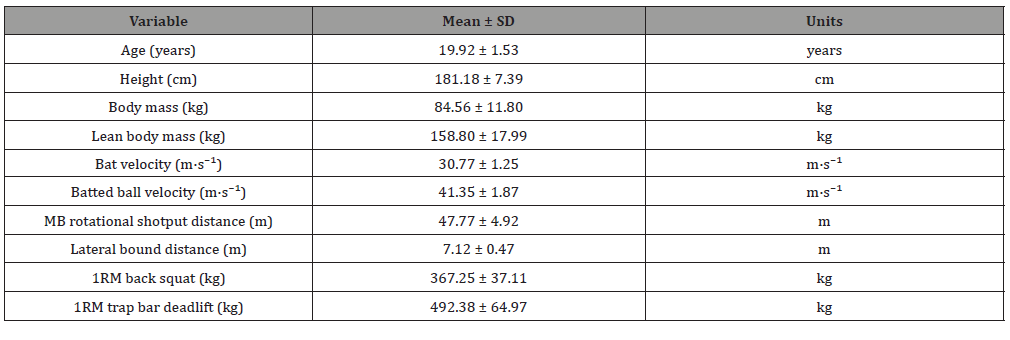
Note: Table 1 displays the subject demographics and averages with standard deviations of all variables collected throughout the study.
Table 2:Pearson’s Product Correlations Between Performance Variables and Hitting Metrics (n = 22).

Note: Table 2 provides the correlation and p-value between the Bat Velocity (BV) and Batted Ball Velocity (BBV) with each variable collected throughout the study.
Bat Velocity (BV): Lean body mass (LBM) was correlated with BV (r = 0.47, p = 0.021). Trends were observed for 1RM back squat (r = 0.39, p = 0.058) and 1RM trap bar deadlift (r = 0.38, p = 0.068). Correlations with MB rotational shotput (r = 0.34, p = 0.102) and lateral bound distance (r = 0.17, p = 0.424) were not significant. Batted Ball Velocity (BBV): LBM (r = 0.54, p = 0.006) and 1RM trap bar deadlift (r = 0.43, p = 0.038) were significantly correlated with BBV. MB rotational shotput showed a non-significant trend (r = 0.39, p = 0.060). Correlations with back squat (r = 0.24, p = 0.257) and lateral bound (r = 0.32, p = 0.126) were not significant.


Discussion
This study investigated the relationships between strength, power, and body composition variables with BV and BBV in NCAA Division II baseball position players. Key findings: LBM was significantly related to both BV and BBV, highlighting the importance of muscle mass in generating bat speed and ball exit velocity. Trap bar deadlift strength was significantly related to BBV and showed a trend with BV, suggesting its utility in developing lower-body force production relevant to hitting performance. MB rotational shotput distance demonstrated a trend with BBV, aligning with previous findings on the transferability of rotational medicine ball training to hitting outcomes [8]. Back squat strength displayed a trend with BV, supporting its role in developing general lower-body strength that may contribute to bat speed.
The dual importance of LBM and trap bar deadlift strength suggests that training interventions for baseball hitters should incorporate hypertrophy phases and maximal strength development, particularly in the trap bar deadlift. Rotational medicine ball exercises may also be beneficial for improving BBV, potentially due to their biomechanical similarity to the hitting motion. These results align with [2, 3], who reported positive associations between LBM, strength measures, and hitting performance. This study extends prior work by demonstrating the relevance of trap bar deadlift strength-a lift not previously examined in this context-alongside back squat strength. Strength and conditioning professionals should consider regular monitoring of LBM, incorporating trap bar deadlifts and rotational medicine ball exercises into training programs, and periodizing hypertrophy and maximal strength phases to optimize both BV and BBV [9-13].
Conclusion
LBM and trap bar deadlift strength were found to be significant contributors to hitting performance in NCAA Division II baseball players, with trends observed for back squat and rotational MB throw. Incorporating these variables into training programs may improve BV and BBV.
Acknowledgement
The authors would like to thank the players and coaching staff for their cooperation.
Acknowledgement
No conflict of interest.
References
- Szymanski DJ, Derenne C, Spaniol FJ (2009) Contributing factors for increased bat swing velocity. J Strength Cond Res 23(4): 1338-1352.
- Szymanski J, Szymanski DJ, Britt AT, Lowe HE, Hsu HS, et al. (2010) Relationship between strength, power, lean body mass, and baseball-specific skills. J Strength Cond Res 24(11): 2933-2943.
- Szymanski DJ, DeRenne C (2010) The effects of small muscle training on baseball hitting performance: a brief review. Strength Cond J 32(6): 99-108.
- Bailey BW, LeCheminant G, Hope T, Bell M, Tucker LA (2018) A comparison of the agreement, internal consistency, and 2-day test stability of the InBody 720, GE iDXA, and BOD POD® gold standard for assessing body composition. Meas Phys Educ Exerc Sci 22(5): 1-8.
- Ferreira de Jesus Leite MA, Sasaki JE, Monteiro Lourenço CL, Ribeiro Zanetti H, Gonsalves Cruz L, et al. (2016) Medicine ball throw test predicts arm power in rugby sevens players. Braz J Kinanthropom Hum Perform 18(2): 166-176.
- Taniyama D, Matsuno J, Yoshida K, Pyle B, Nyland J (2021) Rotational medicine ball throw velocity relates to NCAA Division III college baseball player bat swing, batted baseball, and pitching velocity. J Strength Cond Res 35(12): 3414-3419.
- Haff GG, Triplett NT, editors (2015) Essentials of Strength Training and Conditioning. 4th ed. Champaign: Human Kinetics.
- Earp JE, Kraemer WJ (2010) Medicine ball training implications for rotational power sports. Strength Cond J 32(4): 20-25.
- Aguinaldo A (2016) Baseball bat swing sensor validation. Cent Hum Perform: 1-5.
- Basile R, Otto RM, Wygand JW (2007) The relationship between physical and physiological performance measures and baseball performance measures. Med Sci Sports Exerc 39(Suppl): S214.
- Grgic J, Lazinica B, Schoenfeld BJ, Pedisic Z (2020) Test-retest reliability of the one-repetition maximum (1RM) strength assessment: a systematic review. Sports Med Open 6(1): 31.
- (2022) Major League Baseball Hit (H): Glossary [Internet].
- Szymanski DJ (2007) Resistance training to develop increased bat velocity. NSCA Perform Train J 6(2): 16-20.
-

This work is licensed under a Creative Commons Attribution-NonCommercial 4.0 International License.




