




 Review Article
Peroxisome Proliferator-Activated Receptor Agonists in Patients with Primary Biliary Cholangitis: Beyond Biochemical Control
1 Gastroenterology, Hepatology and Transplantation Unit, Department of Medicine ASST Papa Giovanni XXIII, Bergamo, Italy
2 FROM - Fondazione per la Ricerca Ospedale di Bergamo ETS2, Bergamo, Italy
3 Gastroenterology, Department of Medicine and Surgery, Università degli Studi di Milano Bicocca, Milan, Italy
Received Date:September 02, 2026; Published Date:September 10, 2026
Abstract
Peroxisome proliferator-activated receptors (PPARs) have emerged as key therapeutic targets in primary biliary cholangitis (PBC), reflecting
a fundamental shift in disease management. While biochemical response has traditionally represented the cornerstone of treatment evaluation,
increasing evidence indicates that optimal care should encompass a broader range of therapeutic goals, including symptom control, fibrosis
prevention, risk stratification, and long-term clinical outcomes. Through their pleiotropic effects on bile acid metabolism, inflammatory signalling,
lipid homeostasis, and fibrogenic pathways, PPAR agonists are uniquely positioned to address multiple dimensions of PBC pathophysiology.
This review summarises the biological rationale for PPAR-targeted therapies, with particular attention to the pivotal phase III trials of
elafibranor, a dual PPARα/δ agonist, and seladelpar, a selective PPARδ agonist, which have demonstrated significant improvements in both alkaline
phosphatase (ALP) reduction and normalisation in patients with an inadequate response to or intolerance of ursodeoxycholic acid (UDCA).
Importantly, these studies also highlighted the growing relevance of patient-reported outcomes (PROs) by demonstrating clinically meaningful
and sustained improvements in pruritus and fatigue, combined with favourable effects on health-related quality of life (HRQoL). Emerging data
from open-label extension studies further support the long-term efficacy of PPAR agonists, demonstrating sustained control of disease activity and
symptoms, together with a favourable safety and tolerability profile. Furthermore, PPAR agonists may provide additional benefits through potential
antifibrotic effects and favourable modulation of lipid and glucose metabolism. Beyond the currently approved PPAR agonists, future therapeutic
options are likely to include ileal bile acid transporter (IBAT) inhibitors, such as linerixibat, for patients with moderate-to-severe pruritus despite
standard therapy; additional PPAR agonists, such as saroglitazar, a dual PPARα/γ agonist, and pemafibrate, a selective PPARα agonist; linafexor,
a novel non-bile acid FXR agonist; emerging agents targeting fatigue, bile acid dysregulation, immune dysfunction, and liver fibrogenesis; and
combination regimens involving some of the aforementioned drugs.
Keywords:Alkaline phosphatase; Biochemical Response; Elafibranor; Fatigue; PBC PPAR agonists; Pruritus; Quality of life; Seladelpar; Symptoms
Abbreviations:ALP: Alkaline Phosphatase; AMA: Antimitochondrial Antibodies; AST: Aspartate Aminotransferase; CPK: Creatine Phosphokinase; DEXA: Dual-Energy X-ray Absorptiometry; EMA: European Medicines Agency; LSM: liver stiffness measurement; HSC: hepatic stellate cell; OCA: Obeticholic acid; PBC: Primary biliary cholangitis; PBC-40: Primary Biliary Cholangitis-40; PPAR: Peroxisome proliferator-activated receptor; PPRE: Peroxisome proliferator response element; PROMs: patient-Reported outcome measures; QoL: Quality of life; RXR: Retinoid X receptor; UDCA: Ursodeoxycholic acid; ULN: Upper limit of normal; WI-NRS: Worst Itch Numeric Rating Scale
Introduction
Primary biliary cholangitis (PBC) is a chronic cholestatic liver disease characterised by immune-mediated destruction of the intrahepatic bile ducts, leading to progressive cholestasis, fibrosis, and, ultimately, cirrhosis and its associated complications [1-3]. Although considerable advances have been made in elucidating its immunopathogenesis, the precise aetiology of PBC remains incompletely understood. For decades, ursodeoxycholic acid (UDCA) was the only available therapeutic option and remains the cornerstone of management as well as the recommended first-line treatment for all patients, owing to its well-established efficacy, favourable safety profile, and proven survival benefit [2,4-6]. Despite these benefits, approximately 30-40% of patients exhibit an inadequate biochemical response or fail to achieve treatment goals despite long-term UDCA therapy [7,8]. Following its approval in 2016, obeticholic acid (OCA), a potent farnesoid X receptor (FXR) agonist, became the principal second-line treatment for these patients [9,10]. However, concerns regarding tolerability and safety, particularly in individuals with advanced liver disease, together with the lack of convincing evidence demonstrating an effect on major clinical outcomes, have substantially limited its clinical utility and ultimately led to the withdrawal of its marketing authorisation by the European Medicines Agency (EMA) [11].

The resulting therapeutic gap has become increasingly relevant as our understanding of prognosis and treatment goals in PBC has evolved [12]. Contemporary risk stratification models have clearly demonstrated that treatment response is a major determinant of long-term outcomes and have enabled the identification of patient subgroups at particularly high risk of disease progression, including younger individuals, men, patients with advanced fibrosis, overlap syndromes with autoimmune hepatitis, or a ductopenic phenotype characterised by predominant cholestatic injury [13,14]. In these populations, achieving optimal disease control is crucial to reduce the risk of liver-related complications and disease progression. At the same time, increasing evidence has challenged the traditional concept of treatment response. Rather than merely achieving an “adequate response” after one year of UDCA, as defined by the Paris II [ALP and aspartate aminotransferase (AST) ≤1.5× upper limit of normal (ULN) together with a normal bilirubin level] or POISE (ALP level <1.67× ULN with an ALP level reduction of at least 15% from baseline together with a normal bilirubin level) criteria, there is now increasing emphasis on achieving a “deep response”, also defined as a “complete response”, because the normalisation of ALP and total bilirubin on treatment appears to be associated with the most favourable long-term prognosis [15,16]. This paradigm shift has increased the number of patients eligible for secondline therapies and has raised expectations regarding therapeutic efficacy. Indeed, an adequate response appears to be an acceptable target in older patients with neither advanced fibrosis nor severe PBC-related symptoms. Conversely, in younger patients and/or those with liver stiffness measurements (LSM) ≥10 kPa, prompt escalation to second-line therapy should be considered, and the ideal target should be a “complete response”. Similarly, escalation to second-line therapy may be appropriate for patients who achieve an adequate biochemical response to UDCA but continue to experience symptoms that substantially impair their quality of life (QoL), with the aim of achieving both a complete biochemical response and meaningful symptom improvement. Figure 1 In fact, patients frequently experience debilitating symptoms that profoundly impair health-related QoL, often independently of disease stage or biochemical activity. These include fatigue, chronic pruritus, cognitive dysfunction, sleep disturbances, sicca syndrome, abdominal discomfort, depression, anxiety, and impaired physical functioning. Another important development has been the evolution of the timing of UDCA response assessment. While biochemical response has traditionally been evaluated after 12 months of therapy, growing evidence supports earlier assessment at 6 months in selected high-risk patients, enabling more timely escalation to second-line treatment. Furthermore, growing evidence suggests that PBC is associated with an increased burden of cardiovascular risk factors and a higher incidence of major adverse cardiovascular events, potentially driven by chronic systemic inflammation, metabolic dysregulation, endothelial dysfunction, and persistent cholestatic injury [17,18].
Collectively, these advances have fostered a broader and more patient-centred view of disease management, in which therapeutic goals extend beyond partial biochemical improvement to encompass symptom control, PROs, risk stratification, and longterm clinical benefit. Against this backdrop, a deeper understanding of the molecular pathways involved in cholestasis, inflammation, fibrosis, and metabolic dysfunction has driven the development of peroxisome proliferator-activated receptor (PPAR) agonists [14]. By simultaneously modulating bile acid homeostasis, inflammatory signalling, lipid metabolism, and fibrogenic pathways, PPAR agonists have rapidly emerged as promising disease-modifying therapies capable of addressing multiple dimensions of PBC. Their development reflects a shift from a treatment strategy focused primarily on biochemical response toward a more comprehensive, phenotype-based approach aimed at achieving optimal disease control, improving QoL, and modifying the long-term course of the disease [14,19]. In this review, we critically examine the biological rationale and clinical evidence supporting the use of PPAR agonists in PBC. Particular emphasis is placed on their mechanisms of action, efficacy across multiple therapeutic domains, effects on PROs, and potential role in altering the natural history of the disease. By moving beyond conventional biochemical endpoints, we aim to explore how PPAR agonists may contribute to a more holistic management of patients with PBC and ultimately reshape future treatment algorithms.
Peroxisome proliferator-activated receptors in PBC

PPARs are ligand-activated nuclear transcription factors belonging to the nuclear hormone receptor superfamily that regulate a broad range of biological processes involved in metabolic homeostasis, inflammation, cellular differentiation, and fibrogenesis [20]. Since their initial identification in 1990, three distinct PPAR isoforms have been identified: PPARα, PPARδ (also known as PPARβ/δ), and PPARγ, each encoded by different genes and characterised by specific tissue distributions, target genes, and biological functions [21]. Figure 2 Following ligand binding, PPARs heterodimerise with the retinoid X receptor (RXR) and interact with specific peroxisome proliferator response elements (PPREs) within the promoter regions of target genes, thereby modulating transcriptional activity. The therapeutic interest in PPAR agonists for PBC arises from their ability to simultaneously influence multiple pathogenic pathways involved in the disease. Figure 3 Beyond their established metabolic effects, both dual and selective PPAR agonists exert potent anti-inflammatory, anti-cholestatic, antifibrotic, and immunomodulatory actions, making them particularly attractive targets in chronic cholestatic liver disorders (22).
Features and functions of PPARα, PPARδ and PPARγ
PPARα
PPARα is highly expressed in tissues characterised by high rates of fatty acid oxidation, including liver, cardiac muscle, brown adipose tissue, skeletal muscle, and kidney. Its activation promotes mitochondrial and peroxisomal β-oxidation of fatty acids, enhances lipid catabolism, and regulates lipoprotein metabolism (Figure 3). In the context of PBC, the biological effects of PPARα extend well beyond lipid regulation. Experimental studies have demonstrated that PPARα activation exerts potent anti-inflammatory effects by trans repressing the nuclear factor kappa B (NF-κB) and activator protein 1 (AP-1) signalling pathways, thereby reducing the production of pro-inflammatory cytokines [23]. In addition, PPARα plays a central role in the regulation of bile acid homeostasis. Activation of PPARα enhances biliary secretion through upregulation of the bile salt export pump (BSEP) and multidrug resistance-associated protein 2 (MRP2), while simultaneously reducing bile acid synthesis through downregulation of cholesterol 7α-hydroxylase (CYP7A1), the rate-limiting enzyme of the classical bile acid synthesis pathway. Furthermore, PPARα activation promotes biliary phospholipid secretion through induction of multidrug resistance protein 3 (MDR3/ABCB4), thereby reducing bile acid toxicity and enhancing detoxification mechanisms [24]. Collectively, these effects contribute to improved bile flow and reduced cholestatic injury. Additional evidence suggests that PPARα activation attenuates hepatic stellate cell (HSC) activation and extracellular matrix deposition, thereby limiting fibrosis progression [25,26].

PPARδ
PPARδ is ubiquitously expressed, with particularly high levels in skeletal muscle, skin, heart, adipose tissue and liver. Within the hepatic compartment, PPARδ is expressed in hepatocytes, cholangiocytes, HSCs, and Kupffer cells. Activation of PPARδ plays a key role in fatty acid oxidation, energy expenditure, and cellular adaptation to metabolic stress. In cholestatic liver diseases, PPARδ exerts anti-inflammatory and hepatoprotective effects, at least in part through B-cell lymphoma 6 (BCL6)-mediated signalling pathways (Figure 3) [27]. Experimental models indicate that PPARδ agonists suppress inflammatory signalling, improve hepatocellular resilience to bile acid-mediated injury, and modulate immune responses within the hepatic microenvironment. Importantly, PPARδ activation appears to influence bile acid homeostasis through interactions with fibroblast growth factor 19 (FGF19)-related pathways and genes involved in bile acid transport and detoxification. These mechanisms provide a strong biological rationale for the development of selective PPARδ agonists as therapeutic agents in PBC.
PPARγ
PPARγ exists as three alternatively spliced isoforms (PPARγ1, PPARγ2, and PPARγ3), which differ in tissue distribution while maintaining similar DNA-binding specificity. Although predominantly expressed in adipose tissue, PPARγ is also present in immune cells, HSCs, and cholangiocytes. Among its various functions, PPARγ is particularly recognised for its immunomodulatory and antifibrotic properties (Figure 3) [28]. Activation of PPARγ negatively regulates NF-κB signalling and suppresses the production of key pro-inflammatory cytokines, including tumour necrosis factor-α (TNF-α) and interleukin-1β (IL-1β). In addition, PPARγ plays a crucial role in maintaining HSCs in a quiescent phenotype. Expression of PPARγ, particularly the PPARγ2 isoform, is progressively reduced during HSC activation and trans differentiation into collagen-producing myofibroblasts, suggesting that restoration of PPARγ signalling may counteract hepatic fibrogenesis [28]. Interestingly, reduced expression of PPARγ has been observed in damaged cholangiocytes and biliary epithelial cells, suggesting a potential contribution to cholangiocyte dysfunction and perpetuation of cholestatic injury. Restoration of PPARγ signalling may therefore counteract several mechanisms implicated in disease progression. The complementary biological activities of individual PPAR isoforms have stimulated interest in dual- and pan-PPAR agonists capable of targeting multiple pathways simultaneously. By combining the metabolic effects of PPARα, the anti-inflammatory properties of PPARδ, and the antifibrotic actions of PPARγ, these agents may provide broader diseasemodifying activity than selective agonists. Such pleiotropic effects are particularly relevant in PBC, where cholestasis, inflammation, fibrosis, metabolic dysregulation, and symptom burden coexist and interact throughout the disease course.
PPAR agonists in PBC
Efficacy and Safety of PPAR Agonists in Registration Trials
To date, two PPAR agonists have received regulatory approval for the treatment of patients with PBC who have an inadequate response to or are intolerant of UDCA: elafibranor, a dual PPARα/δ agonist, and seladelpar, a selective PPARδ agonist. Their approval was supported by the positive results of the pivotal phase III ELATIVE [29] and RESPONSE [30] trials for elafibranor and seladelpar, respectively. Notably, both studies adopted the same primary biochemical endpoint based on the POISE criteria after 52 weeks of treatment. In the ELATIVE trial, the primary endpoint was achieved by 51% of patients receiving elafibranor 80 mg daily compared with 4% of those receiving placebo. Moreover, ALP normalisation was observed in 15% of patients treated with elafibranor and in none of those receiving placebo [29]. Similarly, in the RESPONSE trial, the primary endpoint was achieved by 61.7% of patients receiving seladelpar 10 mg daily, compared with 20% of patients receiving placebo. ALP normalisation was achieved in 25% of seladelpar-treated patients, whereas no patient in the placebo arm reached this endpoint [30]. (Table 1) Overall, both agents demonstrated a favourable safety profile, with most treatmentemergent adverse events (TEAEs) being mild to moderate in severity.
Table 1:Main baseline characteristics and outcomes in the elafibranor, seladelpar, saroglitazar, linafexor, and pemafibrate trials.
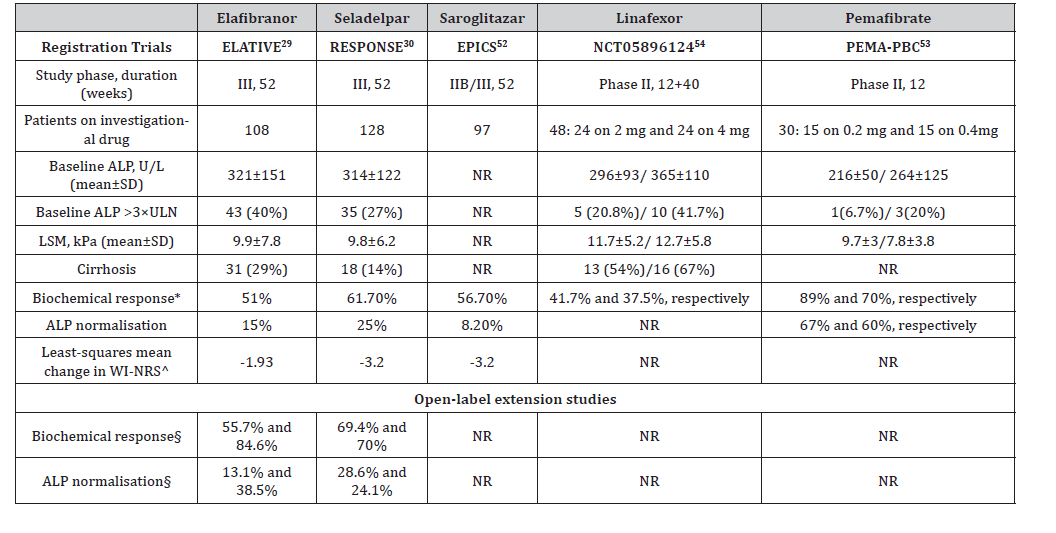
ALP: alkaline phosphatase; NR: not reported; OLE: open label extension; SD, standard deviation; ULN: upper limit of normal. *ALP level <1.67 times the ULN, with a decrease of ≥15% from baseline, and total bilirubin ≤1 times the ULN. At week 52 for elafibranor, seladelpar, saroglitazar, linafexor and at 12 weeks for pemafibrate; ^From baseline through week 52 for elafibranor and week 24 for seladelpar; §at week 104 and 156 for elafibranor and month 24 and 36 for seladelpar, respectively.
Gastrointestinal disorders, including abdominal pain and abdominal distension, were among the most commonly reported TEAEs. Nausea and vomiting occurred more frequently in patients receiving elafibranor than placebo, whereas headache was reported more commonly with seladelpar. A transient increase in aminotransferase levels during the first weeks of PPAR agonist treatment is generally considered to reflect metabolic or enzymatic adaptation rather than drug-induced hepatotoxicity [31]. Elevations in aminotransferases >3× ULN occurred in 0.9% of patients treated with elafibranor compared with 3.8% of those receiving placebo, and in 7% of patients receiving seladelpar compared with 10.8% in the placebo group. Elevation of creatine phosphokinase (CPK) represents another adverse event of clinical interest. Treatment discontinuation due to CPK elevation occurred in 3.7% and 1.6% of patients receiving elafibranor and seladelpar, respectively, compared with none and one patient in the respective placebo groups. A single case of rhabdomyolysis was reported in a cirrhotic patient receiving elafibranor concomitantly with highdose atorvastatin. Acute kidney injury was not observed among patients treated with seladelpar, whereas it was reported in three patients receiving elafibranor and in one patient receiving placebo. An apparent numerical imbalance in fracture incidence was observed in both trials, with fractures occurring in 6.4% of patients treated with elafibranor and 4% of those treated with seladelpar, whereas no fractures were reported in the placebo groups.
However, subsequent analyses incorporating bone mineral density assessment by dual-energy X-ray absorptiometry (DEXA) and bone turnover biomarkers did not identify any detrimental effect of either drug on bone metabolism. In the ELATIVE trial, the higher fracture rate appeared to be largely attributable to a greater baseline prevalence of osteoporosis and accidental falls among patients allocated to elafibranor [32]. Likewise, in the RESPONSE trial, the observed fracture rate was consistent with that expected in an ageing PBC population, and osteoporotic fractures occurred predominantly in patients with pre-existing risk factors, including osteopenia, osteoporosis, or prior fractures [33]. These findings suggest that the observed imbalance is unlikely to reflect a direct pharmacological effect of PPAR agonists on skeletal health. Nevertheless, assessment and monitoring of bone health should remain an integral component of routine PBC management. With regard to special populations, data on the use of these two approved PPAR agonists during pregnancy are limited; seladelpar is currently not recommended, whereas elafibranor is contraindicated, owing to adverse reproductive findings observed in preclinical animal studies. In compensated cirrhosis (Child-Pugh A), both seladelpar and elafibranor may be used, provided there is careful monitoring for signs of hepatic decompensation. In patients with moderate hepatic dysfunction (Child-Pugh B), elafibranor, but not seladelpar, may be used with careful monitoring and discontinuation if progression to Child-Pugh C occurs. In patients with decompensated cirrhosis (Child-Pugh C), neither PPAR agonist is recommended according to current regulatory labelling.
Patient-Reported Outcomes in Registration Trials
As discussed above, symptom control has become a key component of therapeutic decision-making in PBC, reflecting the growing recognition that treatment success should not be defined solely by biochemical improvement. This paradigm shift has led to the incorporation of PROs into contemporary clinical trials, with the aim of capturing the broader impact of treatment on patients’ HRQoL [34]. Several instruments have been developed to assess symptom burden in PBC, although only a limited number have undergone extensive validation and cross-cultural adaptation. The Worst Itch Numeric Rating Scale (WI-NRS) is a validated 11-point PRO measure used to assess the severity of pruritus in patients with PBC. Patients rate the intensity of their worst itch during the previous 24 hours on a scale from 0 (no itch) to 10 (worst imaginable itch). Daily assessments are averaged over one week, providing a sensitive and reproducible measure of treatment response. The PBC-40 questionnaire is a disease-specific QoL instrument comprising 40 items across six domains, including fatigue, emotional well-being, social functioning, cognitive function, general symptoms, and pruritus, with responses referring to the preceding four weeks [35].
The 5-D Itch Scale provides a multidimensional assessment of pruritus by evaluating five dimensions: degree, duration, direction, disability, and distribution [36]. All these tools were used in registration trials of PPAR agonists. In the ELATIVE trial, among patients with baseline moderate-to-severe pruritus, i.e., a WI-NRS score ≥4, the least-squares mean change from baseline through week 52 on the WI-NRS did not differ significantly between the groups (-1.93 versus -1.15; p = 0.20). However, changes from baseline to week 52 favoured elafibranor over placebo in both the PBC-40 itch domain (least-squares mean difference: -2.3) and the total 5-D Itch Scale score (least-squares mean difference: -3.0). (29) By contrast, seladelpar demonstrated consistent and clinically meaningful antipruritic effects across multiple assessment tools. In the RESPONSE trial, patients with moderate-to-severe pruritus experienced a significant reduction in WI-NRS score as early as month 6 (least-squares mean difference, -1.5; p = 0.005), with benefits sustained through week 52. These findings were accompanied by parallel improvements in the PBC-40 itch domain and the 5-D Itch Scale (Table 1) [30].
Moreover, among patients with moderate-to-severe pruritus, 31% and 27% of patients treated with seladelpar for 12 months reported a ≥4-point WI-NRS score improvement and a near resolution of itch (NRS 0 or 1), compared with 9% and 0% of those on placebo, respectively. Importantly, 19% of patients with baseline severe pruritus (NRS ≥7) reported a near resolution of itch at month 12, compared with none on placebo [37]. Fatigue affects up to 80% of patients with PBC and is one of the major determinants of impaired HRQoL. Unlike pruritus, there are currently no approved pharmacological therapies specifically targeting fatigue. Jones et al., in a post hoc analysis of the ELATIVE trial, using the PROMIS Fatigue Short Form 7a (PFSF 7a), showed that patients treated with elafibranor experienced a greater improvement in the overall PFSF 7a T-score than placebo-treated patients. Among patients with moderate-to-severe fatigue at baseline, 42.9% receiving elafibranor improved to mild/normal fatigue by week 52, whereas 31.3% receiving placebo achieved the same improvement. These findings reinforce the concept that effective disease-modifying therapy may also improve symptoms that have historically been considered difficult to treat [38].
Open-Label Extension Studies
The encouraging results observed during the registration trials have been further reinforced by their ongoing open-label extension (OLE) studies, which provide valuable insights into the long-term efficacy and safety of PPAR agonists [39-41]. Overall, these extension data suggest that the benefits achieved during the first year of treatment are not only maintained over time but may continue to deepen with prolonged therapy. For elafibranor, follow-up extending beyond three years has demonstrated sustained biochemical control, with stable or increasing rates of POISE response and ALP normalisation among patients receiving continuous treatment. At weeks 104 and 156, biochemical response was achieved in 55.7% (36/61) and 84.6% (11/12) of evaluable patients, respectively, while ALP normalisation was observed in 13.1% (8/61) and 38.5% (5/13) [39,41]. More recently, an interim analysis at week 182 of the ELATIVE OLE reported 72.1% and 18.6% rates of POISE response and ALP normalisation, respectively [41]. Although these findings should be interpreted cautiously given the limited number of patients available for long-term assessment, they nonetheless support the durability of the therapeutic effect. Notably, benefits extended beyond conventional biochemical endpoints.
Non-invasive markers of disease progression, including LSM and Enhanced Liver Fibrosis (ELF) scores, remained stable or showed favourable trajectories, while patients with moderateto- severe baseline fatigue and pruritus experienced sustained improvements in PROs [41-43]. Mayo et al. reported that treatment with elafibranor was associated with sustained improvements in the lipid profile, including reductions in total cholesterol and low-density lipoprotein cholesterol (LDL-C). Importantly, among patients receiving concomitant statin therapy, no new safety signals or clinically meaningful increase in TEAEs were observed, supporting the favourable tolerability of elafibranor when used alongside lipid-lowering agents. Likewise, long-term observations from the RESPONSE extension study confirmed the persistence of biochemical benefits with seladelpar. Biochemical response rates remained remarkably stable through 24 and 36 months of treatment: 181/258 (70%) and 82/122 (67%), respectively, while ALP normalisation was maintained in approximately one-third of patients: 96/258 (37%) and 41/122 (33%) at months 24 and 36, respectively [44,45].
Pratt et al. reported that treatment with seladelpar resulted in sustained improvements in pruritus over time. Among patients with moderate-to-severe itch at baseline, the pruritus NRS showed clinically meaningful reductions from baseline that were maintained throughout long-term follow-up. Data from an interim analysis of the ASSURE study, evaluating changes in LSM over 3 years, reported that 85% of patients with a biochemical response after the first year of treatment maintained or improved the LSM by month 36 of therapy. Moreover, patients with the highest baseline LSM (≥16.9 kPa) demonstrated a significant LSM reduction during treatment [46]. Across both extension programmes, the long-term safety profile remained consistent with that observed during the placebo-controlled phases, with no new safety signals, no evidence of cumulative toxicity, and sustained treatment tolerability. Taken together, these findings reinforce the concept that PPAR agonists may provide durable disease control and support a treatment paradigm that extends beyond short-term biochemical improvement to encompass symptom relief, stabilisation of fibrosis, and HRQoL [40].
Real-World Experience with PPARs in PBC
In early 2026, Kuo et al. reported the first real-world experience with seladelpar as second-line therapy in a small cohort of patients. Biochemical response and ALP normalisation were achieved in 56.3% and 31.3% of patients after 1 month of treatment [47]. At the EASL 2026 meeting, Terracciani et al. [48] reported in 133 patients that, after 6 months of seladelpar treatment, the probabilities of maintaining or achieving a POISE response and a complete response were 62% and 41%, respectively; 68% of patients with clinically relevant pruritus improved to below the clinically relevant threshold; and the PBC-40 total and fatigue scores also improved significantly. A Spanish real-world study from the multicentre COLHai registry evaluated the effectiveness of elafibranor and seladelpar following the withdrawal of OCA from the European market.
Improvements in cholestatic biochemical markers, particularly ALP, were observed together with a favourable safety profile, supporting the successful implementation of these novel therapies in routine clinical practice [49]. Another Italian study evaluated the efficacy and safety of elafibranor in 80 patients with PBC who had discontinued OCA treatment following the revocation of its marketing authorisation. After a median follow-up of 6 months, ALP significantly decreased from 170 to 119 U/L (p = 0.013) and 77% and 46% of patients achieved a POISE response and ALP normalisation, respectively. (50) Levy et al. conducted a retrospective observational study in patients with PBC and baseline ALP between 1 and 1.67× ULN who initiated elafibranor ± UDCA treatment. By month 6, 71.7% and 58.5% of 53 patients without prior second-line treatment achieved ≥15% ALP reduction and ALP normalisation, respectively; the corresponding proportions among 15 patients with prior second-line treatment were 73.3% and 46.7%, respectively [51].
Novel Therapeutic Perspectives for PBC
The EPICS III study, a phase 2b/3 randomised, double-blind, placebo-controlled trial evaluating saroglitazar, a dual PPAR-α/γ agonist, in patients with PBC who had an inadequate response to or intolerance of UDCA, demonstrated that saroglitazar achieved a 56.7% biochemical response rate, compared with 9.8% in patients receiving placebo (p < 0.001). Saroglitazar reduced mean ALP levels by 33.5% (treatment difference of 40.1% versus placebo) with 37.2% achieving a response by week 2; the effect was sustained through week 52. Treatment was associated with improvements in itch severity without major safety signals and was generally well tolerated [52]. The use of pemafibrate (K-808), a selective PPARα agonist, was evaluated in the PEMA-PBC study [53], a randomised, double-blind, placebo-controlled, dose-finding phase 2 trial (0.2 mg or 0.4 mg once daily versus placebo) in patients with PBC who had an inadequate biochemical response to UDCA. At the 12-week interim analysis, pemafibrate demonstrated significant anticholestatic activity, with dose-dependent reductions in ALP and improvements in other markers of cholestatic liver injury, including γ-glutamyl transferase (γ-GT).
A greater proportion of patients receiving pemafibrate achieved clinically meaningful reductions in ALP compared with placebo (51%, 48.5%, and 1.3% in the 0.2 mg, 0.4 mg, and placebo groups, respectively), while treatment was generally well tolerated across both dose groups. The incidence of TEAEs was comparable between arms, with no unexpected safety signals or evidence of hepatotoxicity. These findings suggest that selective PPARα modulation with pemafibrate may represent a promising therapeutic strategy for patients with PBC who have an inadequate response to UDCA, warranting further evaluation in longer-term studies to establish the durability of biochemical response and its impact on clinical outcomes [53]. A phase II trial [54] evaluated linafexor, a novel pulsatile FXR agonist, in patients with PBC who had an inadequate biochemical response to UDCA. Unlike continuous FXR agonists, linafexor was developed using a pulsatile dosing strategy designed to preserve therapeutic efficacy while potentially improving tolerability, particularly with respect to pruritus. The study demonstrated that at week 12, linafexor produced clinically meaningful reductions in ALP (18.1% and 20.6% with the 2- and 4-mg daily doses, respectively), compared with a 5.6% increase in the placebo group, confirming the therapeutic potential of FXR activation in PBC. Treatment was generally well tolerated, with an acceptable safety profile and a lower incidence of TEAEs than historically reported with OCA [54].
In the GLISTEN trial, a pivotal phase III registration study involving 238 patients with PBC and moderate-to-severe pruritus who were receiving stable background therapy, the IBAT inhibitor linerixibat produced a statistically significant and clinically meaningful reduction in pruritus severity, as assessed by the WINRS, compared with placebo [55]. Improvements were observed early during treatment and were accompanied by significant benefits in itch-related sleep disturbance and HRQoL, including improvements in PROs such as the PBC-40 itch domain. The safety profile was consistent with the mechanism of IBAT inhibition, with gastrointestinal TEAEs, particularly diarrhoea, occurring more frequently in the linerixibat group but generally being mild to moderate in severity and manageable. These results establish linerixibat as the first therapy specifically developed to target cholestatic pruritus in PBC and support its role in addressing one of the major unmet needs in the management of the disease.
Conclusions
The therapeutic goals in PBC have evolved beyond achieving biochemical response alone toward a more holistic and patientcentred approach. Although normalisation or substantial improvement of cholestatic biomarkers remains the cornerstone of treatment because these changes are strongly associated with improved long-term outcomes, optimal therapy should also aim to slow disease progression, prevent fibrosis, preserve liver function, and ultimately improve survival. Equally important is the ability to alleviate patient-reported symptoms, particularly pruritus and fatigue, which remain major determinants of impaired HRQoL. As the clinical profile of patients with PBC becomes increasingly complex, a comprehensive management strategy should also address metabolic health and cardiovascular risk, especially in individuals with coexisting metabolic dysfunction-associated steatotic liver disease in whom cardiometabolic comorbidities may substantially contribute to overall morbidity and mortality. The emergence of novel therapeutic agents, particularly PPAR agonists, offers the opportunity to target multiple domains simultaneously, combining robust biochemical efficacy with potential antifibrotic and metabolic benefits, meaningful improvements in symptoms, and a favourable long-term safety profile. As the therapeutic armamentarium continues to expand, treatment selection should be increasingly individualised according to disease stage, symptom burden, metabolic comorbidities, and patient preferences, with the ultimate goal of delivering truly holistic care and maximising both liver-related and overall health outcomes.
Acknowledgments
All authors contributed equally to the conceptualisation, writing, review, and editing of this work. All authors have read and approved the final version of the manuscript.
Conflict of Interest Statement
G. Mangia, and P. Giani- none; F.Colapietro- advisory: Ipsen; A.Loglio- speaking: Gilead Sciences; S. Fagiuoli- advisory & speaking Gilead Sciences, AbbVie, Kedrion, Novartis, Roche, Eisai, Astra Zeneka, Mirum, Ipsen, NovoNordisk, Lilly, GSK; M. Viganò - speaking and teaching: Gilead Sciences, Ipsen, Kedrion, Novo Nordisk, Lilly, AbbVie, and Mirum.
References
- European Association for the Study of the Liver (2017) EASL Clinical Practice Guidelines: The diagnosis and management of patients with primary biliary cholangitis. J Hepatol 67(1): 145-172.
- Lindor KD, Bowlus CL, Boyer J, Levy C, Mayo M (2022) Primary biliary cholangitis: 2021 practice guidance update from the American Association for the Study of Liver Diseases. Hepatol Baltim Md 75(4): 1012-1013.
- Tanaka A, Ma X, Takahashi A, Vierling JM (2024) Primary biliary cholangitis. Lancet 404(10457): 1053-1066.
- Harms MH, Van Buuren HR, Corpechot C, Thorburn D, Janssen HLA, et al. (2019) Ursodeoxycholic acid therapy and liver transplant-free survival in patients with primary biliary cholangitis. J Hepatol 71(2): 357-365.
- Poupon R, Lindor K, Cauch-Dudek K, Dickson E, Poupon R, et al. (1997) Combined analysis of randomized controlled trials of ursodeoxycholic acid in primary biliary cirrhosis. Gastroenterology 113(3): 884-890.
- Corpechot C, Carrat F, Bahr A, Chrétien Y, Poupon RE, et al. (2005) The effect of ursodeoxycholic acid therapy on the natural course of primary biliary cirrhosis. Gastroenterology 128(2): 297-303.
- Carbone M, Nardi A, Flack S, Carpino G, Varvaropoulou N, et al. (2018) Pretreatment prediction of response to ursodeoxycholic acid in primary biliary cholangitis: development and validation of the UDCA Response Score. Lancet Gastroenterol Hepatol 3(9): 626-634.
- Vespasiani Gentilucci U, Rosina F, Pace-Palitti V, Sacco R, Pellicelli A, et al. (2019) Rate of non-response to ursodeoxycholic acid in a large real-world cohort of primary biliary cholangitis patients in Italy. Scand J Gastroenterol 54(10): 1274-1282.
- Nevens F, Andreone P, Mazzella G, Strasser SI, Bowlus C, et al. (2016) A Placebo-Controlled Trial of Obeticholic Acid in Primary Biliary Cholangitis. N Engl J Med 375(7): 631-643.
- Trauner M, Nevens F, Shiffman ML, Drenth JPH, Bowlus CL, et al. (2019) Long-term efficacy and safety of obeticholic acid for patients with primary biliary cholangitis: 3-year results of an international open-label extension study. Lancet Gastroenterol Hepatol 4(6): 445-453.
- (2023) Ocaliva - referral | European Medicines Agency (EMA).
- Carbone M, Sharp SJ, Flack S, Paximadas D, Spiess K, et al. (2016) The UK-PBC risk scores: Derivation and validation of a scoring system for long-term prediction of end-stage liver disease in primary biliary cholangitis. Hepatology 63(3): 930-950.
- Carbone M, Mells GF, Pells G, Dawwas MF, Newton JL, et al. (2013) Sex and age are determinants of the clinical phenotype of primary biliary cirrhosis and response to ursodeoxycholic acid. Gastroenterology 144(3): 560-569.
- Levy C, Bowlus CL (2025) Primary biliary cholangitis: Personalizing second-line therapies. Hepatology 82(4): 895-910.
- Corpechot C, Lemoinne S, Soret PA, Hansen B, Hirschfield G, et al. (2024) Adequate versus deep response to ursodeoxycholic acid in primary biliary cholangitis: To what extent and under what conditions is normal alkaline phosphatase level associated with complication-free survival gain? Hepatology 79(1): 39-48.
- Murillo Perez CF, Harms MH, Lindor KD, van Buuren HR, Hirschfield GM, et al. (2020) Goals of Treatment for Improved Survival in Primary Biliary Cholangitis: Treatment Target Should Be Bilirubin Within the Normal Range and Normalization of Alkaline Phosphatase. Am J Gastroenterol 115(7): 1066-1074.
- Tan JJR, Quek JWE, Lam SSW, Zheng MH, Corpechot C, et al. (2026) Hepatic and Cardiovascular Outcomes in Primary Biliary Cholangitis with Metabolic-Dysfunction Associated Steatotic Liver Disease. Liver Int 46(8): e70772.
- Colapietro F, Viganò M (2026) MASLD In PBC: A Shift from Liver-Centred to Cardiometabolic Risk Assessment? Liver Int Off J Int Assoc Study Liver 46(8): e70817.
- Jones DEJ, Beuers U, Bonder A, Carbone M, Culver E, et al. (2024) Primary biliary cholangitis drug evaluation and regulatory approval: Where do we go from here? Hepatology 80(5): 1291-1300.
- Issemann I, Green S (1990) Activation of a member of the steroid hormone receptor superfamily by peroxisome proliferators. Nature 347(6294): 645-650.
- Dubois V, Eeckhoute J, Lefebvre P, Staels B (2017) Distinct but complementary contributions of PPAR isotypes to energy homeostasis. J Clin Invest 127(4): 1202-1214.
- Colapietro F, Gershwin ME, Lleo A (2023) PPAR agonists for the treatment of primary biliary cholangitis: Old and new tales. J Transl Autoimmun 6: 100188.
- (2026) Nuclear Receptors in Liver DiseaseΔ : Hepatology.
- Nisanne S Ghonem, David N Assis, James L Boyer (2015) Fibrates and cholestasis: Hepatology 62(2): 635-643.
- Rodríguez Vilarrupla A, Laviña B, García-Calderó H, Russo L, Rosado E, et al. (2012) PPARα activation improves endothelial dysfunction and reduces fibrosis and portal pressure in cirrhotic rats. J Hepatol 56(5): 1033-1039.
- Toyama T, Nakamura H, Harano Y, Yamauchi N, Morita A, et al. (2004) PPARα ligands activate antioxidant enzymes and suppress hepatic fibrosis in rats. Biochem Biophys Res Commun 324(2): 697-704.
- Lee CH, Chawla A, Urbiztondo N, Liao D, Boisvert WA, et al. (2003) Transcriptional Repression of Atherogenic Inflammation: Modulation by PPARδ. Science 302(5644): 453-457.
- Pawlak M, Lefebvre P, Staels B (2015) Molecular mechanism of PPARα action and its impact on lipid metabolism, inflammation and fibrosis in non-alcoholic fatty liver disease. J Hepatol 62(3): 720-733.
- Kowdley KV, Bowlus CL, Levy C, Akarca US, Alvares-da-Silva MR, et al. (2024) Efficacy and Safety of Elafibranor in Primary Biliary Cholangitis. N Engl J Med 390(9): 795-805.
- Hirschfield GM, Bowlus CL, Mayo MJ, Kremer AE, Vierling JM, et al. (2024) A Phase 3 Trial of Seladelpar in Primary Biliary Cholangitis. N Engl J Med 390(9): 783-794.
- Thulin P, Rafter I, Stockling K, Tomkiewicz C, Norjavaara E, et al. (2008) PPARalpha regulates the hepatotoxic biomarker alanine aminotransferase (ALT1) gene expression in human hepatocytes. Toxicol Appl Pharmacol 231(1): 1-9.
- Schattenberg JM, Andreone P, Heneghan MA, Levy C, Antunes N, et al. (2025) P30 Treatment with elafibranor has no impact on bone health in patients with primary biliary cholangitis (PBC). Gut 74(4): A32-3.
- Vierling JM, Hirschfield GM, Kustra RP, Liu X, Proehl S (2025) Fracture events in patients with primary biliary cholangitis during treatment with seladelpar in the phase III RESPONSE trial. Hepatol Commun 9(12): e0845.
- Kim HP, Lieber SR, Rogers ME, Moon AM, Loiselle M, et al. (2020) A Systematic Review of Patient-Reported Outcomes in Primary Biliary Cholangitis and Primary Sclerosing Cholangitis. Hepatol Commun. 4(10): 1502-1515.
- Jacoby A, Rannard A, Buck D, Bhala N, Newton JL, et al. (2005) Development, validation, and evaluation of the PBC-40, a disease specific health related quality of life measure for primary biliary cirrhosis. Gut 54(11): 1622-1629.
- Elman S, Hynan LS, Gabriel V, Mayo MJ (2010) The 5-D itch scale: a new measure of pruritus. Br J Dermatol 162(3): 587-593.
- Kremer AE, Levy C, Mayo MJ, Bowlus CL, Kowdley KV, et al. (2026) Attenuation, Near Resolution, and Prevention of Pruritus in Patients with Primary Biliary Cholangitis Treated with Seladelpar: A Secondary Analysis of Patterns of Pruritus Change in the RESPONSE Trial.
- Jones DE, Kremer AE, Levy C, Antunes N, Asquith D, et al. (2026) LBP-018 Improvements in fatigue in patients with primary biliary cholangitis treated with elafibranor: patient-reported outcome measurement information system fatigue short form 7a (PFSF 7a) data from the phase III ELATIVE® trial. J Hepatol.
- Prendergast Á, Kowdley KV, Bowlus CL, Levy C, Akarca U, et al. (2025) P199 Long-term efficacy and safety of elafibranor in primary biliary cholangitis: interim results from the open-label extension of the ELATIVE® Gut 74(1): A206-207.
- Levy C, Trivedi PJ, Kowdley KV, Gordon SC, Bowlus CL, et al. (2025) Long-Term Efficacy and Safety of Selective PPARδ Agonist Seladelpar in Primary Biliary Cholangitis: ASSURE Interim Study Results. Am J Gastroenterol 24: 121(5): 1140-1153.
- Phagura A, Levy C, Akarca U, Alvares-da-Silva MR, Andreone P, et al. (2026) P55 Long-term elafibranor leads to biochemical and symptomatic improvements for at least 3 years in patients with primary biliary cholangitis (PBC). Gut 75(1): A120-121.
- (2024) Elafibranor Long-Term Efficacy and Safety and Impact on Fatigue in Primary Biliary Cholangitis: Interim Results from the Open-Label Extension of the ELATIVE Trial Up to 3 Years. Gastroenterol Hepatol 20(12(12)): 3-4.
- Mayo MM (2026) SAT-364 Long-term improvements in lipid profiles with elafibranor treatment, and favourable safety with concomitant statin use, in patients with primary biliary cholangitis during the open-label extension of the phase III ELATIVE® trial. Journal of Hepatology 84: 329-330.
- Pratt D, Lawitz EJ, Bowlus CL (2013) Seladelpar is associated with a sustained reduction in cholestatic markers and a consistent safety profile in patients with PBC treated up to 48 months in the ongoing, open-label ASSURE study. Zeitschrift für Gastroenterologie 64(08): e364-e365.
- (2025) Seladelpar Is Associated with a Sustained Reduction in Cholestatic Markers and a Consistent Safety Profile in Patients with PBC Treated Up to 48 Months in the Ongoing, Open-Label ASSURE Study. Gastroenterol Hepatol 21(12(10)): 2-3.
- Hirschfield GM, Bowlus CL, Corpechot C, Kowdley KV, Villamil A, et al. (2026) THU-270 Biochemical response is associated with liver stiffness stability in patients with primary biliary cholangitis treated with seladelpar for up to 36 months: interim results from the open-label ASSURE study. J Hepatol 84: S838-839.
- Kuo SZ, Yin J, Loomba R (2026) Research Communication: Real-World Clinical Experience with Seladelpar in Primary Biliary Cholangitis. Aliment Pharmacol Ther 63(5): 728-731.
- Terracciani F (2026) LBP-034-YI Real-world experience with seladelpar in primary biliary cholangitis: first results from the Italian RESTART-PBC study. Journal of Hepatology 84: 82-83.
- Díaz González A (2026) OS-010 Management of patients with primary biliary cholangitis in the post-obeticholic era: real-world effectiveness data on elafibranor and seladelpar from the ColHai registry. Journal of Hepatology. 84: 16.
- Viganò M, Montecalvo D, Labanca S, Ponziani FR, Lynch EN, et al. (2026) SAT-421 Real-world experience with Elafibranor in patients with primary biliary cholangitis previously treated with Obeticholic acid: an italian multicenter observational study. J Hepatol 202684: S350.
- Levy C, Jayasekera C, Meloni ST, Sobiesk M, Nikolla D, et al. (2026) LBP-023 Real-world outcomes in patients with primary biliary cholangitis who initiated elafibranor treatment with baseline alkaline phosphatase levels between 1× to 1.67× the upper limit of normal. J Hepatol 202684: S78.
- Vuppalanchi R (2026) LBO-001 A phase 2b/3 trial of saroglitazar in primary biliary cholangitis (EPICS III). Journal of Hepatology 84: S7-8.
- Hirschfield G (2026) OS-106 Safety and efficacy of pemafibrate (K-808), a selective peroxisome proliferator-activated receptor alpha modulator, in patients with primary biliary cholangitis: twelve-week data from the randomized, placebo-controlled, PEMA-PBC dose-finding. Journal of Hepatology 84: 67-68.
- Xiao X (2026) OS-107 Linafexor in UDCA-inadequate PBC: a phase 2 trial of a pulsatile FXR agonist. Journal of Hepatology 84: 68.
- Hirschfield GM, Bowlus CL, Jones DEJ, Kremer AE, Mayo MJ, et al. (2026) Linerixibat in patients with primary biliary cholangitis and cholestatic pruritus (GLISTEN): a randomised, multicentre, double-blind, placebo-controlled, phase 3 trial. Lancet Gastroenterol Hepatol 11(1): 22-33.
-

This work is licensed under a Creative Commons Attribution-NonCommercial 4.0 International License.




