



 Research Article
Increased Ultrasound Knowledge Among Medical Residents Through Focused Ultrasound Training
1 Center for Endoscopic Research and Therapeutics (CERT), University of Chicago, Chicago, IL
2 Kaiser Permanente Washington Seattle-Capitol Hill Campus, Gastroenterology, Seattle, WA, USA
Received Date:January 21, 2026; Published Date:February 03, 2026
Abstract
Background and Purpose: Ultrasound is gaining popularity in modern medicine due to its versatility in both diagnostics and treatment. Many
residency programs have begun integrating ultrasound training, yet no formal curriculum exists in graduate medical education. This study evaluates
the feasibility and impact of ultrasound education in an internal medicine residency program.
Methods: This IRB-exempt study recruited internal medicine residents for a voluntary 45-minute ultrasound teaching session. Participants
completed pre- and post-session tests. Test scores were analyzed using a t-test in Microsoft Excel (Microsoft Corporation, Redmond, WA, USA).
Results: Seventeen residents participated, most of whom (9/17; 53%) were interns. The average pre-test score was 53.7 ± 6.9%, which increased
to 89.4 ± 6.7% post-test (p < 0.001). After the session, 13 of 17 residents (76.5%) reported feeling more comfortable with ultrasound, while the
remaining 4 (23.5%) felt much more comfortable.
Conclusion: A single 45-minute ultrasound session significantly improved residents’ knowledge and confidence. These findings suggest that
integrating ultrasound into internal medicine training is both feasible and beneficial. Implementing a standardized curriculum with repeated
exposure may further enhance resident training and patient care outcomes.
Keywords:Ultrasound training; ultrasound curriculum; hepatobiliary ultrasound; graduate medical education; internal medicine residency
Introduction
Ultrasound is becoming increasingly popular in modern medicine owing to its widespread versatility in diagnostic and therapeutic approaches. Both medical schools and residencies across different fields have started to incorporate ultrasound education in their curriculum and have shown to augment learning as well as accuracy of various procedures with focused assessment with sonography in trauma (FAST) exam, point-of-care echocardiogram, central line placement, and paracentesis to name a few [1,2]. However, there is no formalized teaching on ultrasound in internal medicine residency graduate medical education. A 2003 survey on 4,666 obstetrics and gynecology residents showed that only 41.4% of residency programs had a mandatory ultrasound curriculum and only 64.4% had some sort of ultrasound didactic [3]. Similarly, another 2008 survey on 65 emergency medicine residency programs reported that 72% programs require emergency ultrasound education and 79% have a structured ultrasound curriculum [4]. These fields are arguably the two fields in medicine that incorporate ultrasound the most in their practice, and yet many resident trainees lack ultrasound experience. While obstetrics and gynecology and emergency medicine residency programs have developed an ultrasound curriculum to be incorporated into their residency programs, internal medicine residency programs do not have a formalized ultrasound training.
Purpose
This study aims to evaluate the practicability and effectiveness of ultrasound education in internal medicine residency.
Methods
This study has been exempted by the institutional review board. A third-year internal medicine resident who had a focused ultrasound education via Honors Ultrasound curriculum track in medical school developed a PowerPoint presentation to teach the basics of ultrasound with a focus on hepatobiliary ultrasound. This was reviewed and finalized by a supervising gastroenterology attending physician. Internal medicine residents ranging from postgraduate year one to three at a single centered study were recruited on a voluntary basis for a single 45-minute session on ultrasound teaching. The lecture included the basics of ultrasound including understanding the different knobs on the ultrasound machine (i.e., depth, gain, frequency, focal zone), different types of transducers, basic physics of ultrasound and coefficient of attenuation, and the language used in ultrasound to describe the echogenicity. Then the lecture shifted to learning more about the hepatobiliary ultrasound, starting with the indications for a right upper quadrant ultrasound, then the hepatobiliary anatomy, sonographic interpretation of a normal anatomy, and various signs to recognize during hepatobiliary ultrasound including the “Mickey mouse sign” for the portal triad and the “antler sign” for hepatic veins. Then various pathologic sonographic images were shown to describe and identify them, including but not limited to cholelithiasis, cholecystitis, choledocholithiasis, and cholangitis. The lecture concluded with discussion of management for these various biliary pathologies (i.e., cholecystectomy, antibiotics, etc.).
The session also had a 15-question pre- and post-session tests that assessed their knowledge on the basics of ultrasound and on identifying various structures on hepatobiliary ultrasound images. A sample list of questions can be found in the supplementary material. The post-test also included one more question to gauge the residents’ comfort level on ultrasound compared to before the session using a 5-point Likert scale based on the participants’ subjective interpretation. Their responses to the tests were analyzed by t-test using Microsoft Excel (Microsoft Corporation, Redmond, WA, USA).
Results
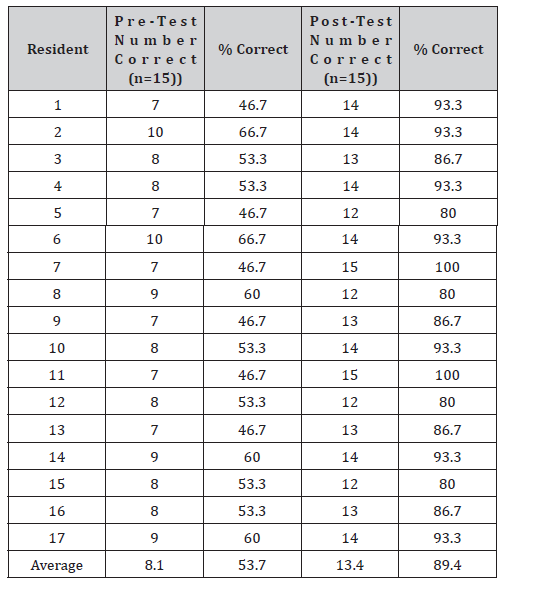
17 residents participated in this study. The majority of the residents (9/17; 53%) were interns, 3 (18%) were second year residents, 4 (23%) were third-year residents, and 1 (6%) was a fourth-year combined internal medicine-pediatrics resident. Table 1 describes number of correct responses for each individual. The average pre-test score for an individual was 53.7 ± 6.9% while that of the post-test was 89.4 ± 6.7%, p < 0.001. At the end of the session, 13 of 17 (76.5%) residents felt more comfortable with ultrasound, and the remaining 4 of 17 (23.5%) felt much more comfortable with ultrasound.
Table 1:Increased scores from pre- and post-tests with ultrasound session by individual.
BMI: Body mass Index; ADK: Adenocarcinoma; PD: Pancreatoduodenectomy
Discussion
Ultrasound is a relatively cost-efficient imaging modality without harmful effects of radiation exposure. With technological advances, ultrasound has become more portable and user-friendly and is utilized in variety of medical fields. Ultrasound is heavily operator-dependent and requires sufficient training to obtain and interpret images properly, but ultrasound training for resident physicians is still lacking.
A study on 437 obstetrics and gynecology residents across 93 programs in 2016 showed that 30% of residents reported not having any ultrasound didactics, and of those who did, 40% reported having it annually or less [5]. A more recent study from 2015-2016 on 110 otolaryngology residents noted that 76% residents had no exposure to formal ultrasound education, 44% did not feel comfortable with ultrasound-guided procedures, and 78% wished they had more exposure to ultrasound [6].
An increasing number of residency programs are becoming aware of the usefulness of ultrasound and starting to incorporate ultrasound education in some form or another. obstetrics and gynecology residency, for example, is one of the fields that has traditionally incorporated ultrasound education into their training given the integral part ultrasound has in the field. Historically, this has been through informal, educator-dependent training, however in 2018, the American Institute of Ultrasound in Medicine and its task force developed a formal standardized curriculum with competency assessment to be incorporated into ob-gyn residency training [7]. The curriculum provides varying levels of ultrasound education depending on the postgraduate year, starting from the fundamentals of ultrasound to a more advanced, procedural ultrasound training. It also requires that the residents personally obtain proper images and clips themselves as part of the assessment. Having such structured curriculum can be applied in various fields including internal medicine and strengthen postgraduate education.
Incorporating ultrasound in internal medicine has many advantages, including timely and efficient diagnostic evaluation that can guide management for the patient. In Netherlands and other European countries, a formal ultrasound training has been developed for internal medicine residents that is similar to the International Federation for Emergency Medicine’s ultrasound curriculum [8,9]. Nonetheless, there is no formalized curriculum for internal medicine residency programs in the U.S. The Alliance of Academic Internal Medicine recently published a position statement in 2019 on point-of-care ultrasound within the field of internal medicine and stated that ultrasound does indeed provide clinical benefit to patient care and supports longitudinal ultrasound training in internal medicine residency [10]. Through robust ultrasound training, internal medicine residents can acquire higher efficiency in ultrasound-guided procedures and tests as they care for acutely sick patients, performing a quick point-ofcare ultrasound to obtain central vascular access and to assess for retroperitoneal bleed or cardiogenic shock.
There are limitations to this study, namely the small sample size. Given that this was solely based on a voluntary basis, this was the maximum number of busy residents we were able to recruit, however one way to overcome this is to incorporate it as an elective rotation in which the residents would have dedicated time for learning and expand it to a multicenter study for a larger sample size. Another limitation is that this was only focused on the hepatobiliary system, largely for efficiency. While our lecture does discuss the specific indications that would warrant a right upper quadrant ultrasound, the participants were made aware that working through the hepatobiliary system alone is not sufficient for patients presenting with abdominal discomfort, and that this may not necessarily be generalized to the overall efficacy of all ultrasound training curriculums. Our study also does not incorporate the actual scanning aspect of ultrasound teaching. This is due to the limited participation of the residents (this was offered as an adjunct but many had schedule conflicts). If a formal curriculum is incorporated with a set allotted time, this would be very feasible and will exponentially enhance ultrasound learning.
One of the major obstacles in incorporating a formal ultrasound curriculum seems to be the lack of time and trained faculty [11]. Nonetheless, our study demonstrates that even just one 45-minute educational session on ultrasound enhanced residents’ knowledge and comfort level on ultrasound. This in turn has considerable clinical implications for more efficient and effective patient care. This study shows that incorporating ultrasound teaching in graduate medical education in the field of internal medicine is feasible and has a favorable outcome. An ultrasound simulator software program that can be used with a phone and a laptop has been shown to work effectively among residents [12], and a systematic review on simulation-based training on abdominal ultrasound highlights its effectiveness [13]. This type of software can help ameliorate difficulties associated with lack of dedicated ultrasound educators or faculty time across residency programs.
Conclusion
A standardized ultrasound curriculum that can provide repeated exposure in ultrasound can strengthen the breadth of internal medicine residents’ training and enhance patient care.
Disclosures/ Conflict of Interest
None.
Institutional Ethics Statement
This study has been exempted from the IRB review.
Author Contributions
GEK: literature review, study design, conduct, manuscript write
up
DGH: statistical analysis, review and finalization of the
manuscript.
References
- So S, Patel RM, Orebaugh SL (2017) Ultrasound imaging in medical student education: Impact on learning anatomy and physical diagnosis. Anat Sci Educ 10(2):176-189.
- Tarique U, Tang B, Singh M, Kulasegaram KM, Ailon J (2018) Ultrasound Curricula in Undergraduate Medical Education: A Scoping Review. J Ultrasound Med 37(1): 69-82.
- Lee W, Hodges AN, Williams S, Vettraino IM, McNie B (2004) Fetal ultrasound training for obstetrics and gynecology residents. Obstet Gynecol 103(2): 333-338.
- Ahern M, Mallin MP, Weitzel S, Madsen T, Hunt P (2010) Variability in Ultrasound Education among Emergency Medicine Residencies. West J Emerg Med 11(4): 314-318.
- Alrahmani L, Codsi E, Borowski KS (2018) The Current State of Ultrasound Training in Obstetrics and Gynecology Residency Programs. J Ultrasound Med 37(9): 2201-2207.
- Meister KD, Vila PM, Bonilla-Velez J, Sebelik M, Orloff LA (2019) Current Experience of Ultrasound Training in Otolaryngology Residency Programs. J Ultrasound Med 38(2): 393-397.
- Abuhamad A, Minton KK, Benson CB, et al. (2018) Obstetric and Gynecologic Ultrasound Curriculum and Competency Assessment in Residency Training Programs: Consensus Report. J Ultrasound Med 37(1): 19-50.
- Olgers TJ, Azizi N, Blans MJ, Bosch FH, Gans ROB, et al. (2019) Point-of-care Ultrasound (PoCUS) for the internist in Acute Medicine: a uniform curriculum. Neth J Med 77(5): 168-176.
- (2021) (IFEM) Iffem. Point-of care ultrasound curriculum guidance.
- LoPresti CM, Jensen TP, Dversdal RK, Astiz DJ (2019) Point-of-Care Ultrasound for Internal Medicine Residency Training: A Position Statement from the Alliance of Academic Internal Medicine. Am J Med 132(11): 1356-1360.
- Carver TW (2018) Ultrasound Training in Surgical Critical Care Fellowship: A Survey of Program Directors. J Surg Educ 75(5): 1250-1255.
- Gunabushanam G, Nautsch F, Mills I, Scoutt LM (2019) Accessible Personal Ultrasound Training Simulator. J Ultrasound Med 38(6): 1425-1432.
- Østergaard ML, Ewertsen C, Konge L, Albrecht-Beste E, Bachmann Nielsen M (2016) Simulation-Based Abdominal Ultrasound Training - A Systematic Review. Ultraschall Med 37(3): 253-261.
-

This work is licensed under a Creative Commons Attribution-NonCommercial 4.0 International License.


 a Creative Commons Attribution 4.0 International License. Based on a work at www.irispublishers.com.
Best viewed in

 | Above IE 9.0 version | Privacy Policy