



 Research Article
Clinical Characteristics and Predictors of Biologic Failure in Inflammatory Bowel Disease: A Retrospective, Single-Center Study from Kuwait
1Consultant gastroenterologist, advanced inflammatory bowel disease specialist, Department of internal medicine, Gastroenterology, Farwaniya hospital, Ministry of health, Kuwait
2Registrar Gastroenterologist, Department of internal medicine, Gastroenterology, Farwaniya hospital, Ministry of health, Kuwait
3Consultant Gastroenterologist, Department of internal medicine, Gastroenterology, Farwaniya hospital, Ministry of health, Kuwait
Received Date:November 11, 2025; Published Date:December 02, 2025
Abstract
Objectives: We aimed to identify the clinical characteristics and predictors of biologic failure in a real-world inflammatory bowel disease (IBD)
cohort from Kuwait.
Methods: This retrospective, single-center study was conducted at Farwaniya Hospital, Kuwait, reviewing electronic medical records of IBD
patients followed in 2024. The primary outcome was biologic failure, defined as a history of failing at least one biologic agent, necessitating a switch.
Patient demographics, disease characteristics, and treatment history were compared between groups with and without a history of biologic failure.
Results: Among 297 patients (mean age 31.3±12.2 years; 62.3% male; 56.9% CD; current smoking 41.8%), prior biologic failure occurred in
24.9%. On univariate analysis, higher odds of failure were seen with Middle Eastern race, CD (vs UC), disease duration >5 years, colonic CD (L2),
stricturing behaviors (B2), and perianal disease. On the other hand, 5-ASA use and current steroids were protective. In multivariable modelling,
independent predictors of biologic failure were disease duration >5 years (adjusted OR [aOR] 2.78; 95% CI 1.51–5.10; p=0.001) and (B2) (aOR 2.62;
95% CI 1.19–5.77; p=0.016). 5-ASA therapy remained independently protective (aOR 0.06; 95% CI 0.02–0.22; p<0.001).
Conclusion: In this Kuwaiti IBD cohort, longer disease duration and stricturing CD behavior independently predicted biologic failure, whereas
5-ASA exposure was strongly protective. These findings support early risk stratification and mechanism-appropriate optimization (including timely
biologic selection and therapeutic drug monitoring) to mitigate failure in high-risk patients in the Gulf region.
Keywords:IBD; Crohn’s disease; Ulcerative Colitis; Kuwait; biological failure
Introduction
Inflammatory bowel disease (IBD), encompassing Crohn’s disease (CD) and ulcerative colitis (UC), represents a group of chronic, immune-mediated inflammatory conditions of the gastrointestinal tract. Characterized by a relapsing and remitting course, IBD significantly impairs patients’ quality of life and poses a substantial burden on healthcare systems worldwide [1,2]. While historically considered a disease of Western nations, recent epidemiological data reveal a rapidly increasing incidence and prevalence of IBD in newly industrialized regions, including the Middle East and the Arabian Gulf [3,4]. This shifting global landscape underscores the need for a deeper understanding of the disease’s clinical course and treatment outcomes in diverse populations.
The management of IBD has been revolutionized over the past two decades by the introduction of biologic therapies. These agents, which include tumor necrosis factor-alpha (TNF-α) inhibitors, antiintegrins, and anti-interleukin-12/23 antibodies, have transformed treatment goals from mere symptom control to achieving sustained clinical remission and mucosal healing [5,6]. Biologics have demonstrated superior efficacy compared to conventional therapies, particularly in patients with moderate-to-severe disease, altering the natural history of IBD and reducing rates of surgery and hospitalization [7].
Despite their efficacy, a significant proportion of patients experience an inadequate response to biologic agents [8,9]. This challenge manifests as either primary non-response (PNR), where a patient fails to respond to induction therapy, or secondary loss of response (SLR), where a patient who initially responded loses efficacy over time [10]. Collectively termed “biologic failure,” this phenomenon is a major clinical hurdle, with studies reporting PNR in up to 30% of patients and SLR in up to 50% of initial responders within the first year of anti-TNF therapy [11]. Management of biologic failure often necessitates dose optimization, switching to another agent within the same class, or transitioning to a biologic with a different mechanism of action, thereby increasing treatment complexity and costs [12].
Several factors have been identified as potential predictors of biologic failure in IBD, including disease-related characteristics (e.g., long disease duration, severe inflammatory burden), patientrelated factors (e.g., smoking), and immunopharmacological variables (e.g., formation of anti-drug antibodies) [13,14]. However, the majority of these predictive models have been developed from studies conducted in North American and European populations. Although the incidence of IBD is rising sharply in the Middle East, there is a scarcity of data on treatment outcomes and predictors of biologic failure from this region [4,15]. Early research from Kuwait dates back several decades, but contemporary, region-specific data are needed to guide clinical practice in a population with distinct genetic and environmental backgrounds [16]. Therefore, the primary objective of this retrospective, single-center study was to describe the clinical characteristics and identify the predictors of biologic failure among a cohort of IBD patients in Kuwait. The analysis of real-world data from our center aims to provide crucial insights that can help optimize treatment strategies and improve patient outcomes in this evolving demographic.
Methods
Study Design and Setting
This was a retrospective, single-center, observational study conducted at the IBD clinic of Farwaniya Hospital, a tertiary care center in Kuwait. Data were collected via electronic chart review of patients followed between 1 January 2024 and 30 December 2024. The study reporting conforms to the Strengthening the Reporting of Observational Studies in Epidemiology (STROBE) statement. The study protocol was approved by the local Institutional Review Board (IRB) at the Ministry of Health, Kuwait (2145/2022). A waiver of informed consent was granted due to the retrospective design and the use of de-identified patient data, which were handled in compliance with institutional privacy policies.
Study Population
All patients (aged ≥14 years, as per local Ministry of Health guidelines) with a confirmed diagnosis of CD or UC who were actively followed at the IBD clinic were eligible for inclusion. Patients were excluded if their medical records were incomplete, if key outcome variables were missing, or if they were not under the healthcare jurisdiction of the Farwaniya governorate.
Data Collection and Variables
Data were systematically extracted from the hospital’s electronic health information system (HIS) using a standardized data-collection form to minimize information bias. For each patient, we recorded demographics (age at diagnosis, sex, race); disease characteristics, including IBD type (CD or UC), disease duration, and Montreal classification (location and behavior for CD; extent for UC); clinical history and lifestyle factors such as smoking status, comorbidities, and IBD-related surgical interventions; treatment history encompassing current and past use of IBD medications, including systemic corticosteroids and biologic agents; and complications, specifically the presence of extraintestinal manifestations and any history of biologic failure
Outcome Definitions
The primary outcome of this study was to characterize the demographic and clinical profile of the IBD patient cohort. The key secondary outcome, which served as the primary endpoint for predictive modeling, was biologic failure. This was defined as a history of requiring a switch to a different biologic agent due to primary non-response, secondary loss of response, or intolerance, after having been treated with at least one prior biologic. An additional secondary outcome was the rate of IBD-related surgery.
Study Size
An a priori sample size calculation was performed to ensure adequate statistical power to detect a clinically significant difference in the rate of biologic failure between patient subgroups. Assuming a two-sided alpha of 0.05 and 80% power, a sample of 306 patients (153 per group) was required to detect an absolute difference of 15% in biologic failure rates between a high-risk group (e.g., 40% failure rate) and a low-risk group (e.g., 25% failure rate). To account for potential confounders and missing data inherent in retrospective studies, a target enrolment of approximately 340 patients was established.
Statistical Analysis
All statistical analyses were conducted using the Statistical Package for Social Science (SPSS), Version 27 (IBM Corp., Armonk, NY). A two-sided p-value of < 0.05 was considered statistically significant for all inferential tests.
Descriptive and Univariate Analysis: Continuous variables were assessed for normality using the Shapiro-Wilk test. Normally distributed data were summarized as mean ± standard deviation (SD), while skewed data were presented as median and interquartile range (IQR). Categorical variables were described using frequencies (n) and percentages (%). To identify potential predictors of biologic failure, baseline demographic and clinical characteristics were compared between patients with and without a history of biologic failure. The Chi-squared test or Fisher’s exact test was used for categorical variables, and the independent samples t-test or Mann-Whitney U test was used for continuous variables, as appropriate. Multivariate Predictive Modeling: To identify independent predictors of biologic failure, a multivariate logistic regression analysis was performed. All variables that demonstrated a statistically significant association (p < 0.05) with biologic failure in the univariate analysis were included as candidate predictors in the multivariate model. The results are presented as odds ratios (OR) with 95% confidence intervals (CI).
Results
Baseline Demographics and Clinical Characteristics
Among 297 patients, the mean age was 31.33 years (SD 12.20); 185 (62.29%) were male. The cohort was predominantly Middle Eastern 206 (69.36%), and 124 (41.75%) were current smokers. By IBD type, 169 (56.90%) had CD and 128 (43.10%) had UC; median disease duration was 3 years (IQR 2–7). The most frequent CD location was ileocolonic (L3) 79 (26.60%), and the predominant CD behaviour was inflammatory (B1) 97 (32.66%); perianal disease was present in 48 (16.16%). In UC, extensive/pancolitis (E3) was most common at 80 (26.94%).
At baseline, 62 (20.88%) were receiving systemic corticosteroids; prior biologic failure occurred in 74 (24.92%). Previous IBD surgery was reported in 22 (7.41%), most commonly small-bowel resection 17 (5.72%). Concomitant therapies most frequently included 5-ASA 82 (27.61%) and azathioprine/6-MP 61 (20.54%). Comorbidities were recorded in 16 (5.39%). Other autoimmune disease was noted in 23 (7.74%), most commonly dermatologic 14 (4.71%). Extraintestinal manifestations occurred in 23 (7.74%), most commonly psychiatric 14 (4.71%), as shown in Table 1.
Table 1:Baseline demographics and clinical characteristics of the study cohort (N=297).
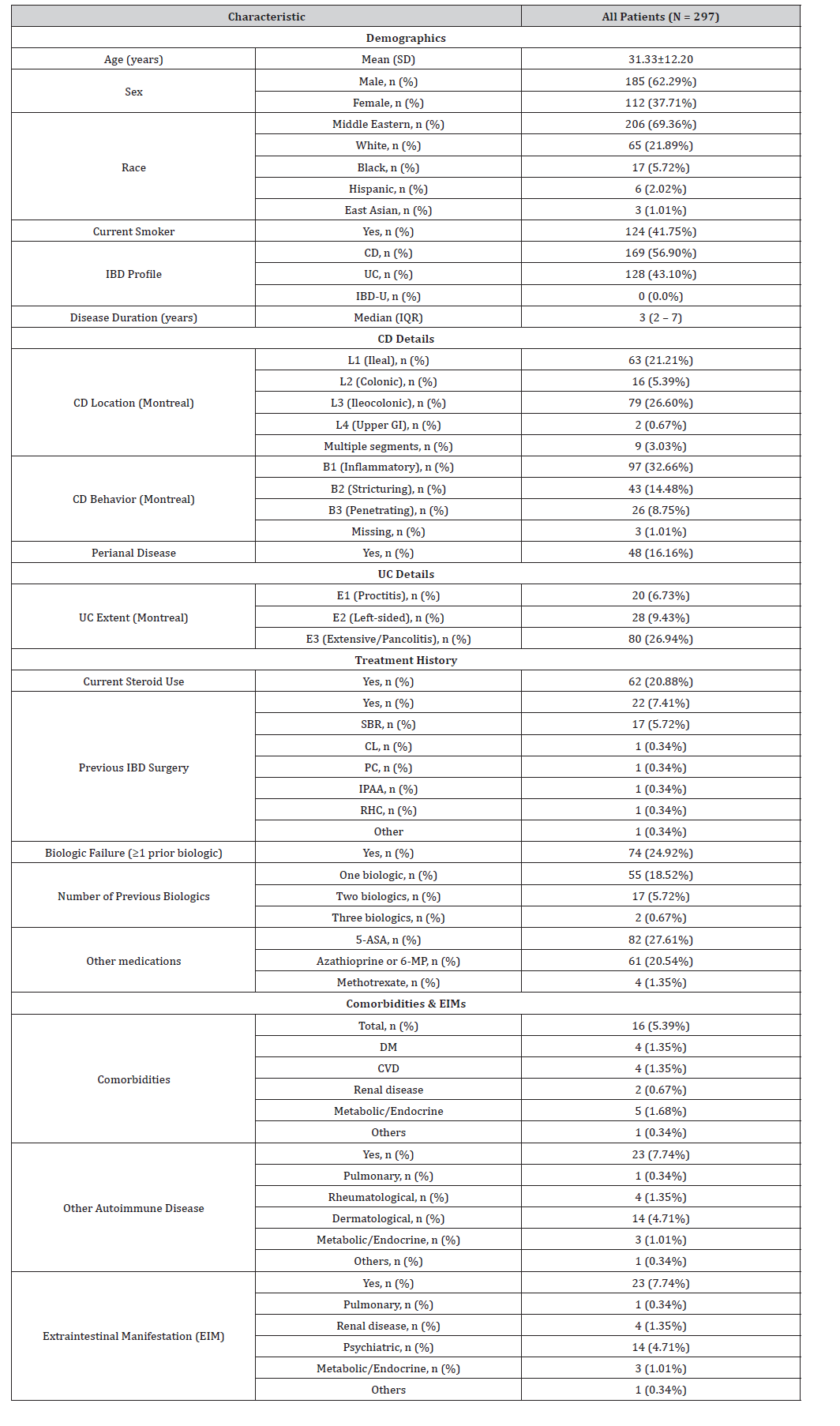
Data are presented as n (%), mean (SD), or median (IQR) as appropriate. Montreal classification for CD location: L1, ileal; L2, colonic; L3, ileocolonic; L4, upper GI; “multiple segments” indicates involvement of more than one non-overlapping category. Montreal behavior: B1, inflammatory; B2, stricturing; B3, penetrating. UC extent: E1, proctitis; E2, left-sided colitis; E3, extensive/pancolitis. Abbreviations: 5-ASA, 5-aminosalicylic acid; 6-MP, 6-mercaptopurine; CD, Crohn’s disease; CL, colectomy; CVD, cardiovascular disease; DM, diabetes mellitus; EIM, extraintestinal manifestation; IBD-U, IBD unclassified; IPAA, ileal pouch–anal anastomosis; PC, proctocolectomy; RHC, right hemicolectomy; SBR, small-bowel resection; UC, ulcerative colitis. Percentages are calculated out of the total cohort unless stated otherwise
Baseline Characteristics by Prior Biologic Failure
Compared with those without biologic failure (n=223), patients with prior biologic failure (n=74) were more frequently Middle Eastern 63 (85.14%) vs 143 (64.13%) (p=0.006), had a higher prevalence of Crohn’s disease 52 (70.27%) vs 117 (52.47%) (p=0.007), and were more likely to have longer disease duration >5 years 39 (52.70%) vs 62 (27.80%) (p<0.001). Notably, no comorbidity was recorded in the biologic-failure group 0 (0.00%) vs 14 (6.28%) among those without failure (p=0.027). Age distribution (≤30 years: 40 (54.05%) vs 113 (50.67%), p=0.614), sex (male: 48 (64.86%) vs 137 (61.43%), p=0.598), current smoking 33 (44.59%) vs 91 (40.81%) (p=0.567), and other autoimmune diagnoses 4 (5.41%) vs 19 (8.52%) (p=0.385) did not differ significantly between groups (Table 2).
Table 2:Comparative baseline characteristics by prior biologic failure status.
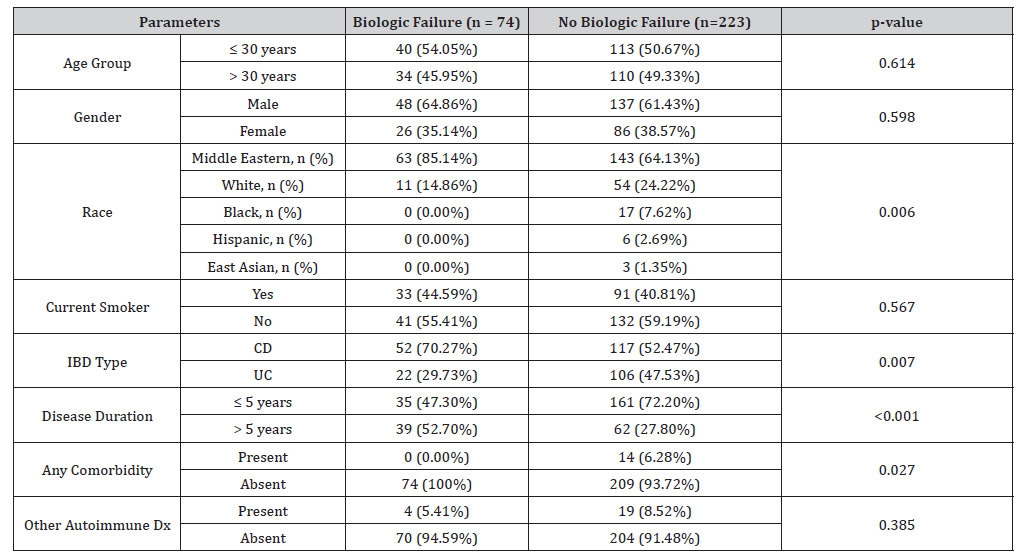
Data are presented as n (%). P-values reflect between-group comparisons for each variable (χ² test or Fisher’s exact test, as appropriate). Age group is categorized as ≤30 vs >30 years. “Biologic failure” denotes prior failure of ≥1 biologic agent. Abbreviations: IBD, inflammatory bowel disease. CD, Crohn’s disease; UC, ulcerative colitis
Baseline Characteristics by History of Surgical Intervention
Patients with a history of surgical intervention (n=22) were more likely to be older than 30 years (68.18% vs. 46.91%, p=0.055) and predominantly of Middle Eastern descent (90.91% vs. 67.64%, p=0.019). Smoking was less frequent in the surgical group (36.36% vs. 60.00%, p=0.031). CD was significantly more prevalent among surgical patients compared to those without surgery (95.45% vs. 53.82%, p<0.001). Longer disease duration (>5 years) was also more common in the surgical group (72.73% vs. 30.91%, p<0.001). Biologic failure was markedly higher among patients who underwent surgery (68.15% vs. 21.45%, p<0.001). No significant differences were observed in gender distribution, comorbidity status, or presence of other autoimmune diagnoses, as presented in Table 3.
Table 3:Comparative baseline characteristics by history of surgical intervention.
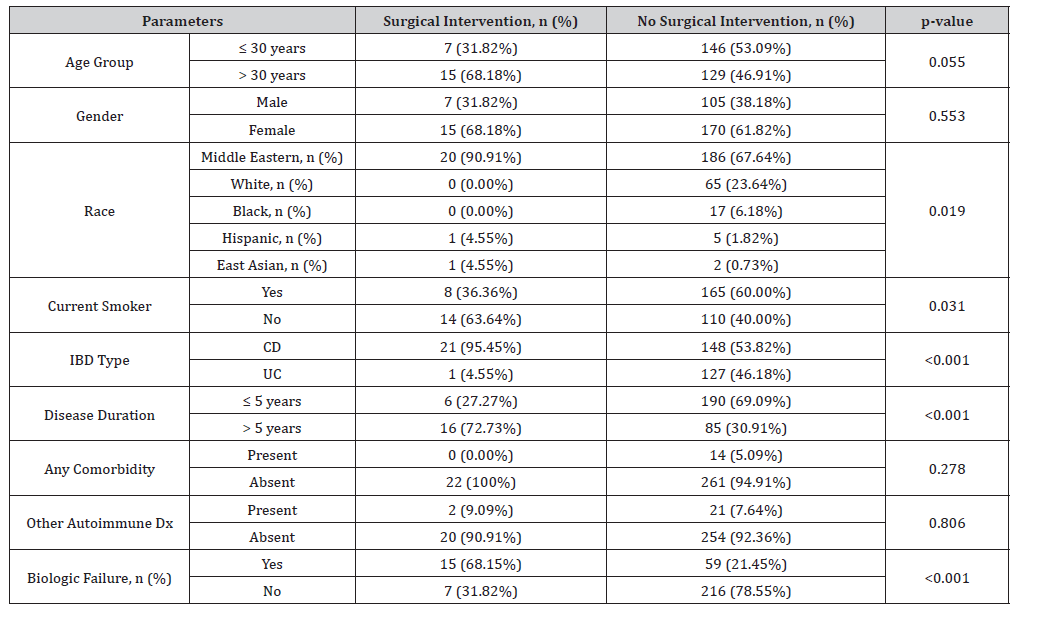
Data are presented as n (%). “Surgical intervention” denotes any prior IBD-related surgery (n=22); “No surgical intervention” denotes no prior IBD surgery (n=275). P-values reflect between-group comparisons (χ² test or Fisher’s exact test, as appropriate). Age group is categorized as ≤30 vs >30 years. Abbreviations: IBD, inflammatory bowel disease; CD, Crohn’s disease; UC, ulcerative colitis.
Relationship Between Biologic Agent Use and Patient Demographics
Infliximab use was significantly higher in patients aged ≤30 years compared to >30 years (30.72% vs. 6.94%, p<0.001) and in Crohn’s disease (CD) compared to ulcerative colitis (UC) (26.04% vs. 10.16%, p<0.001), with no sex difference observed (p=0.878). Adalimumab use followed a similar pattern, with greater use in younger patients (20.26% vs. 11.11%, p=0.031) and in CD vs. UC (23.08% vs. 6.25%, p<0.001), and no difference by sex (p=0.572). Vedolizumab was used more frequently in older patients (8.33% vs. 1.96%, p=0.012), with no significant associations with sex or disease type. Ustekinumab use was higher in CD than UC (24.26% vs. 7.81%, p<0.001), with no significant differences by age or sex. Certolizumab and tofacitinib were rarely used (n=1 each) and showed no significant demographic associations (Table 4).
Table 4:Relationship between biologic agent use and patient demographics.
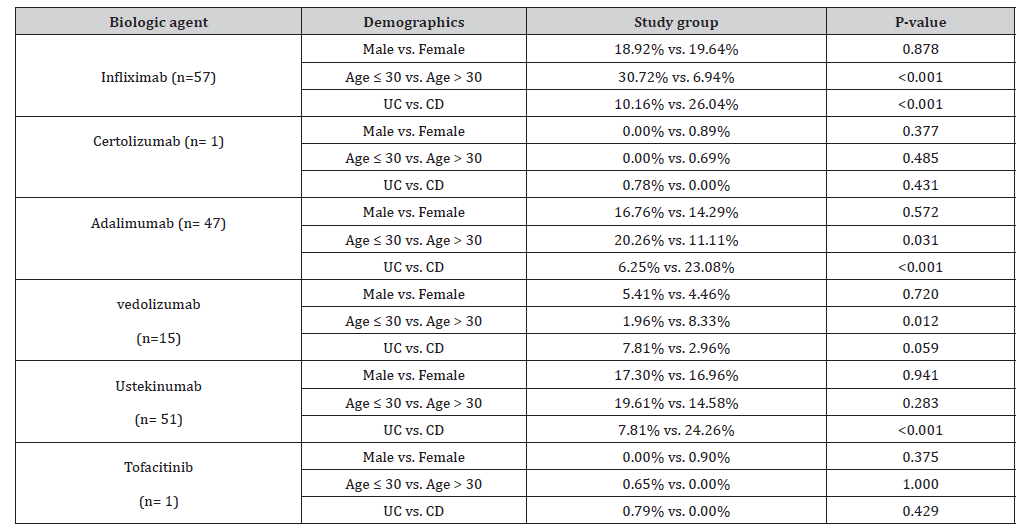
Data are presented as percentages within each demographic subgroup. P-values reflect between-group comparisons (χ² test or Fisher’s exact test, as appropriate). Biologic agents analyzed include infliximab, certolizumab, adalimumab, vedolizumab, ustekinumab, and tofacitinib. Demographic variables include sex (male vs. female), age group (≤30 vs. >30 years), and disease type (ulcerative colitis [UC] vs. Crohn’s disease [CD]).
Association Between Patient Demographics and Current Biologic Therapy Use
Patients receiving current biologic therapy (n=214) were more likely to be aged ≤30 years compared to those not on biologics (59.35% vs. 31.33%, p<0.001). Biologic use was significantly more common in Crohn’s disease (71.96% vs. 18.07%, p<0.001) and among Middle Eastern patients (71.96% vs. 62.65%, p=0.019). No significant differences were observed in gender (p=0.074), smoking status (p=0.161), disease duration (p=0.628), presence of comorbidities (p=0.507), or other autoimmune diagnoses (p=0.213), as reported in Table 5.
Table 5:Association of patient demographics with current biologic therapy use.
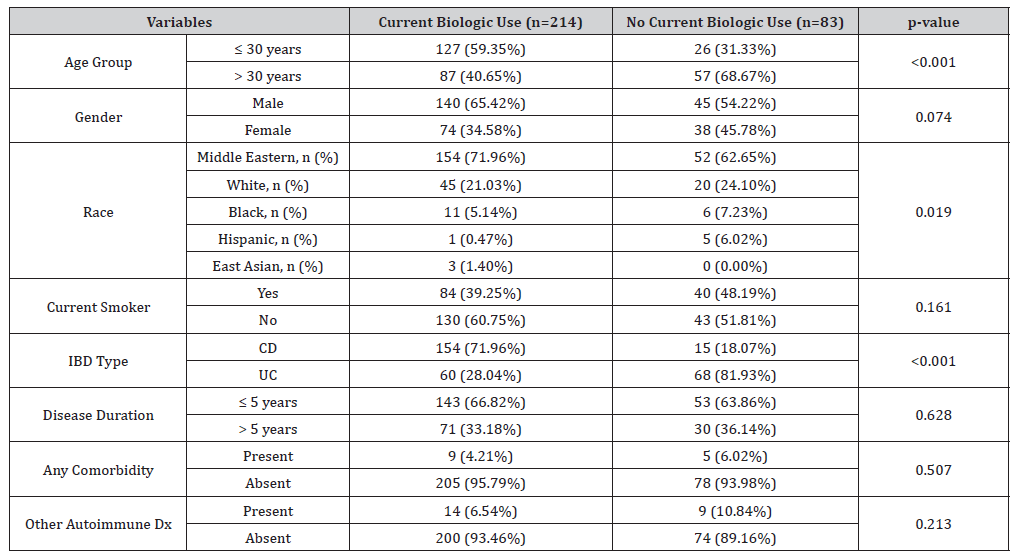
Data are presented as n (%). “Current biologic use” includes patients actively receiving biologic therapy at the time of data collection (n=214); “No current biologic use” includes patients who were biologic-naïve or had discontinued biologics (n=83). P-values reflect between-group comparisons using the χ² test or Fisher’s exact test, as appropriate. Age group is categorized as ≤30 vs. >30 years. Abbreviations: CD, Crohn’s disease; UC, ulcerative colitis; IBD, inflammatory bowel disease.
Association of IBD Phenotype with Biologic Failure and Surgical Intervention
Among CD patients, ileocolonic involvement (L3) was most frequently associated with both biologic failure (36.49%, p=0.028) and surgical intervention (50.00%, p=0.006). Ileal disease (L1) also showed significant associations with biologic failure (20.27%) and surgery (31.82%). Stricturing behaviour (B2) was significantly associated with surgical intervention (45.45%) and biologic failure (25.68%), while penetrating disease (B3) and inflammatory behaviour (B1) were also common in surgical cases (27.73% and 27.27%, respectively; p<0.001). In ulcerative colitis (UC), extensive colitis (E3) was most associated with biologic failure (25.68%, p=0.007), though surgical intervention remained rare across all UC subtypes (≤4.55%), as shown in Table 6.
Table 6:Association of IBD phenotype (Montreal classification) with biologic failure and surgical intervention
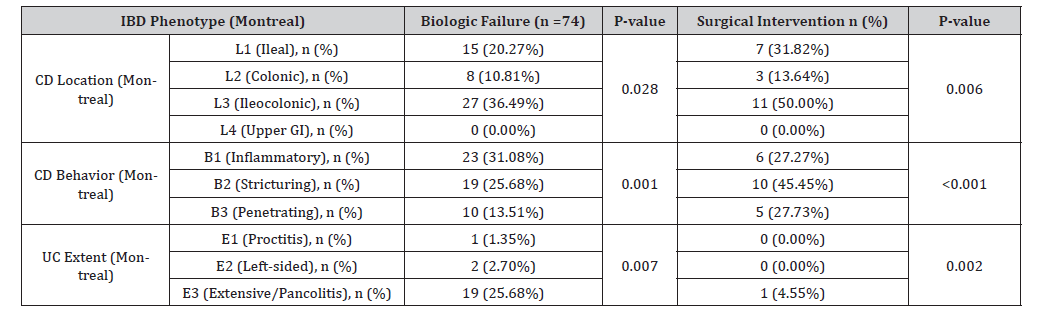
Data are presented as n (%). P-values reflect between-group comparisons using χ² or Fisher’s exact test. Biologic failure includes any patient with documented loss of response or intolerance to biologic therapy (n=74). Surgical intervention refers to any prior IBD-related surgery. Abbreviations: CD, Crohn’s disease; UC, ulcerative colitis; GI, gastrointestinal.
Association of Extraintestinal Manifestations with Biologic Failure and Surgical Intervention
Table 7 shows that the presence of any EIM was not significantly associated with biologic failure (29.25% vs. 22.51%, p=0.199) or surgical intervention (8.49% vs. 6.81%, p=0.595). Similarly, no significant associations were observed between biologic failure or surgery and specific EIM subtypes, including eye (32.14% vs. 24.16%, p=0.353), joint (28.13% vs. 24.53%, p=0.657), or skin manifestations (33.33% vs. 23.29%, p=0.141). However, hepatobiliary manifestations, although rare (n=7), were significantly associated with surgical intervention (28.57% vs. 6.90%, p=0.030), but not with biologic failure (p=0.511).
Table 7:Association of extraintestinal manifestations (EIMs) with biologic failure and surgical intervention. Data are presented as n (%).
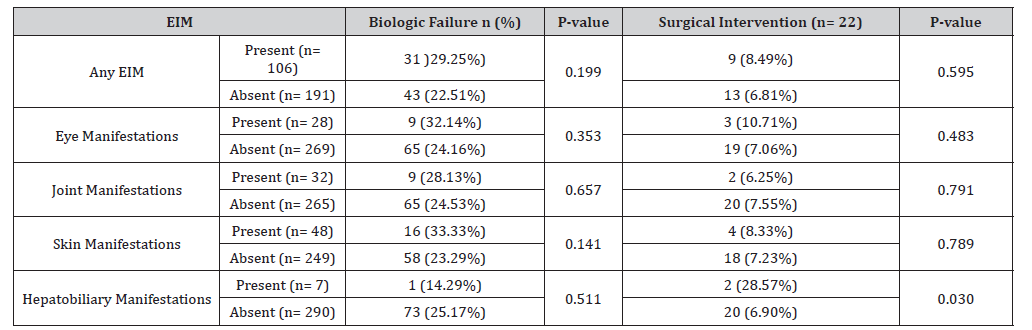
Biologic failure includes patients with documented loss of response or intolerance to biologic therapy. Surgical intervention refers to any prior IBDrelated surgery (n=22). P-values reflect between-group comparisons using χ² or Fisher’s exact test. EIM subtypes include eye (e.g., uveitis), joint (e.g., arthritis), skin (e.g., erythema nodosum), and hepatobiliary (e.g., PSC) manifestations.
Predictors of Biological failure
In univariate logistic regression, higher odds of biologic failure were observed in patients of Middle Eastern race (OR 2.16, 95% CI 1.06–4.41, p=0.034), those with CD versus UC (OR 2.14, 95% CI 1.22–3.76, p=0.008), disease duration >5 years (OR 2.89, 95% CI 1.68–4.98, p<0.001), colonic Crohn’s location (L2) (OR 3.20, 95% CI 1.02–9.99, p=0.045), stricturing behaviour (B2) (OR 2.55, 95% CI 1.19–5.46, p=0.016), and presence of perianal disease (OR 2.07, 95% CI 1.07–3.98, p=0.030). Protective associations were seen with 5-ASA treatment (OR 0.08, 95% CI 0.02–0.25, p<0.001) and current steroid use (OR 0.38, 95% CI 0.17–0.84, p=0.017).
In the multivariate model, independent predictors of biologic failure were disease duration >5 years (adjusted OR 2.78, 95% CI 1.51–5.10, p=0.001) and stricturing behaviour (B2) (adjusted OR 2.62, 95% CI 1.19–5.77, p=0.016). Treatment with 5-ASA remained independently protective (adjusted OR 0.06, 95% CI 0.02–0.22, p<0.001), as shown in Table 8.
Table 8:Predictors of Biologic Failure in IBD.
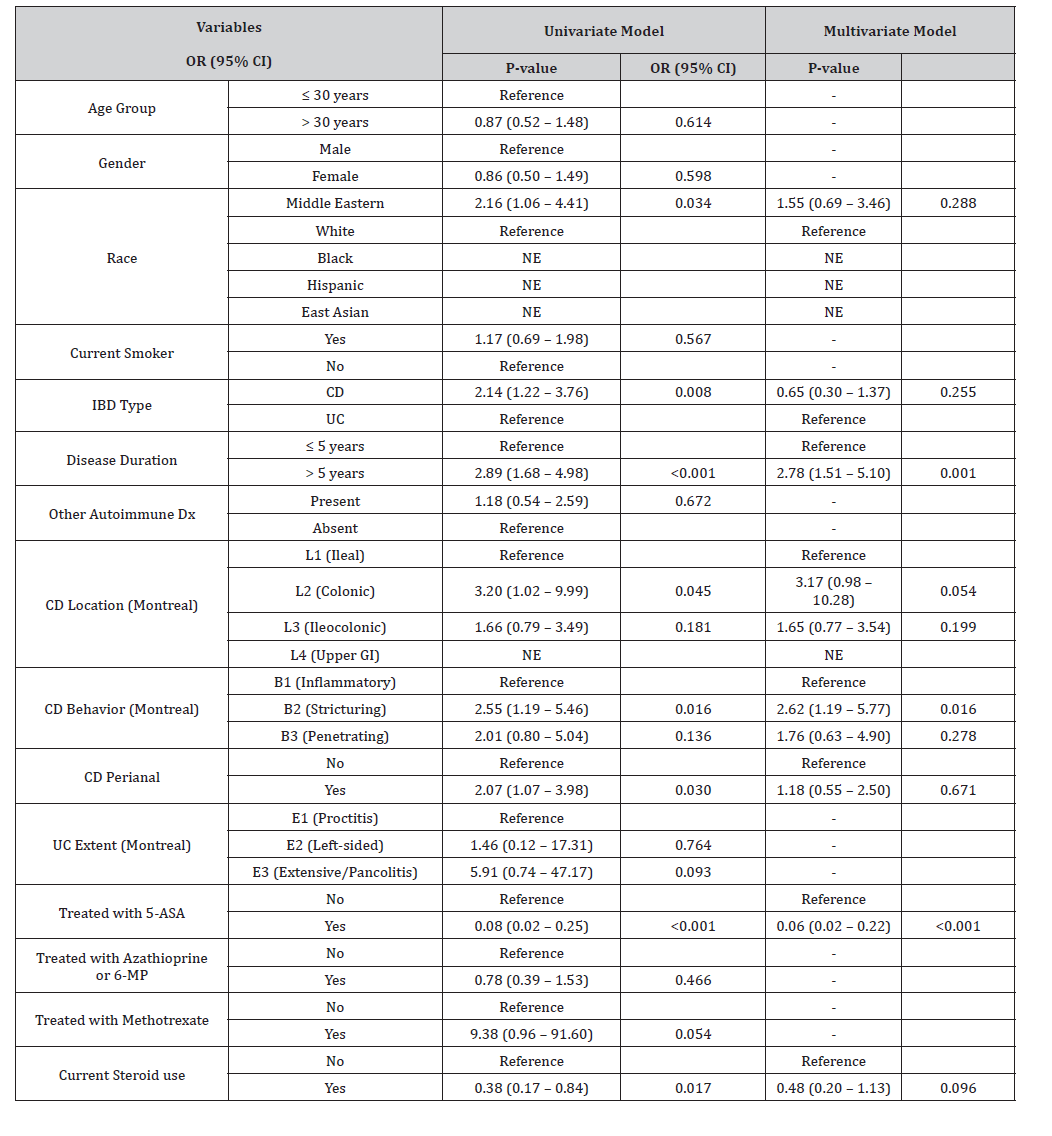
Odds ratios (ORs) with 95% confidence intervals (CIs) from logistic regression. “Reference” indicates the comparator category. “NE” = not estimable due to sparse data. A dash “–” in the multivariate columns denotes variables not retained because they were not significant in univariate analysis (therefore excluded from the multivariate model). Bolded rows in the multivariate model indicate independent predictors. Abbreviations: CD, Crohn’s disease; UC, ulcerative colitis; 5-ASA, 5-aminosalicylate; 6-MP, 6-mercaptopurine.
Discussion
This retrospective, single-center study provides novel insights into the clinical characteristics and predictors of biologic failure in a cohort of IBD patients from Kuwait. Our principal findings indicate that CD, longer disease duration, and Middle Eastern ethnicity were significantly associated with an increased risk of biologic failure. Furthermore, specific disease phenotypes, including ileocolonic (L3) CD and extensive ulcerative colitis (E3), were linked to higher rates of biologic failure, while complex CD behaviors (stricturing and penetrating) were strongly associated with the need for surgical intervention. These findings contribute crucial, region-specific data to the growing body of evidence on IBD treatment outcomes.
The landscape of IBD is rapidly evolving in the Middle East, necessitating a deeper understanding of treatment response in this unique patient population [3,4]. Our study identified several key predictors of biologic failure, some of which align with and others that diverge from the existing international literature. A primary finding was that patients with CD were significantly more likely to experience biologic failure than those with UC. This contrasts with a regional study from Saudi Arabia, which reported higher odds of anti-TNF failure in UC patients [17]. This discrepancy may reflect differences in cohort characteristics, prescribing patterns, our data showed a preference for anti-TNFs and ustekinumab in CD, or variations in the underlying disease biology between populations. However, our finding is consistent with several comparative-effectiveness datasets, particularly for vedolizumab. In a large U.S. cohort of older adults with IBD, vedolizumab was associated with a higher 1-year risk of treatment failure than anti-TNF therapy, and the excess risk was more pronounced in CD on subgroup analysis, supporting a CD>UC failure gradient for this agent [18]. Complementary evidence shows that in Crohn’s disease, ustekinumab outperforms vedolizumab across multiple effectiveness endpoints and persistence, indirectly indicating higher failure on vedolizumab in CD relative to alternatives; this contrast is less evident in UC where vedolizumab often performs comparatively well [19–21]. The reasonable biological explanation is that vedolizumab’s gut-selective α4β7-integrin blockade primarily limits lymphocyte trafficking to the mucosa, aligning better with UC’s superficial, continuous colitis, whereas CD’s transmural, patchy, and often fibrostenotic or penetrating phenotype engages deeper compartments and fibrotic pathways that are less responsive to trafficking blockade and slower-onset agents, mechanistic features that can translate to higher primary non-response or earlier loss of response in CD [22].
Our findings showed a significant association between longer disease duration (>5 years) and biologic failure. This likely reflects a more established and complex inflammatory process, a higher cumulative inflammatory burden, and potentially the development of fibrotic changes that are less responsive to anti-inflammatory agents [23], highlighting the importance of early and effective intervention to alter the natural history of the disease. Prior work on disease duration and biologic outcomes in IBD has been mixed. Abdelwahab et al. reported that longer duration in Egyptian patients with IBD was independently associated with a 2.5-fold higher risk of biologic failure risk of biological failure [24]. On the other hand, in post-hoc analyses of the ULTRA trials of adalimumab, Sandborn et al. found no difference in clinical remission between shorter (≤2 years) and longer (>2 years) duration, while a subsequent analysis suggested a lower colectomy risk with longer duration in adalimumab-treated UC [25,26]. In a retrospective cohort of infliximab-treated corticosteroid-dependent/refractory UC, Murthy et al. reported lower infliximab failure and colectomy with longer duration, though 35% had hospitalized acute severe UC, inherently at higher colectomy risk [27]. Conversely, Ma et al. showed that early anti-TNF use was not linked to higher surgery, hospitalization, or secondary loss of response despite greater baseline endoscopic severity [28]. For vedolizumab, the VICTORY consortium observed no association between disease duration and achieving clinical remission, steroid-free remission, or mucosal healing [29], whereas a validated prediction model from GEMINI 1 indicated that duration ≥2 years independently predicted steroidfree clinical remission by week 26 [30]. This apparent conflict likely stems from heterogeneity across studies, differences in biologic class and line of therapy, definitions and time horizons for “failure,” inclusion of incident vs prevalent users and acute severe UC, baseline disease severity and phenotype mix (CD vs UC), and varied adjustment for confounding by indication, all of which can shift the observed effect of disease duration.
We observed an exceptionally elevated rate of current smoking (41.75%) in our cohort, markedly higher than figures commonly reported from Western cohorts. Contrary to most studies where smoking is a well-established risk factor for biologic failure in CD [31,32], we did not find a statistically significant association. This could be due to our study being underpowered to detect such an effect, or its influence may have been overshadowed by other dominant factors like disease phenotype and duration. The inverse association we observed between smoking and surgical intervention is also perplexing and warrants further investigation, as it may represent a spurious correlation or unmeasured confounding.
Our analysis revealed that Middle Eastern ethnicity was a significant predictor of biologic failure. This novel finding points towards the potential influence of distinct genetic, environmental, or lifestyle factors within this population. For instance, certain genetic variants, such as the HLA-DQA1*05 allele, which are associated with immunogenicity to anti-TNF agents, have been reported to be more prevalent in some Middle Eastern populations [33]. This highlights the need for pharmacogenomic studies in the region to guide more personalized treatment strategies.
The phenotypic analysis provided further clarity. The association of ileocolonic (L3) CD with both biologic failure and surgery aligns with its characterization as a more extensive and often aggressive disease form [34]. Similarly, the link between stricturing (B2) and penetrating (B3) behaviors and a high likelihood of surgery is a classic finding, confirming that despite biologic therapy, disease complications often necessitate surgical management [23]. For UC, the finding that extensive colitis (E3) was most associated with biologic failure is supported by data from the IBD-ME registry, which also identified E3 as a key characteristic in patients requiring biologics [35]. This suggests that a greater disease burden is a consistent predictor of treatment challenges across different IBD subtypes.
Our observation that concomitant 5-ASA use was independently protective against biologic failure (aOR 0.06; 95% CI 0.02–0.22) contrasts with much of the contemporary evidence, which generally finds no added benefit to continuing mesalamine once advanced therapy is initiated. In UC, two large database studies showed that stopping 5-ASA after starting anti-TNF did not worsen clinical outcomes, arguing against a pharmacologic synergy with biologics [36,37]. Similarly, concomitant 5-ASA did not improve clinical or endoscopic outcomes with vedolizumab, and an RCT found no advantage to adding mesalamine to systemic therapy during induction [38]. Guidelines also do not recommend 5-ASA for Crohn’s disease and provide limited rationale for its continuation alongside biologics in moderate–severe UC [39]. Thus, the protective association in our cohort likely reflects confounding by indication and disease severity (e.g., 5-ASA preferentially used in milder, predominantly colonic UC), channeling/survivor bias (patients who tolerate and remain on 5-ASA may have inherently more stable disease), and unmeasured treatment behaviors (adherence, earlier healthcare contact). While hypothesis-generating, this signal should be interpreted cautiously and validated in designs that account for time-varying exposure and confounding (e.g., marginal structural models) before informing practice.
Clinical Implication
The findings of this study have direct and practical implications for clinicians managing IBD in Kuwait and similar Gulf regions. The identification of CD, longer disease duration, and extensive phenotypes (L3 CD, E3 UC) as key risk factors allows for the early stratification of patients. Individuals presenting with this high-risk profile may benefit from more aggressive initial therapy, closer monitoring, and a lower threshold for treatment optimization. In a high-risk patient, clinicians might consider earlier initiation of biologics or selecting agents with a lower risk of immunogenicity. The data suggests that a ‘watch-and-wait’ approach in patients with extensive disease may lead to a higher probability of future treatment failure. Although not directly measured in our study, the high rate of biologic failure (24.9%) underscores the potential utility of TDM. In patients with risk factors for failure, proactive or reactive TDM can help differentiate between mechanistic failure and pharmacokinetic issues (e.g., low drug levels, anti-drug antibodies), thereby guiding more rational treatment decisions, such as dose escalation or switching to a new agent [40]. The high prevalence of smoking in our cohort, even if not statistically linked to failure in this analysis, remains a critical modifiable risk factor. Clinicians must continue to emphasize smoking cessation as a cornerstone of IBD management, particularly in CD.
Future Direction
This study opens several avenues for future research to address the remaining knowledge gaps. A large-scale, prospective, multicenter registry across Kuwait and the GCC region is imperative to validate our findings, mitigate the limitations of retrospective analysis, and create a more comprehensive picture of IBD outcomes. Future studies should integrate pharmacokinetic and pharmacogenomic analyses. Measuring drug trough levels, anti-drug antibodies, and genetic markers (e.g., HLA-DQA1*05) would provide crucial mechanistic insights into why patients of Middle Eastern ethnicity may be at higher risk for biologic failure. Leveraging multi-omics approaches (genomics, proteomics, microbiomics) can help identify novel, non-invasive biomarkers for predicting treatment response [41]. This aligns with the global push towards precision medicine and could lead to predictive algorithms tailored for the regional population. Future research should clearly differentiate between primary non-response and secondary loss of response. Understanding the distinct predictors for each type of failure is essential for developing targeted management strategies [42,43]. The integration of AI and machine learning models could help synthesize complex clinical, endoscopic, and biomarker data to create robust predictive tools for clinical practice, moving beyond traditional statistical analysis [44].
Limitations
We acknowledge several limitations inherent to this study’s design. First, its retrospective and single-center nature limits the generalizability of our findings. The practices and patient population at our hospital may not be representative of all IBD patients in Kuwait. Second, our study was under the target sample size, which, while sufficient for the primary model’s estimates, likely reduced power for subgroup analyses (e.g., the effect of smoking on biologic failure). Third, our reliance on electronic health records is subject to information bias and missing data. We could not consistently differentiate between primary and secondary biologic failure, nor could we capture granular data on disease activity indices or inflammatory biomarkers like fecal calprotectin at the time of failure. The counterintuitive finding regarding comorbidities may also be a result of under-reporting in the medical records. Finally, the observational design is susceptible to confounding by indication, and while we identified strong associations, we cannot establish definitive causality. These limitations underscore that our findings should be considered hypothesis-generating and require validation in prospective studies.
Conclusion
In conclusion, this study provides the first detailed analysis of predictors of biologic failure in a Kuwaiti IBD cohort. We identified CD, longer disease duration, Middle Eastern ethnicity, and extensive disease phenotypes (ileocolonic CD and extensive UC) as significant risk factors. Notably, the observed protective association with 5-ASA should be interpreted with caution, as it may reflect residual confounding (e.g., milder disease, treatment channeling) rather than a true therapeutic effect, and warrants validation in prospective, methodologically robust studies. These findings provide valuable, regionally-specific evidence that can be used to risk-stratify patients and guide personalized treatment decisions. The high rate of biologic failure highlights the urgent need for prospective, mechanistically-driven research in the region to optimize therapeutic strategies and improve long-term outcomes for patients with IBD.
References
- Kaplan GG (2015) The global burden of IBD: from 2015 to 2025. Nat Rev Gastroenterol Hepatol 12: 720–727.
- Alsakarneh S, Ahmed M, Jaber F, Abuassi M, Mourad FH, et al. (2024) Inflammatory bowel disease burden in the Middle East and North Africa Region: a comprehensive analysis of incidence, prevalence, and mortality from 1990-2019. Ann Gastroenterol 37: 527–535.
- Mak WY, Zhao M, Ng SC, Burisch J (2020) The epidemiology of inflammatory bowel disease: East meets west. J Gastroenterol Hepatol 35: 380–389.
- Mosli M, Alawadhi S, Hasan F, Abou Rached A, Sanai F, et al. (2021) Incidence, Prevalence, and Clinical Epidemiology of Inflammatory Bowel Disease in the Arab World: A Systematic Review and Meta-Analysis. Inflamm Intest Dis 6: 123–131.
- Neurath MF (2017) Current and emerging therapeutic targets for IBD. Nat Rev Gastroenterol Hepatol 14: 269–278.
- Kyriacou M, Vuyyuru S, Moran G (2023) Evolution of Treatment Targets in Inflammatory Bowel Disease. Med Res Arch p. 11.
- Singh S, Murad MH, Fumery M, Sedano R, Jairath V, et al. (2021) Comparative efficacy and safety of biologic therapies for moderate-to-severe Crohn’s disease: a systematic review and network meta-analysis. lancet Gastroenterol Hepatol 6: 1002–1014.
- Koo HM, Jun YK, Choi Y, Shin CM, Park YS, et al. (2023) 10 years of biologic use patterns in patients with inflammatory bowel disease: treatment persistence, switching and dose intensification – a nationwide population-based study. Therap Adv Gastroenterol 16.
- Velikova T, Sekulovski M, Peshevska-Sekulovska M (2024) Immunogenicity and Loss of Effectiveness of Biologic Therapy for Inflammatory Bowel Disease Patients Due to Anti-Drug Antibody Development. Antibodies (Basel, Switzerland) p. 13.
- Ben-Horin S, Kopylov U, Chowers Y (2014) Optimizing anti-TNF treatments in inflammatory bowel disease. Autoimmun Rev 13: 24–30.
- Roda G, Jharap B, Neeraj N, Colombel JF (2016) Loss of Response to Anti-TNFs: Definition, Epidemiology, and Management. Clin Transl Gastroenterol p. 7.
- Marsal J, Barreiro-de Acosta M, Blumenstein I, Cappello M, Bazin T, et al. (2022) Management of Non-response and Loss of Response to Anti-tumor Necrosis Factor Therapy in Inflammatory Bowel Disease. Front Med p. 9.
- Fine S, Papamichael K, Cheifetz AS (2019) Etiology and Management of Lack or Loss of Response to Anti-Tumor Necrosis Factor Therapy in Patients with Inflammatory Bowel Disease. Gastroenterol Hepatol (N Y) 15: 656–665.
- Billioud V, Sandborn WJ, Peyrin-Biroulet L (2011) Loss of response and need for adalimumab dose intensification in Crohn’s disease: a systematic review. Am J Gastroenterol 106: 674–684.
- Al-Qabandi WA, Buhamrah EK, Hamadi KA, Al-Osaimi SA, Al-Ruwayeh AA, et al. (2011) Inflammatory bowel disease in children, an evolving problem in Kuwait. Saudi J Gastroenterol Off J Saudi Gastroenterol Assoc 17: 323–327.
- Al-Nakib B, Radhakrishnan S, Jacob GS, Al-Liddawi H, Al-Ruwaih A (1984) Inflammatory bowel disease in Kuwait. Am J Gastroenterol 79: 191–194.
- Alharbi O, Aljebreen AM, Azzam NA, Almadi MA, Saeed M, et al. (2022) Predictors of Anti-TNF Therapy Failure among Inflammatory Bowel Disease (IBD) Patients in Saudi Arabia: A Single-Center Study. J Clin Med 11: 4157.
- Singh S, Iversen AT, Allin KH, Jess T (2022) Comparative Outcomes and Safety of Vedolizumab vs Tumor Necrosis Factor Antagonists for Older Adults with Inflammatory Bowel Diseases. JAMA Netw Open 5: e2234200.
- Supovec E, Hanžel J, Novak G, Manevski D, Štabuc B, et al. (2025) First-line anti-TNF agents, ustekinumab and vedolizumab perform similarly in Crohn’ disease, but not in ulcerative colitis. Eur J Gastroenterol Hepatol 37: 557–564.
- Yang H, Huang Z, Li M, Zhang H, Fu L, et al. (2023) Comparative effectiveness of ustekinumab vs. vedolizumab for anti-TNF- -exposed Crohn’s disease: a multicenter cohort study. eClinical Medicine pp. 66.
- Dai J, Guo R, Gong J (2025) Ustekinumab versus vedolizumab in patients with Crohn’s disease refractory to anti-tumour necrosis factor: A systematic review and meta-analysis. Pakistan J Med Sci 41: 2110–2121.
- Battat R, Dulai PS, Jairath V, Vande Casteele N (2019) A product review of vedolizumab in inflammatory bowel disease. Hum Vaccin Immunother 15: 2482–2490.
- Dalal RS, Njie C, Marcus J, Gupta S, Allegretti JR (2021) Predictors of Ustekinumab Failure in Crohn’s Disease After Dose Intensification. Inflamm Bowel Dis 27: 1294–1301.
- Abdelwahab HM, Elsaghier AM, Gendy RS, Elamin H (2024) Predictors of Relapse among Inflammatory Bowel Disease Patients on Biological Treatment in Upper Egypt. Egypt J Hosp Med 94: 231–238.
- Sandborn WJ, van Assche G, Reinisch W, Colombel Jf, D’Haens G, et al. (2012) Adalimumab induces and maintains clinical remission in patients with moderate-to-severe ulcerative colitis. Gastroenterology 142: 253–257.
- Feagan BG, Sandborn WJ, Lazar A, Thakkar RB, Huang B, et al. (2014) Adalimumab therapy is associated with reduced risk of hospitalization in patients with ulcerative colitis. Gastroenterology 146: 110–118.e3.
- Murthy SK, Greenberg GR, Croitoru K, Nguyen GC, Silverberg MS, et al. (2015) Extent of Early Clinical Response to Infliximab Predicts Long-term Treatment Success in Active Ulcerative Colitis. Inflamm Bowel Dis 21: 2090–2096.
- Ma C, Beilman CL, Huang VW, Fedorak DK, Wong K, et al. (2016) Similar Clinical and Surgical Outcomes Achieved with Early Compared to Late Anti-TNF Induction in Mild-to-Moderate Ulcerative Colitis: A Retrospective Cohort Study. Can J Gastroenterol Hepatol 2016: 2079582.
- Faleck DM, Winters A, Chablaney S, Shashi P, Meserve J, et al. (2019) Shorter disease duration is associated with higher rates of response to vedolizumab in patients with Crohn’s disease but not ulcerative colitis. Clin Gastroenterol Hepatol 17: 2497–2505.
- Dulai PS, Singh S, Vande Casteele N, Meserve J, Winters A, et al. (2019) P631 Development and validation of a clinical scoring tool for predicting treatment outcomes with vedolizumab in patients with ulcerative colitis. J Crohn’s Colitis 13: S433–S433.
- Mahid SS, Minor KS, Soto RE, Hornung CA, Galandiuk S (2006) Smoking and inflammatory bowel disease: a meta-analysis. Mayo Clin Proc 81: 1462–1471.
- Alizadeh M, Ali O, Cross RK (2024) Assessing Progression of Biologic Therapies Based on Smoking Status in Patients with Crohn’s Disease. Inflamm Bowel Dis 30: 788–794.
- Bergstein S, Spencer EA (2025) DOP72 HLA-DQA1*05 associates with immunogenicity and loss of response to anti-TNF therapy in the IBD population: A meta-analysis. J Crohn’s Colitis 17: i148–i150.
- Avellaneda N, Maroli A, Pellino G, Carvello M, Tottrup A, et al. (2025) Long-term comparative outcomes after ileocecal resection for inflammatory versus complicated Crohn’s disease. A multicenter, retrospective study (Crohn’s-Urg). Dig Liver Dis 57: 1920–1926.
- Azzam N, Alharbi O, Altuwaijri M, Alruthia Y, Alfarhan H, et al. (2025) The effectiveness of vedolizumab in advanced therapy-experienced ulcerative colitis patients: Real world data from the Inflammatory Bowel Disease of the Middle East (IBD-ME) Registry group. Saudi J Gastroenterol Off J Saudi Gastroenterol Assoc 31: 34–40.
- Seo J, Kim S, Hong SW, Hwang SW, Park SH, et al. (2024) Continuing or stopping 5‐aminosalicylates in patients with inflammatory bowel disease on anti‐ <scp>TNF</scp> therapy: A nationwide population‐based study. Aliment Pharmacol Ther 60: 389–400.
- Ungaro RC, Limketkai BN, Jensen CB, Allin KH, Agrawal M, et al. (2019) Stopping 5-aminosalicylates in patients with ulcerative colitis starting biologic therapy does not increase the risk of adverse clinical outcomes: analysis of two nationwide population-based cohorts. Gut 68: 977–984.
- Ungaro RC, Kadali H, Zhang W, Adsul S, Reinisch W (2023) Impact of Concomitant 5-Aminosalicylic Acid Therapy on Vedolizumab Efficacy and Safety in Inflammatory Bowel Disease: Post Hoc Analyses of Clinical Trial Data. J Crohn’s Colitis 17: 1949–1961.
- Lichtenstein GR, Loftus E V, Isaacs KL, Regueiro MD, Gerson LB, et al. (2018) ACG Clinical Guideline: Management of Crohn’s Disease in Adults. Am J Gastroenterol 113: 481–517.
- Vaughn BP (2021) A Practical Guide to Therapeutic Drug Monitoring of Biologic Medications for Inflammatory Bowel Disease. J Clin Med p. 10.
- Zhang Y, Thomas JP, Korcsmaros T, Gul L (2024) Integrating multi-omics to unravel host-microbiome interactions in inflammatory bowel disease. Cell Reports Med 5: 101738.
- Ashton JJ, Mossotto E, Ennis S, Beattie RM (2019) Personalising medicine in inflammatory bowel disease-current and future perspectives. Transl Pediatr 8: 56–69.
- Shmidt E, Kochhar G, Hartke J, Chilukuri P, Meserve J, et al. (2018) Predictors and Management of Loss of Response to Vedolizumab in Inflammatory Bowel Disease. Inflamm Bowel Dis 24: 2461–2467.
- Ahmad HA, East JE, Panaccione R, Travis S, Canavan JB, et al. (2023) Artificial intelligence in inflammatory bowel disease: implications for clinical practice and future directions. Intest Res 21: 283–294.
-

This work is licensed under a Creative Commons Attribution-NonCommercial 4.0 International License.


 a Creative Commons Attribution 4.0 International License. Based on a work at www.irispublishers.com.
Best viewed in

 | Above IE 9.0 version | Privacy Policy