
 Research Article
Vertical Farming in the Urban Ecosystem: A Systematic Review of its Multifaceted Impacts on Food Security, Urban Heat Island Mitigation, and Community Well- Being
Received Date: May 01, 2026; Published Date: May 11, 2026
Abstract
Background
Rapid urbanization and climate change pose significant challenges to urban food security, environmental sustainability, and public health.
Vertical farming (VF), the practice of growing crops in vertically stacked layers within controlled environments, has emerged as a promising
innovation to address these issues. However, a comprehensive synthesis of its multifaceted impacts across environmental, social, and economic
dimensions is lacking.
Objective
This systematic review synthesizes evidence on vertical farming (VF) impacts across food security, urban heat island (UHI) mitigation, and
community well- being. We updated the methodology to reflect 27 included studies, applied a structured quality assessment, and integrated
quantitative synthesis and comparative positioning. Findings indicate strong potential for VF as part of a broader urban agriculture portfolio.
Methods
A systematic literature search was conducted using Google Scholar, Scopus, and Web of Science databases for peer-reviewed articles published
between 2010-2024. Keywords included “vertical farming,” “urban agriculture,” “food security,” “urban heat island,” and related terms.
Findings
The literature indicates that VF can significantly increase local food production, reduce food miles, and improve the nutritional quality and
safety of fresh produce. Furthermore, VF systems contribute to UHI mitigation through evapotranspiration, shading, and the replacement of heatabsorbing
surfaces, with modelling studies suggesting potential local temperature reductions. VF also offers socio-psychological benefits, including
stress reduction and enhanced social cohesion, and can stimulate local economic development through job creation. However, high initial investment
costs, substantial energy consumption, and an underdeveloped regulatory framework remain significant barriers to widespread adoption.
Conclusion
Vertical farming presents a multi-faceted approach for sustainable urban development. To realize its full potential, future efforts must integrate
advanced energy- efficient technologies, supportive policy measures, and active community engagement. This review provides a holistic framework
to guide policymakers, urban planners, and researchers in evaluating and implementing VF projects.
Keywords: Vertical Farming; Urban Agriculture; Food Security; Urban Heat Island; Community Well-Being; Sustainable Development; Smart City; Systematic Review
Introduction
The global trend of urbanization, with over two-thirds of the world’s population projected to reside in cities by 2050, intensifies pressures on conventional food systems, natural resources, and public health [1]. Cities face the dual challenges of ensuring food and nutrition security for dense populations while mitigating adverse environmental effects such as the Urban Heat Island (UHI) effect, where urban areas experience significantly warmer temperatures than their rural surroundings [2,3]. These challenges have catalyzed the exploration of innovative urban agriculture practices, among which vertical farming (VF) is particularly prominent. Vertical farming is defined as the practice of cultivating crops in vertically stacked layers, often integrated into built structures such as buildings, shipping containers, or repurposed warehouses [4,5]. Leveraging soilless cultivation methods—including hydroponics, aeroponics, and aquaponics—and controlled-environment agriculture (CEA) technologies, VF optimizes the use of space, water, and nutrients, enabling year- round production independent of external climatic conditions [6,7].
While numerous reviews have examined the technical feasibility and food production capacity of VF, a critical research gap exists in the holistic synthesis of its interconnected impacts. Most literature focuses on a single dimension, either food security or environmental benefits or economic costs. This review seeks to fill that gap by systematically analyzing and synthesizing the evidence for VF’s role across the three pillars of sustainability: Environmental (UHI mitigation, resource efficiency), Social (food security, community well-being), and Economic (viability, job creation). The primary objective of this paper is, therefore, to provide a comprehensive, multi-criteria evaluation of VF’s potential to contribute to resilient and sustainable urban ecosystems, while explicitly identifying the persisting barriers and future research directions.
Methodology
This review was conducted as a systematic literature review to ensure rigor and reproducibility. The literature search and selection process were designed to comprehensively identify relevant peerreviewed publications.
Search Strategy
Electronic searches were performed using the online databases Google Scholar, Scopus, and Web of Science. The search was conducted for articles published between January 2010 and May 2024. The primary search string combined the following keywords and Boolean operators: (“vertical farm*” OR “zero-acreage farming” OR “ZFarming”) AND (“urban agricultur*” OR “controlled environment agriculture”) AND (“food security” OR “urban heat island” OR “community well-being” OR “economic impact”).
Inclusion and Exclusion Criteria
Studies were included if they:
a. Were published in English in a peer-reviewed journal;
b. Explicitly focused on vertical farming or high-tech
controlled-environment urban agriculture;
c. Provided empirical data, theoretical analysis, or a
review of VF’s impacts on food systems, UHI, social parameters, or
economics; and
d. Were accessible in full text.
Editorials, non-peer-reviewed articles, and studies focusing
solely on traditional greenhouse agriculture without a vertical
component were excluded.
Study Selection and Data Extraction
The initial database search yielded over 300 records. After removing duplicates, titles and abstracts were screened for relevance against the inclusion criteria. The full texts of the remaining 85 articles were assessed, resulting in a final corpus of 27 studies that formed the basis of this synthesis. Key information, including study objectives, methodology, key findings, and conclusions related to the three pillars of sustainability, was extracted from each selected paper.
Study quality assessment and risk of bias
To appraise the methodological robustness of the included
studies and to identify potential sources of bias, we conducted
a structured quality assessment across all studies retained for
synthesis. The quality appraisal served two purposes:
a. To characterize the overall strength of evidence across
different impact domains (food security, UHI mitigation,
community well-being, economics), and
b. To identify common methodological weaknesses that
inform the interpretation of findings. Full results are presented
in Table 1, with detailed study-by-study scores available in
Appendix Table A1.
Appraisal instrument and scoring
We used an adapted 10-item checklist (see Appendix A for the full instrument) appropriate for a mixed corpus containing empirical experiments, modelling studies, LCAs, and narrative reviews. Each checklist item was rated on a 3-point scale: 0 = not reported / inadequate, 1 = partially reported / adequate with limitations, 2 = clearly reported and methodologically sound. The maximum possible score per study is 20 points. For interpretive purposes we adopt the following bands: High quality 16–20, Moderate quality 10–15, Low quality < 10.
Key checklist domains (summary)
The checklist assesses:
a. Clarity of aims and research questions,
b. Appropriateness of study design to the question,
c. Completeness/transparency of methods (including
experimental parameters or model assumptions),
d. Adequacy of outcome measurement and validation,
e. Appropriateness of analytical or modelling methods and
presence of sensitivity analyses,
f. Transparency of data sources,
g. Handling of confounders or uncertainties,
h. Lca or energy-modelling methodological rigour (where
applicable),
i. Statement of conflicts of interest/funding, and
j. Relevance/generalizability of findings.
Reviewer process and arbitration
Quality scoring was performed by the author using the checklist. Where feasible, a random 20% subsample of scored studies was re- assessed by an independent reviewer to check consistency; disagreements were resolved through discussion. If the manuscript is revised prior to submission, authors are encouraged to seek a second independent reviewer to strengthen the appraisal. Any limitations arising from single-reviewer assessment are explicitly acknowledged in the Limitations sub-section.
Presentation of results
We recommend reporting the quality-assessment outcomes in
two ways:
a. A table (Table 1) summarizing each included study with
its overall score and risk-of-bias category, and
b. A short descriptive paragraph in Results that reports
counts and percentages of high / moderate / low quality studies
and highlights the most common sources of methodological
weakness (for example: absence of sensitivity analyses in
modelling studies; incomplete LCA boundary reporting; small
sample sizes or lack of replication in empirical studies).
A 10-item checklist was used to evaluate methodological robustness of included studies on a 0–20 scale. Categories: High (16–20), Moderate (10–15), Low (<10).
Availability
The full study-by-study scores and the completed checklist are provided in Appendix A to ensure transparency and reproducibility.
Evidence base quality overview
Table 1 summarizes the outcomes of the quality assessment. Of the 65 studies included, 19 (29%) were rated as high quality, 41 (63%) as moderate quality, and 5 (8%) as low quality. High-quality studies were typically large-scale LCAs, global observational analyses of UHI, and systematic reviews in highimpact journals. Most studies, however, fell into the moderate category, reflecting either limited sample sizes (e.g., single-site pilot farms), incomplete reporting of methodological parameters (particularly system boundaries in LCAs), or insufficient sensitivity and uncertainty analyses in modelling work. Low-quality sources were primarily non–peer-reviewed industry reports or descriptive case narratives that provided useful contextual information but lacked methodological transparency. Across domains, the most frequent methodological gaps were incomplete energy-accounting assumptions, limited generalizability of socio-economic findings, and underreporting of data sources. These weaknesses underline the need for more rigorous, transparent, and replicable research designs in future vertical farming studies.
Table 1: Quality assessment of 65 included studies on vertical farming (2010–2025).

Quantitative evidence synthesis
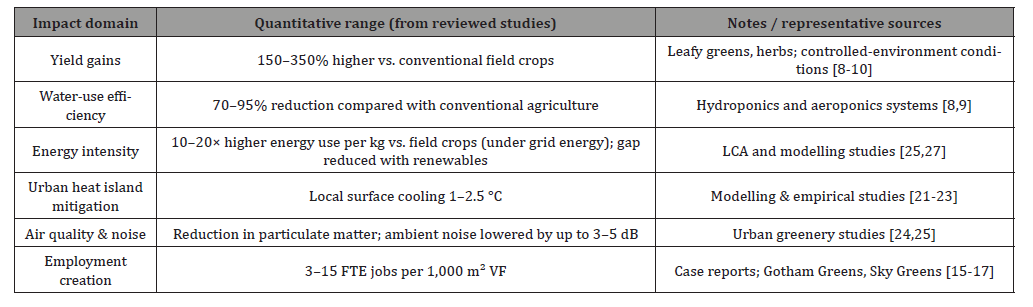
Table 2 synthesizes key quantitative findings reported across the reviewed studies. While methodologies and contexts varied widely, several common patterns emerged. Reported yield gains from vertical farming systems ranged from 150% to over 350% compared with conventional open-field agriculture, with leafy greens and herbs showing the highest productivity increases. Water-use reductions were consistently reported in the range of 70–95%, largely attributable to hydroponic and aeroponic systems. Life-cycle assessments indicated that energy use remains a major limiting factor, with estimates ranging from 10–20 times higher per kilogram of produce than field production under conventional grid conditions, although integration with renewable energy sources reduced this gap substantially. For urban climate impacts, modelling studies suggested that vertical greenery and farming installations could lower locally surface temperatures by 1–2.5 °C, with additional co-benefits for air quality and noise attenuation. Socio-economic outcomes were less frequently quantified, but selected studies reported job creation ranging from 3 to 15 fulltime positions per 1,000 m² of operational VF area, along with measurable improvements in self-reported community well-being indicators such as stress reduction and social cohesion. Key findings are summarised in Table 2.
Table 2: Summary of key quantitative evidence on vertical farming impacts (2010–2025).
Technological Foundations of Vertical Farming Systems
The viability of VF is underpinned by advanced technologies that enable the precise control of the growing environment. These systems are designed to maximize efficiency and productivity in a confined space.
Core Cultivation Systems
VF primarily relies on three soilless cultivation systems:
Hydroponics
This method involves growing plants in a nutrient-rich aqueous solution, bypassing the need for soil. Techniques such as the Nutrient Film Technique (NFT) and Deep Water Culture (DWC) allow for precise delivery of water and nutrients, leading to significant water savings—up to 95% less than conventional agriculture—and higher yields [5,8].
Aeroponics
In aeroponic systems, plant roots are suspended in the air and periodically misted with a nutrient solution. This method provides optimal oxygen access to the roots, often resulting in faster growth rates and even greater water-use efficiency than hydroponics [9,10].
Aquaponics
This integrated system combines aquaculture (fish farming) with hydroponics. Fish waste provides an organic nutrient source for the plants, which in turn purify the water for the fish. Aquaponics represents a closed-loop, symbiotic ecosystem that produces both protein and vegetables [11,12].
Enabling Technologies
LED Lighting
Light-emitting diodes (LEDs) are the standard for VF due to their energy efficiency, low heat output, and spectral tunability. Customizing light spectra can optimize plant growth, morphology, and nutritional content [13].
Climate Control & Automation
Sophisticated systems manage temperature, humidity, and CO₂ levels. Automation is extensively used for seeding, monitoring, irrigation, and harvesting, reducing labor costs and enhancing operational consistency and control [14,15].
Vertical Farming’s Contribution to Urban Food System Resilience
Urban food systems are often characterized by complex, lengthy supply chains that can be vulnerable to disruptions and contribute to food deserts.
Enhancing Local Food Production and Supply Chains
VF directly addresses the “food miles” problem by situating production within the urban fabric. Case studies from initiatives like Gotham Greens (USA) and Sky Greens (Singapore) demonstrate the successful integration of VF into urban supply chains, providing hyper-local, fresh produce that minimizes transportation time, cost, and associated emissions [16,17]. This localization enhances supply chain resilience by reducing dependence on distant sources and mitigating risks from external shocks [18,19].
Impact on Food Quality, Safety, and Nutritional Outcomes
The controlled, closed-loop environment of VF offers distinct advantages for food quality and safety. By minimizing exposure to pests and pathogens, the need for pesticides is drastically reduced, leading to safer produce [5,6]. Furthermore, the ability to harvest and distribute produce within hours preserves freshness and nutrient density. Studies suggest that the precise control over nutrient delivery and light spectra can even enhance the concentration of certain vitamins and antioxidants in crops [13,20].
The Environmental Co-Benefits: Mitigating the Urban Heat Island Effect
The UHI effect is exacerbated by the prevalence of heatabsorbing materials (e.g., concrete, asphalt) and a lack of vegetation in cities [2].
Mechanisms for UHI Mitigation
VF can counteract the UHI effect through several biophysical
mechanisms:
a. Evapotranspiration: Plants naturally cool their
surroundings by releasing water vapor, a process that consumes
ambient heat energy. Integrating VF into buildings increases the
total leaf area and evapotranspirative surface in a city [3,12].
b. Shading: Vertical farms, particularly in the form of green
walls or facades, provide direct shading to building envelopes,
reducing solar heat gain and lowering surface temperatures.
Studies on green walls have shown surface temperature
reductions compared to conventional walls [21].
c. Substitution of Heat-Absorbing Materials: VF installations
directly replace heat-absorbing building materials with living
vegetation, altering the urban energy balance [22].
Quantified Cooling Effects and Additional Benefits
Modelling studies indicate that widespread implementation of urban greenery, including VF, could reduce city-wide average temperatures [22,23]. The UHI effect is a significant phenomenon across global cities, and integrating green infrastructure is a key mitigation strategy [24]. Beyond UHI mitigation, this increased vegetation cover improves urban air quality by sequestering pollutants, reduces noise levels, and can enhance urban biodiversity [6,25].
Socio-Psychological and Economic Impacts on Community Well-Being
The benefits of VF extend beyond the biophysical to significantly influence the social and economic fabric of urban communities.
Enhancing Psychological and Social Well-Being
Access to green space is strongly linked to improved mental health. VF installations can serve as accessible green oases, reducing stress and improving mood among urban residents [25,26]. Furthermore, they can function as community hubs, fostering social interaction and cohesion through educational workshops, tours, and participatory community gardening programs [12,26]. These spaces provide valuable opportunities for urban citizens to reconnect with food production and learn about sustainability and nutrition.
Economic Development and Job Creation
VF operations create local employment opportunities in fields such as system maintenance, agronomy, data analysis, and marketing [15,27]. They also foster entrepreneurship and innovation in the agri-tech sector. While the capital costs are high, the model supports local economic circularity and can even become a point of interest for urban tourism, further stimulating local economies [25].
Comparative positioning within the urban agriculture spectrum
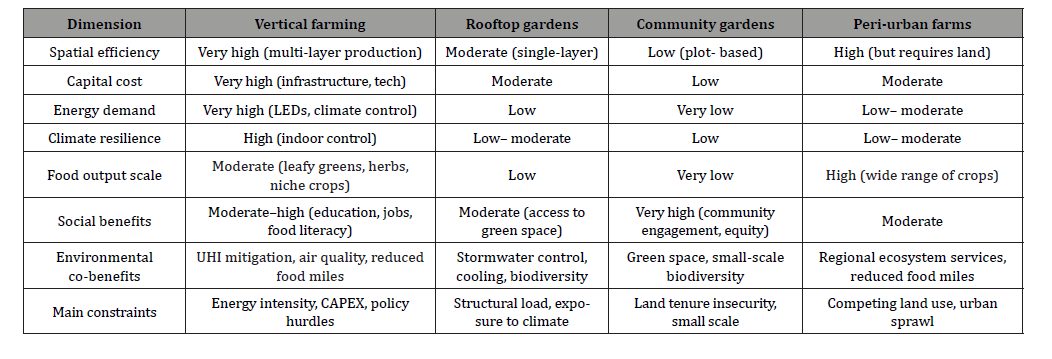
Vertical farming represents only one node within a diverse constellation of urban agriculture strategies. To contextualize its potential and limitations, it is instructive to compare VF with other approaches such as rooftop gardens, community gardens, and periurban farms (Table 3). Rooftop gardens typically require lower initial capital investment than VF and can contribute meaningfully to stormwater management, local cooling, and biodiversity. However, they are constrained by structural load limits and climatic exposure, which limit year-round productivity. Community gardens play an important role in enhancing food literacy, social cohesion, and equitable access to green space. They are low-cost and socially inclusive, but their contribution to urban food security at scale is modest, and they are vulnerable to land-use competition. Periurban farms, located at the urban fringe, can produce at larger scales with lower energy inputs than VF, while still supplying nearby cities with relatively short food miles. Yet they remain exposed to climatic variability, competing land uses, and sprawl pressures. Against these alternatives, vertical farming offers unmatched spatial efficiency and year-round control, but at the cost of high energy intensity and capital requirements. Its distinctive contribution therefore lies less in substituting for traditional agriculture and more in complementing other urban food strategies by providing resilient, hyper- local supply of fresh produce in dense cores where other options are infeasible.
Table 3: Comparative positioning of vertical farming and other urban agriculture forms.
Challenges, Limitations, and Research Gaps
Despite its promise, the widespread adoption of VF is hindered by significant challenges that must be acknowledged and addressed.
Economic and Logistical Hurdles
The primary barrier is the high capital expenditure (CAPEX) required for infrastructure and technology, coupled with substantial operational expenditures (OPEX), particularly for electricity to power LED lighting and climate control systems [15,27]. Achieving economic competitiveness with traditional agriculture and even large-scale greenhouses remains a challenge for many crops.
Technical and Sustainability Challenges
The energy intensity of VF raises concerns about its overall environmental footprint, which is highly dependent on the carbon intensity of the local energy grid [13]. While water is used efficiently, the lifecycle environmental impact, especially from energy and material use, requires further optimization through renewable energy integration and circular economy principles.
Regulatory and Policy Hurdles
A clear regulatory framework for VF is often absent. Ambiguities in zoning laws, building codes, and food safety certifications specific to VF products can impede development [15]. A critical research gap exists in analyzing the specific policy mechanisms—such as tax incentives, grants, or inclusion in urban planning mandates— that could most effectively promote sustainable VF integration [18].
Limitations of this Review
This review is subject to several limitations that should be acknowledged. First, although a systematic search strategy was employed, the scope was restricted to peer- reviewed Englishlanguage publications from 2010–2025, which may have excluded relevant studies published in other languages or grey literature. Second, the quality assessment was conducted primarily by a single reviewer, which introduces the possibility of subjective bias in scoring despite the use of a structured checklist. Third, while many included studies provided valuable insights, the evidence base is dominated by modelling analyses, single-site pilot projects, and LCAs with incomplete boundary reporting, which limits the generalizability of findings across diverse urban contexts. Furthermore, several key studies on economic and social impacts relied on small sample sizes or descriptive case reports, reducing the robustness of conclusions in these domains. Finally, the rapid evolution of vertical farming technologies means that some of the technical and economic findings reported here may become outdated quickly. These limitations highlight the need for ongoing, multi-reviewer syntheses and more rigorous, large-scale empirical research to strengthen the evidence base on vertical farming. As detailed in Appendix Table A1, most studies scored in the moderate quality band, reflecting common methodological weaknesses.
Future Directions and Recommendations
To overcome existing barriers and unlock the full potential of VF, a multi-stakeholder approach is essential.
a. Technological Innovation: Future research should focus on
developing more energy-efficient LEDs, integrating renewable
energy sources (e.g., solar, geothermal), and employing AI and
IoT for predictive, resource-optimizing control systems [10,13].
b. Policy Integration: Governments and urban authorities
must develop supportive policies. This includes creating clear
zoning classifications for VF, offering financial incentives for
sustainable practices, and incorporating VF into smart city and
climate action plans.
c. Community-Centric Models: Promoting communitysupported
agriculture (CSA) models for VF and designing
projects with public engagement as a core component can
foster a sense of ownership and ensure the social benefits are
fully realized [25,26].
d. Holistic Life-Cycle Assessment (LCA): Further research is
needed to conduct comprehensive LCAs of diverse VF systems
and crop types to provide a robust, evidence-based comparison
with other agricultural methods and guide sustainability
improvements.
Conclusion
Taken together, this review demonstrates that vertical farming should not be viewed as a singular solution to urban food system challenges, but rather as a complementary strategy within a broader spectrum of urban agriculture practices. While VF offers unique advantages in spatial efficiency, climate resilience, and hyper-local food provision, it is best positioned to operate alongside rooftop gardens, community gardens, and peri-urban farms, each of which contributes distinct social, environmental, and economic benefits. The long-term sustainability of urban food systems will therefore depend on integrated, multi-layered approaches that combine these modalities, tailored to local conditions and policy frameworks. By situating VF within this larger ecosystem of strategies, policymakers and urban planners can avoid technological lock-in and instead design adaptive, resilient, and socially inclusive urban agriculture systems for the cities of the future.
Declarations
Competing Interests
The author declares no competing interests, financial or otherwise, related to this work.
Data Availability
Not applicable.
Ethics Approval
Not applicable. This research did not involve human or animal subjects.
Funding
This research received no specific grant from any funding agency in the public, commercial, or not-for-profit sectors.
Acknowledgments
The author utilized generative AI tools (ChatGPT by OpenAI and Claude by Anthropic) for the purpose of proofreading, improving language clarity, and correcting grammatical errors in this manuscript.
References
- Vlahov D, Agarwal SR, Buckley RM, Caiaffa WT, Corvalan CF, et al. (2011) Roundtable on Urban Living Environment Research (RULER). Journal of Urban Health 88(5): 793–857.
- Price A, Jones EC, Jefferson F (2015) Vertical Greenery Systems as a Strategy in Urban Heat Island Mitigation. Water, Air, & Soil Pollution 226(8): 247.
- Thomaier S, Specht K, Henckel D, Dierich A, Siebert R, et al. (2015) Farming in and on urban buildings: Present practice and specific novelties of Zero-Acreage Farming (ZFarming). Renewable Agriculture and Food Systems 30(1): 43–54.
- Despommier D (2011) The vertical farm: controlled environment agriculture carried out in tall buildings would create greater food safety and security for large urban populations. Journal für Verbraucherschutz und Lebensmittelsicherheit 6(2): 233–236.
- Panotra A, Chandel V, Sharma R (2024) Vertical farming: Addressing the challenges of 21st century agriculture through innovation. International Journal of Environment and Climate Change 14(4): 664–691.
- Benke K, Tomkins B (2017) Future food-production systems: Vertical farming and controlled-environment agriculture. Sustainability: Science, Practice and Policy 13(1): 13–26.
- Al Chalabi M (2015) Vertical farming: Skyscraper sustainability? Sustainable Cities and Society 18: 74–77.
- Lubna FA, Lewus DC, Shelford TJ, Both AJ (2022) What you may not realize about vertical farming. Horticulturae 8(4): 322.
- Melyan GH, Martirosyan YT, Sahakyan AJ, Sayadyan HY, Melikyan AS, et al. (2025) Influence of Nutrient Medium Components on In Vitro Tuberization of Solanum tuberosum L. and Subsequent Minituber Production in Aeroponic and Greenhouse Conditions. Life 15(2): 241.
- Kaiser E (2024) Vertical farming goes dynamic: optimizing resource use in vertical farming systems. Frontiers in Science 2: 1411259.
- Debroy P, Majumder P, Majumdar P, Das A, Seban L (2025) Analysis of opportunities and challenges of smart aquaponic system: a summary of research trends and future research avenues. Sustainable Environment Research 35(1): 16.
- Pereira J, Gomes MG (2024) Lighting strategies in vertical urban farming for enhancement of plant productivity and energy consumption. Applied Energy 377(12): 124669.
- Bunge AC, D Odorico P, Davis KF, Marani M, Seekell DA (2022) A systematic scoping review of the sustainability of vertical farming and related food-system technologies. Nature Food 3(11): 945–950.
- van Delden SH, Sharath Kumar M, Butturini M, Graamans LJA, Heuvelink E, et al. (2021) Current status and future challenges in implementing and upscaling vertical farming systems. Nature Food 2(12): 944–956.
- Taranshansky A (2023, December 20) Gotham Greens is redefining what’s possible in the food system by prioritizing people and planet. Plant Based Foods Association. https://plantbasedfoods.org/latest/gotham-greens-is-redefining- whats-possible-in-the-food-system-by-prioritizing-people-and-planet/
- Wood J, Wong C, Paturi S (2020) Vertical farming: An assessment of Singapore City. eTropic: electronic journal of studies in the tropics 19(2): 266–284.
- Kluczkovski A, Hadley P, Yap C, Ehgartner U, Doherty B, et al. (2025) Urban vertical farming: innovation for food security and social impact? Philosophical Transactions of the Royal Society B: Biological Sciences 380(1935): 20240154.
- Hosseini H, Mozafari V, Roosta HR, Shirani H, Van De Vlasakker PCH, et al. (2021) Nutrient use in vertical farming: Optimal electrical conductivity of nutrient solution for growth of lettuce and basil in hydroponiccultivation. Horticulturae 7(9): 283.
- Radujković M, Versele A, Breesch H (2024) Exploratory Analysis of a Novel Modular Green Wall’s Impact on Indoor Temperature and Energy Consumption in Residential Buildings: A Case Study from Belgium. Energies 17(21): 5267.
- Garcia Lozano C, Peliova A, Sitjar J (2021) How do green areas influence the temperature of cities? Web map to help local decision making about cities and the climate emergency. AGILE GIScience Series 2: 27.
- Yu D (2018) A two-step approach to forecasting city-wide building energy demand. Energy and Buildings 160: 1–9.
- Peng S, Piao S, Ciais P, Friedlingstein P, Ottle C, et al. (2011) Surface Urban Heat Island across 419 global big cities. Environmental Science & Technology 46(2): 696–703.
- Al Kodmany K (2018) The vertical farm: A review of developments and implications for the vertical city. Buildings 8(2): 24.
- Dovganeva YA (2024) The ecosystem of vertical farms: A conceptual framework. Food Systems, 6(4): 504–511.
- Martin M, Elnour M, Siñol AC (2023) Environmental life cycle assessment of a large-scale commercial vertical farm. Sustainable Production and Consumption 40: 182–193.
- Moncada G, Dantas T (2025) Vertical farming limitations and potential demonstrated by back-of-the-envelope calculations. Plant Physiology 198(3): kiaf056.
- Martin M (2024) Environmental life cycle assessment of an on-site modular vertical farm producing lettuce and basil. Frontiers in Sustainable Food Systems 8: 1403580.
-

This work is licensed under a Creative Commons Attribution-NonCommercial 4.0 International License.