
 Research article
The Hydrozoic Theory of Conscious Perception in Sociohydrology
Received Date: September 05, 2025; Published Date: September 16, 2025
Abstract
Water is the most common molecule in the human body and it is involved in most metabolic functions. Water is a universal solvent and it facilitates many biochemical reactions due to its hydrolytic properties. It contributes to somatic stability and physiological functions via its complex qualities. Water supports the molecular structure of a neuronal network, maintains brain plasticity and improves memory. In all its properties, the bipolar water molecule is unique. The hydrozoic theory provides a hypothesis on how primordial forms of memory and awareness emerged already in the early stages of evolution. Membranes composed of phospholipid bilayers and adhesive water molecules exhibit liquid crystalline properties that combine directional dependence with the mobility of the fluid mosaic model. Hypothetically, magnetic fields in the liquid crystalline construct of cell membranes and adhesive water can store and quickly release energy. There is a fundamental link between water and conscious experience.
Keywords: Awareness; Cell membrane; Consciousness; Magnetic fields; Marine hydrobiology; Memory; Perception; Socio-hydrology
Introduction
The ability to respond adequately to external influences is a basic prerequisite for survival. Perception of stimuli is essential for finding food, detecting potential enemies in a timely manner, and to adapt to changing environmental conditions. In addition to stimulus recognition and processing, this also requires recall from a quickly retrievable memory. Democritus (Greek philosopher, 460- 370 BC) already taught that sensory perception and thinking occur when images from outside approach us. But he also said: “Essentially, we perceive nothing; for the truth lies in great depth” [1]. In the ancient perspective, characteristic features of a primary impression of an event are stored as a memory, and when remembered, the original impression can be read from this memory image. However, effective remembering requires a system in which categories and associations facilitate retrieval. Memories are not static. Repeated retrieval leads to rearranging and intensifying of memory content. According to Wittgenstein, memory is already an aspect of present consciousness [2].
Viewing consciousness as a phenomenon then the properties of consciousness range from simple responsiveness to complex perception and from individual thoughts to social awareness. This involves the basic question “How to survive?” from an existential philosophical point of view as well as the question of principle “Who am I?” from a social-philosophical point of view. A fundamental problem for understanding consciousness is that consciousness is the basic prerequisite for understanding consciousness. Since perception and consciousness are shaped by the same brain, there is an overlap in function. Perception influences consciousness, and consciousness influences perception. Conscious perception is created from current sensory perception and recalled experienced reality [3]. The definition of consciousness is adapted very close to human consciousness therefore other forms of awareness that can be observed in all living beings are usually ignored. Hypothetically, basic awareness and the ability to remember emerged before the development of cells.
For Thales of Miletus (ancient Greek philosopher, 624-547 BC), the founder of a purely rational science, the origin of all things can be reduced to water as the one primary substance. According to his doctrine water is the origin of everything [1]. The interactions of evolution and water are complex and the diverse dependencies of developing life on water represent the concept of a common socio- hydrological development [4]. This joint development already encompasses the emergences of life and conscious being on this planet. To my understanding a phenomenological interpretation of the early development of awareness seems more appropriate than an analytical investigation. If life originated in the marine environment, then consciousness also originated in the marine environment. The hydrozoic theory presented in this paper, emphasizes the role of water in living nature regarding storage, retrieval and reprocessing of information as a fundamental concept of memory and consciousness.
Discussion
Biologic phylogenetics [derived from the ancient Greek words phylon (φῦλον) that means trunk, and genetikós (γενετικός) that means origin] provides a theory of descent. In this theory memory is considered primarily as a neuronal process and consciousness is restricted to highly developed living beings. It is assumed that consciousness emerged from an initial network with central nervous elements [5]. In this hypothetical concept of storage, consolidation, and retrieval of information, neither memory nor the neuronal network are static as memories change and fade over time and synapses are constantly being rebuilt. From a different perspective, I would like to highlight the potential role of a phospholipid bilayer and adherent water in the emergence of perception and awareness. In this essay the importance of the intercellular space as an essential facility of cell function, is accentuated.
Primary awareness and perception
The imagery of basic conception preceded rational consideration. One of the great achievements of Darwin and his forerunners was to free empiric observations somewhat from the stranglehold of transcendent judgement and random speculation. Unfortunately, even in rational and soberly reasoned science, doctrines may become vehemently defended matters of faith. While divine justification renders any questioning superfluous or even prohibits it, a speculative justification using the word “chance” is nothing more than a euphemism for “We don’t know”. Random doesn’t mean inherently unpredictable, but only unpredictable for us. Something not being recognized does not mean that this particular something does not exist. The assertion of the non-existence of a conceivable can’t be proved. This has already been argued by Parmenides from Elea (ancient Greek philosopher, 515-450 BC) who clearly stated: “But where there is no being, there is non-being, which does not exist - nothing is not” [1].
Hypothetically, the formation of water from the two elements oxygen and hydrogen was not really random, since both elements are very common on the earth. The probability that these two elements would react with each other was high from the very beginning and water did not come about by chance [6]. Of crucial importance was the adequate temperature depending on the distance from the sun that allowed water to be preserved in different states of aggregation. The ongoing process of creating new components and their subsequent dissolution was not random either, but rather dependent on the composition and quantity of available elements. The more stable these new structures were, the more lasting their existence and influence were on new compounds. From an analytical point of view, the miracle of creation consists of many small events that evolved over an incredibly long period of time. The spontaneous formation of amino acids under the conditions of the early Earth (Miller-Urey-experiment) was a prerequisite for the development of proteins [7]. When amino acids were linked to long polypeptides via peptide bonds, specific three-dimensional structures were created through folding. This gave rise to the principle of basic protein biosynthesis. Fatty acids also formed from carbon and hydrogen in the energetic environment of this primordial soup. Presumably, compounds of proteins and fatty acids were sufficiently stable to serve as common building blocks for complex structures. Eventually, cell membranes were formed as an intermediate product of numerous reactions on the primordial Earth.
Phospholipids are complex lipids that contain an ester bond with phosphoric acid. Due to their dipolar structure (one polar, hydrophilic ending and one ending with two non-polar hydrophobic hydrocarbon chains) they spontaneously assemble into bilayers in aqueous solutions, forming membranes. The fluid mosaic model of such a bilayer of phospholipids provides two outer surfaces with polar and hydrophilic properties, to which water could adhere. Lyotropic liquid crystal phases are known to be suitable for storing energy. The sensitivity of liquid crystals to electromagnetic fields and the ability to maintain their polarization makes them useful for information storage. The capacity of liquid crystals in optical data storage has been reported indicating a memory effect [8]. Hypothetically, the liquid crystal-like structure of a phospholipid bilayer and adhesive water can serve as the substrate for organic awareness. This is the principle of the hydrozoic theory [a retronym term derived from the ancient Greek words hýdor (ὕδωρ) that means water, and zōe (ζωή) that means life].
The hydrozoic theory
The hydrozoic theory is based on the diverse and unique properties of water in the electromagnetic field. A water molecule consists of one atom of oxygen and two atoms of hydrogen. The primary bonds between oxygen and hydrogen atoms are covalent bonds. Water molecules are bipolar, with a partial negative charge on the oxygen atom and partial positive charges on the hydrogen atoms. Due to differences in electronegativity between oxygen and hydrogen atoms, these partial charges allow water molecules to attract each other in a limited way. Water molecules are arranged in an organized pattern. The slightly positive hydrogen of one water molecule is attracted to the slightly negative oxygen of the neighbouring water molecule, forming a hydrogen bond. These hydrogen bonds are weaker than the covalent bonds within the water molecule itself and can be altered by dissolved substances. Shockingly, water in a quantum tunnelling state can break the hydrogen bonds and exhibit quantum motion trough normally impenetrable walls and energy barriers [9].
The given distribution of charges on the water molecule also affects the spatial alignment of the ligands. It limits the possibilities of arrangement (position) and the axial alignment (orientation) and it determines the physical and chemical properties. Through adhesion of water to a phospholipid bilayer, kind of a liquid-crystalline state of order is formed, comparable to the hypothetical fourth state of matter [10]. The arrangement of charged elements within the liquid-crystalline structure creates an electric field (E). Changes in the electric field act as a current and create a magnetic field (B). The quantity of magnetic field lines passing through a given area is determined as magnetic flux (Φ). The time interval (dt) of the changing electric field correlates to the flow of the magnetic field lines in the magnetic field (1).

A changing magnetic flux can induce an electromotive force (EMF) that causes current to flow. When applying Faraday’s law of induction, the EMF is proportional to the change of magnetic flux (Φ) with respect to time (dt). The magnetic flux can be altered either by changes in the magnetic field (B), changes in the transverse section area (A), or in the deviation of the angle cos θ between B and the normal vector to A [11]. From this it follows that EMF referred to an induced voltage (U) is related to the changing magnetic flux (2).

According to the hydrozoic theory, memory arises from induction of a magnetic field within a liquid crystal composed of phospholipid bilayers and adherent water. When external mechanical energy is leading to stretching or contracting of phospholipid bilayers with adhesive water molecules, the electric field changes and creates a magnetic field that induces voltage and a short-lived current (Figure 1). Thus, mechanical energy acting on phospholipid bilayers can be converted into electrical energy.
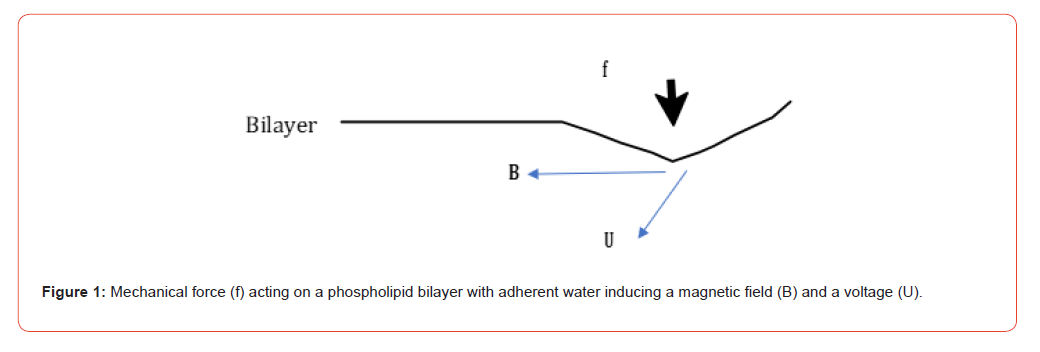
If a series of identical stimuli act on the membrane, more voltage is induced, and the resulting electrical current flow lasts longer. From a biophysical point of view, phospholipid bilayers surrounded by adhesive water molecules function like a solenoid made of multiple loops. Any coil-like structure is equivalent to an inductor that can generate a static magnetic field inside and around. Such a biologic inductor can store energy in the magnetic field and quickly release it. Since it is assumed that identical stimuli create similar patterns in the liquid crystal, a pattern corresponds to a specific image of perception. Due to the self-induction of a delayed and short-lived current in the solenoid the perceived image is followed by an afterimage, that lasts for a few seconds. The afterimage corresponds to the eidetic image (image of a previously perceived stimulus). That means, the image of the original event is split into two temporally separated images. The afterimage exists only in time. It creates a separate entity, kind of a memory for a few seconds, which corresponds to an awareness for a few seconds. The delay in time (dt) is seen as the ratio of self-inductance (L) to resistance (R) (3). According to Lenz’s law, the induced voltage is opposite in direction of the current [11].

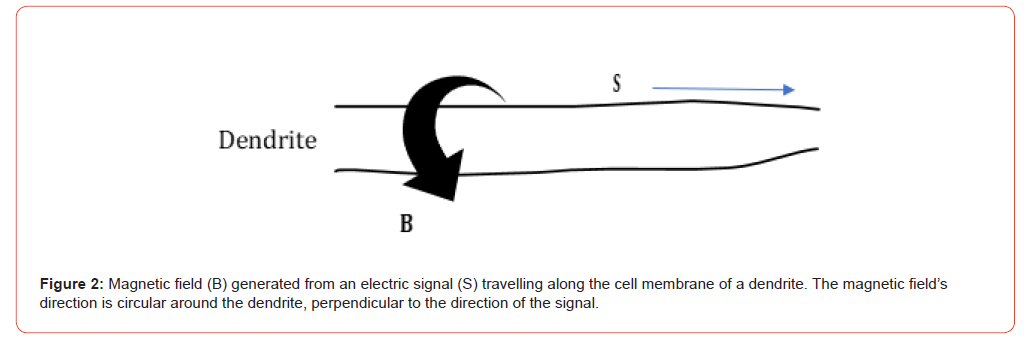
In the traditional microanatomical and histological perspectives, the cell membrane is often reduced to a boundary and the cell cleft is often viewed as an obstacle that must be overcome by adjacent cells. However, the hydrozoic theory emphasizes the special importance of the interstitial space, which, together with the cell membranes, forms a separate functional unit. In the vertebrate brain, interstitial water that adheres directly to the cell membranes surrounding non-insulated dendrites in the cortex, functions like a biologic solenoid that can generate an electromagnetic field inside and around the dendrite (Fig.2). In this setting the varying diameter in the interstitial space does not really affect the magnetic field. The dendrite acts as a waveguide. When the incoming electric signals propagate along the unmyelinated dendrites as electromagnetic waves, the changing magnetic field induces a voltage that is opposite in direction of the signal current.
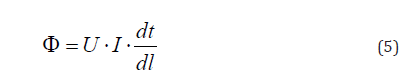
The voltage generated by induction is proportional to the rate of change of the current [11]. Taking into account Faraday’s law and Lenz’s law, the magnetic flux can be estimated (4):

Understanding R . I2 as performance (P) then the magnetic flux can also be seen as the product of voltage and current and the ratio of time interval to the change in current using Ohm’s law (5).
Memory and awareness are closely connected but recall is bound to space (location) while awareness is bound to time (present). Hypothetically, in humans, conscious perception emerges from the self-induction of current in the cell membranes and adherent water following signal transmission along the dendrite and concurrent changes in the electromagnetic fields.
Interstitial space and transmission
The development of the cell is considered undisputed model of evolutionary success. In single-celled organisms the outer boundary is formed by a semi-permeable cell membrane composed of a phospholipid bilayer with peripheral glycoproteins for defence, cholesterol molecules for stability, and integral proteins for transport. Cell membranes separate the inner cell plasma from the outer environment and prevent osmotically active particles from passing through. Due to uneven distribution of ions, different charge ratios can occur inside a cell than on the outside. In single-celled organisms a mechanic stimulus on the cell membranes can activate mechanically-gated ion channels. When ions pass the channels the electrochemical gradient declines and the polarity of the cell membrane changes temporarily [12]. Presumably, stimulus-induced polarity changes also enable faster responses to repeated, identical stimuli as part of basic stimulus processing in the cell membrane. In contrast to the precursing state of phospholipid bilayers and adhesive water, which can recognize stimuli but cannot react to them, single-celled organisms can react to stimuli. Simple stimulus-response loops can be already observed in the single-celled state of amoebae. Amoebae can respond to chemical signals, temperature, light, and tactile stimuli by moving away from the stimulus or changing their shape. In response to repeated stimuli even an avoiding behaviour can be induced.
Probably, the metabolism in the pre-cell state occurs through passive exchange due to the short diffusion distances. With increasing volume and relatively smaller outer surfaces, mechanisms of active resorption become necessary. In amoeba the detection of edible objects via pseudopodia already requires discriminative awareness of one’s self and the environment. This awareness allows to distinguish between “me”(cell membrane) and “not me” (environment) [3]. With the emergence of an individual “me”, passive reaction to stimuli transitions to active influence and shaping. The separation of an individual “me” also creates the finiteness of the individual “me”. From this it follows that the experienced death of the individual becomes detached from the timeless coexistence of an all-encompassing whole. Furthermore, the “me” related will to survive is linked to a conscious mind early on, as a chimera of strong desire and irrepressible compulsion. Individual survival in wilderness would not be possible without the strong will to live, which is counterbalanced by the will to die [13]. The ability to choose between two opposites within a limited range of perception and response options, is based on the dual principle of consciousness [3]. In humans it may be referred to as “free will” but the will is always bound to the self.
Two closely spaced cells have the ability to better detect and respond to stimuli. When more cells join together to form a cell cluster, a new structure is created, namely the interstitial space. Thus, cell membranes and fluid in the interstitial space create an additional compartment. Just as the cell membrane encloses the entire single-cell organism, the interstitial space encloses each individual cell in the cell cluster. This space is filled primarily with water and electrolytes and it connects all cells within the cluster. Stimulus detection occurs via the outer surface of the cell cluster, which is now restricted to the superficial sections of the cell membranes of the outermost cells. Certain proteins in the cell membrane specialize as receptors and allow for even more precise and rapid responses to stimuli. However, a cell cluster also requires coordinated control for a joint response of all cells. The interstitial space, as a three-dimensional structure between the cell membranes, creates a spatial connection between the cells. It therefore plays an important role in the coordination of cellular functions. The functional unit of outer and inner cell membranes along the interstitial spaces enables improved stimulus detection and coordinated response.
In even larger cell clusters, the ratio of shared outer surface to combined volume declines. The need for a higher-level centre for stimulus processing and coordinated response also requires good signal transmission, from the outer surface to the interior. In arthropods specific ganglion cells are arranged segmentally in pairs of ganglia, interlinked by longitudinal connections to neighbouring segments and coordinated by cerebral ganglions. This represents the principle of the rope ladder nervous system which is an early edition of a complex nervous system [14]. The superior internal reaction centre, composed of cells that concentrate on processing, is only indirectly in contact with the outside world. Thus, with increasing speed and precision of signal processing, the experienced reality becomes more and more a constructed reality. In highly developed organisms with a central digestive tract, stimulus detection occurs not only via the outer surface of the skin but also via the inner membranous surface made of the digestive tract. Individual cells specialize in receptor function and combine to form sensory units. Physical stimulus energy that reaches the body as an electromagnetic wave (e.g. light, heat), a compression wave (e.g. sound), or mechanically (e.g. touch) is transformed into electrical impulses through chemical reactions. These impulses can be modulated and transmitted to the central processing unit by particularly conductive cells. In the vertebrate nervous system ganglion cells play an important role in the modulation and transmission of signals and in the processing and interconnection of the spinal ganglia and the nuclei [15]. There are more ganglion cells in the human intestine than in the central nervous system. The ganglion cells are arranged in three submucosal nerve plexuses (Meissner, Auerbach, Shabadash) and form the bulk of the enteric nervous system, which functions largely independently of the central nervous system. With the constant increase in information, outsourcing of autonomous processes from awareness became increasingly important. While automated reactions are controlled by the autonomic nervous system and occur unconsciously, voluntary reactions are accompanied more or less consciously by the somatic nervous system.
Conscious experience and imagination
Signal processing in the brain takes place in specific neuronal cells, shielded from the external environment. Most vertebrates with a central nervous system have a bony-protected brain that no longer has direct access to stimuli. Wittgenstein commented: “One of the most philosophically dangerous ideas is, strangely enough, that we think with our heads, or in our heads. The idea of thinking as a process in the head, in an almost completely enclosed space, gives it something occult” [16]. In the vertebrate brain, the neuronal cells in the cortex, primarily pyramidal cells with their dendritic ramifications, play the key role in processing. Neuronal cells perform computations. In his pioneering work Kees Wiersma could show that individual nerve cells are recognizable and functionally important and have “personalities” of their own [17].
The apical dendrite which extends from the tip of a pyramidal cell into the outer layers of the cerebral cortex, receives specific afferent impulses from the sensory organs and nonspecific afferent impulses from the ascending reticular activation system (ARAS) via stellate cells [18]. The dendrites occur in bipolar and multipolar nerve cells and greatly increase the surface area and the interstitial space. Unlike the axon, dendrites also contain cell organelles and are unmyelinated. A flow of energy can create an oscillating electric field and a magnetic field perpendicular to it. As presented in the hydrozoic theory incoming impulses travelling down the dendrite change the surrounding circular electromagnetic field and induce voltages (Figure 2). These rhythmic electrical voltage fluctuations in the cortex correlate with the level of alertness and attention [15]. During evolution there was an ongoing improvement in the speed and capacity of memory. From simple awareness tied to an afterimage as presented in the hydrozoic theory, a more and more independent consciousness developed, which learned to recall and link abstract patterns to an imagination even in the absence of external stimuli. This also necessitated that intermediate primary afterimages had to be transferred into lasting secondary afterimages and stored in the neuronal network. In the human brain primary images are processed, categorized, verbalized and linked to an association that finally forms a specific pattern. The highly developed nervous system enables rapid signal processing and provides enormous storage capacities of perceptual, conceptual, and semantic memory [15]. In a declarative memory, verbalization results in a strengthening and contrasting of content [15]. Memory content is divided and stored in different brain regions of which the hippocampus (short-term functional memory) and the cortex (long-term structural memory) have the key functions.
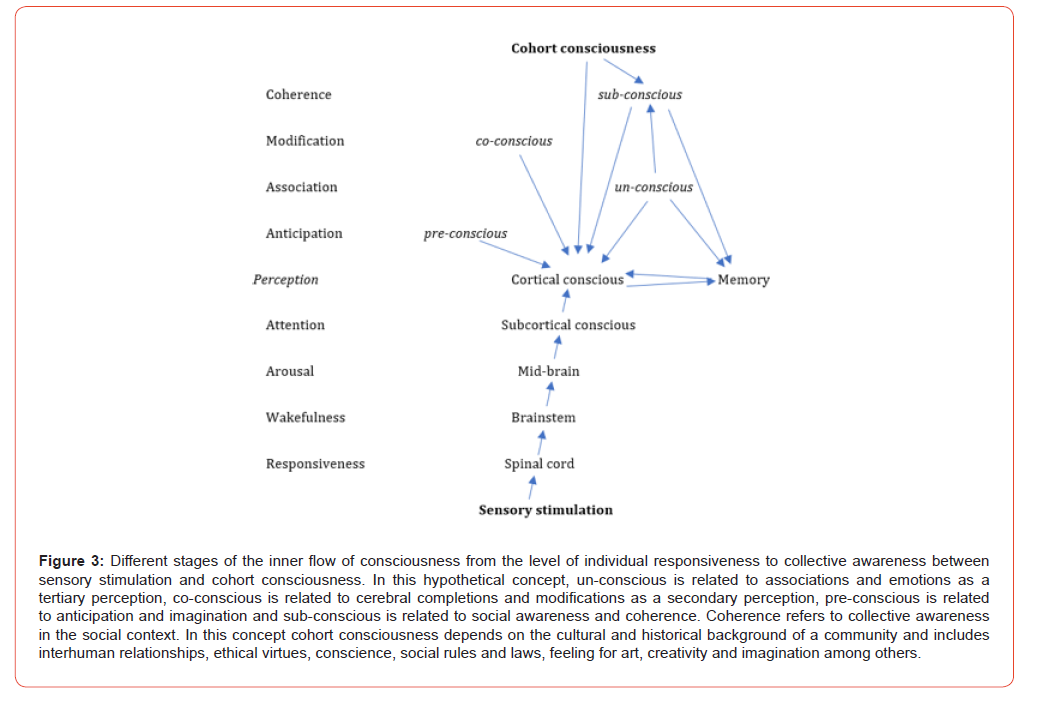
Consciousness of varying intensity occurs at different levels of the nervous system (Figure 3). While disturbances in the pathways between spinal and cortical regions are classified as neurological disorders, limitations affecting anticipations, associations, modifications, and coherence (social awareness) are classified as psychiatric and psychological disorders. The spinal cord not only plays a crucial role in relaying information to and from the brain it also has direct effects on awareness and responsiveness [15]. Impairment at the cervical spinal region may cause prolonged disorders of consciousness (pDOC). The brainstem plays an important role in basic states of consciousness such as wakefulness, arousal and attention regulated by the ARAS. Impairment at the brainstem region may cause a persistent vegetative state (PVS). Subcortical structures support and modulate dependent regions, and create functional integration to produce emotional and goal-directed behaviours that are crucial for affective consciousness. Disturbances in the cortical region impair conscious experience and when extended may present as Apallic syndrome. Impaired memory may be associated with dementia and Alzheimer’s disease.
With the ongoing increase in cognitive elements, further processing becomes necessary to enable the interplay of complex processes. This includes categorization according to urgency and linking to associations in order to act quickly and appropriately to the situation. Emotions are important associations, that influence thought processes, decision-making, motivation and behaviour. They are defined a complex reaction pattern, involving experiential, behavioural and physiological elements. Basic emotions include joy and sadness, anger and fear, surprise and disgust [19]. During individual life, more complex emotions can emerge such as hate, shame and guilt. Of all the associations, pain plays a special role. Pain has an unpleasant sensory component via nociceptors and an additional emotional component associated with actual or threatened tissue damage. Pain sensations may result from biologic, psychic and social factors. Pain is a good teacher and pain avoidance is a powerful motivator for learning. Cognition emerges from recognition of a specific pattern related to its opposite. Abstracting and categorizing also use the dual concept of fitting or not fitting to certain patterns. This dual concept of cerebral information processing is one explanation why emotions and thoughts often appear ambivalent [3].
Consciousness is a complex phenomenon. Every living being has kind of specific consciousness varying between the extremes of reactivity and highly developed social awareness (Figure 3). The cohort consciousness occurs between different members of a community. It can be somehow compared to the swarm intelligence of insects. The more developed communities, the more dependence of the individual occurs. The influence of cohort consciousness on the individual is considerable and occurs through familial and state education, school training, as well as through appeasement by power structures such as religion, military, police, and administrative authorities. In human society the primary means of influence is language. Verbalization of thoughts has a key function in cognition. Linguistic abstraction brings about an enormous expansion of the possibilities of conscious experience. In addition, language creates a platform for multilateral exchange of ideas, abstract thinking, and learning. Linguistic transmission of general knowledge may save painful learning from one’s own experience and can avoid fulminant mistakes. Verbal communication provides shared consciousness, leads to enormous expansion of knowledge content and enables creativity, imagination, and circumstantial understanding. Advanced verbal communication constructs social reality and creates identification. However, limits to cognition are set with regard to the content, intensity and extend of linguisticality. In his Tractatus logicophilosophicus Wittgenstein postulated: “The limits of my language are the limits of my world” [20]. From his perspective, language is not only a tool for communication and memory, but also a fundamental element of our understanding of the world. Language games and role-playing have a major influence on chosen focus areas of our conscious life and the way we approach them.
Conclusion
The hydrozoic theory strengthens the hypothesis that water played a crucial role in the emergence of perception and awareness during evolution. Furthermore, in vertebrates water considerably effects the information processing of interlinked somatodendritic compartments. According to this theory, self-induction of voltage from a changing magnetic field prepares the ground for the division of depiction and replication of an image, ultimately creating the phenomenon of memory. A simple discrimination in the dual principle between event and response can be considered a first rudimentary form of awareness. Storage of stimuli response patterns provided the chance to accumulate experience and to learn from it. In humans a highly developed nervous system determines the capacities of memory. Verbalization of thoughts significantly embossed cognition but the limits of language affect cognition and thus limit perception and consiousness.
Acknowledgement
None.
Conflict of Interest
No Conflict of Interest.
References
- H Diels, W Kranz (1951) The fragments of the Pre-Socratics [Die Fragmente der Vorsokratiker], Ed.: H Diels, W Kranz, 6th, Weidmann Zürich 1903-10. 17.
- L Wittgenstein (1969) The blue and brown books. Blackwell, Oxford.
- W Lederer (2025) Development of the Dual Concept of Perception in the Marine Environment – A Thought Experiment. Adv in Hydro & Meteorol 2(4): AHM.MS.ID.000542.
- M Sivapalan, HHG Savenije, G Blöschl (2012) Socio-hydrology: A new science of people and water. Hydrological Processes 26(8): 1270–1276.
- C Semple (2003) Phylogenetics. Oxford University Press, ISBN 0-19-850942-1.
- W Lederer (2025) The Hydro-Chronometric Measurement of Temporality in Natural Philosophy. Adv in Hydro & Meteorol.
- SL Miller, HC Urey (1959) Organic Compound Synthesis on the Primitive Earth. Science 130(3370): 245-251.
- Bobrovsky A, Shibaev V (2012) Polarised light-induced orientation and reorientation processes and unexpected ‘memory effect’ in side-chain azobenzene-containing LC polymers. Liquid Crystals 39(3): 339-345.
- AI Kolesnikov, GF Reiter, N Choudhury, TR Prisk, E Mamontov, et al. (2016) Quantum Tunneling of Water in Beryl: A New State of the Water Molecule. Phys Rev Lett 116(16): 167802.
- GH Pollack (2013) The Fourth Phase of Water beyond solid, liquid, and vapor. Ed.: Ebner & Sons Publishers Ebnerandsons.com, Seattle WA 98105, USA.
- KF Kuhn, F Noschese (2020) Basic Physics: A Self-Teaching Guide. Ed.: Jossey-Bass, Wiley pp. 978-11196229900.
- K Jacobson, OG Mouritsen, RGW Anderson (2007) Lipid rafts: At a crossroad between cell biology and physics. Nature Cell Biology 9(1): 7-14.
- S Freud (2000 [1920]). Beyond the Pleasure Principle [Jenseits des Lustprinzips]. In: S Freud Study Edition 3 Psychology of the Unconscious [Psychologie des Unbewußten], Fischer, Frankfurt a. Main, Germany.
- GE Budd, MJ Telford (2009) The origin and evolution of arthropods. Nature 457(12): 812-817.
- S Silbernagl, A Despopoulos (2018) Pocket Atlas of Physiology [Taschenatlas Physiology], Georg Thieme Verlag, Stuttgart, Germany.
- L Wittgenstein (2022 [1948]) Notes [Zettel]. transl. By D Paul and GEM Anscombe, 1st ed. GEM Anscombe and GH von Wright. In: Sammelband 8, Ed.: CH Beck, 13th ed., Suhrkamp Verlag Berlin, Germany pp. 273-281.
- G Hoyle (1977) Kees Wiersma: An Appreciation. In: Hoyle G (eds) Identified Neurons and Behavior of Arthropods. Springer, Boston, MA.
- G Stuart, N Spruston, M Hausser (2007) Dendrites. Oxford University Press; 2nd Revised edition ISBN 978-0-19-856656-4.
- P Ekman (1999) Basic Emotions. In: Handbook of Cognition and Emotion, Ed.: T Dalgleish & M Power. John Wiley & Sons Ltd.
- L Wittgenstein (1980 [1918]) Tractatus logico-philosophicus. Ed.: G Busch, 15th, edition suhrkamp 12, Frankfurt am Main, Germany.
-

This work is licensed under a Creative Commons Attribution-NonCommercial 4.0 International License.