
 Research article
The Hydro-Chronometric Measurement of Temporality in Natural Philosophy
Received Date: June 11, 2025; Published Date: July 16, 2025
Abstract
The formation of a global hydrosphere that occurred on the cooling earth presumably more than two billion years ago, became a fundamental precondition for the emergence of life as we know it today. Like hardly any other process, the water cycle between the geosphere and the atmosphere influenced animate and inanimate nature. Abrasive, dissolving, and absorbing effects of water serve as a good timekeeper that displays physical, chemical and biological hydro-chronometric processes. Thus, the impression of passing time on earth can be read from intervals between progressing physical events such as erosion of mountains as well as from periodically recurring events such as seasons and tides. Water also serves as a chronometer through assessment of the temporal progression of chemical reactions, e.g. aggregation and disaggregation, and the speed of solubility and crystallization. In addition to the electromagnetic energy of the sun, the varying levels of water during seasons and during tides operate a biological clock. Even the inner water cycle in the body and the relative change in water content of a creature during his life reflects a hydro-chronometric measurement of temporality. With the element of water, the fundamental aspects of the natural cycle between recurring origin and transience become aware.
Keywords: Consciousness; marine hydrobiology; perception, time; religious philosophies; socio-hydrology; space perception; water cycles
Introduction
There are many giant chronometers in the universe that indicate elapsing time. Time can be read from the continuous process of star decomposition, from the speed and return of planets and comets on regular orbits, and from the course of a solar eclipse, to name a few examples. Seeing absolute time as a phenomenon then measured time fragments (intervals) can be regarded relative time. This corresponds with classical mechanics founded by Isaac Newton. Newton distinguished relative space and relative time that we can measure from the phenomena absolute space and absolute time that appear without regard to whether events occur or not [1]. Strictly speaking, measuring time in the present means to distinguish, count and record regular intervals in a numerical order (chronological order).
Temporality is a measure of change within an infinite cosmic time. Since relative time depends on observable changes within matter, we have to go back to the hypothetical creation of matter when we want to trace back the onset of temporality. What did matter come from? What made something emerge from nothing, the given from the not given? Was it vigor, spirit, or just a roll of the divine dices? From his strict monist perspective to see the universe as an entity that was not generated, Parmenides from Elea (ancient Greek philosopher, 515 – 450 BC) would have sternly disapproved such questions. How can something emerge from nothing? [2]. Going back to the very beginning of universal existence seems contradictory since by definition, infinite means sine finitum, and that excludes a hypothetical beginning. An event that after a fixed start progresses ad infinitum is itself not infinite. The hypothetical nonend in the presumed course of the universe is based on the incompleteness of a preliminary hypothesis. In his philosophical remarks Wittgenstein specified: In geometry, infinite possibility is assumed, not infinite reality [3]. Wittgenstein further quoted: Infinity of time is not an extension [3]. He firmly refused a correlation such as “extensive infinity”. When determining the onset of the temporal emergence of a physical world, we have to extrapolate finite cosmic intervals within infinite cosmic dimensions. Imagination and interpretation of such intervals are difficult from a human perspective. We still lack a clear fundamental truth which serves as an axiom on which related theorems can be built reliably.
So far, the ultimate beginning of existence remains obscure. Instead of contradictory scientific speculations, we can just as well take philosophical considerations. In his first elementary theorem of the Tractatus logico-philosophicus Wittgenstein postulated: “The world is everything that is the case. The world is the totality of facts, not of things” [4]. In his second elementary theorem he specified: “What is the case, the fact, is the existence of facts of the case. A fact is a combination of things” [4]. If facts are understood as states of affairs, we can conclude that the combination of things is related to the ontology of existing objects and conditions. Human consciousness is not capable of perceiving all interactions, relationships and circumstances between objects. The imaginability of the physical world is quite limited. From this it follows:
Spatial perception
In a world of facts of the case, the spatial impression arises from the steric configuration of objects. Relative space is subject of stereoscopic extension and limitation. Optical perspective relativizes the dimensions depending on the distance between objects. The human observer is himself an object among objects. For the human perception it is neither possible to recognize the entirety of all objects, nor to capture all kinds of interrelations between existing objects. The regularity of spatial order confines the steric configuration of objects and the probability of events. In his philosophical remarks Wittgenstein determined: “Space is the realization of a law”, and elsewhere: “Infinity is a property of space” [3]. Space provides the configuration of objects; it is not a configuration.
Temporal perception
In a world of facts of the case, temporal events arise from interactions between objects. Thought logically, current events cannot be influenced retroactively by events that are to be. This impression allows to differentiate between early and late events, between the past and the present [5]. The probability of future events can be speculated from the regularities of observed and remembered events. Temporal perception requires the recognition of events and the recall of matched patterns from a highly-efficient memory. Intervals in experienced reality do not match intervals in physical reality. In experienced reality the pace of relative time depends on the totality of remembered events, while in physical reality the course of relative time depends on measured intervals of recorded events.
Conscious perception
As memory is a source of time our sentences are verified by the present [3]. Memory allows the past to exist in the present. Wittgenstein quoted: “Memory and reality must be in the same space” [3]. Although past events cannot be changed, what is remembered changes with each retrieval. Furthermore, imagination supplements the perception of the world creating an anticipated reality. It exceeds the reality that is created from our sensory impressions. Objects and interrelations between objects that cannot be realized, still can be imagined. Wittgenstein stated: “Imagination is directly related to reality” [3]. And elsewhere he wrote: “One can construct the not given from the given” [3]. Ultimately, conscious perception of reality arises from the fusion of sensory impressions from a physical world, of selectively re-casted memories from an abstracted world and of imaginations from an individually anticipated world, spanned in a virtual space under a virtually set time.
In his allegoric poems Parmenides from Elea put reason above perception [2]. He postulated: “Reality can only be grasped through a process of dialectical thinking. Being is a single unchanging reality. Change and multiplicity are merely illusions. Being is eternal and imperishable” [2]. In a more holistic understanding Khalil Gibran wrote in Sand and Foam: “I have neither past nor future. If I stay here, there is a going in my staying; and if I go, there is a staying in my walking. Only love and death change things” [6].
Discussion
Physical hydro-chronometric measurement
Thales of Miletus (ancient Greek philosopher, 624 -547 BC), recognized water as the origin of everything [2]. Water causes the characteristic appearance of our blue planet. There are essential interactions between living nature and the water cycle, with humans and their actions being part of its dynamics [7]. The hydrosphere [composed of the ancient Greek words hýdor (ὕδωρ) that means water, and sphaîra (σφαῖρα) that means globe] encompasses the total water content of the earth. Within the range of influence of the hydrosphere, dependent physical, chemical and biological events are also massively influenced. The numerous hydro-chronometric processes from abrasive, dissolving, and absorbing effects of water serve as a good timekeeper. Recalling regular recurrences from repeated measurements allows both, the retrospective interpretation of observations and forward-looking speculations. However, empirical comparisons among physical magnitudes reveal only approximate equality and different kinds of measurement scale convey different kinds of empirically significant information [8]. Furthermore, measured time and experienced time do not match.
In a hypothetical dichotomous model, there are two elementary forces from which all acting forces can be derived: a preceding tension and a concurrent tension reduction. In pursuit of balance between continuous acceleration and deceleration, various partial forces act in alternating sequences. This hypothesis complies to the imagination of Anaxagoras (ancient Greek philosopher, 499-428 BC), that from a given matter only the composition of components changes. After infinite transitions between mixing and separation, total matter will finally pass into the state of being totally mixed up. [9]. A previous disequilibrium (greatest order) gradually transforms into an equilibrium (greatest disorder) according to the principles of entropy. The higher the prevailing disorder in a system, the higher maximum freedom and entropy [10]. In this concept, the origin of life on earth is rather an aberrance which arose from imbalance. Accordingly, dissolution of the entire life must occur before the final equilibrium is reached. Or, to put it simply, individual life is resembling imbalance and death is resembling balance. In relation to the external physical world, the evolution of life is irrelevant. From a religious point of view, it seems strange, when God’s creation, with the earth as the center and man as the crowning achievement on top, is degraded to a mere accessory.
The flow of time often corresponds to the metaphor of flowing water. Water as an elementary substance can indicate temporality in various ways. It can be recognized in the flight of clouds, in the rising of a wave, in the dripping of a faucet, in the drying up of a pond - there are countless events that indicate the flow of time. Man-made mechanical devices for hydro-chronometrical measurement range from the simple klepshydra [derived from the ancient Greek word klepsýdra (Κλεψύδρα), that means “thief (of) water”], to complex mechanical clocks invented by Italians in the 19th century and to the modern water-powered clocks [11]. Measurements can be drawn from the interval of filling a given volume or from the distance between two measuring points depending on the flow velocity. The underlying principle of time measurement arises from the flowage of a specific quantity of water from a higher level to a lower level through gravity. In principle a klepshydra consists of two communicating tanks of water [11]. The upper outlet tank has a few small holes in the bottom of the vessel that can leak when the upper opening of the tank is not closed. The water level in the inlet tank below indicates the elapsed time. However, the outflow of water through the pores is not even. During the measurement the flow from the outlet tank declines as the hydrostatic pressure declines with the decreasing level of water. Variability of time flow also exists in subjectively experienced time and it even was specified in the space-time continuum of modern quantum physics. In advanced models, buoyancy is used to trigger a mechanical action with the help of a float.
In his famous experiment about the proof that there is no entity such as an empty space Anaxagoras used a klepshydra [9]. He observed that when the upper opening is kept closed during the outlet tank in upright position is pressed into water, then no water can enter the tank. Anaxagoras interpreted this phenomenon that empty spaces do not exist [9]. For the early days of empirical research this interpretation of an experimental observation is quite remarkable. Parmenides from Elea had already suspected earlier that there is no empty space. He deducted: “Emptiness can only exist where there is no being. But where there is no being, there is non-being, which does not exist - nothing is not” [2].
Powered by the sun, water circulates between the rocky layers of the earth’s surface and the surrounding atmosphere and presents in different physical aggregates [12]. The hydrosphere creates the water air boundary surface that, viewed locally, resembles a plane, but viewed regionally, resembles an upward curvature and, viewed globally, even a sphere in the human imagination. In the external physical world, there are numerous acting forces in and on water, e.g. adhesive force, capillary force, elevation head, surface tension, Coriolis force, vortex force by pressure and suction, vapor pressure, frost and freezing pressure, solvent pressure, even the pressure from Brownian molecular motion and the partial pressure of elements in a fluid, expansion from temperature, dispersion, dilution and dissolution, transport and resorption, among others. In this concept, I distinguish between the outer balance aquaelibrium [derived from the Latin words aqua that means water and libra that means scale) and the inner balance aquaestasis (derived from the Latin word aqua and the Greek word stasis (στάσις) that means stability]. The outer balance of water depends mostly on pressure conditions along the water-air boundary line. The inner stability of water is primarily achieved between the upward force by displaced volume (buoyancy) depending on the density of the liquid, and the downward force by fluid level (hydrostasis) depending on gravity. Rotational forces and gravitational forces provide plenty of possibilities for hydro-chronometric time recordings. This includes, above all, the Coriolis force that arises from the inertial resistance to the external rotation of the earth [13]. The Coriolis force influences the water and air currents. It determines the direction of rotation of air between areas of high and low pressure, thus significantly influencing ocean currents and the formation of global wind systems such as the trade winds that in consequence influence the sequence of seasons [13].
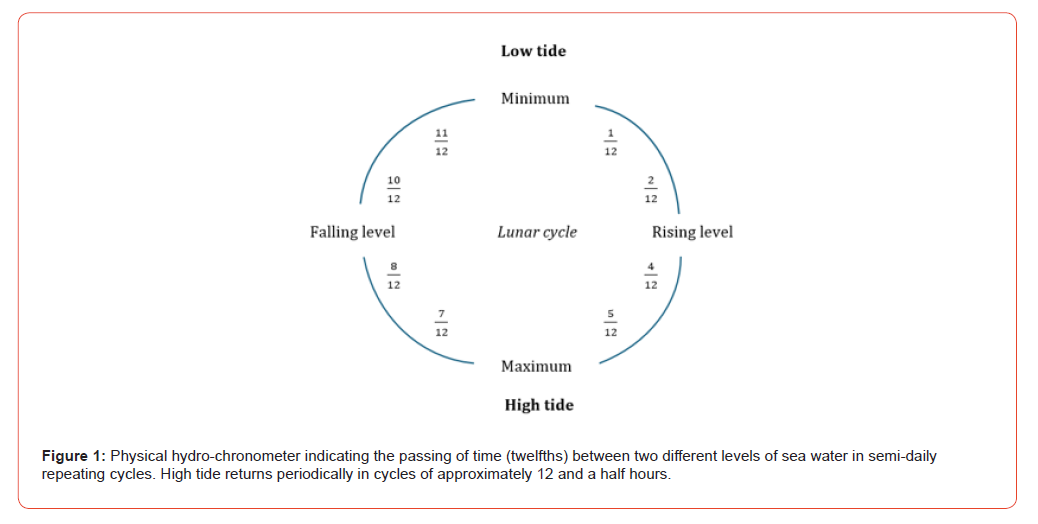
Periodical changes in tides and seasons can be calculated from the rotation speed of the earth around itself and around the sun [14]. Regularly increasing and decreasing water levels in the oceans are influenced by the gravitational forces of the moon and the sun. The distance to moon and sun and the shape and depth of the oceans affect the extent of periodically changing water levels. The tides represent a relatively precise physical clock that had impact on the development of life in the marine environment (Figure 1). Coastal appearances permanently change by the abrasive action of the tides, thus also reflecting the passing of time.
Chemical hydro-chronometric measurement
Anaxagoras postulated that the total amount of matter does not change. What changes is only the arrangement of the components. He postulated, that there are infinite transitions between mixing and separation [9]. Relating matter to energy, this agrees with Newton’s thesis in mechanics that total energy in the universe is constant.
On earth, the formation of water from the two elements oxygen (O) and hydrogen (H) was pretty much predetermined and did not happen by extraordinary coincidence. While O obtains a mass fraction of at least 50% of the earth’s shell, H presumably, is the most common chemical element in the universe [15]. Atomic H is the element with the lowest atomic mass and the lowest density; the molecular form (H₂) makes just 11% of the mass of water. The nucleus of atomic H consists of a positively charged proton. Deviating from this, the nucleus of the isotope deuterium (2H) contains one neutron and the nucleus of the isotope tritium (3H) contains two neutrons in addition [15]. It needs only little energy to break the bonds between O₂ molecules to form new bonds to hydrogen atoms and react to either water (H₂O) or to hydrogen peroxide (H₂O₂). When the molecular forms of the two elements react, then H gets oxidized, O gets reduced and energy is released (1).
2 H₂ + O₂ →2 H₂O + Heat (1)
The complete reduction of O by four electrons generates two equivalents of water. The resulting energy exceeds the initially required energy [15]. The selective reduction of O to water is important to maximize the energy produced for cellular metabolism. In living nature eukaryotes require O to generate energy through oxidation in the mitochondria. In the respiratory chain O is reduced to water. It is one of the great peculiarities of evolution that an aggressive and hostile element such as O could be used to operate a power unit within a syncytium (cytoplasmic mass formed by fusion of cells), which ultimately became a basic requirement for the emergence of more highly developed creatures.
Chemical reactions such as aggregation and disaggregation are well suited for hydro-chronometric measurements. Reaction kinetics, a branch of physical chemistry deals with the temporal progression of chemical reactions [16]. In principle all molecular reaction mechanisms are composed of one elementary reaction. The bimolecular reactions of H with O as the collision partner comprise all consequent reaction mechanisms [16]. Reactions depend on physical parameters, most of all temperature, pressure and volume. The rate of reaction (amount of substance nS per unit time) and the resulting volume (V) of a substance (S) indicate the progress of time (2).
nS = S x V (2)
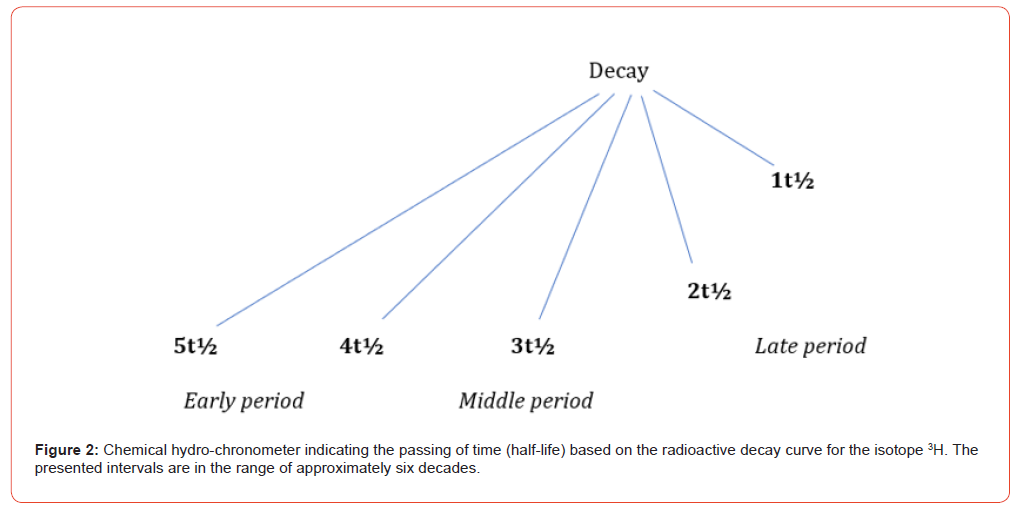
This also includes the concentration-time profile that can be determined by measuring changes in optical activity, conductivity, volume, pressure, temperature, absorption, emission and solubility [16]. The solubility of a crystalline compound in water as well as the crystallization process are also suitable for a chemical hydro-chronometer. A well-established method to distinguish between different time intervals is the radiocarbon dating (14C) that can estimate the age of organic materials within a time frame of approximately 60,000 years [17]. Radiocarbon is constantly being created by the interaction of cosmic rays with atmospheric nitrogen. In organic matter lacking metabolism 14C decreases exponentially due to radioactive decay. The half-life of 14C is about 5,730 years. Using isotope hydrology for time estimation, the age of glacial ice from drill cores can be determined from the 3H content (Figure 2). The halflife of 3H is about 12.4 years, estimated from the amount of decay product that accumulates in the ice.
Biological hydro-chronometric measurement
The coexistence of all living beings takes place in a delicate balance. Everything is interlinked in mutual dependencies. This also agrees with the original finding of Anaxagoras: “… and it is not possible for something to exist separately on its own, but rather everything contains a part of everything else within itself” [9]. Similarly, in his composition On Nature Parmenides of Elea had specified that multiplicity and change of existing things is within the appearance of a single eternal reality: “All is one” [2].
Terrestrial life is subject to periodical rhythmicity. Duration and intensity of solar radiation have a great impact on natural cycles. The daily supply with sunlight is primarily controlled by the earth’s rotation while the annual cycle is determined by the earth’s orbit around the sun. Due to the axial tilt of the earth rotation the number of daily sun hours and the altitude of the sun at solar noon change throughout the year. This results in a regular recurrence of changing living conditions that influence food supply and fertility and allow to distinguish a sequence of different seasons. This periodic cycle also determines the dynamics of the seasonal migratory behavior of land animals and migratory birds. The rhythm of life arises from the dance of the twisting earth around the sun. In his book The prophet, Khalil Gibran wrote: “But if in your thought you must measure time into seasons, let each season encircle all the other seasons, and let today embrace the past with remembrance and the future with longing” [18].
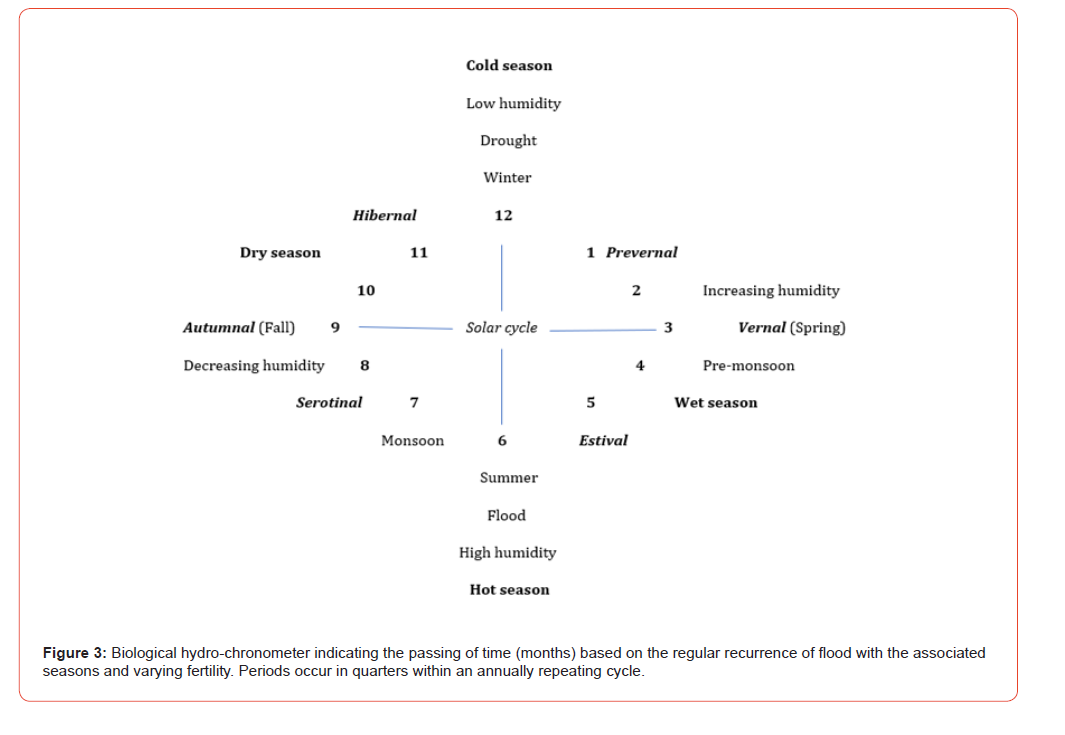
While tropical climates mainly have a dry season followed by a rainy season (monsoon season), subtropical climates have a longer and a shorter rainy season in addition to the dry season. In temperate climates there are already four seasons a year with the precipitations more evenly distributed during the warm season. In autumn, precipitations decrease, and so do the hours of sunshine and the temperatures. During the dry winter season, temperatures drop due to the few hours of daily sunshine and the narrow angle of incident sunlight caused by the deviation of the earth’s tilted axis from the rotation axis. Lack of food during the cold season forces many animals either to hibernate or to migrate. Delayed changes in seasonal temperature are caused by the large heat storage capacity of water. The regular sequence of the seasons follows a hydro- chronometric water clock and can be read from the dial of the stars (Figure 3). The dawn rising of Sirius in the constellation of the Dog, predicted the annual flooding of the river Nile and brought abundant harvests and prosperity to an otherwise barren area in ancient Egypt.
Survival in nature is based on the principle of balance, not on fair distribution. Regarding the alleged “survival of the fittest” by Herbert Spencer, the decisive factor of a successful strategy lies in recognizing and using the current opportunity. However, the dominance of the fittest is not based exclusively on certain abilities such as muscle strength and force. Environmental conditions strongly influence survival in a defined region. The altered living conditions during cambium approximately 540 million years ago, led to an explosive proliferation of living organisms and to great biodiversity [19]. Most of the animal and plant species are now extinct, but their traces in the various rock layers preserve a time etched in stone. During the vertebrate water-land transition (approximately 390 million years ago) numerous physiologic changes and adaptations were necessary to make living beings increasingly independent of the sea. Changes also include specific gene duplications and mutations of various protein receptors and adrenergic receptors in lungs, kidneys, liver, and in vascular and skeletal system [20].
Contrastable to the external water cycle through evaporation and precipitation there is an internal water cycle in the body through absorption and release. To maintain internal stability that allows unimpaired metabolism indicates the significance of water in cellular function. Stable conditions were already important in unicellular living beings e.g. for calcium homeostasis, and the consequent adaptive effects on oxygen uptake by cells, tissues and organs [21]. During marine development the homeostasis of the water balance to maintain the internal environment within narrow range despite changes of osmotically active components per unit volume water in salt and fresh water was crucial. The challenge was to prevent water loss in seawater and uncontrolled water inflow in freshwater. Especially for life in brackish water with varying contents of dissolved salts it was important to find the happy medium between dehydration and edema. The importance of maintaining the cellular function when leaving the marine environment even increased depending on the water supply in the external environment. Within the body cellular function is best maintained in the absence of hyper-osmolar and hypo-osmolar states that influence cell volume, transport, pH, enzyme function, cellular metabolism and oxygen supply. This requested the development of highly specific receptors, such as osmoreceptors (sensory receptors to detect changes in the absolute and relative solute concentrations of extracellular fluids), baroreceptors (sensory receptors to detect pressure changes and stretching in the atrium and the large vessels), and chemoreceptors (sensory receptors to detect changes in the amount of chemical components in fluids, e.g. pCO2 and pO2 in intravascular volume that influence breathing rate and tidal volume via the respiratory centers) [22, 23].
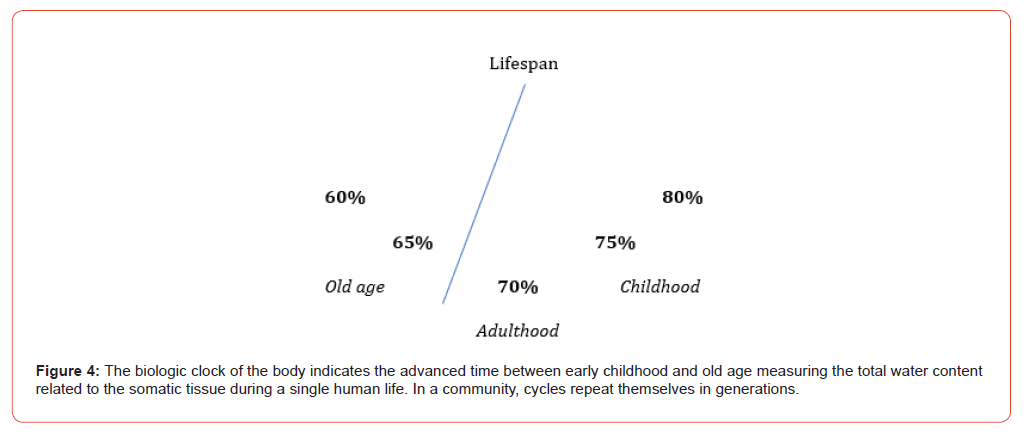
Water is the main component of all living beings. Every plant, every tree resembles a water clock. Literally, trees record the progression of the fat and lean years of a life in their trunk cross-section. In humans the water content in the tissues decreases over the course of life. Between childhood, adulthood, senior age and old age the relative water content in humans is shrinking from approx. 80% at birth to about 60% in the very old (Figure 4). Just as the shadow of a sundial that indicates the sunny hours of a single day between sunrise and sunset, this hydro-chronometric measurement shows the natural course of a single human life between birth and senility.
Similar to the water cycle the wheel of time does not stop and relative time flows unhindered at its pace according to physical rules. Compared to the age of the earth, the lifespan of every living being lasts the same. The art of living is to recognize the uniqueness of the experienced time on hand without losing the lightness and before the conscious present and all still tangible memories dissolve into nothingness. In his famous collection of essays Ralph Waldo Emerson wrote: “Time is finite. Too late, comes too quickly. Live with your best discretion knowing that there may be no tomorrow” [24]. And the Ecclesiastes reported even more clearly: “There is no gain for man that lasts beyond the death. For naked as he came into the world, he must leave again. His name will be forgotten, and no memory will survive the passage of time” [25]. If everything is finite, the joy of life but also pain and grief, then at least, the finiteness of experienced time takes the heaviness out of fate. The lightness of temporal being is particularly evident in the plant’s true-blue confidence in lush thrive. This already applies to the seed that waits dormant behind its capsule unaware of its imminent mission. And when it comes to sprouting, even a delicate flower of the genus Antirrhinum can bloom with little more than water and sunlight and celebrate each moment in bright colors and lavish splendor. With the element of water, the fundamental aspects of temporality become aware. Hydro-chronometric measurement of temporality always means measuring transience.
Conclusion
From the development of primitive life forms in the primordial ocean to the temporary stay of humans in space, an enormous amount of relative time seems to have passed. Unimaginable from the perspective of a single human life and insignificant as an event of an unimaginably large and still expanding universe. On earth, the development of a hydrosphere has led to diverse changes in both living and inanimate nature, which can serve as an indicator of the passage of relative time. In the light of limited life expectancy, the measurement of temporal processes gains importance. Hydro-chronometric measurement of temporality on earth can be measured from the erosion of mountains, from recurring seasons and tides, temporal progression of chemical reactions, the speed of solubility and crystallization, and the inner water cycle in the body. The hydro-chronometric measurement of temporality displays aspects of the natural cycle between recurring origin and awareness of transience.
Acknowledgement
None.
Conflict of Interests
The author has no conflicts of interests to declare including financial, consultant, institutional and other relationships that might lead to bias or a conflict of interests.
Funding
None.
References
- (2004) Newton’s Views on Space, Time, and Motion. In Stanford Encyclopedia of Philosophy, United States.
- H Diels, W Kranz (1951) The fragments of the Pre-Socratics. [Die Fragmente der Vorsokratiker], Ed. H Diels, W Kranz (6th ed) Weidmann Zürich 1903-10. 17.
- L Wittgenstein (2022 [1930]) Philosophical remarks [Philosophische Bemerkungen]. Ed.: CH Beck, 13th ed., Suhrkamp Verlag Berlin, Germany.
- L Wittgenstein (1980 [1918]) Tractatus logico-philosophicus. Ed.: G Busch, 15th ed., edition suhrkamp 12, Frankfurt am Main, Germany.
- W Lederer (2024) The Socio-hydrological Cycle Between Origin and Transience. Adv in Hydro & Meteorol 1(5): 1-4.
- G Khalil (1954) Sand and Foam Ed.: William Heinemann, Ltd., ISBN-10:
- M Sivapalan, HHG Savenije, G Blöschl (2012) Socio-hydrology: A new science of people and water. Hydrological Processes 26(8): 1270–1276.
- (2015) Measurement in Science. In Stanford Encyclopedia of Philosophy, United States.
- P Curd (2007) Anaxagoras of Clazomenae. Fragments and Testimonia. A Text and Translation with Notes and Essays. Ed.: P Curd. University of Toronto Press, Toronto, Canada.
- B Kanitscheider. Philosophy Lexicon of Arguments [Philosophie Lexikon der Argumente].
- ZH Hwang, HS Yan, TY Lin (2021) Historical development of water-powered mechanical clocks. Mech Sci 12(1): 203–219.
- GH Pollack (2013) The Fourth Phase of Water beyond solid, liquid, and vapor. Ed.: Ebner & Sons Publishers Ebnerandsons.com, Seattle WA 98105, USA.
- KS Schmitz (2018) Chapter 3 – Geoscience In: Physical Chemistry, Ed.: KS Schmitz, Elsevier pp. 611-754.
- DA Ross (1995) Introduction to Oceanography. New York, NY: HarperCollins pp. 236-242.
- B Bagchi (2014) Water in biological and Chemical Processes. Cambridge University Press, Cambridge, England.
- KJ Laidlerv (1996) A glossary of terms used in chemical kinetics, including reaction dynamics (IUPAC Recommendations 1996). Pure and Applied Chemistry 68(1): 149-192.
- W Aeschbach Hertig, R Kipfer, M Hofer, DM Imboden, H Baur (1996) Density-driven exchange between the basins of Lake Lucerne (Switzerland) traced with the 3H-3He method. Limnol Oceanogr 41(4): 707–721.
- G Khalil (1923) The Prophet. Ed.: Alfred A Knopf, Inc., NY pp. 1-107.
- MP Smith, DAT Harper (2013) Causes of the Cambrian explosion. Science 341(8): 1355-1356.
- S Aris Brosou, X Chen, SF Perry, TW Moon (2009) Timing of the functional diversification of alpha- and beta-adrenoceptors in fish and other vertebrates. Ann N Y Acad Sci 1163(3): 343–347.
- JS Torday (2025) Homeostasis as the Mechanism of Evolution. Biology (Basel) 4(3): 573-590.
- CW Bourque (2008) Central mechanisms of osmosensation and systemic osmoregulation. Nature Reviews Neuroscience 9(7): 519–531.
- JS Torday (2015) A central theory of biology. Med Hypotheses 85(1): 49-57.
- RW Emerson (2017 [1884]) The Works of Ralph Waldo Emerson: Vol. 3, Ed.: Hansebooks.
- AA Fischer (1998) Ecclesiastes and Early Apocalypticism: An Interpretation of Ecclesiastes 3:16-21 [Kohelet und die frühe Apokalyptik. Eine Auslegung von Koh 3,16-21] In: Qohelet in the Context of Wisdom (BEThL 136), Ed.: A Schoors, Leuven, 339-356.
-

This work is licensed under a Creative Commons Attribution-NonCommercial 4.0 International License.