
 Research Article
Farmers’ Perception of the Local Manifestation of Atmospheric Variables
Received Date: March 24, 2026; Published Date: April 02, 2026
Abstract
Meteorology is positioned as a science that offers invaluable services to society, particularly to agricultural production, where it has also advanced in its decentralized implementation and popularization through agrometeorology. With the aim of understanding farmers’ perceptions of the local manifestation of atmospheric variables they recognize as important, and the variations they have identified in these variables over the last few years, meetings were held in nine territories of central Cuba, with the participation of 126 farmers who manage family farms, cooperative collective areas, and urban gardens. Farmers identified temperature, relative humidity, wind, rain, fog, tornadoes, severe local storms, seasons, tropical cyclones/hurricanes, drought, and sea level rise as important atmospheric variables for agricultural production in their territories. The most frequently perceived variations in local occurrence were: temperature (increase), relative humidity (fluctuations between increase and decrease), seasons (shift), tropical cyclones/hurricanes (more intense and with varying frequency), and drought (longer duration and greater intensity). The arguments and debates that arose during the meetings demonstrate that farmers possess the capacity for atmospheric observation, whether regarding daily weather conditions, their meteorological memory for conducting multi-year analyses, and their relationship to agricultural and livestock management on their farms and orchards.
Keywords: Agrometeorology; folk knowledge; meteorological phenomena
Introduction
Climate and weather management is primarily approached through scientific research that monitors and documents variations in climate patterns and meteorological phenomena, information which then justifies specific actions by different sectors. Meanwhile, those managing agricultural and livestock production, although they may have access to this information through the press or other channels, typically combine their knowledge of climate patterns with atmospheric observations to plan and decide on the tasks to be carried out. In this respect, popular meteorology provides rural people with a general and open framework for scheduling agricultural tasks, with proverbs becoming a fundamental repository of popular meteorological knowledge [1].
Therefore, most proverbs about the weather originate in rural areas and frequently link meteorology and agriculture, allowing for a multidisciplinary approach that integrates geographical, linguistic, historical, anthropological, and other content, developing teaching and learning strategies based on inquiry and empirical research [2]. Farmers’ knowledge has been preserved and systematized through climatic indicators within their culture, which has the practical purpose of anticipating potential weather patterns and their effects on the growing season [3]. The perception that people who live and work in agricultural systems have about changes in climate behavior, which are often not due to climate change but to normal processes, is an issue that is becoming increasingly important because it is related to their concerns and worries about observing climate behavior and to their needs; the latter because climatic events have effects on all life, but are particularly decisive for agricultural production [4].
There are scholars who mention that it would be reductionist to think that meteorological proverbs are simply a fragmentary manual of pre-scientific methods for weather prediction, since they constitute small treatises that synthesize the popular wisdom accumulated over centuries through empirical observation of the weather, in an easy and simple way for dissemination, without the need to adopt a technical language or for the receiver to possess specialized knowledge [5]. In this sense, the agrometeorological skills of farmers constitute a critical local knowledge necessary for managing adaptation to variations in the manifestation of atmospheric variables in agricultural territories; for this reason, and specifically to demonstrate their capabilities in this regard, this article offers perceptions captured in meetings held with the participation of farmers.
Materials and Methods
The perception study was conducted through meetings organized in nine territories in central Cuba: five very close to the northern coast in Villa Clara province, with 95 farmers participating, and four in central Camagüey province, with 31 farmers; 22% of these were women. Participants manage family farms, cooperative collective areas, and urban community gardens. The meetings were held within the framework of the projects “Recovery of Urban Agriculture in Six Municipalities of Villa Clara Province” and “Support for Food and Nutritional Security in Two Municipalities of Camagüey with a Gender and Generational Focus”. To carry out the exercise at each meeting, participants gathered in a room where everyone had the opportunity to share their perceptions of the local manifestation of atmospheric variables. Each meeting began with an awareness-raising presentation (importance and conceptualization) and continued with exercises to answer the following questions: 1st exercise: What atmospheric variables do you recognize as important for agricultural and livestock production in your territory?; 2nd exercise: What variations have you identified in their manifestation, considering the last 5 years?
Using flip charts, participants’ contributions to each question were recorded. These were then analyzed collectively until a consensus was reached, transforming them into collective perceptions of farmers in the region. In addition to the arguments and debate among participants to delve deeper into the questions of each exercise, reflections were fostered that reinforced the importance of atmospheric observation for agricultural management. For the purposes of this study, atmospheric variables were considered to be climate, meteorological phenomena, and extreme weather events; variations were defined as those observed in the manifestation of these variables in their respective territories. It was assumed that:
a. Climate variability consists of those changes in climate
that depend on extreme atmospheric conditions that greatly
exceed standard averages; while
b. Climate change is defined as a lasting and significant
modification of the climate with respect to a climate history,
both on a regional and global scale; and that these contrasts
lead to
c. Meteorological phenomena, some of which manifest
themselves with extreme intensity.
Results and Discussion
Participants identified temperature, relative humidity, wind, rain, fog, tornadoes, severe local storms, seasons, tropical cyclones/ hurricanes, drought, and sea level rise as important atmospheric variables for agricultural production in their territories. Of these variables, they identified 42 variations in their manifestations in their territories, distributed as 2-6 per variable. The highest frequency in the participants’ perception of local variations was observed for the following atmospheric variables (Figure 1, dark blue bar): temperature (increase), relative humidity (increasingdecreasing oscillations), seasons (shift), tropical cyclones/ hurricanes (more intense and of varying frequency), and drought (longer duration and more intense). It was interesting that the farmers recognized the seasons as an atmospheric variable and their shift as a major variation in local manifestations, among other things such as: seasons are not clearly defined, their start is delayed, there is no winter or it is shorter, spring is shorter, and the dry season is longer.
They commented on the importance of the seasons for the planning and successful execution of agricultural production and animal feed, given that most of the technologies and species/varieties they cultivate have been developed for the traditional behavior of the seasons. They argued that, although they are making adaptive adjustments, these are not sufficient, or because the variations are unpredictable, losses occur (costs, harvests), which are more significant when spring is delayed due to prolonged drought or is shorter in duration. In other atmospheric variables, the order of variability in the local manifestations observed by farmers was as follows: rainfall (shifted rain periods and more intense at certain times > less frequent > greater difference between the coast and the interior > more localized); tropical cyclones/hurricanes (more intense > varied frequency > larger exposed area, less rainfall, and greater wind intensity and saline winds); drought (longer duration and greater intensity).
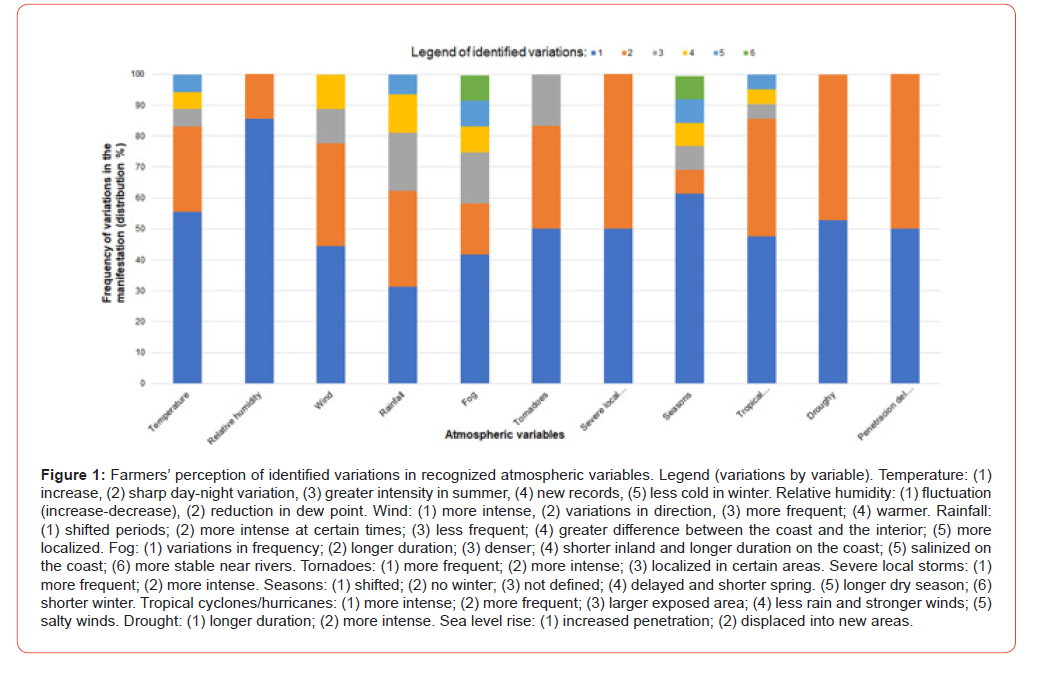
A similar study conducted in eastern Cuba found that participants (farmers and local technicians) identified drought as the most significant factor (50.7%), followed by high temperatures and cyclones/hurricanes (14.8%), heavy rainfall (9.5%), local storms, and dry winds [6]. Although the local variations identified by farmers may not coincide with the results recorded by the meteorological service’s network of stations, due to differences in measurement accuracy between automated equipment and human observation, they can be considered sensitive to the practical effects of management on their farms and orchards, as they deem them important for agricultural and livestock production.
Because these and other atmospheric variables are recorded and analyzed by the meteorological service’s network of stations [7-10], it is suggested that future territorial studies could compare sensor data with farmers’ perceptions, as a way to enrich farmers’ observations and establish synergies for decentralizing meteorological management toward agroecosystems. In fact, the arguments and debates raised at the meetings demonstrate that farmers possess capabilities in observing the atmosphere, whether regarding daily weather conditions, meteorological data for conducting multi-year analyses, or its relationship to agricultural and livestock management on their farms and orchards. Some farmers even mentioned making adjustments or changes to planting dates and agricultural practices, and evaluating the performance of traditional varieties and breeds, as well as those proposed by research centers, as adaptations that help them take advantage of benefits or reduce the physical effects on their production.
Because agroecological designs and management practices predominate in peasant farms and urban gardens, mainly productive diversification, crop rotation, polycultures, self-management of resources and reduction of degrading interventions, the integration of peasant meteorology can be considered a fundamental tool in the agroecological transition, because it facilitates the adaptation of these practices to the variations they observe in the manifestation of atmospheric variables. Based on evidence, various experts have suggested that rescuing traditional management systems combined with the use of agroecologically based management strategies, may represent the only viable and robust path to increase the productivity, sustainability and resilience of peasant-based agricultural production under predicted climate scenarios [11].
Contributing to this purpose is the “agroecology route for transforming farms into resilient ones in the face of climate change,” a methodological proposal for farmers’ self-management in transforming their farms, considering the resilience functions needed to achieve climate events through the practices and actions implemented [12]. Regarding information services, forecasts, and warnings related to climate and meteorological phenomena, including extreme events, there was agreement that they are very useful in three ways: for staying alert, for comparing them with their perceptions, and for assessing vulnerability as a criterion for making adaptive adjustments.
Regarding tropical cyclones and droughts, catastrophic events that have become recurrent in recent years, the narratives of participating farmers revealed that agricultural management is based on a combination of criteria:
a. Forecasts or warnings issued by the meteorological
service through the press (print, radio, television);
b. Their meteorological memory in defining the season in
which these events occur, as a basis for planting plans;
c. Changes they have observed in their intensity and
duration over the years, which allows them to make empirical
assumptions;
d. Understanding of the physical effects of these events
on the soil and crops, as a basis for making technological
adjustments; and
e. Encouraging farmer experimentation to find varieties that
escape the period of incidence or tolerate the physical effects,
including recovering traditional varieties.
Due to their particular logic, farmers develop a heightened sensitivity to the information they receive about climatic phenomena, especially regarding forecasts, as this is vital to their production strategy [13]. Regarding farmers’ opinions on the use of climate forecasts, a need for climate information has been identified at certain times in their operations; however, they view forecasts as an auxiliary tool that can provide context for making partial modifications to a pre-established strategy [13]. For farmers, climate is a continuum, so they don’t differentiate between weather forecasts and climate forecasts, but rather between shortterm and medium-term forecasts. Likewise, when asked whether the climate is changing, producers handle the temporal dimension very differently than a climatologist would, with regard to “periods,” “phases,” “cycles,” “peaks,” “valleys,” and “patterns.” A farmer might assert that the climate is indeed changing because it rained a lot or a little in the last two years, and therefore a wet or dry cycle has begun, respectively. They might claim that there are phenomena that “didn’t happen before” and be referring to four or five years ago [13]. In this regard, some people view climate change as a natural phenomenon, while others, even knowing that it causes damage, perceive it as distant because it is not directly related to their activities or property, as explained in studies on urban perceptions of climate change [14-16]. In fact, research on the various levels of knowledge and perception of climate change worldwide has also increased, although the challenge remains to narrow the spatial scale [17].
Final Comments
Meteorology has expanded into the fields of environmental, agricultural, and human community management, encompassing areas such as agrometeorology, medical meteorology, biometeorology (Simon et al. 2014), and folk meteorology [1], among others. Within this context, biometeorology, defined as an interdisciplinary science that considers the interactions between atmospheric processes and living organisms, plants, animals, and humans [18,19], brings together research from diverse disciplines, including geography, biology, mathematics and statistics, environmental science, and physiology, and requires its practitioners to be familiar with a wide range of disciplines [20]. Although, from a social science perspective, climate is primarily the result of how individuals perceive, appropriate, and interpret the meteorological and climatic events that occur around them, the concept of climate is a cultural construct developed through material and symbolic processes, and it denotes cultural, spatial, and historical aspects [21].
Social dialogue, therefore, seems indispensable for achieving a deep understanding of the interrelated variables of a problem that transcends the traditional view of scientific disciplines. In fact, public knowledge and awareness have increased in recent years, and citizens have the capacity to make valuable contributions that should be taken into account by both scientists and decision-makers, that is, by politicians [22]. Accelerated global change and the loss of ecosystem services are highlighting the importance of traditional ecological knowledge for building socio-environmental resilience. Over time, communities have maintained a close relationship with the environment and have developed knowledge, practices, and social and institutional frameworks to cope with disturbances and maintain ecosystem services under conditions of uncertainty and change [23,24].
In particular, peasant knowledge originated from the accumulation of experiences, empirical knowledge, beliefs, and customs that are consistent with each other [25]. The formal study of traditional knowledge systems has led to the understanding that they are cognitive systems made up of a praxis and a corpus that are interdependent, where the corpus is nothing more than the sum and repertoire of signs, symbols, concepts, and perceptions of what is considered the traditional cognitive system [26]. The peasant worldview stands out, stemming from the systematic observation of nature, where contemplations and reflections on it were verified daily, allowing them to classify, predict, and formulate knowledge that integrates communities into their way of life [27].
Within the context of traditional knowledge, local responses to the new experiences of climate change are being incorporated into endogenous perceptions in a selective, fragmented, and modified way. However, they can constitute an important practical approach to addressing these changes and even to articulating them with local development policies to confront risks and identify vulnerability issues at the local and regional levels [28]. This new trend is understood to encompass, although lacking scientific precision, collective wisdom based on the experience of hundreds of generations. While some may be based on superstitions or beliefs, others stem from ancient empiricism and meteorological assertions that remain unchanged to this day. Consequently, several official meteorologists have defended these truths contained in meteorological proverbs [29].
People who work in rural areas are more exposed than others to risks related to natural phenomena. Therefore, it is logical to assume that they have developed a greater sensitivity to certain events they perceive as potentially dangerous and that they have a range of options for managing the situations they face. Thus, the quantity and quality of information that individuals possess is central to the construction of their subjectivities [13]. Due to the rapid development of communication technologies in recent years, farmers are constantly bombarded with news and data through various channels. However, it is worth asking how they process this new information within the context of their existing knowledge. Ultimately, any communication strategy among agricultural producers must first assess the organization of their subjective perception systems [30].
A study conducted in Puebla, Mexico, by Velázco-Hernández et al. [31] found synergy between scientific and empirical knowledge. Empirical knowledge about weather forecasting is widely accepted by farmers and continues to influence agricultural practices. Farmers with meteorological skills could be hybrid actors in the participatory management of agrometeorology at the territorial level, due to their ability to make meteorological observations and because they constitute a reservoir of adaptive practices.
References
- Mesa S, Delgado AB, y Blanco E (1997) Rain rituals and weather prediction in Mediterranean Spain. In: Anthropology of climate in the Hispanic American world. Tomo I. Goloubinoff M, Katz E, y Lammel AM (eds). Ediciones, ABYA-YALA, Colección Biblioteca ABYA YALA. Nú 49: 93-126.
- Gaite MJM (2011) Teaching and learning Geography through different languages. A project-based learning experience to study the climate of Spain using proverbs. Anales de Geografía 31(1): 107-123.
- Claverías R (2000) Knowledge of Andean farmers about climate predictors: elements for its verification. Trabajo expuesto en el Seminario-Taller organizado por Proyecto NOAA (Missouri). Chucuito-Puno.
- Vazquez LL (2011) Climate change, pest incidence and resilient agroecological practices. En: Pp. 75-101. Rios H., Vargas D. y Funes-Monzote F.R. (eds). Agroecological innovation, adaptation and mitigation of climate change. PIAL-Instituto Nacional de Ciencias Agrícolas (INCA) pp. 1-248.
- Álvarez X (2013) Geoparemiological distribution of Asturian meteorological proverbs. Lletres Asturianes, Boletín Oficial de l’Academia de la Llingua Asturiana 109: 67-102.
- Vazquez LL, Aymerich Y, Díaz A, Peña A, Cobas R, et al. (2016) Drought resilience based on agroecological principles. Systematization of a participatory co-innovation process. Guantánamo Province, Cuba. Ed. OXFAM, Gobierno Belga, CITMA, ANAP. Guantánamo pp. 143.
- Alvarez L, y Borrajero I (2016) Characterization of the annual course of meteorological phenomena in Cuba, classified according to the current weather code. Revista Cubana de Meteorología 22 (1): 3-25.
- Planos EO, y Gutiérrez Pérez TL (2020) Third National Communication to the United Nations Framework Convention on Climate Change. CITMA (La Habana) pp. 1-403.
- Fonseca C, Hernández D, Cutié V, Martínez M, Gil L, et al. (2022) Climate Status in Cuba 2021. Extended Summary. Revista Cubana de Meteorología 28(1).
- Pardo R, y Rodriguez Y (2014) Classification of tropical storms according to associated rainfall: (1) state of the art. Ingeniería Hidráulica y Ambiental 35(2): 18-34.
- Altieri MA, y Nicholls CI (2013) The adaptation and mitigation potential of traditional agriculture in a changing climate. Climatic Change 140: 33-45.
- Vazquez LL (2021) Agroecology route for transforming farms into resilient farms in the face of climate change. Colección aprender a innovar No. 13. Proyecto Redes para una Agricultura Resiliente (RedAR). La Habana pp. 148.
- Barsky A, Podestá G, Ruiz F (2008) Perception of climate variability, use of information, and risk management strategies of stakeholders. Analysis of decision-making processes among farmers in the Argentine Pampas region. Mundo Agrario 8(16): 1-42.
- Martínez CA (2015) Public perception of climate change in Mexico (master's thesis) Universidad Iberoamericana, Mé Recuperado de http://ri.ibero.mx/handle/ibero/698.
- Novion AC, y Estrada GC (2011) Perception of the lived effects of climate change in a sample of southern urban inhabitants. Magallania 39(1): 93-102.
- Urbina J (2015) The social perception of climate change in urban areas. In: Ortiz B. y Velazco C. (coords.), The social perception of climate change. Studies and guidelines for environmental education in Mexico. Universidad Iberoamericana de Puebla. Recuperado de pp. 22-36.
- Ferrero EL, Hernández YT, y Zafra CF (2014) Latin American perceptions of climate change: methodologies, tools, and adaptation strategies in local communities. A review. U.D.C.A Actualidad & Divulgación Científica 17(1): 73-85.
- (2013) International Society of Biometeorology-ISB. What is biometeorology? http://biometeorology.org/what_is_bm/index.cfm.
- MacIver D, Urquizo N, Auld H (2002) Biometeorology and Adaptation in the Context of Climate Change and Biodiversity. Proceedings of the 15th Conference in Biometeorology and Aerobiology/16th International Congress on Biometeorology, Kansas City, Mo, forthcoming.
- Gosling SN, Bryce EK, Grady P, Gabriel CMA, Gosling EY, et al. (2011) Aglossary for biometeorology. Int J Biometeorol 58: 277-308.
- Mariño N (2011) Reflections on the cultural perspective in climate change policies in Colombia: an approach to the cultural and spatial analysis of public policies. En Ulloa A. (ed.). Cultural perspectives on climate. Bogotá: Universidad Nacional de Colombia. Biblioteca abierta: Perspectivas Ambientales pp. 495-528.
- Jori G (2009) Climate change as a problem and social dialogue as a solution. Investigaciones Geo gráficas 48: 125-160.
- Gómez Baggethun E, Corbera E, Reyes García V (2013) Traditional ecological knowledge and global environmental change: research findings and policy implications. Ecology and Society 18(4): 72.
- Berkes Fy, Turner NJ (2006) Knowledge, learning and the evolution of conservation practice for social ecological system resilience. Human Ecology 34(4): 479-494.
- González V (2008) Saberes campesinos y agricultura como forma de vida. Universidad Autónoma Chapingo pp: 177.
- Torres J, y Valdivia J (2012) Climate and traditional knowledge in the Andean region: Climates encountered. Compilation and analysis of existing thematic literature. First approach. SP ITDG- UNALM pp. 68.
- Juárez A (2010) The profession of observing and controlling the weather: meteorological specialists in the central highlands. A systematic and comparative study. Doctoral thesis in Anthropology, Universidad Nacional Autónoma de México, Facultad de Filosofía y Letras. Instituto de Investigaciones Antropológicas pp. 305.
- Molina JCR (2014) Perceptions of weather in the rural populations of Contramaestre, Santiago de Cuba. Batey: Revista Cubana de Antropología sociocultural 6 (6): 98-109.
- Rua F (2013) Meteorology in proverbs. Aller Argutorio 30: 37-42.
- Podestá G (2002) Use of ENSO-related climate information in agricultural decision making in Argentina: a pilot experience. Agricultural Systems 74(3): 371-392.
- Velasco Hernández MA, Morales Acoltzi T, Juárez Sánchez JP, Estrella Chulim NG, Díaz Ruíz R, et al. (2016) Relationship between peasant knowledge and climatic variables in the central-eastern region of Puebla, Mexico. Agricultura, Sociedad y Desarrollo 13(4): 643-662.
-

This work is licensed under a Creative Commons Attribution-NonCommercial 4.0 International License.