 Mini Review
EURI-UR: Circular Economy of Rainwater at the Bilbao School of Engineering
Received Date: December 15, 2025; Published Date: December 19, 2025
Abstract
Society is increasingly aware of the value of water as an essential global resource, although its importance is often fully recognized only when it is scarce. Therefore, it is necessary to promote the reuse of rainwater for activities that do not require the high quality standards achieved in Drinking Water Treatment Plants (DWTPs), such as irrigating gardens and plants, cleaning outdoor pavements, or supplying toilet cisterns. The EURI-UR project proposed at the Bilbao School of Engineering, within the framework of the “Campus Bizia Lab” (CBL) projects promoted by the University of the Basque Country (EHU) to foster sustainability, innovation, and social commitment, aims to study the potential accumulation of rainwater and to design a system that enables its use.
Keywords: Circular economy; rain; reuse
Introduction
The reuse of rainwater in buildings has become established as a key strategy to reduce potable water demand and improve urban water resilience, supported by numerous recent studies. Research such as that by Ghisi and Freitas (2024) [1] demonstrates that rainwater harvesting combined with reuse systems can be economically feasible in multifamily buildings, especially when oriented toward non-potable uses such as cleaning, irrigation, or toilet flushing. Similarly, bibliometric analyses conducted by Yanilmaz and Gültekin (2025) [2] show sustained growth in the development of hybrid rainwater reuse and greywater recycling systems, reflecting increasing interest in integrated water management models in sustainable architecture. From a more specialized perspective, models such as that proposed by Yeh and Chapman (2021) [3] illustrate the applicability of rainwater in green roof systems, expanding the range of nature-based solutions. Taken together, these references show that rainwater reuse is an effective, mature, and technically validated tool for advancing toward more sustainable buildings and more resilient cities.
The use of rainwater for cleaning windows and surfaces in buildings has become established as a sustainable practice that reduces potable water consumption and offers technical advantages due to its low mineral content, which minimizes the appearance of stains or residues after drying. Several studies have shown that stored and properly managed rainwater presents adequate quality for washing tasks, provided that its physicochemical and microbiological composition is controlled; for example, Struk- Sokołowska et al. [4] demonstrated that treated rainwater can be safely used for cleaning operations. Likewise, applied experiences in university environments, such as the case of the campus of the Pontificia Universidad Javeriana (Bogotá), show the feasibility of using rainwater for cleaning façades and exposed surfaces, significantly reducing potable water use [5]. Recent reviews [6] highlight that rainwater harvesting and treatment constitute a key measure within the framework of sustainable water management, increasingly integrated into buildings seeking to reduce their environmental footprint through low-impact non-potable solutions.
The Bilbao School of Engineering [7] is part of the University of the Basque Country (EHU) [8], and consists of three buildings in which water consumption is high, with approximately 6,000 users. In recent years, the EHU has promoted initiatives derived from the Erasmus University Educators for Sustainable Development project, such as the Campus Bizia Lab (CBL) program [9], which is aligned with the University’s strategic plan and responds to the objectives of the EHUagenda 2030 [10]. At the School, in the newest building, rainwater collection tanks were installed and are used to supply toilet cisterns. Therefore, the aim is to continue implementing new rainwater utilization measures in the other buildings, such as using the collected water for window cleaning, a practice that will gain importance as public awareness increases.
Objectives and Tasks of the Project
The objectives proposed in this project, which applies the Sustainable Development Goals (SDGs) [11]—specifically SDG 6 (Clean Water and Sanitation) by prioritizing rainwater use, SDG 12 (Responsible Consumption and Production), SDG 9 (Industry, Innovation and Infrastructure), and SDG 5 (Gender Equality), as the project team is gender-balanced—are as follows:
a. To study the precipitation falling on the EIB/BIE buildings.
b. To analyze precipitation accumulation.
c. To assess possible applications.
d. To implement the defined applications by establishing a
protocol applicable to other EHU centers.
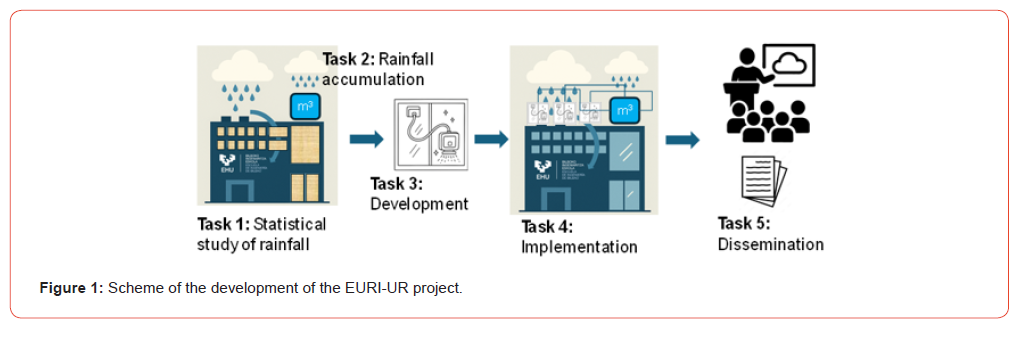
The tasks to be developed are aligned with the project
objectives, as shown in Figure 1, and are the following:
a. Task 1: Study of precipitation based on data recorded by
the rain gauge located on the rooftop of Building 1G.
b. Task 2: Analysis of precipitation accumulation and
possible treatment.
c. Task 3: Development of possible applications, even though
these applications are already known.
d. Task 4: Implementation of the defined applications.
e. Task 5: Dissemination and transfer of the applications.
Task 1: Study of Precipitation
In order to assess the real availability of rainwater at the Bilbao School of Engineering, a statistical analysis of recorded precipitation was carried out using an extensive historical series (1871–2025), allowing characterization of both interannual variability and the seasonal distribution of rainfall in the campus environment.
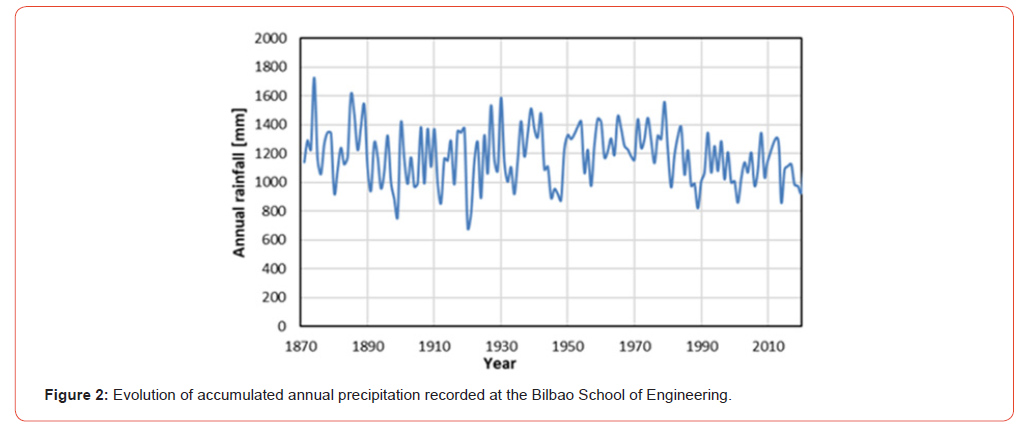
First, Figure 2 shows the evolution of accumulated annual precipitation over the study period. Significant interannual variability is observed, with values ranging approximately between 700 mm and 1,700 mm per year, with a considerable random component. Nevertheless, most years fall within a range between 1,000 mm and 1,400 mm, confirming that the study area is characterized by a high and relatively constant long-term rainfall regime.
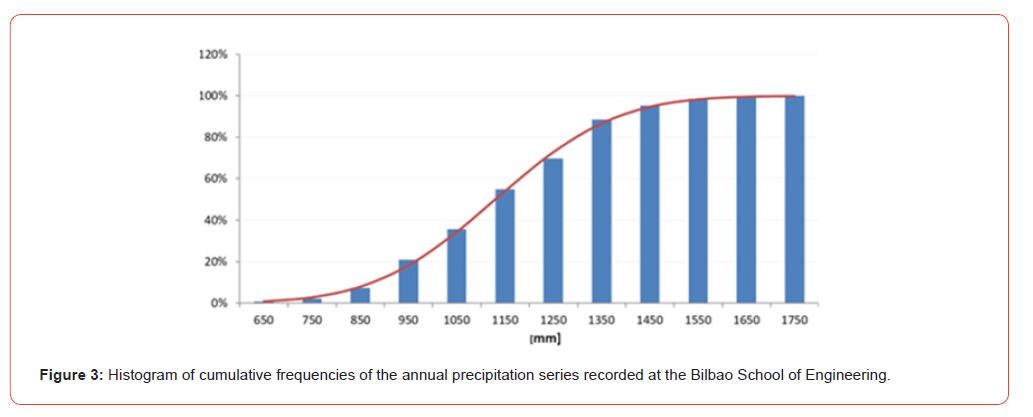
This magnitude of annual precipitation highlights the significant potential for rainwater harvesting and utilization in the School’s buildings. This is also reflected in Figure 3, which shows that in more than 70% of the years, annual precipitation exceeded 1,000 mm.
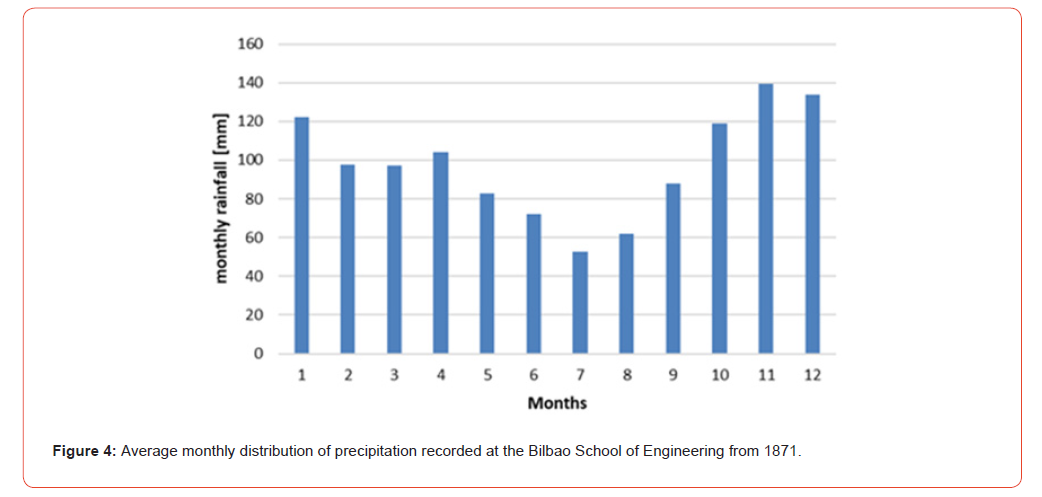
To analyze the temporal distribution of rainfall throughout the year, average monthly from 1871 precipitation has been calculated from the complete historical series. The results are presented in Figure 4.
A marked seasonal pattern is observed, typical of an Atlantic climate, with maximum precipitation during autumn and winter months, especially November, December, and January. In contrast, summer months—particularly July and August—show the lowest average values, although without prolonged periods of total absence of rainfall.
This distribution pattern is especially favorable for rainwater harvesting and storage systems, as periods of higher precipitation coincide with times of lower evaporation, allowing regular replenishment of storage tanks. Furthermore, although summer presents lower rainfall inputs, this behavior is also favorable from a demand management perspective, since these months coincide with the summer period, when university academic activity is significantly reduced due to partial closure of facilities. Consequently, water needs for non-potable uses, such as window and exterior surface cleaning, also decrease during this period. This complementarity between resource availability and demand reinforces the feasibility of rainwater use on campus, enabling more efficient use of stored water throughout the year.
Overall, the analysis of the historical precipitation series confirms that the Bilbao School of Engineering has an abundant and regular pluviometric resource over time, despite observed interannual variability. Both the recorded annual values and the seasonal distribution of rainfall demonstrate a high potential for rainwater harvesting and storage. Moreover, the correspondence between periods of lower precipitation and reduced university activity during summer months helps balance supply and demand. These results support the technical feasibility of rainwater use for non-potable purposes on campus and justify the development of subsequent project stages focused on accumulation analysis and potential applications.
Conclusions and Perspectives
The availability of rainwater and its feasibility for nonpotable uses represent a significant opportunity to improve water sustainability in urban environments. The reviewed studies demonstrate that rainwater reuse is technically feasible and environmentally advantageous, enabling reductions in potable water demand for activities such as irrigation, cleaning of outdoor spaces, toilet flushing, and even certain building maintenance processes. Integrating rainwater harvesting and utilization systems not only reduces pressure on conventional water resources but also promotes more resilient management in the face of drought periods, contributing to a transition toward more efficient and responsible consumption models.
At the Bilbao School of Engineering, a project is being carried out to design a window-cleaning system based on rainwater use. Likewise, it would be interesting to consider citizen participation and communication campaigns to ensure proper use and social acceptance. With these steps, the initiative can evolve from a proof of concept into a replicable and standardizable solution in coastal areas facing potable water scarcity.
Acknowledgement
The authors would like to thank the Water Hall “CABB” (The Bilbao Bizkaia Water Consortium (CABB, in Spanish), a Business Hall located at the Bilbao School of Engineering, where data to make this revision related to energetic generation along the water supply system of Greater Bilbao were available.
Conflict of Interest
No Conflict of Interest.
References
- Ghisi E, Freitas DA (2024) Economic feasibility of rainwater harvesting and greywater reuse in a multifamily building. Water 16(11): 1580.
- Yanilmaz BB, Gültekin AB (2025) A bibliometric analysis on hybrid rainwater reuse–greywater recycling systems in buildings. Gazi University Journal of Science Part B 13(2): 243–261.
- Yeh CH, Chapman MP (2021) A non-linear differentiable model for stormwater-based irrigation of a green roof in Toronto. arXiv, USA.
- Struk Sokołowska J, Joanna Gwoździej Mazur, Piotr Jadwiszczak, Andrzej Butarewicz, Piotr Ofman, et al. (2020) The quality of stored rainwater for washing purposes. Water 12(1): 252.
- Lara Borrero JA, Andrés Eduardo Torres Abello, María Claudia Campos Pinilla, Leonardo Duarte Castro, Jairo Iván Echeverri Robayo, et al. (2010) Using rainwater for irrigation, hard surface & façade cleaning at Pontificia Universidad Javeriana’s campus (Bogota). Ingeniería y Universidad 11(2): 193-202.
- Raimondi A, Ruth Quinn, Abhijith G R, Gianfranco Becciu, Avi Ostfeld (2023) Rainwater harvesting and treatment: State of the art and perspectives. Water 15(8): 1518.
- Bilbao School of Engineering – UPV/EHU.
- University of the Basque Country – UPV/EHU.
- Campus Life Lab – Sustainability – UPV/EHU.
- EHUagenda 2030 – Sustainability – UPV/EHU.
- Sustainable Development Goals and Targets - Sustainable Development.
-

This work is licensed under a Creative Commons Attribution-NonCommercial 4.0 International License.