
 Mini Review
AI-Based Prediction of Coal Mine Water Inrush: A Concise Review
Received Date: April 27, 2026; Published Date: May 11, 2026
Abstract
Often causing deaths, considerable equipment damage, and extensive production interruptions, water inrush is among the most serious and destructive hydrogeological threats in underground coal mining activities. Often failing to depict the intricate nonlinear relationships among geological, hydrogeological, and mining-induced variables—particularly under dynamic hydrological conditions—conventional forecasting techniques mostly rely on empirical formulae and numerical simulations. Artificial neural networks, support vector machines, ensemble learning, and deep learning models among other artificial intelligence (AI) approaches used in coal mine water inrush risk prediction are shortly reviewed in this work. A hybrid PCA-BP neural network shows a predicted accuracy over 92%, hence proving the viability of artificial intelligence in hydrogeological risk assessment. Existing problems—including data imbalance, inadequate model interpretability, and real-time deployment difficulties under changing hydrometeorological circumstances—are examined. Future study directions suggested are those that concentrate on explainable artificial intelligence (XAI) and Internet of Things (IoT) integrated intelligent early warning systems, consistent with current hydrological monitoring requirements.
Keywords: Artificial intelligence; neural networks; risk assessment; mine hydrogeology; coal mine water inrush; hydrological hazard prediction
Introduction
Water in coal mines is the abrupt influx of groundwater or surface water (usually aggravated by hydrometeorological influences like torrential rain) into subsurface operations along geologic paths including fractures, karst collapse columns, and faults. This phenomenon is a major threat to worldwide coal mining safety, especially in China, where more than 60% of stateowned coal mines face dangers from limited Ordovician limestone aquifers—with hydrological dynamics playing a key role in setting off inrush events. Along with varying hydrometeorological inputs, the dynamic interactions between aquifer water pressure, rock mass mechanical properties, mining‑induced stress redistribution, and geological structural complexity result in highly nonlinear disaster mechanisms, making precise long‑term and real‑time prediction extremely difficult.
Traditional assessment techniques for water inrush include the water inrush coefficient method, analytic hierarchy process (AHP), and numeric simulations utilizing tools such FLAC and MODFLOW. While these strategies help regional risk analysis, they are dependent on basic geological and hydrologic assumptions and cannot completely incorporate multi‑source, real‑time monitoring data (e.g., real‑time groundwater level, precipitation, and aquifer recharge data). Artificial intelligence offers a data-driven solution that automatically detects latent patterns from historic disaster records, hydrological monitoring data, and sensor data, hence allowing for more exact and flexible risk categorization—essential for hydrogeological hazard management in mining environments.
This mini-review presents a high-accuracy hybrid modeling approach, summarizes the current knowledge in AI-driven water inrush prediction, and discusses opportunities for future generation smart hydro-meteorological monitoring systems in mining settings.
AI Methodologies for Water Inrush Prediction
Data Sources and Preprocessing
Good multi‑dimensional datasets with hydrogeological, geological, mining, and hydrometeorological indicators—often comprising: are needed for accurate artificial intelligence forecasting.
a. Hydrogeological signs: aquifer pressure, thickness,
permeability coefficient, groundwater level variance.
b. Geological structural factors include rock mass
fragmentation degree, fractal dimension, fault density, distance
to karst collapse columns.
c. Parameters for mining engineering: depth of mining,
coal seam thickness, rate of advancement of the working face,
strength of excavation disturbance.
d. Apparent resistivity - Microseismic event frequency -
Mine water inflow rate - Precipitation amount - Surface runoff.
e. Borehole logging, geophysical surveys, subterranean
sensor networks, and hydrometeorological monitoring stations
provide data. Essential for model reliability, preprocessing
methods include:
f. Features standardization and normalization to remove
scale effects between hydrological (e.g., precipitation) and
geological (e.g., mining depth) factors.
g. Outlier exclusion using isolation forests and expert
judgment to rule out faulty sensor data and extreme
hydrometeorological events (e.g., unusual precipitation bursts).
h. Particularly for hydrometeorological data with sporadic
monitoring gaps, missing value imputation using K‑nearest
neighbors (KNN) and spatial interpolation.
Typical AI Models
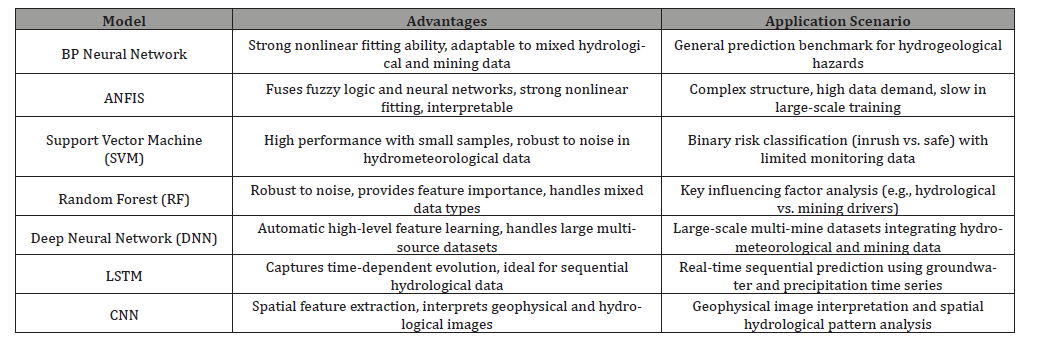
Several machine learning and deep learning algorithms have been widely adopted in water inrush prediction, with varying suitability for integrating hydrological and mining data: [1-6].
Table 1: Comparison of various machine learning and deep learning algorithms.
Hybrid and Ensemble Models
Hybrid systems are becoming more and more used to beat
overfitting and poor generalization in single models—especially
when incorporating variable hydrometeorological data—by means
of the following:
a. PCA‑BPNN: With Principal Component Analysis
dimensionality reduction lowers feature redundancy,
especially helpful for high-dimensional datasets including
hydrometeorological parameters.
b. Hyperparameter optimization using Genetic Algorithms
to improve model performance with sparse hydrological
monitoring data, GA-SVM.
c. Weighting important time steps in sequential data
(precipitation peaks, groundwater level surges) enhances
interpretability using attention-LSTM.
d. Stacked ensemble models (RF + GBDT) fit ideally for
combining several hydrological, geological, and mining data
sources as they provide greater stability and prediction
accuracy.
Case Study: Neural Network Application
In a northern China coal mine menaced by Ordovician limestone karst water, a case study was done whereby hydrometeorological parameters (e.g., seasonal precipitation) greatly affect aquifer water pressure. Eight input variables were set up in a dataset of 200 working faces: water pressure, aquifer thickness, fault fractal dimension, mining depth, aquifuge thickness, excavation area, distance to collapse columns, and monthly precipitation (added to reflect hydrometeorological impacts). 120 safe faces were mixed with 80 water inrush occurrences [6]. PCA efficiently eliminated redundancy among hydrological (precipitation) and geological elements by reducing the 8‑dimensional feature space to 5 principal components explaining 93.7% of the entire variance. Using the scaled conjugate gradient technique, a BP neural network with one hidden layer—ten neurons and tanh activation—was trained. With five-fold cross-validation to avoid overfitting, the data was separated 80% for training and 20% for testing.
a. Prediction accuracy: 92.5%.
b. Precision: 90.9%; Recall: 88.2%; F1‑score: 89.5%.
c. AUC: 0.95.
d. Performance ranking: PCA‑BP > Random Forest > SVM >
standalone BP.
Feature importance analysis confirmed that water pressure (0.28), fault structure (0.24), mining depth (0.19), and monthly precipitation (0.12) are the dominant controlling factors— highlighting the critical role of hydrometeorological inputs in water inrush prediction, consistent with hydrogeological theory. Water inrush study in Namdock Coal Mine (DPR Korea), located in a complex hydrogeological setting with developed faults, fractured aquifers, and variable lithology, examines the mine’s hydrogeological features and proposes an integrated water inflow prediction method combining the Entropy Weight Method (EWM) and Adaptive Neuro-Fuzzy Inference System (ANFIS). Field discharge observations and drilling surveys were conducted to identify water-bearing strata, fault flow pathways, and seasonal inflow changes. EWM was applied to evaluate water risk in different drifts, recognizing high-risk zones with entropy weights over 0.2221. The ANFIS model was built with six input factors: mining depth, coal seam thickness, dip angle, hanging wall failure, geological structure, and season, using measured inflow as output. Trained on 25 field datasets and tested on 5, it obtained a test error of just 1.0158%, far superior to the traditional BP neural network’s 8.56%. Field application in the 9-Pit area confirmed its accuracy in predicting inflow for high-risk sections and optimizing mining sequences [7].
Challenges and Future Perspectives
Despite major advances, several obstacles prevent practical use of AI-based water rush forecasting—integrated with hydrometeorological monitoring requirements—in the real world:
a. Recorded water inrush occurrences are rare; hence,
hydrometeorological data variance (e.g., strong precipitation)
further frustrates model training. Particularly for datasets with
unequal hydrological conditions, SMOTE and cost‑sensitive
learning are needed to help lower model bias.
b. Deep learning models lack openness, which is essential
for safety-critical decision-making in mining and hydrological
hazard management. Combining understandable artificial
intelligence technologies (SHAP, LIME) will aid in the
identification of important hydrological and mining factors
causing inrush occurrences, therefore improving stakeholder
and engineer confidence.
c. Real‑time IoT integration calls for low‑latency processing
of data streams from continuous hydrometeorological
(precipitation, surface runoff) and underground (groundwater
pressure, mine inflow). Real‑time model updates will be made
possible by edge computing and internet learning, therefore
responding to changing hydrological conditions.
d. Cross‑mine generalisation: Hydrological and geological
situations differ greatly among mines, therefore restricting
the portability of educated models. Integrating several
hydrometeorological datasets, domain adaptation and
federated learning across several mine locations can create
more solid predictive models devoid of sensitive data.
e. Further improving prediction accuracy will come from
the multimodal fusing of structured tabular data (mining,
hydrological), time-series signals (precipitation, groundwater
level), and images (geophysical, hydrological) within a single
framework—that using graph neural networks representing
geological and hydrological topology.
To create a single water hazard prevention platform— thereby addressing the basic scope of Advances in Hydrology & Meteorology—future intelligent mining systems would combine real‑time hydro‑meteorological monitoring, subterranean IoT sensing, and artificial intelligence prediction.
Conclusion
From conceptual study to practical engineering application in coal mine water inrush forecasting, artificial intelligence has grown from PCA‑BP neural networks modeling nonlinear hydrogeological, mining, and hydrometeorological interactions to achieve over 90% accuracy. Though lack of data, interpretability, and real-time implementation are still obstacles, developments in XAI, IoT, and edge computing will fuel the creation of strong, flexible, and intelligible early warning systems. Modern mine hydro-meteorological safety management will increasingly include AI-based water inrush prediction, hence lowering disaster risk and safeguarding mining staff and equipment. By combining artificial intelligence with hydrological hazard assessment, this research fits to enhance safety and sustainability in mining areas.
References
- An Z (2021) Failure depth prediction method of stope floor based on PCA-BP neural network model. China Sciencepaper 16(5): 468-474.
- Hou E, Qiang Wen, Zhenni Ye, Wei Chen, Jiangbo Wei (2020) Height prediction of water-flowing fracture zone with a genetic-algorithm support-vector-machine method. International Journal of Coal Science & Technology 7(4): 740-751.
- Li H, Xianjie Hao, Jinyi Ji, Huaixiang Yang, Wantong Lin, et al. (2025) Quantitative Early Warning of Floor Water Inrush Based on Deep Learning: Joint Response of Microseismic Three-Dimensional Kernel Density and Hydrodynamics. Rock Mechanics and Rock Engineering pp. 1-20.
- Bukowski P (2015) Water hazard assessment in active shaft sinking in the Upper Silesian Coal Basin. International Journal of Rock Mechanics and Mining Sciences 78: 143–154.
- Che Y, Which X, Wang Yu, Li P (2025) Machine Learning Model for Predicting the Height of the Water-Conducting Fracture Zone Considering the Influence of Key Stratum and Dip Mining Intensity. Water 17(2): 234.
- Cheng Y, Xingshuo Xu, Peng Li, Xiaoshuai Guo, Wanghua Sui, et al. (2025). Application of Game Theory Weighting in Roof Water Inrush Risk Assessment: A Case Study of the Banji Coal Mine, China. Applied Sciences 15(16): 9197.
- Li JM, Choe KH (2026) Hydrogeological Characteristics of the Namdock Coal Mine Area and an Evaluation Method for Water Inflow Prediction Using the Entropy Weight Method and ANFIS (Adaptive Neuro-Fuzzy Inference System). Journal of Petroleum Gas & Chemical Engineering Applied Sciences 3(1): 1-8.
-

This work is licensed under a Creative Commons Attribution-NonCommercial 4.0 International License.