


 Mini Review
Circular Economy on Beaches: Saltwater Showers
Received Date:October 23, 2025; Published Date:October 28, 2025
Summary
Currently, the water supplied to beach showers is of high quality. However, to cool off and wash off sand, it is not necessary for the water to be fresh or of such high quality. Therefore, the possibility of using saltwater has been studied, which would involve implementing a circular water economy while maintaining a safe, high-quality service.
Keywords: Circular economy; beaches; showers; saltwater
Introduction
About 2.5% of all the water on the planet is fresh water, meaning that 97.5% is salt water. Of this percentage of fresh water, more than two-thirds (68.7%) consists of ice and snow, with practically all the rest stored underground as groundwater. Consequently, only 0.3% of the freshwater on the planet is available on the Earth’s surface in rivers, streams, marshes and lakes [1] and, in theory, the global population and all living species in the world are sustained by this small amount of water. However, the uncertainty regarding water scarcity and availability is a real challenge, because even though the absolute amount of fresh water on Earth is always about the same, human settlements and the uneven distribution of this resource keep causing problems with accessibility and availability. The need to tackle climate change, the decline in the quality of water resources and the high demand for water from economic sectors make it essential to transform the model for managing this resource, which is vital for human health.
The concept of circular economy involves an economic model that manages resources efficiently, maintaining and recirculating them in the economic system for as long as possible, generating less waste and avoiding the use of unnecessary resources. Thus, environmental impacts are reduced, natural resources are restored and their regeneration is favoured, while the minimum amount of natural resources necessary, including water and energy, is used to meet the needs required at any given time [2]. This study proposes applying the circular economy to beach showers. In this case, it analyses the possibility of using seawater to supply the new beach showers, instead of using drinking water for those users who use the shower to cool themselves off.
Study Methodology
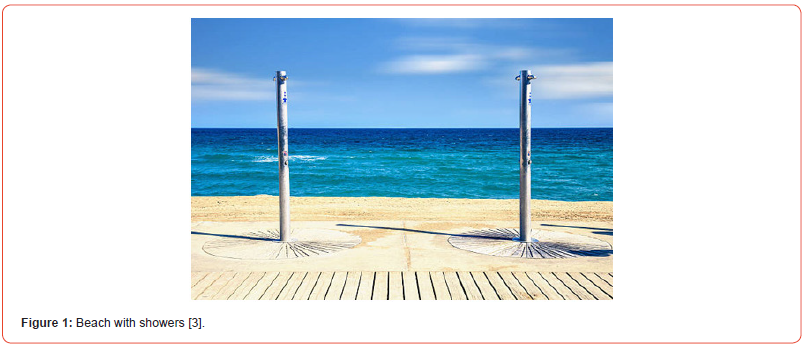
It is very common on beaches to use the showers that are installed to cool off or wash off sand (they are never intended for for cleaning purposes with soap). Practically all beaches along the coastline, Figure 1, at least in Spain, have showers that serve these purposes.
To give scientific robustness to the estimations and initial design, a mixed methodological approach is adopted (Figure 2), combining quantitative analysis and conceptual modelling:

a. Data collection and usage assumptions: simplified estimation
of general occupancy values, usage times and flow rates of
public shower facilities from municipal sources and technical
reports.
b. Calculation of consumption per service point (shower) during
the summer period.
c. Conceptual modelling of the collection, filtration and dosing
system, with estimation of pressure losses, pump requirements
and sizing of auxiliary tanks
d. Simple energy analysis (avoided electricity consumption and
energy incorporated in materials) and economic sensitivity
assessment in response to variations in water price and
equipment service life.
e. Literature review and comparison with patents and
commercial solutions to validate technical feasibility..
The following technical sections will develop the initial calculations, the assumptions used and the design criteria for the proposed prototype.
Calculation of the Necessary Water Supply
The first part of this study is to estimate the volume of water
used for this purpose. To do this, the key variables and assumptions
are specified:
a. Flow rate per flush (Vacc): 2.5 L (taken from sampling of
standard public showers [4]).
b. Maximum activation frequency: 4 activations/min
(conservative assumption for periods of high demand) [4].
c. Daily availability: 10 hours/day (10:00–20:00).
d. Number of days in season: 90 days (23rd June–21st
September).
e. Unit price of drinking water: 2 €/m³ (national average) [5].
f. Expected useful life of the installation: 10 years (design
assumption for public equipment exposed to a marine
environment) [6].
Therefore, the volume of water required per day is

Taking into account the summer period, the total volume of water used amounts to 540 m3.
And considering an average value of 2 €/m3 in Spain, approximately 1100 € would be spent on water per summer period per shower installed.
Technical Specifications and Design of the Saltwater Shower
The design of a shower that works with saltwater must prioritise efficiency, durability and environmental sustainability. The collection system must be simple and have a minimal impact on the environment. It is recommended to use a vertical intake buried under the sand [7], which allows access to the marine water table and takes advantage of the natural filtration of the substrate. This type of collection acts as a natural pre-filter, reducing the presence of particles and sediments in the water before it is pumped to the shower. The latter, vertical drainage, would be the simplest due to the simplicity of the civil engineering work required to collect the water. The complexity of the other types of collection is excessive, as the device to be used should have a manual pumping system that does not require a large flow rate. The pumping system can be based on a manually operated pump or a small, low-power mechanical device. Piston or diaphragm pumps are suitable, as they generate the necessary pressure without relying on electrical power. In addition, their mechanical simplicity facilitates maintenance and reduces the possibility of breakdowns. If an automated system is installed, it is recommended to incorporate non-return valves and a flow regulator to optimise consumption.
The pumped water must undergo a basic filtering and disinfection process. A double filtering system – with a mesh filter to retain coarse solids and a microfiltration cartridge for fine particles – ensures adequate quality for the required use. Disinfection can be carried out using a chlorine dosing device or equivalent solutions, maintaining safe and stable concentrations. This treatment, although mild, is essential to prevent the proliferation of microorganisms in the pipes. All structural and hydraulic components must be made of materials resistant to salt corrosion, such as AISI 316 stainless steel [8], engineering plastics such as high-density polyethylene or PVC-U [9], or glass fibre reinforced composites. These materials offer good durability in coastal environments and require minimal maintenance. In addition, their lightness and strength facilitate assembly, disassembly and recycling at the end of their useful life. The overall design of the installation should allow for quick and safe maintenance. Filters and dispensers should be easily accessible for cleaning or replacement, and the system should include drain valves to facilitate drainage and prevent fouling. A weekly check is recommended during the season of use and a full inspection at the beginning and end of the summer.
Finally, the environmental integration of the system is a key aspect. The shower must blend in with the beach environment, using discreet structures and non-invasive materials. In addition, its operation must minimise energy consumption and avoid any discharge that could alter the marine ecosystem. A well-executed design not only improves the user experience, but also reinforces the commitment to the circular economy and sustainable water management. Subsequently, a search of the literature revealed that since 2007 there has been a registered patent for a prototype that reproduces a system equivalent to the one proposed. Specifically, the ‘Pit Stop’ (patent: November 2007, owned by Armando Clemente Fantini) is also applicable in lakes, rivers, etc. and can be installed on sand or soil [10].
Two commercial alternatives have been found:
a. Ecological Shower - PIT STOP - Refresh Brazil [10].
b. A project for saltwater beach showers (Figure 3) created in
Torremolinos seeks to revolutionise bathing in the 21st century
[11].

Economic Assessment
The main indicators of the simplified economic study of the
proposal are summarised briefly below:
a. Capital Expenditures (CAPEX): initial estimate ≈ 1000 € per
unit (materials, installation and assembly).
b. Operational Expenditures (OPEX): estimated annual
maintenance (spare parts, filters, disinfectant) 50 –150 €/year.
c. Annual savings in drinking water: taking into account 540
m³/year and a price of 2 €/m³ → 1080 €/year
d. Amortisation: simple payback ≈ 1–2 years. With a useful life
of 10 years, NPV and IRR would be positive in medium water
tariff scenarios.
In other words, it has been estimated that the cost of the shower would be amortised in one summer. Assuming that the average lifespan of each shower is around 10 years, the water savings would amount to more than 5,400 m³ and, financially, to 10000 €.
Conclusions and Prospects
From a social and technological perspective, the adoption of saltwater showers may represent an opportunity to promote environmental education and innovation in coastal infrastructure. Their implementation would serve not only as a water-saving measure, but also as a tangible example of adaptation to climate change and the real-world application of circular economy principles in tourist environments. Technically, the viability of the system depends heavily on critical factors such as the selection of the coastal collection point and a filtration and dosing system calibrated for local water quality. Therefore, it would be interesting to carry out hydrochemical and microbiological sampling at the proposed collection points under different tidal and weather conditions. On the other hand, it would be desirable to build a pilot prototype with instrumentation to measure actual flow rates, frequency of use, disinfectant consumption and water quality parameters (turbidity, coliforms, residual chlorides…).
In terms of economics, it is important to select materials and designs that minimise corrosion and maintenance in a marine environment in order to maximise its life. In addition, it would be appropriate to carry out a life cycle study of the shower and a more detailed economic analysis including maintenance costs in order to obtain a robust sustainability assessment. Similarly, it would be interesting to consider citizen participation and communication campaigns to ensure appropriate use and social acceptance. With these steps, the initiative can be transformed from a proof of concept to a replicable and standardisable solution on coastlines with drinking water shortages. Whatever the case, after completing this simplified study, it can be concluded that it would be very interesting to install saltwater showers on beaches. It is economically profitable from the first year onwards and would involve the responsible use of fresh water.
Society must become aware that anything that does not require high-quality fresh water should be done with reclaimed water, rainwater or, as in this case, salt water, without exacerbating the possible water stress in some regions in the coming years.
Acknowledgement
The authors would like to thank the Water Hall “CABB” (The Bilbao Bizkaia Water Consortium (CABB, in Spanish), a Business Hall located at the Bilbao School of Engineering, where data to make this revision related to energetic generation along the water supply system of Greater Bilbao were available.
Conflict of Interest
No Conflict of Interest.
References
- (2025) What percentage of water does the Earth have and its distribution?
- (2019) Agua y Economía Circular. Fundación Conama.
- (2025) free-beach-shower-picture-id187362565 (612×408)
- (2021) BLUE FLAG BEACH CRITERIA.
- (2025) Price of water in Spain per liter and cubic meter.
- (2025) What Are the Benefits of an Outdoor Shower?
- Diane P Horn (2002) Beach groundwater dynamics. Geomorphology 48(1–3): 121-146.
- (2025) Acero Inoxidable 316 Ficha Tecnica, Acero AISI 316 Propiedades, Inox 316 S.
- (2025) Polypropylene vs. PVC: What are the differences? https://es.cnpolychemer.com/news/polypropylene-vs-pvc-what-are-the-differences-79405133.html; https://www.fontanerialucero.es/cuales-son-las-ventajas-y-desventajas-de-pead-y-pvc/.
- (2025) Pit Stop Beach.
- (2025) A saltwater beach shower project created in Torremolinos seeks to revolutionize 21st-century bathing.
-

This work is licensed under a Creative Commons Attribution-NonCommercial 4.0 International License.