


 Case Report
Early Metabolic Response to IDH Inhibitor Treatment in Grade 2 Astrocytoma
Received Date:February 23, 2026; Published Date:March 09, 2026
Case Report
A 37-year-old right-handed woman with no comorbidities developed headaches and multiple episodes of right-sided paresthesia and olfactive hallucinations linked to focal inaugural epilepsy. Magnetic Resonance Imaging (MRI) revealed a large nonenhancing infiltrative lesion on FLAIR sequences located in the left temporo-insular region. 18F-Fluoroethyl-Tyrosine (FET) Positron Emission Tomography (PET) revealed hypermetabolism at the superior border of the left temporo-insular lesion. Functional MRI indicated that the left temporo-insular tumor was enveloped by the arcuate fasciculus with a dangerous proximity (of the order of half a centimeter) to Wernicke’s area at the posterior depths of the superior temporal sulcus. The patient underwent neuronavigation-guided partial resection twenty-five days after the occurrence of the first epileptic phenomenon. Postoperative MRI confirmed partial removal without complications. The patient experienced immediate improvement in the frequency of partial seizures. Immunohistochemical and molecular analyses revealed an isocitrate dehydrogenase (IDH) type 1-mutant, WHO grade 2 astrocytoma.
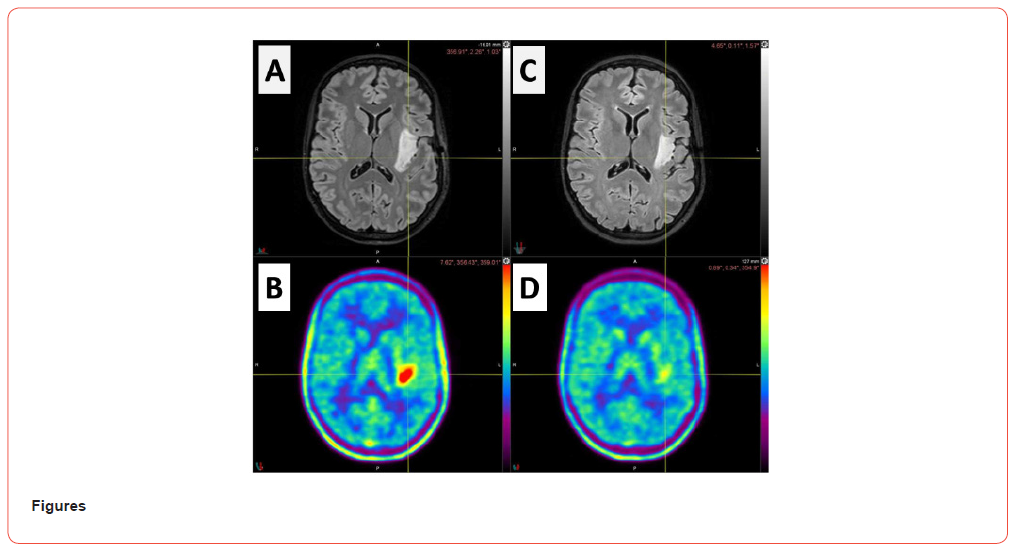
To delay radiotherapy, the adjuvant therapeutic option after subtotal resection of grade 2 diffuse astrocytoma, for this young patient, we opted for oral administration of the IDH inhibitor Vorasidenib (Servier) through a compassionate-use program. MRI and FET-PET seven weeks after surgery and prior to treatment with IDH inhibitor revealed a residual tumor in the FLAIR sequence (Figure 1A) with persistent metabolic activity at the superior border of the resection cavity (Figure 1B).
Eleven weeks after the initiation of IDH inhibitor treatment, FET-PET revealed an early, almost complete metabolic response of the residual glioma. After six months of IDH inhibitor therapy, MRI revealed a slight decrease in the FLAIR volume hyperintensity in the left lateral temporal lobe (from 16 cm3 to 12 cm3) (Figure 1C) whereas FET-PET confirmed a maintained metabolic response (Figure 1D). The IDH inhibitor dosage was reduced from 40 mg daily to 20 mg daily because of patient fatigue and an increase in hepatic transaminase levels as revealed by blood analyses. The patient-reported frequency of focal epileptic seizures improved with the use of Vorasidenib. FET-PET imaging appears to be useful for early assessment of the treatment response to IDH inhibitor for patients with residual IDH-mutated glioma.
Declaration of Interest
Declaration of Interest
Acknowledgments
The IDH inhibitor was provided by Servier through a compassionate use program (Belgium, ref CUP- 202417)
-

This work is licensed under a Creative Commons Attribution-NonCommercial 4.0 International License.