


 Research Article
Predictors of Early Mortality in Patients with Multiple Myeloma in Urban Ugandan Cancer Treatment Centres: A Retrospective Study
Received Date:April 21, 2026; Published Date:May 11, 2026
Abstract
Background: Multiple myeloma (MM) is a clonal plasma cell proliferative disorder characterized by the abnormal increase of monoclonal
paraprotein leading to evidence of specific end-organ damage. There is scanty literature on predictors of early mortality among multiple myeloma
patients across sub-Saharan Africa and Uganda in particular. Therefore, this study assessed predictors of early mortality (six-months from MM
diagnosis) among multiple myeloma patients in urban cancer centers of Uganda.
Method: This was a retrospective chart review study among 191 participants, medical records reviewed were between December 2019 and
February 2023. Data was collected using structured questionnaire, entered into REDCAP, transferred to STATA version 17.0 for statistical analysis.
Descriptive statistics for continuous and categorical variables was done; chi-square test and logistic regression analysis were performed to determine predictors of early mortality among MM patients at confidence level of p<0.05.
Results: In this study the mean age of participants was 57.66 years and SD ±11.29years. Early mortality within six months of multiple myeloma
diagnosis was 26.7% (51/191). Predictors of early mortality were; patient-reported fatigue (aOR: 2.38, CI: 1.01 – 5.61, P=0.046), Hepatitis B infection (aOR: 11.83, CI: 1.49 – 93.68, P=0.019), and Hemoglobin level <7.0g/dl (aOR: 3.45, CI: 1.39 – 8.56, P=0.008), and non-adherence to treatment (aOR: 61.54, CI: 7.96 – 675.5, P<0.001),were independently associated with early mortality among MM patients.
Conclusion and Recommendation: Early mortality within six months of MM diagnosis is generally high MM among patients. The ministry of
health and related stake holders in health should design strategies aimed at preventing early mortality among MM patients, these strategies may
include but not limited to early screening for co-morbidities in MM patients, and optimize adherence to cancer treatment among patients.
Keywords:Predictors; early mortality; multiple myeloma; patients; uganda
Abbreviations: LMICs: Low-middle-income countries; WHO: World Health Organization; SS: Sub-Saharan Africa; MM: Multiple myeloma; UCI: Uganda Cancer Institute; SFH: St. Francis Hospital
Introduction
Multiple myeloma (MM) is a clonal plasma cell proliferative disorder characterized by the abnormal increase of monoclonal paraprotein leading to evidence of specific end-organ damage [1]. Globally, the incidence of multiple myeloma is estimated at 16000 and mortality of 106,000, accounting for 10% of all hematological malignances [2]. The global incidence and outcome of MM show significant disparities, indicating under-recognition and suboptimal treatment in many parts of the globe [2]. Across Africa, the incidence of MM per 100,000 population ranges from 0.44 in the eastern region to 2.14 in the southern region [3]. In Uganda, MM has been demonstrated to show a progressively increasing incidence rate (per 100,000) of 0.4, 0.7, and 1.9 among males and 0.5, 0.9 and 1.7 among females for the periods of 1991–1995, 1996–2001, and 2002–2006 respectively [4].
Multiple Myeloma, is a hematological malignancy of plasma cells with no exact etiology known. However, frequent alterations and translocations in the promoter genes, especially chromosome 14, are commonly found in multiple myeloma and likely play a role in disease development. In addition, other oncogenes such as NRAS, KRAS, and BRAF may participate in plasma cell proliferation. Other factors contributing to disease occurrence include obesity, alcohol consumption, environmental causes such as insecticides, organic solvents, agent orange, and radiation exposure [5-7].
Prior to the introduction of novel therapies, early mortality in newly diagnosed MM (NDMM) was reported to occur in 10%–25% of patients within the first 6 months [8]. A study of clinical trials conducted between 1980 and 2002, reported overall that 10% of patients died within the first 60 days of therapy [9]. Predictors of early mortality among MM patients highlighted from previous literature included, patients age, co-morbidity with cardiac diseases, and pulmonary disease [10]. However, these previous studies have been carried out mostly in developed countries creating paucity of information of characteristics and predictors of early mortality in low-and middle-income countries Uganda in particular [11]. Investing into the predictors of EM in our context is important in that we improve clinical suspicion, early diagnosis or referral, and to draw attention to those complications that are associated with poor prognosis [12]. The aim of this study is to assess predictors of EM in patients with MM managed at SFH Cancer Center and Uganda cancer institute.
Materials and Methods
Study Design and Setting
This was a retrospective chart review study. Participants medical files were retrieved and information was extracted using study questionnaire. The study was conducted at St. Francis hospital Nsambya (SFH) Cancer Center and Uganda Cancer Institute (UCI). SFH founded in 1903 is a tertiary highly specialized referral hospital located in Kampala, the capital City of Uganda. The hospital houses a postgraduate medical school for Uganda Martyrs University. UCI is a public, specialized, tertiary care medical facility owned by the Uganda Ministry of Health. UCI is designated as East Africa’s Centre of Excellence in Oncology, located along upper Mulago hill road on Mulago hill, Central division Kampala about 5 Km North East of the central business district of the city.
Study Population and Eligibility Criteria
This study reviewed medical records of patients diagnosed with multiple myeloma at St. Francis hospital Nsambya and Uganda Cancer Institute from January 2019 to December 2023. The study never involved physical interaction with the patients of MM. All files for patients with multiple myeloma having incomplete patients’ data, treatment or care offered to patients were not included for review in this study.
Sampling and File Selection
At SFH sixteen files were retrieved of patients diagnosed with multiple myeloma. Fourteen out of the sixteen files met the requirements for inclusion in this study. At UCI two hundred thirty files were retrieved and only one hundred seventy-seven files met all the requirements for inclusion in this study. After screening for eligibility all files were consecutively enrolled in this study. Data extraction lasted for about 30 days.
Data Collection Tool
Data was collected using structured questionnaire designed by the researcher from the review of previous literature on MM. The questionnaire was comprised of three sections, section A: on socio-demographic characteristics of the participants (age, sex, occupation, level of education, address, tribe), section B: on level of early mortality 6 month from time of diagnosis, this was assessed using Yes and No question, presenting signs and symptoms. Section C: associated factors (time of diagnosis, co-morbidities, treatment regimen, treatment duration, staging of MM). The data collection tool was tested for a validity index score.
Data Collection Procedure
Data was collected by the trained three research assistants with bachelor’s degree of science in nursing. All patients’ files were assessed for eligibility before actual process of data extraction. The researcher and his three research assistants extracted data from the patient’s files directly into the study tool. Prior to data collection, the principal investigator briefed his research assistants about the study, the study tool and the information to be captured during the data extraction process. Data on bio-demographic characteristics, presentation issues, laboratory markers, serum Para protein levels and immunotyping, bone marrow analysis, severity score, chemotherapy regimen and time-to-event were collected as per the sections in the data collection tool. All questionnaires were checked for completeness to ensure no missing information is not captured. The extraction process lasted for a period of three month.
Data Management and Analysis
On completion of every data extraction session, questionnaires were checked for completeness. The filled data tools were then entered by the researcher into REDCAP (Research Electronic data capture), with data entry checks to avoid entering erroneous data. The data set was then exported to STATA version 17/MP for statistical analysis. The collection tools were then tagged and kept under double lock safety cabinet. The data collection tools are stored by the PI and will be destroyed by burning as per institution time limit of storing research tools which is ten years.
Data were analyzed using STATA software version17.0. Descriptive statistics was performed and continuous variables will be presented as range, mode, mean and standard deviation (SD). Categorical variables were presented in terms of frequencies and percentages in appropriate tables and charts. Statistical association was determined using chi-square test at 95% level of significance, p<0.05. variables significant at bivariate analysis were assessed for collinearity and that fit were selected and included in the multivariate model at 95% confidence interval to generate predictors independently associated with the primary outcome (early mortality) among MM patients. The association from the analysis was reported in terms of odd ratios
Results
Demographic Characteristics of Study Participants
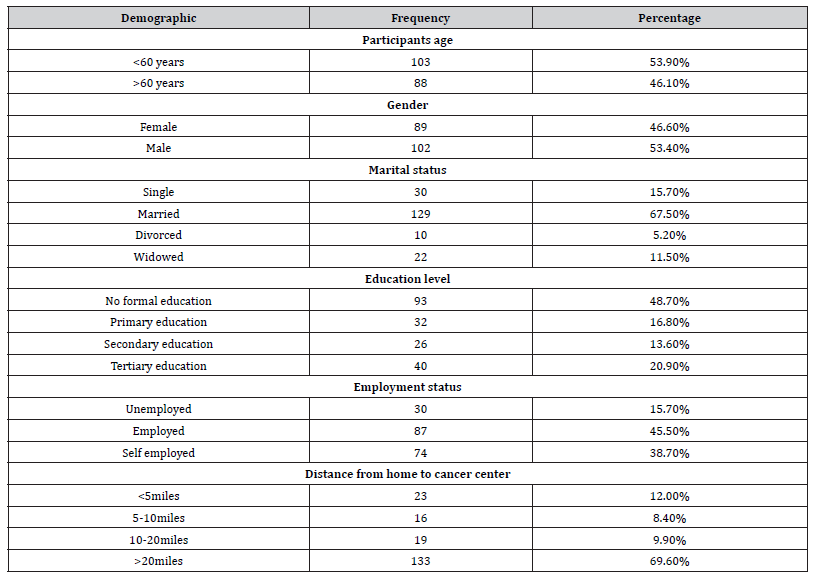
In this study 191 participants were enrolled, with mean (SD) age of 58±11 years, majority of the participants were; males 53.4% (102/191), below 60 years 53.9% (103/191), married 67.5% (129/191), lived >20 miles from home to cancer center 69.6% (133/191) as shown in Table 1 below.
Table 1:demographic characteristic of study participants (N=191).
MM Staging, Clinical Symptoms of Patients at MM Diagnosis
Majority of the study participants had unknown ISS stage 63.9% (122/191), then those with ISS stage III were 31.4% (60/191). In this study patients also presented with the following symptoms; bone pains 86.4% (165/191), fatigue 46.1% (88/191), weight loss 6.3% (12/191), abdominal distention 5.8% (11/191), as shown in Table 2 below.
MM Patient’s Clinical Signs in this Study
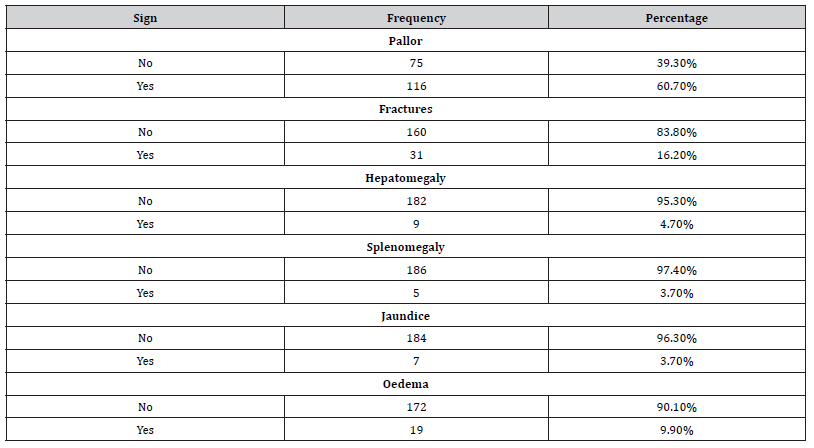
Patients in this study presented with the following signs at the time of diagnosis; pallor 60.7% (116/191), fractures 16.2% (31/191), oedema 9.9% (19/191), hepatomegaly 4.7% (9/191), splenomegaly 3.7% (5/191), jaundice 3.7% (7/191), as shown in Table 3 below.
Table 2:MM staging, and Clinical symptoms of patients at MM diagnosis.
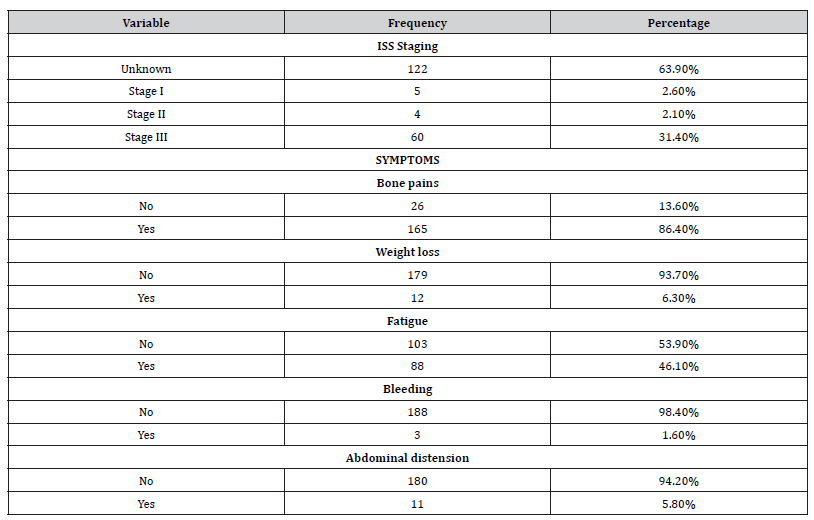
Table 3:Signs among patients of MM.
Early Mortality (Six Months) from Diagnosis with Multiple Myeloma
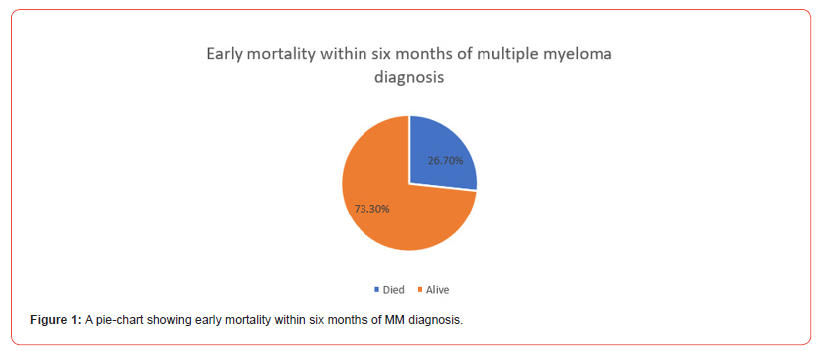
Early mortality within six months of multiple myeloma diagnosis was 26.7% (51/191) as shown in the Figure 1 below.
Bi-variate Analysis of Socio-Demographic, Clinical Symptoms and Signs Associated with Early Mortality among MM Patients
On bivariate analysis using chi-square test, the following variables were; fatigue (p=0.033), hypercalcemia (p=0.028), pallor (p=0.019), hepatomegaly (p=0.005), jaundice (p=0.006), were significantly associated with early mortality among MM patients. As shown in Table 4 below.
Bi-variate Analysis of Comorbidities Associated with Early Mortality
On bivariate analysis using chi-square test, comorbidity with Hepatitis B infection (p=0.006) was significantly associated with early mortality among MM patients as shown in Table 5 below.
Table 4:Bi-variate analysis of socio-demographic, clinical symptoms and signs associated with early mortality among MM patients.
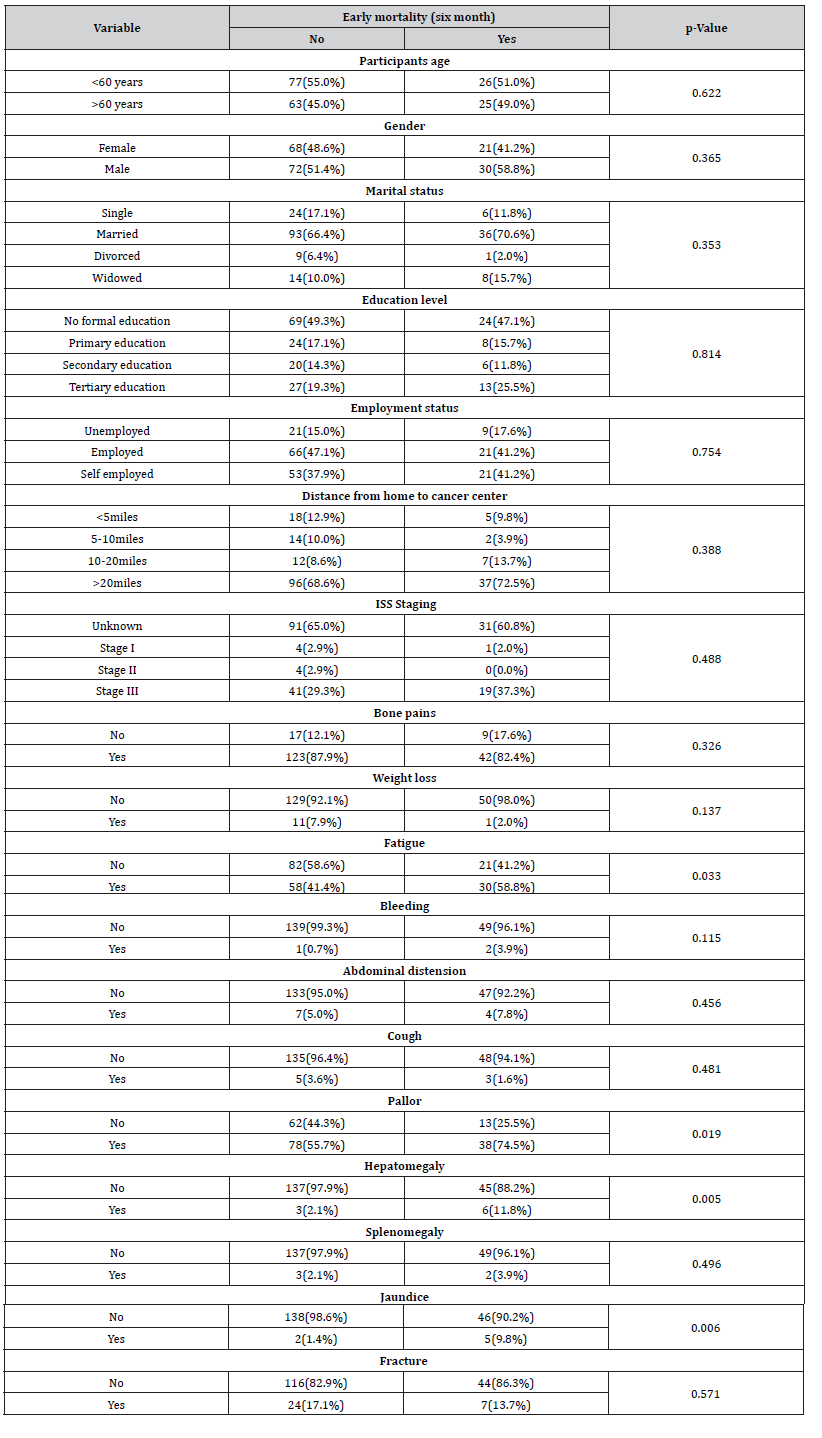
Chi-square value (X2), degree of freedom (df), 95% significance level p<0.05
Table 5:Bi-variate analysis of comorbidities associated with early mortality.
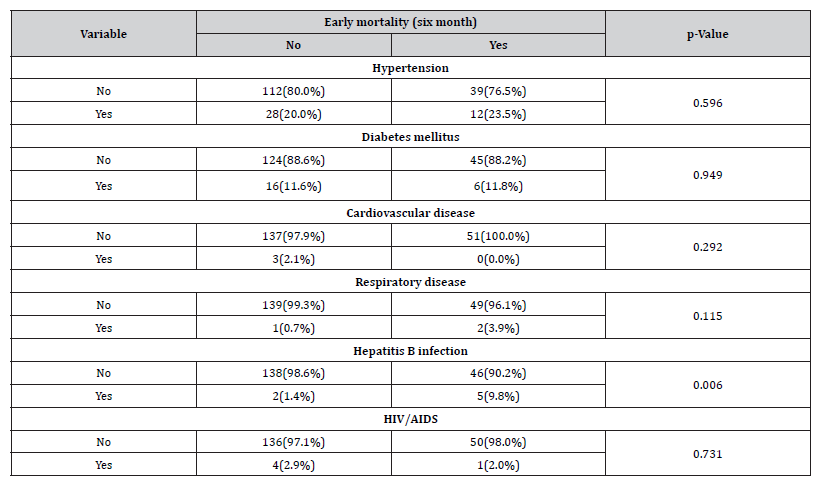
Chi-square value (X2), degree of freedom (df), 95% significance level p<0.05
Bi-variate Analysis of Clinical Investigations Parameters Associated with Early Mortality among MM Patients
On bivariate analysis using chi-square test, the following variables were hemoglobin level (p-0.000), LDH (p=0.023), Platelet count (p=0.011), adherence to treatment (p-0.000) and EGFR (P=0.028 were significantly associated with early mortality among MM patients as shown in Table 6 below.
Table 6:Bi-variate analysis of clinical investigations parameters associated with early mortality among MM patients.
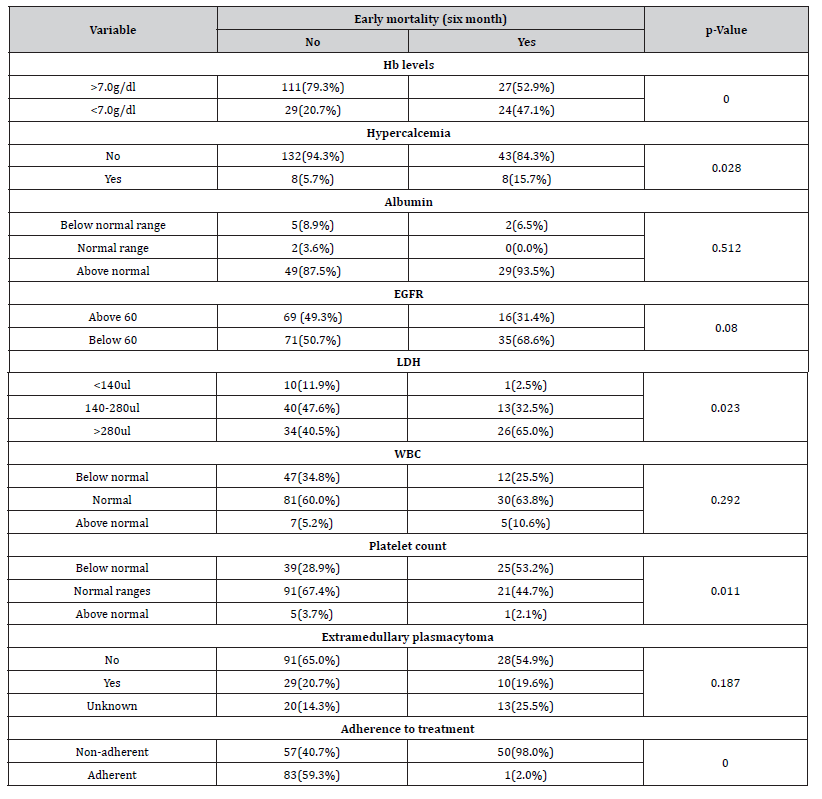
Chi-square value (X2), degree of freedom (df), 95% significance level p<0.05
Multivariate Analysis of Predictors Associated with Early Mortality among MM Patients
From bivariate analysis ten variables were significantly associated with early mortality. Variable were checked for collinearity, and three variables such as platelet count, jaundice and pallor were excluded and not included in the logistic regression model. seven variables were analyzed on multivariate level, Hosmer Lemeshow fitness was done and found fitting for the variables included in the model. Regression was done at significance level of 95%, p<0.05.
Predictors independently associated with early mortality include; presentation with fatigue (aOR: 2.38, CI: 1.01 – 5.61, P=0.046), Hepatitis B infection (aOR: 11.83, CI: 1.49 – 93.68, P=0.019), Hb below 7g/dl (aOR: 3.45, CI: 1.39 – 8.56, P=0.008), and non-adherence to treatment (aOR: 61.54, CI: 7.96 – 675.5, P-0.000), were independently associated with early mortality among MM patients. As shown in Table 7 below.
Table 7:Predictors independently associated with early mortality among MM patients.
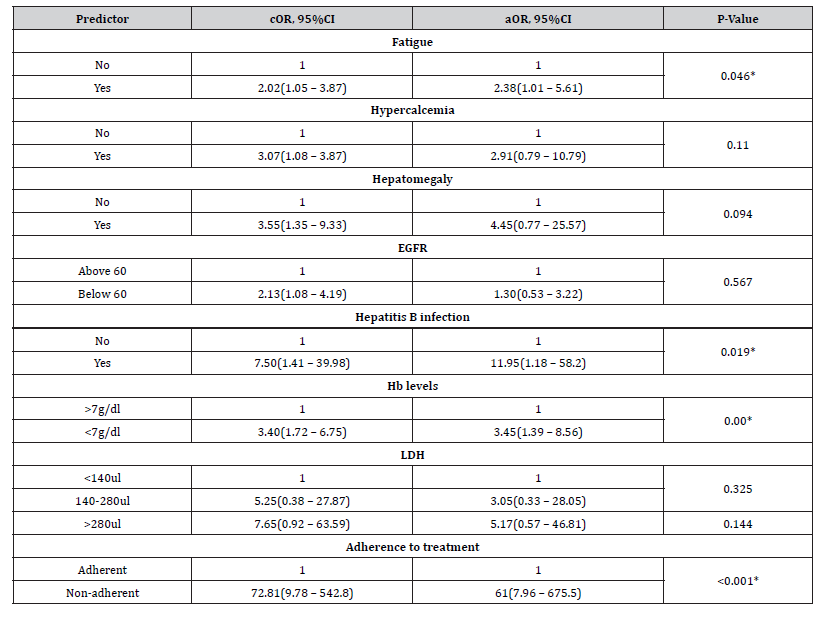
Crude odds ratio -cOR, adjusted odds ratio-aOR, 95% confidence level, p<0.05.
Discussion
This study was conducted among 191 participants, medical records reviewed were between December 2019 and February 2023. Majority of the participants were males with 53.5% (102/191), and also majority of the participants were aged below 60 years 53.9% (103/191), this finding conforms with the result from a previous study done in Uganda where majority of the participants were males 54.8%, and a mean age of 59 years [11]. Our study shares one of its data collection sites (Uganda Cancer Institute) with the previous Ugandan study [11]. This result also conforms with the global epidemiological evidence of multiple myeloma being more prevalent among males [13]. However, our results on age of MM diagnosis differ from that report in a retrospective analysis of 32 patients diagnosed with multiple myeloma in Nigeria showed a median age at diagnosis of 62 years [12].
In this study, the observed early mortality rate within six months of multiple myeloma (MM) diagnosis was 26.7% (51/191), a finding notably higher than rates reported in high-income countries. Specifically, this contrasts with a 4.5% mortality rate in New Zealand and 8.3% in the USA within the same timeframe, as reported by [10,14] respectively. This significant discrepancy cannot be solely attributed to variations in sample size, despite the substantial difference in patient recruitment (our study: 191 patients; New Zealand: 2377 patients; USA: 7512 patients). While larger sample sizes in the comparative studies may yield more precise estimates and potentially capture a broader range of patient characteristics, the magnitude of the difference strongly suggests underlying systemic factors. A more plausible explanation lies in the pronounced variations in healthcare systems and resource availability between Uganda and these developed nations. High-income countries typically possess robust healthcare infrastructures, including advanced diagnostic capabilities for earlier detection, more comprehensive access to novel therapeutic agents (e.g., proteasome inhibitors, immunomodulatory drugs, monoclonal antibodies), and superior supportive care interventions such as prompt infection management, blood product transfusions, and renal support. In contrast, low-income settings like Uganda often face limitations in timely diagnosis, restricted access to specialized oncological treatments, and challenges in managing treatment-related toxicities and infectious complications due to resource constraints, directly impacting patient outcomes and contributing to elevated early mortality rates in complex malignancies like MM [16].
Patients who presented with fatigue in our study as symptom were two times more likely to die within six months of MM diagnosis compared to their counterparts with no fatigue. Our findings concur with results from a previous study were patient-reported fatigue was almost two times associated with early -mortality among newly diagnosed MM patients [17]. Previous literature is suggestive that fatigue can lead patients to abandon treatment, presence of fatigue and pain have a negative impact on physical functionality among MM patients [18,19]. Fatigue and weakness, drowsiness, and confusion can also be attributed to the prominent increase in the concentration of serum globulin (hyper viscosity), calcium levels, and anemia associated with MM, these have also been ruled out as red flags for MM among patients [19].
Furthermore, this study revealed a statistically significant association between Hepatitis B virus (HBV) coinfection and early mortality in multiple myeloma (MM) patients. Our findings indicate that MM patients coinfected with HBV were almost twelve times more likely to succumb within six months of diagnosis compared to their uninfected counterparts. This heightened susceptibility to early mortality may be partly explained by the established oncogenic potential of HBV. Existing literature, suggests that HBV infection can contribute to MM pathogenesis, specifically through mechanisms like 1q21 amplification, a known cytogenetic abnormality associated with adverse prognosis in MM [20]. Moreover, the presence of HBV has been posited as an independent prognostic factor in MM patients, underscoring its significant impact on disease trajectory. Consistent with these observations, prior epidemiological studies [21] have indicated that HBV infection may even increase the risk of developing MM. The elevated mortality observed in this cohort aligns with the broader understanding that infections represent a predominant cause of morbidity and mortality in MM patients. The inherent immunosuppression due to the underlying malignancy itself, coupled with the myelosuppressive effects of anti-myeloma therapies, renders these patients highly vulnerable to opportunistic and severe infections. While a reported infection-related mortality rates of 1.2% within the first six months (1% within four months) in their cohort [22], our significantly higher observed mortality in HBV-coinfected patients suggests that specific viral coinfections like HBV may exacerbate this vulnerability beyond generalized infectious risks, potentially through direct pathogenic mechanisms or by complicating treatment protocols.
This study determined that patients presenting with hemoglobin levels below 7.0 g/dL at the time of multiple myeloma (MM) diagnosis faced an almost four-fold increased risk of mortality within six months compared to those with hemoglobin levels at or above this threshold. This observation is consistent with findings from a prior investigation in Turkey by Dogan et al., 2022, which similarly reported a statistically significant association between lower hemoglobin levels and heightened early mortality among MM patients. The underlying mechanism for this severe anemia in MM is multifaceted. A significant contributor is the direct infiltration of the bone marrow by malignant plasma cells, physically disrupting normal hematopoiesis. Furthermore, the myeloma cells within the bone marrow microenvironment actively secrete high levels of chemokines, notably CCL3 (macrophage inflammatory protein-1 alpha). CCL3 has been shown to disrupt erythropoiesis in hematopoietic stem and progenitor cells (HSPCs) by suppressing the expression of key transcription factors essential for red blood cell differentiation and maturation, as elucidated by [24]. This impaired erythropoietic activity, combined with potential contributions from chronic inflammation, renal dysfunction, and treatment-related myelosuppression, collectively contributes to the severe anemia observed in MM patients, which in turn significantly compromises physiological reserve and increases vulnerability to adverse outcomes, including early death.
Finally, our analysis revealed a profoundly critical association between non-adherence to chemotherapy treatment and early mortality in multiple myeloma (MM) patients. Specifically, patients exhibiting non-adherence were found to be 62 times more likely to die within the first six months of MM diagnosis when compared to their treatment-adherent counterparts. This stark difference underscores the fundamental principle that consistent administration of anti-neoplastic agents is essential to effectively suppress the proliferation of malignant plasma cells. Adherence to the prescribed chemotherapy regimen directly counteracts the rapid expansion of cancerous clones, thereby minimizing their detrimental effects on the functionality of normal cells and vital organ systems. When treatment is intermittent or incomplete, it provides an opportunity for the cancerous cell population to rebound and expand unchecked, leading to disease progression, increased tumor burden, and ultimately, greater systemic compromise. This finding is corroborated by external literature; for instance, a Korean study by [25] demonstrated a trend towards improved long-term outcomes, with the good adherence group exhibiting a higher 3-year overall survival (OS) rate (70.9%) compared to the poor adherence group (60.2%, p=0.059), although statistical significance was narrowly missed in their specific cohort. The dramatic impact observed in our study highlights the imperative need for robust support systems and interventions specifically designed to enhance and sustain treatment adherence among MM patients. Such strategies are crucial, particularly in resource-constrained settings like Uganda, to ensure patients receive the full benefit of their prescribed therapy, thereby improving their chances of achieving disease control and reducing the devastating risk of early mortality.
Limitation and Strength of the Study
The study acknowledges several limitations that may influence the generalizability and interpretation of its findings. Firstly, the sample size, comprising 191 participants, is relatively small. This inherent constraint means that the findings may not be fully representative of the broader Multiple Myeloma patient population across Uganda, thus limiting the direct extrapolation of our results to all individuals affected by the disease within the country. However, a significant mitigating factor and strength of our study lies in its utilization of data from two distinct cancer centers: one a government-funded institution (Uganda Cancer Institute) and the other a private healthcare setting (St. Francis Hospital Nsambya Oncology Unit). This dual-center approach, encompassing different operational models, enhances the generalizability of our findings by offering a broader perspective on cancer management challenges and opportunities within both public and private healthcare landscapes in Uganda.
Conclusion and Recommendation
In this study early mortality within six months of MM diagnosis is generally high at 26.7% among patients. Predictors were comorbidity with patient-reported fatigue, hepatitis B infection, hemoglobin below 7g/dL, and poor adherence to treatment were independently associated with early mortality among MM patients. The ministry of health and related stake holders in health should design strategies aimed at preventing early mortality among MM patients, these strategies may include but not limited to early screening for co-morbidities in MM patients, and optimize adherence to cancer treatment among patients.
Declaration
Ethical Considerations
This research was conducted following the Helsinki Declaration. Ethical approval for this study was obtained from St. Francis hospital Nsambya research ethics committee- NH/DDCS/ RESCH/68/24. A waiver of consent to access the charts was also sought from the REC. Administrative permission was sought from St. Francis hospital Nsambya office and Uganda Cancer Institute who grant permission to access patients’ charts. During the data collection, study identification numbers were used on all study related documents to maintain confidentiality and privacy.
Consent for Publication
Not applicable
Availability of Data Materials
The dataset supporting the conclusions of this article is accessible on request from the corresponding author.
Competing Interest
The authors declare that they have no competing interests
Funding
Research reported in this publication was not supported by any internal or external funding source. All the financial support was entirely from the authors.
Authors Contribution
JBB, ODK, AM, DB, and CN contributed in idea conceptualization, protocol development, data coding and data analysis, and manuscript writing.
JBB, ODK, DB, contributed in protocol development, manuscript drafting, and manuscript reviewing.
Acknowledgement
We extended our sincere appreciation to St. Francis Hospital Nsambya and Uganda Cancer Institute for their participation in this study.
Clinical Trial Number
Not applicable
References
- Albagoush SA, Shumway C, Azevedo AM (2023) Multiple Myeloma. StatPearls.
- Ludwig H, Novis Durie S, Meckl A, Hinke A, Durie B (2020) Multiple Myeloma Incidence and Mortality Around the Globe; Interrelations Between Health Access and Quality, Economic Resources, and Patient Empowerment. Oncologist 25(9): e1406-e1413.
- Cancer Today.
- Parkin DM, Nambooze S, Wabwire-Mangen F, Wabinga HR (2010) Changing cancer incidence in Kampala, Uganda, 1991-2006. Int J Cancer 126(5): 1187-1195.
- Pasca S, Tomuleasa C, Teodorescu P, Ghiaur G, Dima D, et al. (2019) KRAS/NRAS/BRAF Mutations as Potential Targets in Multiple Myeloma. Front Oncol 9: 1137.
- Dhodapkar MV (2016) MGUS to myeloma: a mysterious gammopathy of underexplored significance. Blood 128(23): 2599-606.
- Bumma N, Nagasaka M, Hemingway G, Miyashita H, Chowdhury T, et al. (2020) Effect of Exposure to Agent Orange on the Risk of Monoclonal Gammopathy and Subsequent Transformation to Multiple Myeloma: A Single-Center Experience from the Veterans Affairs Hospital, Detroit. Clin Lymphoma Myeloma Leuk 20(5): 305-311.
- Murakami H, Hayashi K, Hatsumi N, Saitoh T, Yokohama A, et al. (2001) Risk factors for early death in patients undergoing treatment for multiple myeloma. Ann Hematol 80(8): 452-455.
- Augustson BM, Begum G, Dunn JA, Barth NJ, Davies F, et al. (2005) Early mortality after diagnosis of multiple myeloma: analysis of patients entered onto the United Kingdom Medical Research Council trials between 1980 and 2002--Medical Research Council Adult Leukaemia Working Party. J Clin Oncol 23(36): 9219-9226.
- McQuilten Z, Wellard C, Moore E, Augustson B, Bergin K, et al. (2022) Predictors of early mortality in multiple myeloma: Results from the Australian and New Zealand Myeloma and Related Diseases Registry (MRDR). Br J Haematol 198(5): 830-837.
- Okello CD, Mulumba Y, Omoding A, Ddungu H, Welch K, et al. (2021) Characteristics and outcomes of patients with multiple myeloma at the Uganda Cancer Institute. Afr Health Sci 21(1): 67-74.
- Madu AJ, Ocheni S, Nwagha TA, Ibegbulam OG, Anike US (2014) Multiple myeloma in Nigeria: An insight to the clinical, laboratory features, and outcomes. Niger J Clin Pract 17(2): 212-217.
- Bray F (2002) Cancer Incidence in Five Continents Volume VIII. Parkin D, Whelan S, Ferlay J, editors. International Agency for Research on Cancer PP. 87-89.
- Grant SJ, Wildes TM, Rosko AE, Silberstein J, Giri S (2023) A real-world data analysis of predictors of early mortality after a diagnosis of multiple myeloma. Cancer 129(13): 2023-2034.
- World Health Statistics.
- Abdallah N, Bohra A, Mammadzadeh A, Buadi F, Kapoor P, et al. (2025) Prognostic impact of patient-reported symptoms in multiple myeloma. Blood Adv 9(4): 884-892.
- Coleman EA, Goodwin JA, Coon SK, Richards K, Enderlin C, et al. (2011) Fatigue, Sleep, Pain, Mood and Performance Status in Patients with Multiple Myeloma. Cancer Nurs 34(3): 21927.
- Türk U, Dalda Y, Olgun A, Akar H (2019) Fatigue as a presenting symptom of multiple myeloma. Demiroglu Science University Florence Nightingale Journal of Medicine 5(3): 149-151.
- Guo D, Xu P, Guan C, Xu Y, Yang Y, et al. (2019) Hepatitis B virus infection and 1q21 amplification in multiple myeloma. Oncol Lett 18(6): 6196-6206.
- Li Y, Bai O, Liu C, Du Z, Wang X, et al. (2016) Association between hepatitis B virus infection and risk of multiple myeloma: A systematic review and meta-analysis. Intern Med J 46(3): 307-314.
- Encinas C, Hernandez-Rivas JÁ, Oriol A, Rosiñol L, Blanchard MJ, et al. (2022) A simple score to predict early severe infections in patients with newly diagnosed multiple myeloma. Blood Cancer J 12(4): 68.
- Dogan EE, Arslan A, Demirel N, Aydin D, Mansuroglu I, et al. (2022) Survival in patients with multiple myeloma: evaluation of possible associations with bone marrow fibrosis and investigation of factors independently associated with survival. Bulletin of the National Research Centre 46(1): 1-14.
- Liu L, Yu Z, Cheng H, Mao X, Sui W, et al. (2020) Multiple myeloma hinders erythropoiesis and causes anaemia owing to high levels of CCL3 in the bone marrow microenvironment. Sci Rep 10(1): 20508.
- Cho HJ, Seo SK, Baek DW, Park SW, Lee YJ, et al. (2018) Chemotherapy adherence is a favorable prognostic factor for elderly patients with multiple myeloma who are treated with a frontline bortezomib-containing regimen. Yeungnam Univ J Med 35(1): 76-83.
-

This work is licensed under a Creative Commons Attribution-NonCommercial 4.0 International License.