


 Review Article
Tidal Volume and Ventilator Induced Lung Injury
Received Date: May 07, 2024; Published Date: November 15, 2024
Abstract
Received Date: March 21, 2024; Published Date: November 08, 2024
Abstract
The current standard of care for patients with acute respiratory distress syndrome (ARDS) which includes Covid 19 is to limit tidal volume for the purpose of reducing lung damage due to ventilator induced lung injury (VILI). In order to achieve adequate gas exchange an elevated respiratory rate is then required. Excessive mechanical power applied to the lungs has been found to be the main cause of VILI. Prediction equations for mechanical power have been developed and applied for constant airflow mode in patients but not for constant pressure. The VILI mechanical power damage threshold for patients may require adjustment because of this difference. The optimal tidal volume and frequency to minimize mechanical power while supplying a given level of alveolar ventilation was derived and proposed as a potentially better method for ventilator adjustment to minimize VILI. Dead space is known to vary significantly with tidal volume in ARDS patients and must be accounted for. The main new additional measurements required over prior methods are patient dead space at more than one tidal volume.
Introduction
The current standard of care for mechanical ventilator used on patients with Acute Respiratory Distress Syndrome (ARDS) including Covid 19 patients limits tidal volume to about 6 mL/Kg to limit lung damage due to Ventilator Induced Lung Injury (VILI) (New Eng J Med 2000). This tidal volume was about half the traditional tidal volume to achieve normal arterial blood partial pressure of CO2 (PaCO2) which were compared in clinical trials. There was a significant difference in mortality rate which justified use of the lower limit. More recently VILI has been linked to mechanical power applied to the lungs [1]and a threshold of damage by VILI estimated [2] at 22 J/min for ARDS patients. A constant airflow mode of ventilation minimizes mechanical resistive power [3] and should also minimize VILI. Prediction equations have already been derived for this mode [1]. Constant pressure is another popular mode used in ventilating patients and will be compared to constant airflow in terms of mechanical power. Constant pressure will be shown to always require higher mechanical power and use of different prediction equations. The VILI threshold may have to be reconsidered because of this difference. The Covid 19 pandemic has led to very high levels of mortality connected to ventilator use [4]. This has apparently led to decreased ventilator use in such patients and raises a question about whether the current low tidal volume limit ARDS strategy is best for patients with Covid 19. The goal of the current work is to re-evaluate the role played by tidal volume limits and how mechanical power and associated VILI might differ for parameters measured in Covid 19 patients.
Mechanical Power Prediction Equations
Constant airflow mode
Yamashiro and Grodins [3] derived the optimal airflow pattern and frequency to minimize mechanical power in normal human subjects. These results can also be applied to ventilated subjects. The optimal airflow pattern was constant airflow during inspiration and passive expiration. The details of the derivation will not be repeated here but the main result was there is no other mode which can result in a lower resistive mechanical power level including the constant pressure mode. This unique property of constant airflow has not been previously emphasized for ventilator applications. The equation predicting mechanical power for constant airflow has been previously derived [1]. This equation was used as a starting point below and extended to include an alveolar ventilation constraint.

Where R=respiratory system resistance, C=respiratory system compliance, f=breathing frequency, VT=tidal volume, PEEP=positive end-expiratory pressure, T=Tin+Texp, b = Tin/Texp, and f = 1/T
Dead space Vd is known to increase in ARDS and Covid 19 patients and alveolar ventilation Va is a necessary constraint to maintain normal arterial blood partial pressure of CO2 (PaCO2). This can be incorporated by substituting into Equation (2)
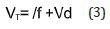
Resulting in total respiratory power

The optimal frequency fopt which minimizes respiratory power can be efficiently predicted by using numerical search functions such as fminsearch in Matlab. After the mechanical parameters are defined, the following two commands can be used:
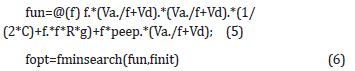
where finit is an initial starting estimate for f. Plots of Equation (4) show a smooth curve over the full frequency range with only a single minimum point so no numerical problems are anticipated. Mechanical parameters R and C can be estimated from respirator measured parameters including Pplateau and Ppeak as previously described [1].
Constant pressure mode
A similar derivation can be made when a constant pressure Pc is applied from a constant PEEP level in a step fashion during inspiration.
Pc -PEEP = V/C + R dV/dt (7)
The temporal solution assuming a constant PEEP application is
V(t)=C (Pc-PEEP) (1+exp(-t/RC)). (8)
The airflow is
d V/dt = (Pc-PEEP)exp(-t/RC)/R. (9)
The respiratory work W can be divided into the elastic and resistive portions as
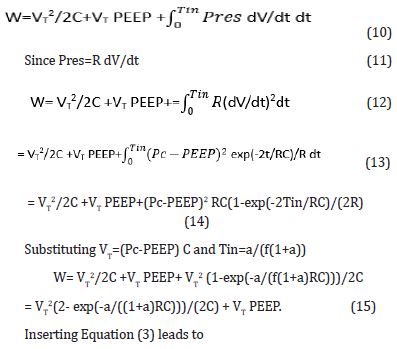

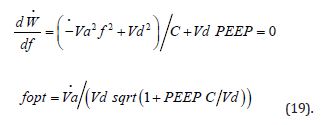
The above equation can be used directly as described earlier for constant airflow to estimate the optimal frequency to minimize respiratory power. A simpler approximation can also be used when RC<<2Tin corresponding to when Pplateau=Ppeak.
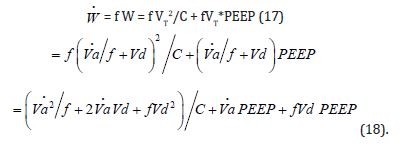
The optimal frequency to minimize power is:
Evaluation of Predictions
Low tidal volume strategy
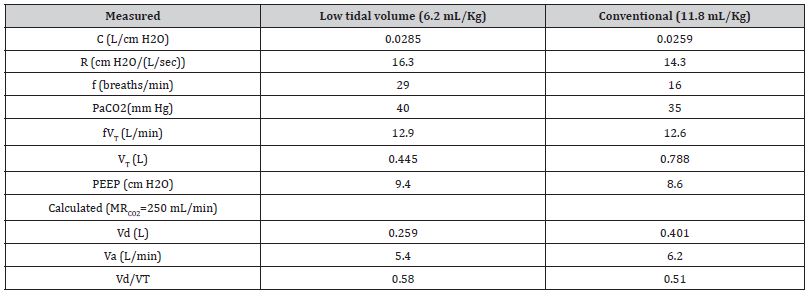
The low tidal volume strategy for minimizing VILI in ARDS patients was based on a clinical trial comparing low and conventional ventilator tidal volumes [5]. Starting with the listed average patient measurements, the parameters for the low and conventional tidal volume groups for day 1 were calculated and are listed in Table 1. The conversion factor used was .098 Joules/cm H2O-L [1]. The estimated mechanical powers were 26 J/min for low tidal volume and 31.5 J/min for conventional based on the parameters in Table 1 and the constant airflow prediction equation. Low tidal volume resulted in significantly lower mortality rate so 31.5 J/min can be concluded to exceed the VILI threshold of damage and 26 J/min below the threshold of significant damage.
ARDS VILI Damage Threshold
The VILI threshold of damage was estimated in pig experiments as 12 J/min [1]. The animals used averaged 20 Kg of body weight compared to 70 Kg for an average adult human. A higher damage threshold is then expected for adult humans which has been estimated as 22 J/min for ARDS patients [5]. This estimate was made based on mechanical power prediction equations assuming constant airflow mode. Review of this study suggested that a constant pressure ventilator mode was actually used for some of the runs. This appeared to be the case because peak and plateau ventilator pressures were reported as equal for several groups. A different prediction formula should then be used as derived earlier which will increase the predicted power level. Equality of peak and plateau pressures also justify use of the simplified equation for constant pressure. For the mild ARDS group, the following parameters can be estimated from the listed data: C=.0393 L/cm H20, VT=.55 L, f=20 Breaths/min, and PEEP=10 cm H2O. This leads to a mechanical power estimate of 26 J/min using Equation (17) and the conversion factor .098 Joules/cm H2O-L mentioned earlier. The listed power estimate was 22 J/min, which was also the estimated damage threshold. Thus, the threshold may actually be 26 J/min or 18% higher. Constant pressure mode with these parameters then leads to 18% more mechanical power compared to constant airflow mode. Two conclusions can then be made: Constant airflow mode should be used to minimize VILI and the threshold of damage due to mechanical power may be 26 J/min. This damage threshold was also equal to the estimated mechanical power for the low tidal volume ARDS group which reported lower mortality [5].
ARDS dead space
ARDS patients have significant gas exchange abnormalities which have been observed to correlate to elevated Vd/VT [6]. Vd in ARDS patients is also known to vary with VT [7]. A linear change of Vd with VT will be initially tried since it has been previously found to adequately fit normal human exercise data [8].
Vd=d0+d1 VT (19).
The parameters d0 and d1 can be estimated from Table 1 after assuming a normal resting metabolic rate (MRCO2=250 mL/min (STPD)) and estimating alveolar ventilation Va and Vd using the measured PaCO2 values. Data from both groups were combined to estimate dead space parameters.
Vd=.0748+.414 VT (20)
The validity of a linear equation is also supported by the data reported by Kiiski [9] which is shown in Figure 1 which compared dead space measurements in ARDS patients at three tidal volume levels. When dead space linearly changes with tidal volume the prediction equation for mechanical power should be modified by the following substitution:
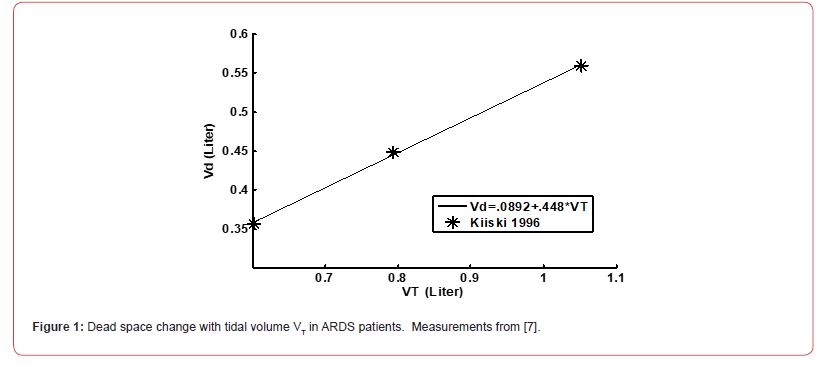
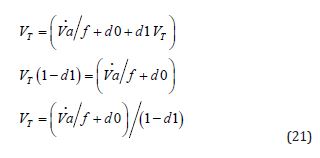
Figure 2 predictions applies a constraint on alveolar ventilation which includes dead space change with VT. For low tidal volume predictions Va = 5.4 L/min and 6.2 L/min for conventional. Parameters for both groups were comparable when tidal volume was not constrained so power versus frequency curves were similar. Minimum power was about 23 J/min at a frequency of 20 breaths/min. The corresponding tidal volumes were .588 L for low tidal volume and .655 for conventional. Use of the minimum power strategy is then predicted to lower mechanical power by 10% compared to the current low tidal volume strategy while maintaining alveolar ventilation at the same level. The parameters in Table 1 for the low tidal volume group were also used to predict mechanical power versus breathing frequency for constant pressure mode as shown in Figure 3. A minimum power of 28.3 J/min was predicted which was 22% higher than what was predicted for constant airflow. Parameters for above were low tidal volume but constant pressure. Fopt=14.4 bPM, power =28.3 (22% higher than constant airflow) (Figure 4).
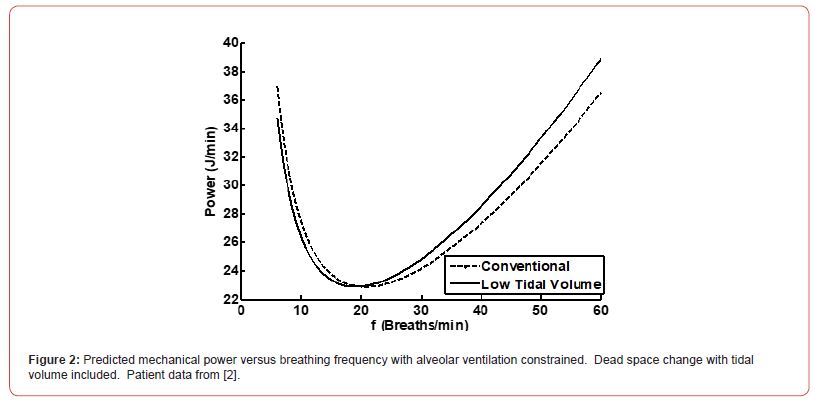
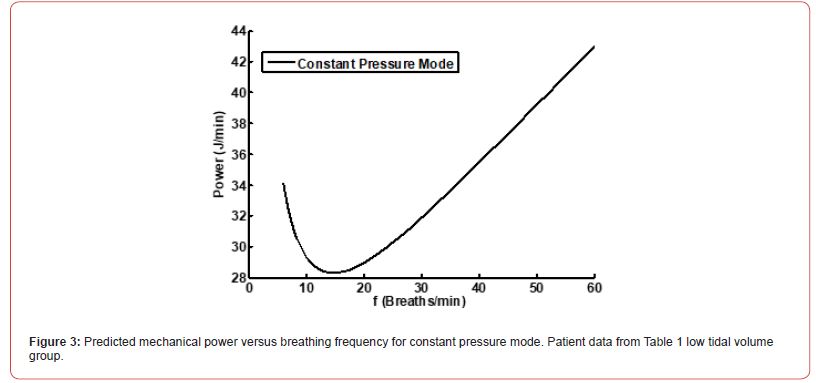
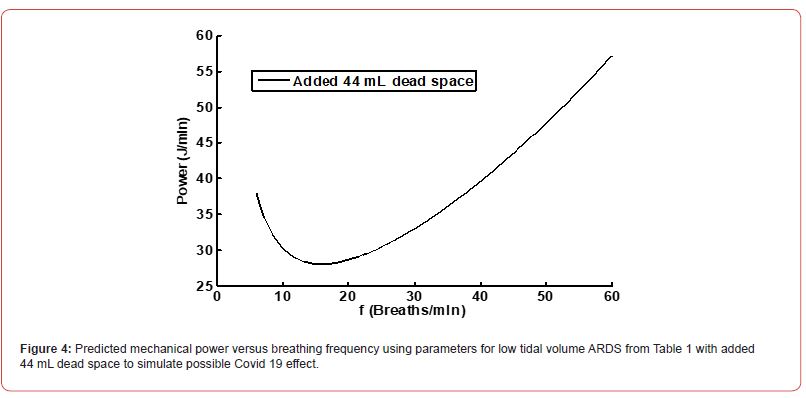
Table 1: Patient parameters for ARDS Clinical Trial.
VILI damage threshold
The VILI threshold of damage was estimated in pig experiments as 12 J/min [1]. The animals used averaged 20 Kg of body weight compared to 70 Kg for an average adult human. A higher damage threshold is then expected for adult humans which has been estimated as 22 J/min for ARDS patients [6]. This estimate was made based on mechanical power prediction equations assuming constant airflow mode. Review of this study suggested that a constant pressure ventilator mode was actually used for some of the runs. This appeared to be the case because peak and plateau ventilator pressures were reported as equal for several groups. A different prediction formula should then be used as derived earlier which will increase the predicted power level. For the mild ARDS group, the following parameters can be estimated from the listed data: C=.0393 L/cm H20, VT=.55 L, f=20 Breaths/min, and PEEP=10 cm H2O. This leads to a mechanical power estimate of 26 J/min. The listed power estimate was 22 J/min, which was also the estimated damage threshold. Thus, the threshold may actually be 26 J/min or 18% higher. Constant pressure mode with these parameters then leads to 18% more mechanical power compared to constant airflow mode. Two conclusions can then be made: Constant airflow mode should be used to minimize VILI and the threshold of damage due to mechanical power may be 26 J/min.
Covid 19 and ARDS
Respiratory mechanical parameter changes for ARDS and Covid 19 were similar [9]. Covid 19 may have an additional effect on alveolar dead space due to thrombus formation at the alveolar level uniquely caused by the virus [10,11]. To explore this possible connection, predictions were made by assuming the parameters for the low tidal volume ARDS patients in Table 1, but adding fixed dead space 10% of baseline VT which approximates the increase measured in Covid 19 patients [6]. The resultant optimal frequency was decreased to 16 breaths/min and minimum power increased to 28 J/min. If Covid 19 does increase dead space due to blood clotting more than ARDS, mechanical power is predicted to increase significantly and VILI damage will be higher.
Discussion
Low tidal volume has been the main strategy used to limit lung damage in ARDS and more recently Covid 19 patients [9]. Mechanical power has been found to be the main factor responsible for this damage [1]. The mechanical power connected with the original clinical trials in ARDS was not reported, and was predicted in the current study from the listed patient data. Based on these calculations the threshold of VILI damage for ARDS patients leading to increased mortality was estimated as above 26 J/min. This value was higher than the 22 J/min previously estimated [8]. However, this lower threshold value can be questioned because of the suspected use of the wrong prediction equation. Prediction equations for constant airflow and pressure ventilator modes were found to differ significantly. Constant airflow in general was predicted to lead to lower mechanical power. Use of the prediction equation for constant pressure support a VILI threshold of 26 J/min. Low tidal volume strategy is not necessarily the best to minimize VILI in ARDS patients. Instead, dead space and alveolar ventilation can be incorporated as a constraint to insure a normal level of arterial blood partial pressure of CO2 (PaCO2).
The prediction equations necessary to predict the breathing frequency and tidal volume to minimize mechanical power constrained by alveolar ventilation and dead space were derived. Dead space in ARDS patients has been previously found to be increased and to vary with tidal volume [7]. These effects were also included in the predictions. Incorporation of a constraint on alveolar ventilation resembles the conventional ventilator strategy except mechanical power is minimized by using the optimal breathing frequency. Covid 19 patients may differ from ARDS due to enhanced blood clotting leading to higher alveolar dead space [10,11]. Such an increase was predicted to lead to increased mechanical power and VILI damage unique to Covid 19. Since dead space can vary with tidal volume, prediction of the optimal frequency and tidal volume to minimize mechanical power requires dead space measurements at more than one tidal volume. The other required parameters can be calculated from existing ventilator measurements: plateau and peak pressures, tidal volume, inspiratory duration, PEEP, and breathing frequency.
References
- Gattinoni LT, Tonetti M, Cressoni P, Cadringher P, Herrmann, et al. (2016) Ventilator-related causes of lung injury: the mechanical power. Intensive Care Med 42(10): 1567-1575.
- The ARDS Network: Roy G Brower, Michael A Matthay, Alan Morris, David Schoenfeld, B Taylor Thompson, et al. (2000) Ventilation with lower tidal volumes as compared with traditional tidal volumes for acute lung injury and the acute respiratory distress syndrome. N Engl J Med 342(18): 1301-1308.
- Yamashiro SF, Grodins (1971) Optimal regulation of respiratory airflow. J Appl Physiol 30(5): 597-602.
- Auld SM, Cardi Scheible, J Blum, Chad Robichaux, Colleen Kraft, et al. (2020) ICU and ventilator mortality among critically ill adults with coronavirus disease 2019. Crit Care Med 48(9): e799-e804.
- Parhar KK, Zjadewicz A, Soo Alan Sutton, Margaret Zjadewicz, et al. (2019) Epidemiology, mechanical power, and 3-year outcomes in acute respiratory distress syndrome patients using standardized screening. An observational cohort study. Ann Am Thorac Soc 16(10): 1263-1272.
- Kallet R, H Zhuo, K Liu, Carolyn S Calfee, Michael A Matthay, et al. (2014) The association between physiological dead-space fraction and mortality in subjects with ARDS enrolled in a prospective multi-center clinical trial. Respir Care 59(11): 1611-1618.
- Kiiski RS, Kaitainen R, Karppi J Takala (1996) Physiological effects of reduced tidal volume at constant minute ventilation and inspiratory flow rate in acute respiratory distress syndrome. In Care Med 22(3): 192-198.
- Gray JF Grodins, E Carter (1956) Alveolar ventilation and the dead space problem. J Appl Physiol 9(1): 307-320.
- Bain WH, Yang F, Ali Shah, Tomeka Suber, Callie Drohan, et al. (2021) Covid-19 versus non-Covid 19 acute respiratory distress syndrome: comparison of demographics, physiological parameters, inflammatory biomakkers, and clinical outcomes. Ann Am Thorac Soc 18(7): 1202-1210.
- Graf JR, Perez R Lopez (2022) Increased respiratory dead space could associate with coagulation activation and poor outcomes in COVID-19 ARDS. J Crit Care 71(1): 154095-154098.
- Harbut PG, Prisk R, Lindwall, Sarah Hamzei, Jenny Palmgren, et al. (2023) Intrapulmonary shunt and alveolar dead space in a cohort of patients with acute Covid-19 pneumonitis and early recovery. Eur Respir J 61(1): 2201117-2201119.
-

This work is licensed under a Creative Commons Attribution-NonCommercial 4.0 International License.