




 Research Article
Comparative Determination of Vitamin C in Fresh and Commercial Fruit Juices Using Iodometric Titration
Received Date:July 10, 2026; Published Date:August 04, 2026
Abstract
Ascorbic acid (Vitamin C) is a water-soluble micronutrient crucial for immune defense, antioxidant activity, and several metabolic processes. Commercial fruit juices are frequently utilized as a dietary source of vitamin C, although storage and industrial processing may reduce their nutritional value. In this study, we evaluated the Vitamin C concentrations in freshly prepared and commercially packaged fruit juices using an iodometric titration. A total of five juice types (pineapple, orange, mango, pomegranate, and apple) and their corresponding commercial juices were analyzed in triplicate. Fresh and commercial juices were compared statistically, and vitamin C contents were given as mean ± standard deviation (SD). The concentration of vitamin C was higher in natural fruit juices than in commercial juices, with mango having the highest concentration (87.3 mg/100 mL), whereas apple had the lowest (18.3 mg/100 mL). The findings suggest that processing and storage may contribute to reduced ascorbic acid content and also show that iodometric titration is a simple and inexpensive technique for comparing vitamin C levels in fruit juices.
Keywords:Vitamin C; Ascorbic acid; Fruit juice; Iodometric titration; Commercial juice; Food quality; Antioxidant
Introduction
Vitamin C (also called ascorbic acid) is an important water-soluble micronutrient which is necessary for various physiological processes, including collagen synthesis, antioxidant defense, iron absorption, and immune functions in the body [1,2]. Because of a mutation in the gene encoding gluconolactone oxidase (GULO), humans do not synthesize vitamin C and must obtain it through the diet to maintain normal physiological function [3]. Fruits and vegetables contain a high quantity of Vitamin C, with citrus fruit and tropical fruit being the best sources [4]. Due to their convenience and extended shelf life, commercially packaged fruit juices have become increasingly popular. Pasteurization, oxidation, heat treatment, and extended storage are the different industrial processing techniques that reduce the vitamin C content in these commercial products, though they are regularly being advertised as high in Vitamin C [5,6]. As a result, commercial fruit juices and freshly prepared juices might contain quite distinct nutritional values.
Different analytical techniques, including spectrophotometry, redox titrations, and high-performance liquid chromatography (HPLC), have been used to determine the concentration of Vitamin C in food products [7]. One of the commonly used methods is the iodometric titration method, due to its cost-effectiveness and easy to use for comparative study. widely used [8]. Though fruit juices from different regions have been evaluated for vitamin C, there remains a lack of comparison data on fresh and commercial fruit juices that are often consumed in Bangladesh. Thus, the present study used the iodometric titration method to determine and compare the vitamin C concentrations of a few fresh and commercial fruit juices.
Materials and Methods
Sample Collection
Five commonly consumed fruit varieties: orange, pineapple, mango, pomegranate, and apple, were selected for analysis. The commercial fruit juices were collected from nearby supermarkets, and fresh fruits were purchased from local markets in Chattogram, Bangladesh. Fresh fruits were processed immediately after purchase to reduce vitamin C degradation.
Chemicals and Reagents
Throughout the investigation, analytical-grade iodine (I₂), potassium iodide (KI), L-ascorbic acid, soluble starch, and distilled water were utilized. Prior to analysis, every solution was made fresh.
Determination of Vitamin C
The vitamin C content was determined using the iodometric titration method, as described by Arya, et al. [7] with small modifications. and Mussa and Sharaa [8]. Initially, the standard iodine solution (0.005 mol/L) was prepared. Before the analysis of samples, it was standardized against the standard L-ascorbic acid solution. Additionally, the soluble starch (0.5%) serves as an indicator when finishing end-point titration. Around 100g of each fruit sample was smashed using a mortar and pestle to make fresh fruit juices, which were then filtered to remove pulp residues. The filtrate was diluted with distilled water to a volume of 100 mL. The commercial juices were filtered before analysis. 20 ml of each juice sample was transferred into a conical flask, diluted with distilled water, and combined with starch indicator solution for titration. A standardized iodine solution was used to titrate each sample until the formation of a persistent blue-black endpoint. Three duplicates of each measurement were made (n = 3), and further calculations were based on the average value. All titrations were performed under similar laboratory conditions, and glassware was properly cleaned between analyses to minimize analytical variability.
Calculation of Vitamin C Concentration
The concentration of vitamin C was determined based on the 1:1 stoichiometric reaction between iodine and ascorbic acid: C6H8O6 + I2 → C6H6O6 + 2I− + 2H+. The amount of vitamin C was calculated and expressed as mg/100 mL of juice.
Statistical Analysis
The results were determined in triplicate (n=3) and expressed as mean ± SD. Microsoft Excel was utilized for statistical analysis. To evaluate differences between fresh juices and commercially available juices, appropriate statistical test was assessed using statistical tools. To analyze the effect of industrial juice treatment, the percentage reduction of the vitamin C concentration in commercial juice with respect to fresh juice was calculated. Statistical analyses were performed in Microsoft Excel (Microsoft Corporation, Redmond, WA, USA), and the p-value < 0.05 was considered statistically significant.
Results and Discussion
The vitamin C concentrations of commercial and freshly prepared fruit juices are summarized in Table 1, and the comparative distribution is presented in Figure 1.
Table 1: Comparison of vitamin C concentrations and percentage reduction in commercial and fresh fruit juices.
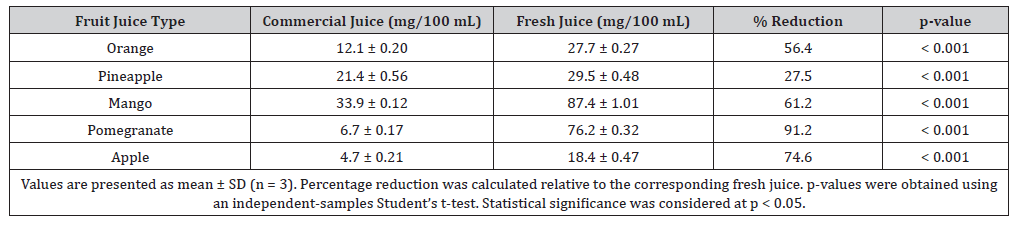
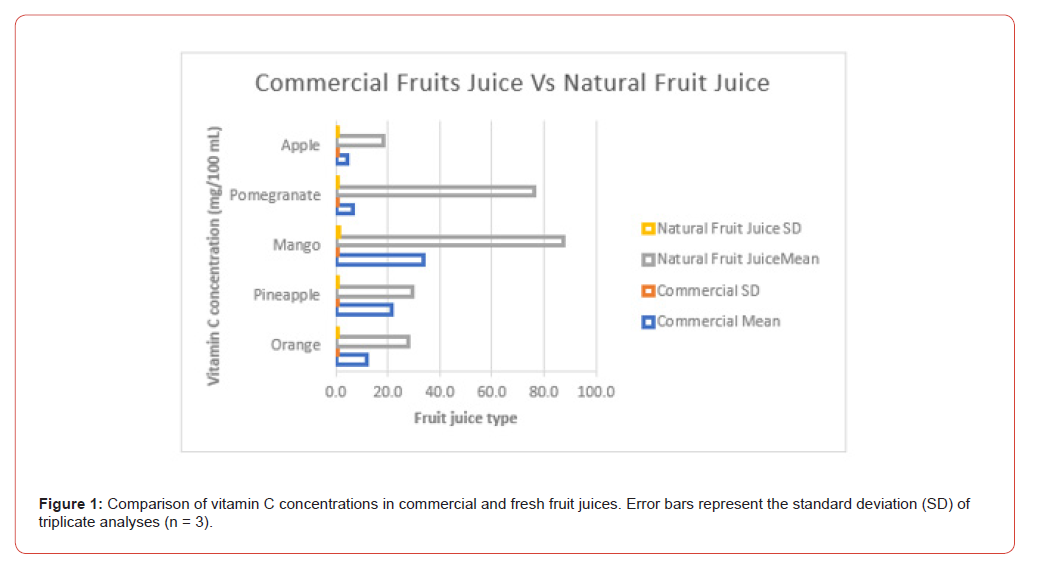
On average, fresh juices exhibited higher vitamin C concentrations than the respective commercial fruit juices. Among the fresh juices analyzed, mango juice (87.3 ± 1.01 mg/100 mL) had the highest vitamin C concentrations, followed by pomegranate juice (76.3 ± 0.32 mg/100 mL), pineapple (29.52 ± 0.48 mg/100ml), orange (27.74 ± 0.27 mg/100ml), and lastly, apple (18.39 ± 0.47 mg/100ml). As shown in Table 1, commercial juices’ vitamin C levels range from 4.68 ± 0.21 to 33.94 ± 0.12 mg/100 ml, which are considerably lower. Commercial processing of juice resulted in a very severe loss of vitamin C, which varied from around 27-91%, in comparison to their respective fresh juices (Table 1). In terms of percentage, the maximum loss of volume was in pomegranate juice (91.2%), followed by apple (74.6%), mango (61.2%), orange (56.4%), and pineapple (27.5%). Independent samples t-tests indicated significant differences between vitamin C concentrations of commercial juice and fresh juice from all the fruits studied (p < 0.001). Pooled data also confirmed a significant decrease in vitamin C in the commercial juices as analyzed by Welch’s t-test (p=0.001).
The known variability of ascorbic acid during food processing and storage is consistent with the reduced vitamin C concentrations found in commercial fruit juices. Vitamin C is also prone to oxidation when exposed to heat, light, and air, and when stored in bulk, the process is considerably accelerated during manufacture and distribution [5,6]. Similar findings from earlier research by Lee and Kader [4]. Have shown that postharvest handling and processing factors significantly affect vitamin C retention in horticultural crops. Tropical fruits are important natural dietary supplies of this vital element, as evidenced by the exceptionally high vitamin C concentrations found in fresh mango and pomegranate juices.
It can be concluded from this study that commercial fruit juices do not provide equivalent vitamin C levels as fresh juices, while also highlighting the nutritional benefits of a packaged food source. Whereas, advanced analytical methods like High-performance liquid chromatography (HPLC) have higher analytical sensitivity but the method like Iodometric titration as used in the present study is an easy and simple method which was found reliable, fast, and low-cost comparative estimation of vitamin C in juices for day-today laboratory analysis as well as research and study purposes [7]. However, there were some limitations in this study. Only a limited number of commercial juice products and fruit samples were analyzed, and the lack of any chromatographic confirmation. Additionally, differences related to their storage time, manufacturing conditions, and brand-specific commercial juice compositions were not assessed.
Conclusion
In this study, we observed that freshly prepared fruit juices contained significantly higher vitamin C than the commercially packed juices. This is due to the result of heat treatment, industrial processing, oxidation, or storage conditions that are used to manufacture and distribute the commercial product. The Iodometric titration method used for the comparison to determine vitamin C in fruit juices provided an easy and cost-effective technique. The results show that consuming fresh fruit juices has greater nutritional value than consuming commercially produced fruit juices as a source of Vitamin C.
References
- Carr AC, Maggini S (2017) Vitamin C and immune function. Nutrients 9(11): 1211.
- Padayatty SJ, Katz A, Wang Y, Eck P, Kwon O, et al. (2003) Vitamin C as an antioxidant: evaluation of its role in disease prevention. J Am Coll Nutr 22(1): 18-35.
- Nishikimi M, Fukuyama R, Minoshima S, Shimizu N (1994) Cloning and chromosomal mapping of the human nonfunctional gene for L-gulono-gamma-lactone oxidase, the enzyme for L-ascorbic acid biosynthesis missing in man. J Biol Chem 269(18): 13685-13688.
- Lee SK, Kader AA (2000) Preharvest and postharvest factors influencing vitamin C content of horticultural crops. Postharvest Biol Technol 20(3): 207-220.
- Davey MW, Van Montagu M, Inzé D, Sanmartin M, Kanellis A, et al. (2000) Plant L-ascorbic acid: chemistry, function, metabolism, bioavailability and effects of processing. J Sci Food Agric 80(7): 825-860.
- Odriozola-Serrano I, Soliva-Fortuny R, Martín-Belloso O (2008) Changes in bioactive compounds of fresh-cut strawberries stored under superatmospheric oxygen, low-oxygen or passive atmospheres. J Food Compost Anal 21(4): 295-299.
- Arya SP, Mahajan M, Jain P (2000) Non-spectrophotometric methods for the determination of vitamin C. Anal Chim Acta 417(1): 1-14.
- Mussa S, Sharaa I (2014) Analysis of vitamin C (ascorbic acid) contents packed fruit juice by UV-spectrophotometry and redox titration methods. IOSR J Appl Phys 6(5): 46-52.
-

This work is licensed under a Creative Commons Attribution-NonCommercial 4.0 International License.


 a Creative Commons Attribution 4.0 International License. Based on a work at www.irispublishers.com.
Best viewed in

 | Above IE 9.0 version | Privacy Policy