




 Research Article
Are Shorter Meals More Stressful? The Psychological Impact of Feeding Method on Caregivers of Children with Special Needs
Received Date:January 14, 2026; Published Date:February 04, 2026
Abstract
Purpose: This study aims to evaluate the levels of depression, anxiety, and stress in caregivers of children with special needs according to their
child’s feeding method.
Methods: A cross-sectional study of 90 parents (45 oral, 45 non-oral) was conducted in three special education centers. Children were matched
on Gross Motor Function Classification System (GMFCS) scores, and the Depression, Anxiety and Stress Scale (DASS-42) was used to assess their
psychological state.
Results: Parents of non-orally fed children had significantly higher depression, anxiety, and stress scores compared to parents of orally fed
children (p<0.05). The orally fed group, however, had a significantly longer meal duration (p=0.03).
Conclusion: The feeding method directly impacts parental well-being. Despite shorter meal times, tube feeding imposes a significant
psychological burden. Our findings suggest that support for these families must include comprehensive psychological and social programs along
with feeding management.
Practical implications: Support programs must be tailored based on the child’s feeding method, not solely on their motor function level.
Interventions for families using tube feeding (PEG/NG) should heavily prioritize psychological counseling and emotional support. Mental health
professionals must be integrated into the care plan for children receiving enteral nutrition using a multidisciplinary approach to mitigate parental
stress.
Keywords:Anxiety; Caregivers; Children with Disabilities; DASS-42; Enteral Nutrition
Introduction
Feeding difficulties in children are a complex clinical condition that is frequently encountered due to developmental, neurological or genetic reasons and that leads to important consequences for both children and their families. These difficulties, in addition to leading to physical problems such as growth and developmental delay, malnutrition and frequent recurrent respiratory tract infections, also create a serious emotional burden on parents [1,2]. Especially parents who undertake the care of a child with special needs face higher levels of stress, anxiety and depression compared to parents of children without developmental disorders due to the intensity brought on by these care processes [3]. One of the most common types of feeding difficulties is inadequate oral feeding. This situation creates a recurring feeling of struggle for parents at every meal.
Problems such as their children refusing to eat, meals lasting for hours and inadequate calorie intake can cause intense feelings such as inadequacy, guilt, and failure in parents. Technical difficulties such as adjusting food consistency, finding special feeding positions and using equipment turn oral feeding into a constant source of tension [4]. This situation can seriously challenge the psychological resilience of parents. In cases where oral feeding is insufficient, enteral feeding methods such as a NZasogastric (NG) tube or a Percutaneous Endoscopic Gastrostomy (PEG) tube become inevitable. While these methods ensure adequate nutrition for the child, they bring a different set of challenges for parents. The continuous medical responsibility of tube care and potential risks such as infection or the tube coming out are a constant source of anxiety and worry for parents. Furthermore, the replacement of the social and emotional bonding function of the act of eating with a medical procedure can lead to feelings of grief and sadness in parents, leaving a permanent impact on their mental health [5].
Although there are many studies in the literature that examine the general stress and depression levels in parents of children with special needs [6,7], studies that comparatively evaluate the psychological status of parents based on their child’s feeding method (oral or by tube) are limited. Considering that both feeding methods have their own specific psychological burdens on parents, filling this comparative gap is of great importance in terms of developing more targeted and effective support programs for families. In this context, our study aims to compare the levels of depression, anxiety, and stress in caregivers of children with special needs based on their feeding method. The psychological state of the parents was evaluated using the DASS-42 scale, a measurement tool whose validity and reliability have been proven, and the independent effect of the feeding method was examined by controlling for the level of motor function. The findings of our study aim to fill the literature gap in this area by providing important information about the effect of the feeding method on the psychological burden of parents.
Method
Research Design and Ethical Approval
The study was planned as multicenter and prospective. Ethical approval was obtained from the Necmettin Erbakan University Health Sciences Scientific Research Ethics Committee with the decision dated 02.03.2022 and numbered 2022/20-180. Data were obtained from 3 special education and rehabilitation institutions and the entire data collection process was carried out by the same researcher. The data collection period took place between September 2022 and March 2023. This study was conducted in accordance with the principles of the Declaration of Helsinki.
Sample selection and inclusion criteria
Using power analysis (G*Power 3.1), the required minimum sample size for the study was determined to be 45 based on a 95% confidence level (1-α), 95% test power (1-β) and d=0.5 effect size [6]. A total of 90 parents were included in the study; 45 of them were parents of non-orally fed children (PEG: 21, NG: 24) and 45 of them were parents of orally fed children. Parents of children with special needs with GMFCS scores of 4 and 5 were included in the study. Cases with another serious systemic disease or a psychiatric diagnosis of the parent were excluded from the study.
Data Collection Tools
• Demographic Form: The parent’s age, gender, education level,
employment status and the child’s age and gender were recorded.
• Gross Motor Function Classification System (GMFCS): The
child’s motor development level was classified between 1-5 [8]. The
GMFCS score of the participant included in the study was evaluated
and recorded by the researcher.
• Feeding Duration: The average feeding duration per meal
was recorded in minutes as the time specified by the parent.
• Depression, Anxiety and Stress Scale (DASS-42): The scale
developed by Lovibond & Lovibond (1995) and adapted to Turkish
by Akkuş & Kaya (2018) was used [9,10]. DASS-42 consists of 42
items and includes three subscales:
Depression (14 items): Evaluates emotional states such as
discontent, worthlessness, low motivation and loss of energy.
Anxiety (14 items): Measures the individual’s autonomic
arousal, panic, subjective anxiety and muscle responses.
Stress (14 items): Includes situations such as difficulty relaxing,
irritability, impatience, overreaction and boredom. The items
are scored between 0 (not at all applicable) and 3 (completely applicable)
and each subscale gives a total score in the range of 0-42.
Data Collection Process
One-on-one interviews with parents were conducted by the same researcher and the interviews lasted approximately 15-20 minutes. Before the study, parents were informed about the study and their written/verbal consent was obtained.
Statistical Analysis
Data analysis was performed using SPSS 25.0 software. Continuous variables (parent’s age, child’s age, feeding duration, DASS-42 scores) were presented as mean ± Standard Deviation (SD). Categorical variables (parent’s gender, education level, employment status; child’s gender, GMFCS level) were reported as number and percentage (%). For comparisons between the Non-Oral group total (PEG + NG) and the Oral group, the Mann-Whitney U test was applied for continuous variables and the Chi-square test for categorical variables. A p < 0.05 significance level was accepted in all analyses.
Findings
A total of 90 parents were included in the study; 45 of them were caregivers of non-orally fed (PEG and NG) and 45 were caregivers of orally fed children. The non-oral group included 21 children fed with PEG and 24 children fed with NG. The mean age of caregivers was found to be 33.07 ± 4.11 years in the non-oral group and 35.12 ± 2.43 years in the oral group. No significant difference was found between the two groups in terms of age (p=0.08). The majority of the non-oral group were women (88.9%), while the proportion of women in the oral group was 84.4% (p=0.62). When the education level of the parents was examined, 24 people in the non-oral group had primary education, 7 people had high school education, and 14 people had university education, while in the oral group, 18 people had primary education, 11 people had high school education, and 16 people had university education (p=0.14). A significant difference was observed in terms of employment status; the majority in the non-oral group were not working (42 people), while the number of non-working parents in the oral group was 23 (p=0.01).
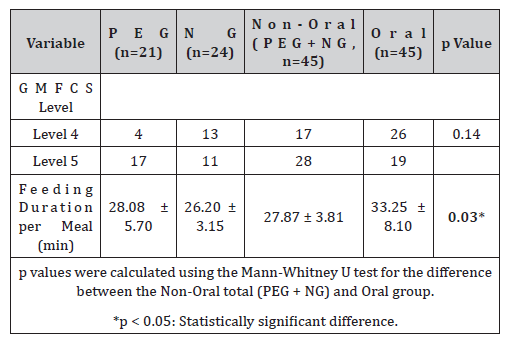
The mean age of the children was found to be 26.07 ± 8.11 months in the non-oral group and 28.26 ± 7.64 months in the oral group (p=0.12). The gender distribution of the children was 28 girls and 17 boys in the non-oral group, and 24 girls and 21 boys in the oral group (p=0.39) (Table 1). As a result of the GMFCS evaluation, 4 of the PEG-fed children were level 4, and 17 were level 5, while 13 of the NG-fed children were level 4, and 11 were level 5. In orally fed children, 26 were selected as level 4 and 19 as level 5. No significant difference was observed between the groups in terms of GMFCS levels (p=0.14) (Table 2). The average feeding duration per meal was found to be 28.08 ± 5.70 minutes in the PEG-fed group, 26.20 ± 3.15 minutes in the NG-fed group, 27.87 ± 3.81 minutes in the total non-oral group, and 33.25 ± 8.10 minutes in the oral group. Orally fed children were found to have a significantly higher feeding duration (p=0.03).
Table 1: Demographic Characteristics of Parent and Child.
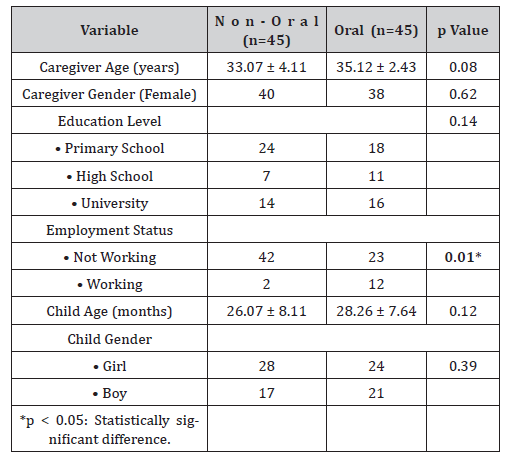
Table 2: Clinical Characteristics and Feeding Duration of Children.
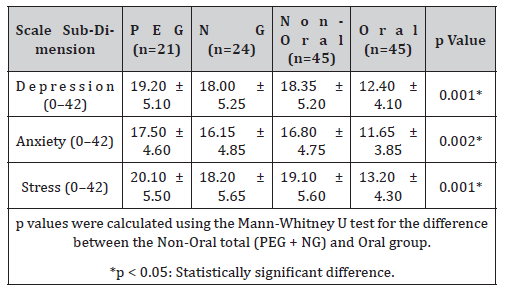
The DASS-42 evaluation showed that the parents of the nonoral group had higher scores than the parents of the oral group on all subscales. In the depression subscale, the mean of the non-oral group was 18.35 ± 5.20, and the mean of the oral group was 12.40 ± 4.10 (p=0.001). In the anxiety subscale, the mean of the non-oral group was 16.80 ± 4.75, and the mean of the oral group was 11.65 ± 3.85 (p=0.002). In the stress subscale, the mean of the non-oral group was 19.10 ± 5.60, and the mean of the oral group was 13.20 ± 4.30 (p=0.001). These findings show that the levels of depression, anxiety, and stress in parents of non-orally fed children are significantly higher than in parents of orally fed children (Table 3).
Table 3: DASS-42 Subscale Scores of Parents.
Discussion
The findings obtained in this study show that the feeding method of children with special needs has a direct and significant effect on the psychological state of parents. The levels of depression, anxiety, and stress were found to be significantly higher in parents of children fed with PEG or NG tubes compared to parents of children fed orally. This result is consistent with the general consensus in the literature stating that the psychological burden experienced by parents is directly related to the child’s care needs [6,7]. In this context, studies by Sloan, et al. (2020) also reveal that these parents exhibit a lower psychological well-being compared to parents of children without developmental disabilities [3].
Our study’s most fundamental contribution is to shed light on the psychological impact mechanism of feeding methods on parents. Our findings showed that the duration of a single meal was significantly longer in children fed orally (p=0.03). However, despite this, the DASS-42 scores of parents of tube-fed children were higher. This situation strongly suggests that the main reason for stress in parents is not the time spent on feeding, but the nature of the feeding and the new responsibilities it brings. The transition to tube feeding, while providing time savings, creates a permanent emotional and social burden on the mental health of parents.
Tube feeding brings a series of complex psychosocial difficulties for parents. The loss of a normal family meal experience can create a situation similar to a “grief process” in parents. Interview studies conducted by Yap, et al. (2025) reported that parents expressed this situation as feelings of loneliness, sadness, and social exclusion [11]. Similarly, Lively, et al. (2023) stated that the loss of the emotional bond provided by the act of eating has a permanent effect on the mental health of parents [12]. This emotional loss is associated with a higher care burden and lower quality of life, as also emphasized by Folwarski, et al. [13].
In addition to the psychosocial burden, the medical and technical responsibilities of tube feeding also increase parental stress. A study by Ahmad, et al. [5] showed that the risk of aspiration and the responsibility of feeding create a continuous feeling of inadequacy and anxiety in parents. It has also been reported that factors such as lifestyle changes, lack of free time, fatigue, and the need for social support increase stress in caregivers of patients receiving home enteral nutrition [14]. This situation also parallels recent studies on how complex care processes affect a parent’s psychological resilience [15,16].
The fact that the depression, anxiety, and stress scores were higher in parents of children fed with PEG compared to those fed with NG in our study is consistent with studies in the literature showing that PEG care creates a more intense psychological burden on parents [15]. This may be due to the fact that PEG care is more complex in terms of technical aspects and responsibility, and the risk of aspiration is high. Parents of orally fed children also face their own difficulties in a similar way. Rabaey [4] stated that factors such as feeding position, adjustment of food consistency, and the prolongation of meal duration create stress in these parents. A study conducted by Savaş, et al. [17] also found high stress levels in parents of children with feeding difficulties and found that this created negative effects on their social, family, couple, and work lives. These findings show that the stress in parents is specific to different feeding methods.
Our study, by ensuring that the Gross Motor Function Classification System (GMFCS) scores of the children in the sample were similar between the groups, succeeded in minimizing the effect of motor function level on the psychological state of the parents. In this way, the independent effect of the feeding method on the care burden and psychological stress was examined more clearly. This methodological approach allows us to evaluate the relationship between the feeding method and the parent’s care burden more reliably and is consistent with other studies in this area [18].
The findings emphasize the importance of psychological support and counseling services for parents of children with special needs. The high levels of stress and anxiety observed especially in parents of children fed with PEG and NG reveal the necessity of a multidisciplinary support approach. Providing only education on feeding management to these families is not enough; emotional and social support mechanisms should also be offered. In future studies, longitudinal studies examining the long-term psychological effects of different feeding methods on parents will enable the determination of causal relationships more clearly. In addition, the effects of factors such as the parents’ social support level, economic status, and spousal support on stress levels should also be examined in more detail.
This study contains some limitations. First, the sample size is limited and data were collected from only three special education institutions; this may restrict the generalizability of the findings. Since the study has a cross-sectional design, a causal relationship between the feeding method and the psychological state of the parents cannot be determined. In addition, the psychological states of the parents were evaluated by self-report using the DASS-42 scale, and there is a possibility of socially desirable response or bias. Feeding duration was measured only for one meal and was recorded by the observer; therefore, daily feeding variations could not be taken into account. Although GMFCS scores were matched between groups, the effects of motor function on daily care and stress could not be fully controlled. Finally, psychosocial factors such as the parents’ social support level, economic status, and spousal support were not evaluated in this study; these are important variables that can affect parents’ stress and anxiety levels.
Conclusion and Recommendations
This study demonstrates that the feeding method of children with special needs significantly impacts the psychological health of their parents. Our findings revealed that the levels of depression, anxiety, and stress were significantly higher in caregivers of children fed via PEG or NG tubes compared to parents of orally fed children. This suggests that the medical and psychosocial burden brought on by tube feeding, despite the shortening of meal duration, is a more dominant source of stress for parents. These findings fill a gap in the literature by showing that the difficulties experienced by parents are not just related to time management, but also to the nature of the care and the emotional burden it brings.
In light of these findings, important recommendations can be developed for clinical practice. The support services offered to parents of children with special needs should include not only feeding management and technical information but also comprehensive psychological and social support programs. It is critically important to establish counseling and support groups to reduce the stress associated with caregiving, especially for parents of tube-fed children. The care provided to these families should be approached with a multidisciplinary perspective that also considers their emotional and social needs.
Future studies should take these findings further to increase the knowledge base in this field. Longitudinal studies with larger sample groups should be conducted to more clearly determine the causal relationship between the feeding method and the parent’s psychological state. In addition, other psychosocial factors that may affect stress levels, such as the parents’ social support level, economic status, and spousal support, should also be included in the studies for more comprehensive analyses.
Acknowledgement
We would like to thank the special education institutions that allowed the execution of this study and all the participating caregivers.
Clinical Trial Registration: Not applicable. Funding
This research received no external funding.
Author Contributions
The entire process of this study, from its conceptualization and data collection to its analysis and manuscript writing, was conducted by Neslihan Altuntaş Yılmaz.
Conflict of Interest Statement
The author declares that there is no conflict of interest regarding the research, writing, and publication of this article.
References
- Vilaseca R, Rivero M, Ferrer F, Bersabé RM (2020) Parenting behaviors of mothers and fathers of young children with intellectual disability evaluated in a natural context. PLoS One 15(10): e0240320.
- Reilly C, Marshall J, Packer R, Thapar N, Bell KL, et al. (2025) Experiences and insights from parents of children with temporary feeding tubes. Journal of Child Health Care 23: 13674935251370415.
- Sloan CJ, Mailick MR, Hong J, Ha JH, Greenberg JS, et al. (2020) Longitudinal changes in well-being of parents of individuals with developmental or mental health problems. Social Science & Medicine 264: 113309.
- Rabaey P (2017) A review of feeding interventions for children with disabilities: Implications for institutionalised settings. International Journal of Therapy and Rehabilitation 24(4): 174-181.
- Ahmad FK, Al-Assaf NF, Alzoubi M, Odeh N, Samara D, et al. (2025) Feeding with care: caregiver perspectives on pediatric gastrostomy tubes. Children 12(7): 813.
- Pocinho M, Fernandes L (2018) Depression, stress and anxiety among parents of sons with disabilities. Psychological Practice and Research Journal 1(1).
- Ha CTM, Nguyen HT, Nguyen AHV, Tran Thien GP (2024) Psychological stress in parents of children with autism spectrum disorder. National Journal of Community Medicine 15(6): 451–460.
- Palisano R, Rosenbaum P, Walter S, Russell D, Wood E, et al. (1997) Development and reliability of a system to classify gross motor function in children with cerebral palsy. Developmental Medicine & Child Neurology 39(4): 214-223.
- Lovibond SH, Lovibond PF (1995) Manual for the Depression Anxiety Stress Scales. (2nd. Ed.) Sydney: Psychology Foundation.
- Akkuş Çutuk, Z, Kaya M (2018) Depresyon, anksiyete ve stres ölçeği (DASS-42) lise formu: Türkçe geçerlik ve güvenirliğ Elektronik Sosyal Bilimler Dergisi 17(68): 1327–1336.
- Yap ASH, Aw MM, Chua JS, Ng JQX, Ng NBH, et al. (2025) Exploring parents' experiences and perceptions of caring for children with feeding difficulties and developmental disabilities: A descriptive qualitative study. Journal of Advanced Nursing.
- Lively EJ, McAllister S, Doeltgen SH (2023) Parents' experiences of their child's transition from tube to oral feeding during an intensive intervention programme. Child: Care, Health and Development 49(4): 740–749.
- Folwarski M, Maciejewska-Cebulak M, Skonieczna-Żydecka K, Sumlet M, Kupiec M, et al. (2024) Quality of life of caregivers of patients on home enteral nutrition. Clinical Nutrition 43(9): 1983–1990.
- Bourke-Taylor HM, Joyce KS, Grzegorczyn S, Tirlea L (2021) Mental health and health behaviour changes for mothers of children with a disability: Effectiveness of a health and wellbeing workshop. Journal of Autism and Developmental Disorders 52(2): 508–521.
- Önal G, Güney Yılmaz G (2025) Cross-cultural perspective on family resilience: Turkish validity and reliability study of family resilience scale short form. Turkish Psychological Counseling and Guidance Journal 15(72): 610–623.
- Williams CA, Thompson PA, Hastings RP (2025) Longitudinal evaluation of the Family Stress Model in families of children with intellectual disabilities. Research in Developmental Disabilities 164: 105082.
- Savaş M, Kahraman Beğen S, Manay B, Şentürk A, Demir Aİ, et al. (2025) Parental stress levels in relation to dysphagia and communicative difficulties in pediatric intensive care patients. Journal of Health Sciences and Medicine 8(3): 680-685.
- Silverman AH, Erato G, Goday P (2021) The relationship between chronic paediatric feeding disorders and caregiver stress. Journal of Child Health Care 25(1): 69-80.
-

This work is licensed under a Creative Commons Attribution-NonCommercial 4.0 International License.




