


 Research article
Information and Informational Model of Human and Living Structures: Info-Transduction and Info-Decision are Driving/Operational Processes for Structuration and Behavior Within the Interaction with Implicit/ Explicit Informational Sources
Received Date:December 12, 2023; Published Date: January 23, 2024
Abstract
In this paper it is approached the communication in biological structures, with or without nervous system, in terms of information. For this, it introduced, discussed, and treated this issue by means of the new concepts of matter-related information and info operational concepts of Transduction, Transduction Chain, DECISION, Exe, TARGET and TERMINAL, explaining the bioprocesses in the elementary prokaryotic and eukaryotic cells and multicellular organisms. Applying these concepts within the Informational Model of Human and Living Structures (IMHLS), this is able to explain the self-structuration and behavior of human and of all other living structures by the driving/operability of the body with information/info-transduction and decisional/regulatory processes during the structuration/destructuration mechanisms and info-transduction chains, completed by execution (Exe) processes, operating with matter-related information, a new concept indispensable for such a purpose. For this, it is shown that the human and living organisms are connected to two main informational sources: the implicit Sources iS are constitutive part of body itself and consist in every cell by genetic system – genes/genome in nucleus, and the explicit Sources eS, which are the external sources, which trigger a chain of operational/sentient reactions for adaptation. Quantitative estimations on the contribution of energy and information, expressed in terms of mass, to the self-structuration of the body are given, showing that living organisms are dynamic structures, animated/operated by these fundamental contributors. The manifestation/behavior of the singular eukaryotic/prokaryotic cells, as the most elementary representative of living organisms, without a nervous system, demonstrate/support IMHLS and the corresponding concepts, applicable on the entire organizational/ evolution scale.
Keywords:Information/info-transduction; matter-related information; informational model/system of human and living structures; structuration/destructuration; implicit and explicit information sources; info-decision and execution; transduction chain; regulatory processes; quantitative estimations; behavior of prokaryotic/eukaryotic cells
Introduction
In our information era [1], with an unprecedented development of communications [2,3] and deep penetration of the Artificial Intelligence (AI) in professional fields [4,5] and private life [6,7], the role of information in the human body [8-10] and living structures [11- 13] is practically ignored or unknown. Major advancements there were registered however in the recent years, acknowledging the role of information in psychology [14,15], medical sciences [16,17], neurosciences [18], neurology [19,20], psychiatry in neuro-aging and info-therapy [21], adjudicating the fundamental role of information in the human body, opening pioneering new ways of investigation in medicine and healthcare activities. Extending this analysis to other types of organisms, remarkable results were obtained in the understanding of the life mechanisms and the info-communication processes with the external and internal informational sources [22,23], and consciousness in various states [24-26] and info-communication in the body [27-29], as a highest expression of informational capabilities of living matter [30,31].
The general conception about the transmission of information in living organisms is that the nervous system should be a basic imprescriptible support. However, according to the Informational Model of Human and Living Structures (IMHLS), such a restriction is not included. Fallowing such a new line of investigation, in this paper it is shown that the structuration and functions in the living organisms are driven by information and by info-transduction and decisional/regulatory processes, within the interaction with implicit and explicit informational sources, indifferently if they possess or not a nervous system, determining the abilities of selfstructuration/ organization and the functions/behavior, which allow the communication with the environment and with own body, for maintenance, adaptation and survival.
Implicit Information in Human and Living Structures
It seems that it has not been easy at all to discuss information and info-processing in the human body, and even less in other living organisms, because first the concept of information in these systems was not well clarified and understood. As it was recently recognized in a prestigious conference [28], neuroscience needs a revolution to understand consciousness. Indeed, while information is a concept mainly used to describe communication and infoprocessing in the associated informational devices, treated as new events, distinct from the rest, by statistical/probabilistic tools, applied in electric/electronic devices [32], where information is codified and transmitted from an informational source through an informational channel/line, inherently affected by noise, to an infodecoder and final receiver. However,in living matter it is not clear how to use this concept.
The terms “info-codifier/info-decoder” refer to a specific “lcurrent of communication, which should be understood by both communicating partners, like in a current/regular communication between people and in mass-media communication. However, a first question which arises concerning the human body, is how the various components of the organism can communicate, and what communication in this case consists of in. This question can be clarified considering the multicellular composition of the human body and the multi-particle participation not only to the structuration, but also for the communication within and between the unit components – the eukaryotic cells (Figure 1 left side). On this way, starting from this reality, the definition of the Matter-Related Information (mrI) as a result of a Structuration/ Destructuration Process (SDP) in a multi-particle or Multi- Component System (MCS), as the living structures are, resolves the problem of the coherent description of the communication within the living systems, independently on the nature of the informational sources (Figure 1).
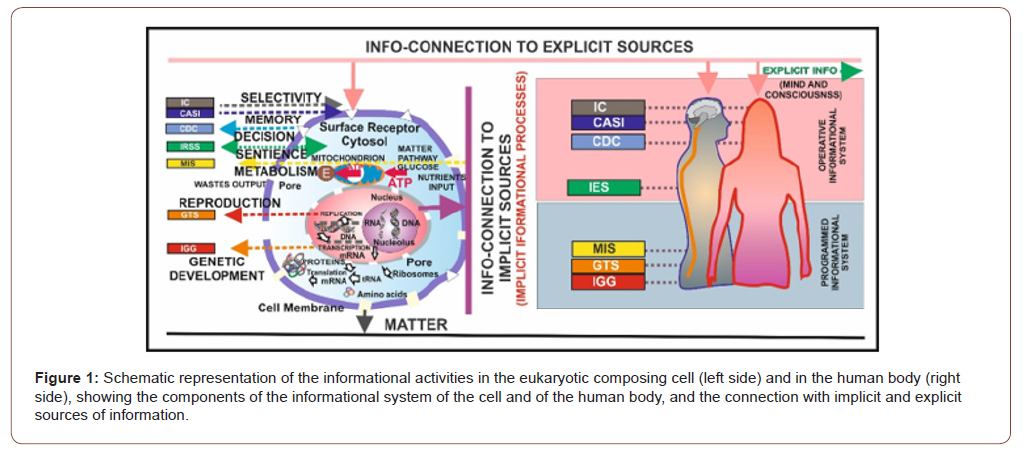
Information and Info-Structuration from Implicit Sources of Living Organisms
To understand this concept, let’s consider a MCS with the components A and B in interaction. The simple relation (A+B) <=> AB to compose or decompose a compound AB is not sufficient to describe the entire phenomenology of this SDP process, because this includes only the effect of a chemical, physical or biologic (or mathematical) law, but not the intervention of information, like in the informational devices. Therefore, a true/complete reaction, defined here as informational reaction/relation, is that which includes information I as following:
(A+ B) + I <=> (AB)(mrI ) (1)
where mrI is a matter-related information hidden into the new component during the structuration process, which is released during the reverse decomposing phase of this SDP. Therefore, the successive reactions specific to the living matter (the body of the living organisms), both for the structuration and communication, are actually transduction processes, in which a certain set of information received from external or internal sources is transduced as a new set of informational pack/message during each interaction with various species of structures of the organism, each of them with well-defined functions. In the eukaryotic cell, like in the human body or other living systems, these specific structures are the organs, which are multicellular structures complying the same task, but at the microscopic level, these can be also reactive agents on the trajectory of the reactive circuit. Such transduction processes can be thus written in terms of SDPs on the basis of relation (1) as follows:
INFO => (A+ B) + (Info1) => C(mrI1) => (D + E) + (Info2) => F(mrI 2) => (G + H) + (Info3)... => TERMINAL (2)
where INFO is the input information, Info1, Info2, Info3…are the informational messages released during the destructuration process from the hidden forms mrI1, mrI2, mrI3…in the intermediary compounds C.F, etc. A, B, C, D, E, G, H… are the interacting material components with information till the TERMINAL step in a TARGET. Examples of such informational chains of structuration/ destructuration processes with absorption/release of information will be given below. As energy is a consequence and detected from the disordered movement of microparticles/molecules, information is detected from ordered/certain configuration of them.
For this, it is necessary to observe that human and other living organisms, including the eukaryotic cell, are connected with two main sources of information:
a) One of them is the implicit Source iS, as an essential part of the body itself, composed by genes and genome in each nucleus – the MEMORY of the eukaryotic cell, which conserves all necessary information to build the structure of the body, and serves for structuration of the body and communication circuits, informational tools (info-detectors, surface and cytoplasm receptors in cell, senses in multicellular organisms) and info-communication agents (some proteins (ligands of surface receptors), electrical pulses, neurotransmitters (between the nervous cells), hormones).
b) Another is the explicit Source eS, composed by a multitude of external and internal sources components, detectable by a network of corresponding specific sensors (informational sensing tools), necessary to maintain the communication with the external environment and internal self-status. The dogma norm in biologic structures shows that the genetic reactions (from IS) follow a unique sense in relation (1), like the conduction in the microelectronic diodes. The functioning of the structuration/genetic iS source starts from the development of the primary fertilized egg (zygote) cell, once the conditions of development (food and air/water (matter) connection and ambient temperature) by two main informational processes: multiplication/replication and transcription-translation process [33].
The replication process initiates the reproduction of cell in two identical mother/daughter cells, according to the following schematic informational reaction:
iS(DNA) =>1/ 2 DNA+1/ 2 DNA+ (2New Strands) => 2DNA (3)
where iS (DNA) highlights the role of DNA as constituent of implicit source (iS). The replication is a decisional process, which depends on the external and internal factors [34-36]. As the relation (equation 3) shows, this consists in the splitting of the molecule of the deoxyribonucleic acid (DNA) of genes and the completion of each strand with the necessary complementary new strand by an enzyme-assisted process, with an extraordinary precision, proved by the intervention of an additional repair mechanism [37]. The subsequent transition processes to an irreversible cycle is regulated/marked by underlying bistable YES/NO Bit-type switches, based on activatory /inhibitory action of some specific proteins, which are finally locked by a double negative feedback, blocking bath activation and inhibition, and which assures a single switching way irreversible commitment [38,39]. The ensemble of all these types of automatic/programmed processes/functions driven by successive transfer of information in the eukaryotic cell can be defined as the Genetic Transmission System (GTS), which in human and other corresponding multicellular organisms (planta and animals) composed by eukaryotic cells (the starting primary egg is also a unicellular organism), are complied also at the macroscopic level. The primary egg is a unicellular entity, but the fertilized egg contains a few hundred cells. The transcription-translation process allows to build and develop the body, by a series of informational processes, schematically described as follows:
iS (Seq (DNA) => mRNA => tRNA + Amino Acids => Proteins (4)
where Seq(DNA) are DNA sequence, as part of implicit informational source iS. This is a DECISION-MAKING process, manifested by gene expression, a regulatory process triggered by INFO external circumstances/cues transmitted through the cell bio-circuits and conveniently processed for adaptation and survival, explained in the next section. This relation shows that various sequences of the DNA molecule (Seq(DNA))are copied by the messenger ribonucleic acid (mRNA) in a four letter “alphabet” of the nucleotides, i.e. adenine (A), cytosine (C), guanine (G) and thymine (T), and transmitted (=>) as informational “messages” to ribosomes, which convert them in a new “language” of the transport tRNA, and transmit them toward cytoplasm, to combines with amino acids (11 produced and 9 imported), in a binary YES/ NO Bit-type complementary manner, to form proteins – the bricks of the body (Figure 1 left side). The nucleotide “letters” themselves are complementary YES/NO Bit-type units, because A can be structurally coupled/bonded only with T, and C only with G.
The ensemble of all these types of automatic/programmed processes/functions can be defined as Info Genetic Generator (IGG), which assures the development of the body of cell and of the living multicellular organisms (plants, animals, human), which all of them initiate their life, starting from the unicellular unit – the primary eukaryotic fertilized egg. The metabolic activities are driven also by automatic/programmed processes, allowing the conversion of matter nutrients (foods, water/air) in energy and micro-constituents necessary for the structuration /restructuration processes. The main driving process for the generation of energy E in cell consists in the conversion in mitochondria organelles of adenosine diphosphate (ADP) (Figure 1 left side) into adenosine triphosphate (ATP), by an oxygen-assisted process which continues by an anaerobic process in cytoplasm, controlled by a critical value of the concentration ratio (ADP/ATP) for the production (YES) or not (NO) of energy.
The “digestive” system of the cell, leaded also by own DNA molecules, is similar with that of the human organism, formed by organelles as vacuoles (with similar functions for foods accumulation like a stomach), Golgi apparatus like a “heart” and vessels for fluids distributions, endoplasmic reticulum/ lysosomes for lipid/insulin metabolism, functioning similarly with a “pancreas” and “spleen” in human. The ensemble of the metabolic processes automatically assuring the functions of the body maintenance can be defined as Maintenance Informational System (MIS) in cell and human. In plant cells, the chloroplast provides the basic constituent of energy production, by a light-assisted process and chlorophyll participation. The activities of these automatic/programmed functions can be represented globally by the Programmed Informational System (PIS), defined as: PIS = MIS + GTS + IGG (Figure 1).
The processes involved into PIS are the same, following in each species the same way of development and actuation. They are informational, because from a large variety/uncertain possibilities, these obey the same specificity/certainty processes within the range of the existing possibilities. This shows also that matter, in this case living mater, can dispose of information and of a certain degree of knowledge [40], because this may know how execute by itself a series of operation for self-organization and survival, under dynamic conditions and equilibrium with itself and with environment. Therefore, as it was recently shown, the composition of real world consists not only in matter and energy, but also in information, as a particular component. Information is thus that which self-organizes and animates the living organisms. Information also allows us to maintain, develop, and reproduce living organisms.
Quantitative Estimations of Body Micromaterial Components Contributing to Energy and Information
The quantity of information necessary to reproduce an human cell according to the genetic processes, was reported to be of the order of 8.38×10^8 Bits [41]. Eukaryotic cells have not only more genes than prokaryotic cells, they also have much more DNA that does not code for protein or for any other functional product molecule; in particular, the human genome contains a 1000 times as many nucleotide pairs as the genome of a typical bacterium, 20 times as many genes, and about 10,000 times as much noncoding DNA ( about – 98.5% of the genome for a human is noncoding, while for the genome for the bacterium E. coli, the best studied one this is about 11% [33]). The necessary energy can be measured in ATP (adenosine triphosphate) units, produced by mitochondria processes, so ATP is considered the molecular unit of intracellular energy currency [2]. The concentration of cellular ATP is maintained in the range of 1-10 mmol/L (1mmol=10^-3 mol), with a regular ratio of ATP/ ADP of about 1000 [42]. which is a critical value for ATP production (YES) or NO.
In the intercellular interstices the ATP concentration is about 1000 times less. The molecular mass of ATP is roughly 500 Da (1 Da is the atomic mass unit equal to the twelfth of free Carbon 12, approximately equal to 1.660 x 10^−27 kg, or 507.18 g/mol [43], its size (measured in effective diffusion diameter) is of about ≈1.4 nm (1nm=10^-9 m), and an ATP molecule has 30,5 kj/mol (7,3 kCal/mole) [44]. The ATP is recycled in ADP by the intervention of the enzyme called adenosine triphosphatase (ATPase), so this process is a thrifty form of energy production, because in this way the cell uses less energy than creating a new ATP molecule. The total quantity of ATP in an adult person is about 0.10 mol/L, and about 100 - 150 mol/L of ATP is necessary daily, so that each ATP molecule is recycled some 1000 - 1500 times per day, which practically corresponds with the body turning over its weight in ATP daily.
Various organs of the body have a distinct consume of ATP, special consumption being dedicated to the nervous system: a single cortical action potential needs about 10^8 – 10^9 ATP molecules, in brain 50-60% from the necessary consumption of ATP is dedicated to the Na+ / K+ commutation for the action potential triggering, and in kidney about 40-70% [44]. The energy is obtained by the coupling of this process with the energy production. The average mass of a human cell is of the order of 1 nanogram (10^-12 Kg), but the shapes and dimensions are different, depending on the specific functions [44]. An adult of 70 kg should have therefore about 70 trillion (7×10^13) cells which corresponds reasonably with the value of 3.7×10^13 cells reported earlier [45]. Taking into account such estimations, a representation of the three components of a living organism, i.e. mass, energy (in terms of ATP) and information (in terms of active genetic mass – the implicit informational source (iS) of the cell) could be done as momentary ternary diagram, or in a three-coordinate system, represented by mass, energy, and information, suggestively emphasizing the momentary ternary composition of them.
At human, it should be consider that the male nuclear diploid genome, which extends for 6.27 Gigabase pairs (Gbp), 205.00 cm (cm) long is of a weigh of 6.41 picograms (1pg=10^-15 kg), while the female values are 6.37 Gbp, 208.23 cm, 6.51 picograms [46], representing approximatively only 0,64% from the total cell mass. With the available data, for a person of 70kg, referring to a value of 250g of ATP which sustains at any time the energetic activity [47], and a calculated quantity of genetic mass from the above data (0448kg), there can be obtained the fallowing vales, expressing in mass terms the momentary contribution of energy and information to the functioning of the body: 0,35% energy (in ATP mass terms) and 0,628% for genetic information, considering all genetic information to be active. Although these values seem to be small, the cyclic conversion of ATP in ADP and recovery, recycles in 24h a weight equivalent with that of the body, and genetic information builds/rebuilds the body and express the body behavior, showing the consistent power of information in human and living structures.
From Implicit to Explicit Information as Reactive Response for Adaptation
Living organisms are connected to explicit sources of information (eS) from the environment. At human, the explicit information is received by the main senses: sight, earing, smell, taste, touch. The connection with eS assures the informational interaction with external reality for real-time adaptation. External extracellular signals can be physical excitatory agents (pressure, electrical voltage, temperature, light), or chemical agents (small molecules, peptides, gas molecules) [48].
Info-Transduction and Decisional Processes for Adaptation
In terms of information, the connection with the environment is performed by a network of sensors represented by surface receptors on the cell membrane, basically proteins, sensitive to the external stimuli, which are chemically coupled by structural complementarity (with specific ligands), of the form of YES/NO - Bit-type signals. This interaction is actually a transduction process of the initial signal in another type of signal, which can directly activate/open (YES) or close (NO) an ion channel (ligand-gated ion channel, in particular in carnivore plants [49]) or in nervous cells, or can initiate a second messenger system cascade that propagates the signal through the cell, amplifying (YES) or inhibiting (NO) it [50]. Such an informational downstream could activate/deactivate the internal sensing receptors in the cytoplasm or near nucleus (the internal sensors), on the specific signaling pathways (circuits), affecting the genes themselves, finally activating (YES) of dormant genes, or inhibiting (NO) their activity, within a DECISION - making response process.
Cellular receptors are proteins, either inside of a cell or on its surface, which receive a signal, so an internal sensor network can be activated in this way [51]. Each receptor can be coupled only with a corresponding ligand, so a certain binding ligand-receptor is manifested by a cellular reactive effect, including altering gene transcription or translation, or changing cell morphology. The signaling molecules may interact therefore in various ways with the internal structural network of sensing elements on circuit reactive pathways, which in turn may lead to distinct various biological responses output within a regulatory process [52]. Such a dynamic activity can be described therefore in terms of information, defining specific informational systems as follows: Center of Acquiring and Storing of Information (CASI), working on the basis of the network of sensors, associated informational circuits and central MEMORY (genes) in cell, and in brain in the multicellular organisms (human, animals); Center of Decision and Command (CDC), represented by the DECISION – making processes inside of a cell, groups of cells (organs), like root apices in plants [49] and brain in human and animals.
The versatility of cell to build/generate its own specific proteins, not only for the body structuration, but also as a response of the external stimuli/information, shows/demonstrates the intimate correlation between matter and information in the living structures, as indicated by the relation (1). These serve also the mechanisms of adaptation and reactive processes, including the inter-changing/info-transducing activities allowing the transfer of informational messages converted in specific memorized/ memorable/reactive material response, according to the relation (2). Within these kind of processes, the sentient/feeling internal effect as a result of an information reception, consists in a specific sensation of GOOD/”comfortable” (acceptable) or BAD (rejectable) effect. Therefore, an Info-Reactive Sentience System in the living structures and an equivalent Info Emotional System at human can be defined. A cell or a multitude of cells in an organ in multicellular organisms comply with the same type of reactive output functions, according to the specific input information which they receive, in accordance with the adaptive correlation between the connecting environment and their structural/physiological/functional capabilities.
Consequently, they are adapted only to certain range of signals, in which their functionality is normal. An Info-Connection (IC) system should therefore be defined, which maintains the right connection with the external informational field, according the their inherited/acquired/memorized experience. IC of a cell or group of cells bearing to the same organ, so dedicated to the same functional tasks, maintain the correct connection inside of a multicellular organism, within the tolerance/specific limits of informational permitted range, which assure a correct/normal working. At human, such a system is revealed within the current behavior by compatibility in social relations, and by the selection of the “right”/reliable/certainty (experienced/trust) information vs. uncertain information. Certainty vs. uncertainty is actually a form to express information. According to above discussion, an Operative Informational System (OIS) can be defined as: OIS=CASI+CDC+IRSS/ IES+IC.
Defining the Transduction Chain, an INFORMATIONAL OPERATOR, described by a series of successive reactive processes in cell or multiple cells in multicellular organisms, consisting in successive transport/transduction of initial information (INFO) emitted by an explicit source eS, detected/received by unicellular organism or sensorial cell/multiple cell sensorial organ/detector, thus the full info-operational process on the entire pathway of infotransmission, from reception of initial INFO to the final TARGET (Info-TERMINAL) can be expressed in terms of relation (1) and (2) by the following schematic multiple transducing relation:
TERMINAL in relation (5) is a superior level of the informational process, where a final DECISION is made, and where the symbolic expression DECISION | Criteria underlines the fact that the DECISION process is made inside of an already existing context, with reference values taken as decision criteria, represented in this case by memory (actual configuration) itself. In the above formal representation, the symbol (|) suggests a set of activated infocomponents of the information system, the symbol (=>) indicates the command transmission to the execution elements, and (| =>) suggests the addressed beneficiary.
Examples of TARGET/TERMINAL are the genetic system in genome/nucleus during the epigenetic/regulatory processes in cell, or brain/mind for the representation as consciousness of the virtual reality in human and subhuman multicellular organisms [53]. Relations (3) and (4) are also a result of a DECISION at the nucleus TARGET, terminating by execution (Exe) of replication and transcription - translation structuration processes. The switching processes in which the intervention of certain proteins to initiate (YES) or close (NO) a certain decisional process is typical in cells.
DECISION is an informational driving/operational process, consisting in the choice from many alternatives available for exploration, from which only one is reliable/optimal/suitable, so electable for some specific/certain conditions. DECISION is followed by a COMMAND (execution – Exe) process, which is a TERMINAL phase, with various effects/results. DECISION and COMMAND (Exe) consists in living structures in the choice to a certain evolution of a multi-particle related system, from a critical state toward a new convenient (adaptive/regulatory) stable state with respect to the memorized state (experience/configuration), for which some additional execution (typical) processes are necessary. According to the above discussion, it is evident that the relation (5) can be applied to describe the decisional process in a cell or a chain of decisional processes by transducing steps between consecutive elements/parts/organs in multicellular organisms, including human.
Exe => Operational System in relation (5) shows that execution can be referred at any operational system (like mind), which operates with information, able to command certain execution elements (EE) (like muscles), or any other execution/transduction (typical) processes like biologic/chemical reactions like the replication or fabrication of proteins through transcription-translation. The conversion of electrical nervous signals in mechanical work for motor/vital functions, including the vessel pressure, heart and digestive activity) leaded by the brainstem is also a relevant example. In this case, this is an automatic execution, belonging to PIS. The terminal output response of a cell or group of cells in a multicellular organism is therefore actually explicit information shared outside. This information detected by the surrounding cells becomes implicit information, info-transduced to other cells within a chain-type communication, as relation (2) shows. Each cell, either nervous or not, acts as a micro-device with specific info-connection (IC) and specialized functions, transmitting subsequent output response by chemical agents to neighbors. The exploration of reality during the connection with explicit sources gives rise finally to a virtual explicit reality in mind and consciousness at human and subhuman organisms (Figure 1 right upper side).
The conduit/behavior of individuals in family and society, their personal and professional trajectory in life, is marked by continuous decisional successive small or large steps of decision, accepting YES, or rejecting NO a variant from many others, so making a DECISION in any moment. The result of such a decisional chain is the actual stage of personal development/evolving stage/step, if a dynamic/ open mind behavior is followed [54], allowing the fulfilment of own dreams, desires, and projects in personal and professional career [55].
Regulatory Processes as Info-Operational Decision Factors for Adaptation
A large and specific range of SDPs is associated with the Regulatory Processes of gene expression, during the interaction with the external information (eS), which control the increase or decrease the production of proteins or RNA for cell development/ differentiation, to trigger development pathways (micro-circuits), to respond by an adaptive decision-making process to the received environmental information, or to adapt to new food resources, which can intervene/modulate any step of the info-reaction (3), depending on the adapting goal [56,57]. The living structures are able to build therefore their body by using iS for development, reproduction, and maintenance (PIS), but also are able to generate their specific tools of info-detection, info-processing of information, DECISION and COMMAND of execution to the execution elements for a subsequent labor by (OIS), useful for organism functioning and for behavioral/plastic adaptation, according to the momentary circumstances. At elementary organisms, singular cells or animals, this is manifested by mobility, especially necessary for the food detection, reproduction and defense. The singular fighting cells of immunity system against the undesirable invaders (bacteria) in human and mammals, able to DECIDE/DRIVE/OPERATE the reconfiguration of their body by a plasticity process (Exe), is a relevant example [58].
Eukaryotic cell is not only a basic component of the multicellular (human, plants, animals), but this can also live in solitary life, as hunters, adapted with specific MIS and hunting tools. Protozoa for instance [33] shows specific structures as sensory bristles, photoreceptors (CASI=>CDC), with sinuously beating cilia as appendages (CDC=>EE – execution elements assisted by Calcium ions), mouth parts (IC|CASI|CDC=>EE=>MIS), stinging darts (IRSS|CDC=>EE), and muscle-like contractile bundles (CDC=>EE). Some unicellular algae are endowed with photo synthesizers-like elements (specific MIS and CASI sensors), and the unicellular fungi acting as “scavengers”, or yeasts (specific IC|CASI|CDC=>EE/=>MIS), in a large variety of forms. However, in spite of their diversity, all of them use a system with the same informational structure, as discussed above. This is defined as Informational System of Human and Living Structures (ISHLS), which can be described by the following expression:
ISHLS = OIS + PIS = (CASI +CDC + IRSS / IES + IC) + (MIS +GRS + IGG) (6)
The regulatory processes are thus initiated by OIS, while structural/reconfiguration modifications are operated by PIS. The Informational Model of Human and Living Structures (IMHLS) is able to describe the self-structuration and behavior of living organisms on the entire biological organizational/evolutionary scale [59] : according for instance to recent studies, although they are single cells, protozoa can be as intricate as versatile, and as complex in their behavior, as many multicellular organisms. The large category of existing species on the organization/evolution scale is actually an evident demonstration of the high capability of the living organisms for adaptation, according to the local and momentary conditions. Protozoa are unicellular, either independent or parasitic organisms, reproducing asexually (GTS) by binary or multiple fission, but also by sexual means, exchanging genetic material by conjugation (through a common tube between two cells, from ‘male’ to ‘female’ partner), like also some bacteria [60].
Meiotic sex (GTS), which consists in the division of a cell in four descendants with half from the original genetic material, like the human sperm and eggs, is largely widespread among eukaryotes. The nervous system is characteristic to the multicellular organisms of animals, with small exceptions, referred to sponges and to microscopic organisms like placozoans and mesozoans. The simplest nervous system is a diffuse net, like in hydras and corals [61]. Although the info-transmission in sponge cells is not driven by synaptic conduction like in the nervous system, they do communicate with each other via calcium cell-to-cell waves and other impulses, as precursors of the nervous cells, which mediate some simple actions such as whole-body contraction [62], precursors of the nervous cell [63]. All other types of animal’s superior to sponges, excepting echinoderms and a few types of worms, have a nervous system, with a size ranging from a few hundred cells in the simplest worms, to on the order of 100 billion cells in humans, which consists in a brain and one or two central parallel cords, from which radiate nerves to the body.
At the most basic level, the nervous system serves to allow the movement of the organism of animals, but the electric conduction by calcium ions also permits the sudden movement of the execution elements (catching traps) of the carnivore plants [49]. Bacteria are the “simplest” living structures, without detectable organelles, but showing a very complex behaviors, like the eukaryotic cells. Bacteria dispose of remarkable abilities to manage their mobility in fluid environment by DECISION MAKING process according to circumstances (CDC=>EE) by means of small motor-like elements embedded in membrane, powered by electrical proton gradients, able to move micromechanical flagella (EEs) [64]. Similar structures operate also in other unicellular organisms like protozoa (eukaryotic parasitic unicellular organisms) and spermatozoa in the multicellular organisms like mammals/human.
Such a behavior is driven by the info-operability of OISadapting intervention, mediated by “tunable”/(IC)/CASI sensorial system with adjustable sensitivity to detect specific nutrients. The detected signals trigger a cascade/chain-type reactive/decisional system (Transduction Chain as defined in relation (6)) by means of proteins assisted response regulation (IGG) (Regulatory Process) on specific reactive pathways (circuits) to move toward food (MIS), or in a contrary direction, if food concentration falls [64,30]. A similar driving/operational Transduction Chain is applied by other bacteria, which move toward more oxygenated locations [65], according to the Earth magnetic field orientation [66], or toward/ against the light sources [67]. All these microscopic unicellular organisms – bacteria, archaea, protozoa, live a successful life without a nervous system [68] driving/operating their body according to circumstances through a self DECISIONSL/EXECUTION process for adaptation and survival.
Conclusion
It was shown that the Informational Model of Human and Living Structures can explain the self-structuration and behavior of living organisms on the basis of new matter-related information (mrI) and of that of new subsequent derived informational concepts like info-transduction, info-Transduction Chain, driving operational DECISION and Execution (Exe) Information is a participant to physics/chemical/biologic/mathematical laws, or operated by biological structures, acting as informational devices. The human and living organisms are actually connected to main two informational sources, one of them defined as implicit source (iS), consisting in the genetic system – genes/genome in the eukaryotic cell, the elementary component of plants, animals, and human, and another one defined as explicit informational source (eS) from external/internal environment. The self-structuration – growth and development, is driven by iS, assisted by the connection to material resources for energy production, which is also involved in adaptation, initiated by the connection with eS, by means of info-Transduction Chains and decisional/regulatory reactive processes, DECISION/Exe in TARGET and TERMINAL operators, as a function of circumstances. A quantitative estimation of energetic and informational contribution in expressed in mass terms, highlights the indispensable role of information, besides of energy and material components. The experimental evidence, referred to the behavior of prokaryotic singular cells (bacteria) and eukaryotic independent or as composing parts of the multicellular organisms (plants, animals, human), without a nervous system, strongly support the Informational Model of Human and Living Structures and its info-operational concepts, applicable on the entire evolutionary/organization scale.
Conflict of interests
No
Acknowledgment
To Academician Florin Gheorghe Filip, for continuous incentivizing support on this new frontline field of investigation of living organisms.
Special thanks to Professor Stuart Hameroff, MD, and Abi Behar Montefiore, for stimulation and organization of the conditions to communicate such new results in Conferences on Consciousness, organized by the Center of Consciousness Studies of University of Arizona, contributing to understanding of mind and consciousness.
To Scientists and to Science and Technology of Information in Romanian Academy.
To all other scientists, who should recognize the Romanian contribution to this field, either from country or from everywhere in the world.
Special thanks to this Journal for the kind invitation and publication.
To Adrian Gaiseanu and Ana-Maria Gaiseanu, with love.
In the memory of my loved parents, Professors Emanoil and Florica Gaiseanu, and of my brother Constantin Gaiseanu.
References
- Gaiseanu F (2023) Information: From Cognitive-Sentient Exploration of Reality to Predictive Big Data Assisted Informational Era, Romanian Journal of Information Science and Technology 26(1): 78-99.
- Gaiseanu F (2019) Language Patterns and Cognitive-Sentient Reality: Certainty/Uncertainty in Cognitive-Sentient Exploration of Reality, Chapter in “Media Models to Foster Collective Human Coherence in the PSYCHecology. Stephen Brock Schafer, (Eds.,). IGI Global, USA, pp. 49-72.
- Gaiseanu F (2022) The Cognitive-Sentient Exploration of Mediated Reality: From Proto-Cognition/Epigenetic Informational Processes to Big Data Assisted Prediction, Chapter in “Global Media’s Preternatural Influence on Global Technological Singularity, Culture, and Government”. Stephen Brock Shafer and Alex Bennet, (Eds.,), IGI-Global, USA, pp. 193-213.
- Filip FG (2020) DSS—A class of evolving information systems. G Dzemyda, J Bernatavičienė, J Kacprzyk (Eds.,), Data science: New issue, challenges and applications, Springer, pp. 253-277.
- Filip FG (2022) Collaborative Decision-Making: Concepts and Supporting Information and Communication Technology Tools and Systems. International Journal of Computers, Communications & Control 17(2): 1-10.
- Gaiseanu F (2020) Physics of Consciousness and Life: The Informational Model of Consciousness – Information in Neurosciences, Biocomputers and Biosystems.
- Filip FG (2021) Automation and Computers and Their Contribution to Human Well-being and Resilience. Studies in Informatics and Control 30(4): 5-18.
- Gaiseanu F (2020) Information-Matter Bipolarity of the Human Organism and Its Fundamental Circuits. From Philosophy to Physics/Neurosciences-Based Modeling, Philosophy Study 10(2): 107-118.
- Gaiseanu F (2020) Informational structure of the living systems: From philosophy to informational modeling. Philosophy Study 10(12): 795-806.
- Gaiseanu F (2020) Informationally Assisted Equilibrium and Health. Specific ACC Contribution from the Perspective of the Informational Model of Consciousness. EC Psychology and Psychiatry J 9(5): 37-49.
- Gaiseanu F (2021) Solution to the Mind-Body Relation Problem: Information. Philosophy Study 11(1): 42-55.
- Gaiseanu F (2022) Information-Body Relation and Informatiim une on as a Solution of the Consciousness Problem in the Biological Structures. Philosophy Study 12(5): 287-303.
- Gaiseanu F (2021) Information as an essential component of the biological structures and their informational organization. Journal of Microbiology & Biotechnology 6(2): 1-9.
- Gaiseanu F (2019) Destiny or Free Will Decision? A Life Overview from the Perspective of an Informational Modeling of Consciousness Part I: Information. Consciousness and Life Cycle, Gerontology & Geriatrics 4(3): 1-6.
- Gaiseanu F (2018) Destiny or Free Will Decision? A Life Overview from the Perspective of an Informational Modeling of Consciousness Part II: Attitude and Decision Criteria. Free Will and Destiny, Gerontology & Geriatrics 4(1): 1-7.
- Gaiseanu F (2021) Pathological expression and circuits in addiction and mood disorders: Informational relation with the brain and info-therapy. EC Neurology 13(8): 24-35.
- Gaiseanu F (2021) Mental Aggressive Operability from Informational Perspective: A Deterrence Manifesto. EC Neurology 13(4): 31-39.
- Gaiseanu F (2019) Informational Mode of the Brain Operation and Consciousness as an Informational Related System. Archives in Biomedical Engineering and Biotechnology 1(5): 1-7.
- Gaiseanu F (2019) Informational Neuro-Connections of the Brain with the Body Supporting the Informational Model of Consciousness. Archives in Neurology and Neuroscience 4(1): 1-6.
- Gaiseanu F (2020) Information Based Hierarchical Brain Organization/Evolution from the Perspective of the Informational Model of Consciousness. Archives in Neurology & Neuroscience 7(5): 1-9.
- Gaiseanu F (2022) Multitask Music-Based Therapy Optimization in Aging Neurorehability by Activation of the Informational Cognitive Centers of Consciousness. Gerontology and Geriatrics Studies 6(3): 621-625.
- Gaiseanu F (2020) What Is Life: An Informational Model of the Living Structures’. Biochemistry and Molecular Biology 5(2): 18-28.
- Gaiseanu F (2021) Informational Model of Consciousness and Life, Information as a Constitutive Element of the Living Systems: from Philosophy to Modeling and Applications, in Colocviile Mihai Draganescu, Romanian Academy, Science and Technology of Information 18: 1-79.
- Gaiseanu F (2019) The Informational Model of Consciousness: Mechanisms of Embodiment/Disembodiment of Information. Neuro Quantology 17(4): 1-17.
- Gaiseanu F (2017) An Information Based Model of Consciousness Fully Explaining the Mind Normal/Paranormal Properties. Neuro Quantology 15(2): 132-140.
- Gaiseanu F (2017) Quantum-Assisted Process of Disembody Under Near-Death Conditions: An Informational-Field Support Model, Neuro Quantology 15(1): 4-9.
- Gaiseanu F (2023) The Eukaryotic Cell as an Informational Device. Biomedical Journal of Scientific and Technical Research 52(4): 1-6.
- Gaiseanu F (2023) What is Mind and Consciousness: An Information-Based Response, in the Conference ‘Neuroscience Need a Revolution to Understand Consciousness’ 8: 18-20.
- Gaiseanu F (2021) Human as an Informational Device. Archives in Biomedical Engineering & Biotechnology 6(1): 1-8.
- Gaiseanu F (2023) Information and Informational Modeling in Living Structures. Encyclopedia of Information Science and Technology. IGI Global pp. 1-23.
- Gaiseanu F (2021) Information, Info-Creational Field, Creativity and Creation, according to the Informational Model of Consciousness. International Journal on Neuropsychology and Behavioural Sciences 2(3): 75-80.
- Shannon C E (1948) A mathematical theory of communication. Bell Syst Tech J 27(379-423): 623-656.
- Alberts B, Johnson A, Lewis J, Morgan M, Raff M, et al. (2015) Molecular Biology of the Cell, Sixth Edition. Garland Science, Taylor&Francis Group.
- Bhagavan N V, Ha C F (2015) DNA Replication, Repair, and Mutagenesis, chapter 22 Essentials of Medical Biochemistry (Second Edition) With Clinical Cases pp. 401-417.
- Muzi-Falconi M, Brown G W, Kelly T J (1996) DNA replication: Controlling initiation during the cell cycle. Current Biology 6(3): 229-233.
- Aze A, Maiorano D (2018) Recent advances in understanding DNA replication: cell type–specific adaptation of the DNA replication program. F1000Res 7: F1000 Faculty Rev-1351.
- Ahern K, Rajagopa J (2013) Biochemistry Free and Easy, Libre Text.
- Lodish H, Berk A, Zipursky S L, Matsudaira P, Baltimore D, et al. (2008) Molecular Cell Biology (8th Edn,), W. H. Freeman.
- Verdugo A, Vinod P K, Tyson J J, Novak B (2013) Molecular mechanisms creating bistable switches at cell cycle transitions, Open Biol 3(3): 120179.
- Gaiseanu F (2023) Knowledge: A Life Property Revealed by the Informational Model of Living Systems, in: A. Bennet & R. Turner, Reblooming the Knowledge Movement: The Democratization of Organizations pp. 341-362. Mountain Quest Institute, MQI Press, USA.
- Jiang Y, Xu C (2010) The calculation of information and organismal complexity. Biology Direct 5(59): 1-17.
- Zimmerman J, Arnim A V S A, McLaughlin J (2011) Cellular Respiration, Chap 74 in: Pediatric Critical Care (Fourth Edition) 1058-1072.
- (2023) Dalton (Unit) Wikipedia.
- Milo R, Philips R (2015) Cell Biology by the Numbers. Garland Science, Taylor&Francis Group.
- Bianconi E, Piovesan A, Facchin F, Beraudi A, Casadei R, et al. (2013) An estimation of the number of cells in the human body. Annals of Human Biology 40(6): 463-471.
- Piovesan A, Pelleri M C, Antonaros F, Strippoli P, Caracausi M, et al. (2019) On the length, weight and GC content of the human genome. BMC Res Notes 12(106): 1-7.
- May P (1998) Adenosine Triphosphate (ATP) The body's energy storage molecule. University of Bristol, Molecule of the Month.
- Anonimous, Wikipedia, Cell signaling.
- Gaiseanu F (2022) Information in Plants: The Informational Model of the Plant Cells and Plant Structures. Cell Biology 10(1): 31-40.
- Kumar P, Mina U (2014) Life science fundamental and practice part I. New Delhi, India: Pathfinder Publication.
- Miller EJ, Lappin SL (2023) Physiology, Cellular Receptor. StatPearls Publishing LLC.
- Krauss G (2012) Biochemistry of Signal Transduction and Regulation, Fifth, Completely Revised Edition. Wiley-VCH, Werlag GmbH&Co, KGaA, Germany.
- Gaiseanu F (2023) What is Mind, What is Consciousness, and Where This Resides. Philosophy Study 13(3): 103-120.
- Bennet D H, Bennet A, Turner R (2022) Unleashing the human mind: A consilience approach to managing self. Foreword by Dr. F. Gaiseanu. MQIPress.
- Gaiseanu F (2023) In_Novation, a Great Native Dynamic Way Toward Successful Performance, in: INside Innovation: Looking from the Inside Out. Alex Bennet, Rajat Bais (Eds.,), Mountain Quest Institute MQIPress USA.
- Anonymous, Wikipedia, Regulation of gene expression, Wikipedia.
- Carlberg C, Molnár F (2020) Mechanisms of gene regulation: how science works, Springer.
- Gaiseanu F (2023) Cellular Info-Operability: Micro/Macro-Scale Inter-Communication in The Immune System of The Human/Mammalian Organism. Annals of Biostatistics & Biometric Applications 5(1): 1-7.
- Gaiseanu F (2023) The Informational Model of the Human Body and Living Strucures: from Micro to Macro Structuration and Functions. Preprints pp. 1-19.
- Anonymous, Protozoa,Wikipedia.
- Skaggs WE (2023) Nervous System, Scholarpedia,.
- Jacob E B, Shapira Y, Tauberd A I (2006) Seeking the foundations of cognition in bacteria: From Schröinger’s negative entropy to latent information. Physica A 369(1): 495-524.
- Sakarya O, Loving K, Adamska M, Adamski M, Wang I F, et al. (2007) A Post-Synaptic Scaffold at the Origin of the Animal Kingdom. PLoS ONE 2(6): e506.
- Shapiro J A (2021) All living cells are cognitive. Biochemical and Biophysical Research. Communications 564: 134-149.
- Gumerov V M, Ortega D R, Adebali O, Ulrich L E, Zhulin I B (2020) MiST 3.0: an updated microbial signal transduction database with an emphasis on chemosensory systems. Nucleic Acids Res 48(D1): D459-D464.
- Miller L D, Russell M H, Alexandre G (2009) Diversity in bacterial chemotactic responses and niche adaptation. Adv Appl Microbiol 66: 53-75.
- Wilde A, Mullineaux C W (2017) Light-controlled motility in prokaryotes and the problem of directional light perception. FEMS Microbiol Rev 41(6): 900-922.
- Roth G (2013) Bacteria, Archaea, Protozoa: Successful Life without a Nervous System. The Long Evolution of Brains and Minds, Springer Science, Dordrecht.
-

This work is licensed under a Creative Commons Attribution-NonCommercial 4.0 International License.