



 Mini Review
A New Vision of Chitin-Lignin Activity at Human Level
Received Date: July 03, 2026; Published Date: July 16, 2026
Abstract
After an Introduction on the Chitin and Lignin activities and functions the new vision on their skin effectiveness has been reported. Specifically the new supposed activity of Chitin has been discussed by its possible transformation in Hyaluronic acid at level of the skin cytoplasm through the chondroitinase and HA-like Synthetase enzymes actuvity. Thus both Chitin and Lignin hydrolized in their actve molecules by the skin microbiota are able to streghtnkng the ECM functions endering the proposed tissue-Carriers morev effective and safe then the actual emulsions.
Keywords:Chitin; lignin; microbiota; hyaluronic acid; tissue; vehicle; cell membrane
Introduction
Chitin
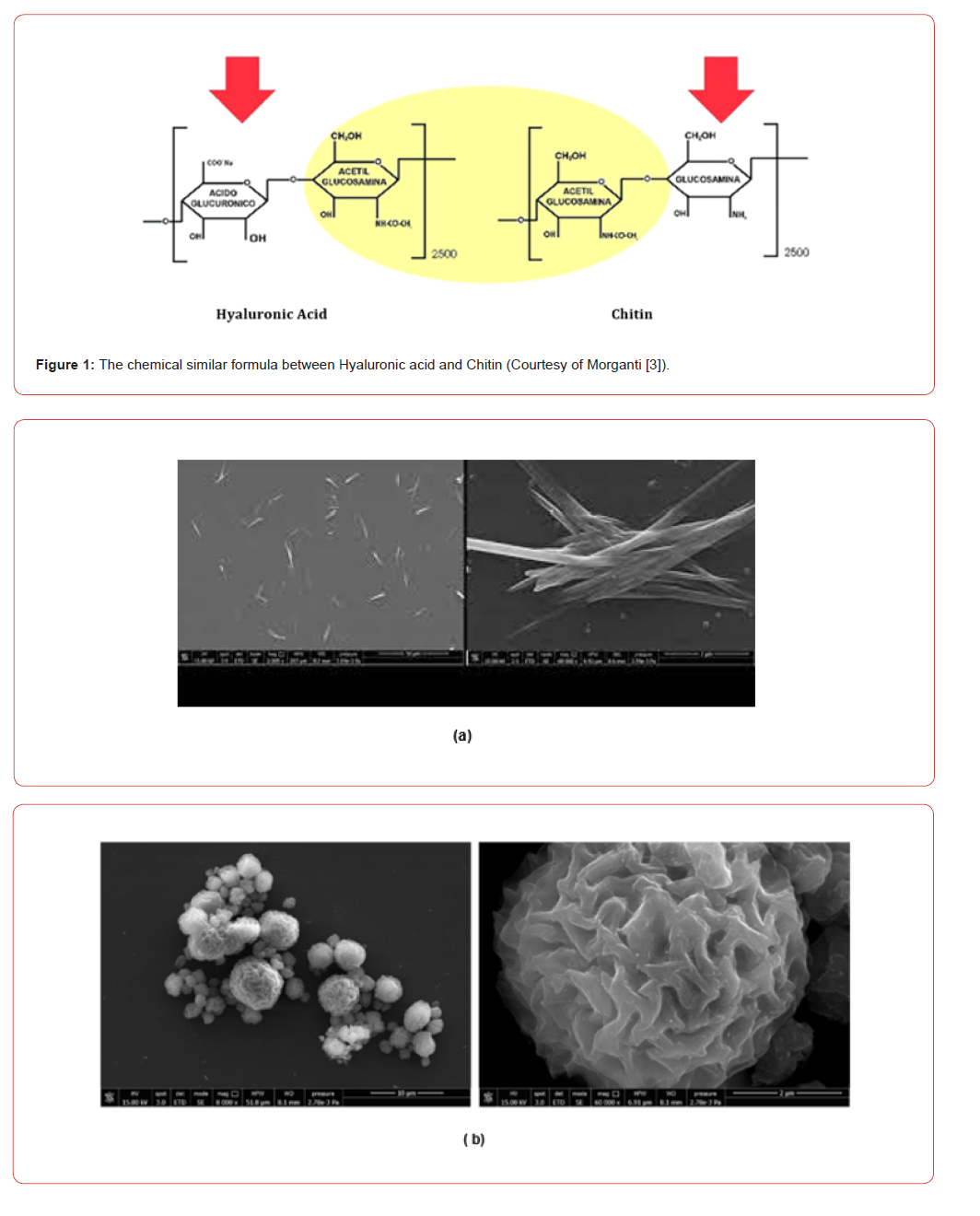
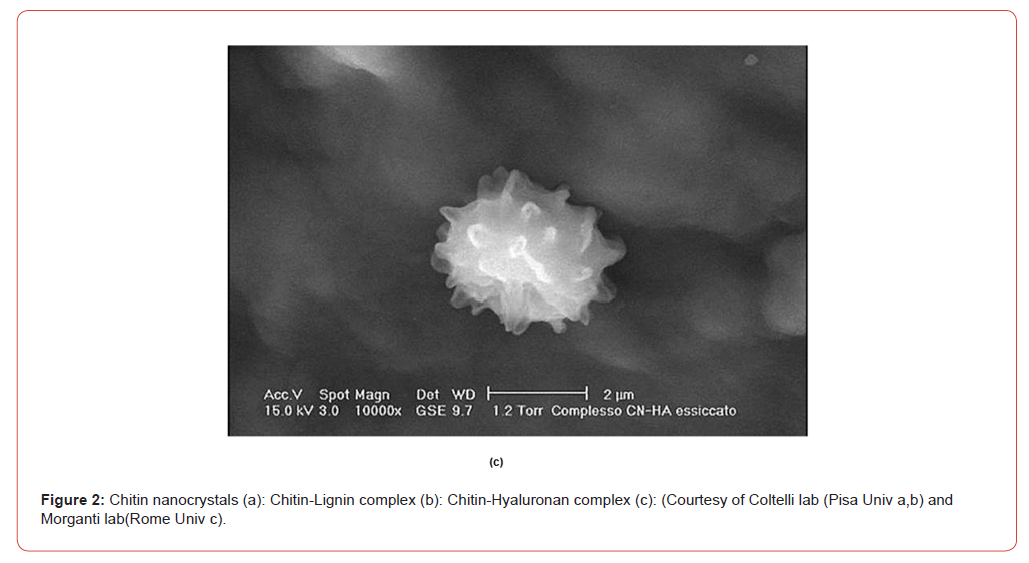
Chitin is a polymer of crystallin nature that recovered in the exoskeleton of crustaceans and insects as well as in the cell wall of fungi is synthesized every day in biosphere in the quantity between 10 billion and 1000 billion metric tons [1,2]. A single crystal produced by the method of our research group, is present in water suspension at pH between 2 and in the quantity of about 300 trillion of nanocrystals. However these crystallites enveloped by molecules of water necessary to impede their flocculation have a mean dimension of about 240x7x5 nm and a mean weight evaluated to be equal to 0.074x10⁶ ng. [3]. Chemically nanochitin is a natural polymer represented by a Nitrogen-containing polysaccharide made of repeating N-acetyl glucosamine and glucosamine units linked together by beta-(1-4)glycosidic bonds in a manner similar to Hyaluronic acid: chitin is made by acetyl glucosamine and glucosamine units while hyaluronic acid is made by glucuronic acidic and acetyl glucosamine ones [3] (Figure 1). At this purpose it is to remember that chitin gives resistance and flexibility to the structure of crustaceans and plants being of healp for humans in a way focused and reported below. Moreover these crystals covered by positive charges on their surface form easily complexes with negative polymers such as lignin and hyaluronic acid supporting the cell Extra Cellular Matrix (ECM) (Figure 2).
Lignin and Its Complexes
Lignin recovered in high quantity from the waste biomass is an high branched polyphenolic polymer consisting fundamentally by a complex of three propanoid compounds:p-coumaryl alcohol sinapyl alcohol and coniferyl alcohol linked each other by different bonds to form a structure to be broken by high physicochemical difficulties also if by new and innovative methodologies it seems possible to obtain micro-nanoparticles easily workable [3- 5]. Thus our research group has obtained interesting results complexing together Chitin Nanofibrils (CN) and Nanolignin (NL) that characterized for their bioavailability and safety have Shown the ability to encapsulate different active ingredients [6-8]. These activated microcapsules have been inserted into tissue-fibers to obtain specialized tissues that used as novel vehicles for making innovative cosme-Nutraceuticals have shown to be more effective and safe than the usual emulsions [9-12]. But what is the real innovation?
The Innovative Vision
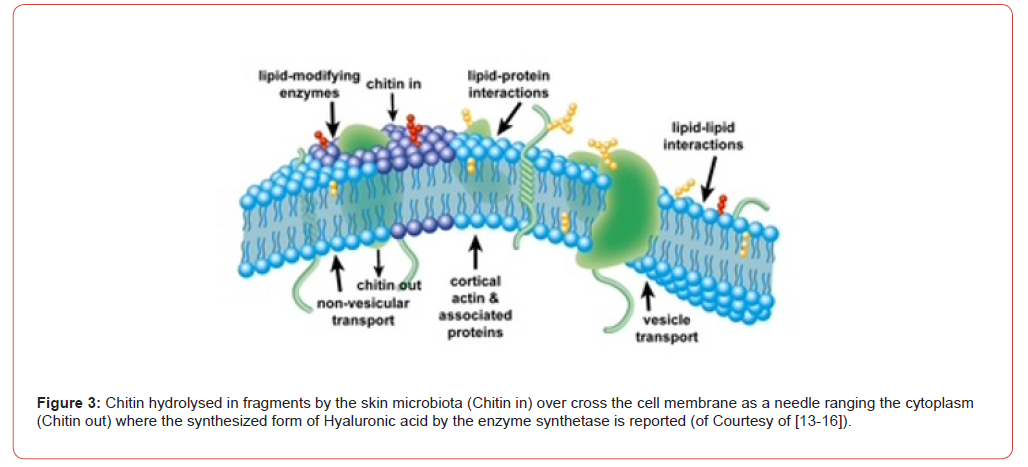
The Innovation of this approach consists to use the novel nanochitin-nanolignin (CN-NL) as a complex with a double activity. On the one hand it acts as vehicle to load carry and release the selected active ingredient at the designed area of skin and/or mucous membrane [6,7]. On the other hand CN-NL act as active agents also. When applied on the skin the skin microbiota hydrolise lignin in its anti-oxidant polyphenolic thus acting as protectant agent against the environmental aggressions [12]. On the other hand chitin at level of skin surface is synthesized by the skin microbiota activity (Chitin in) in 7/9 fragments of saccharide units [13-16]. These fragments overcross the cell membrane acting as a needle ranging the cell cytoplasm (Chitin out) where there are synthesize in Hyaluronic acid by the HA Synthetase (Figure 3). Moreover these new vehicles free of any kind of ingredients such as preservatives, emulsifiars, fragrances and other chemicals are free of allergic and sensitization skin problems. Finally being packed in foils of gauze-paper and/or alluminium results plastic-free.
Conclusive Remarks
According to a reported hypothesis Chitin might be transformed in Hyaluronic acid by the hyaluronidase-like and the chondroitinase enzymes present in the human genome since an ancient period [17]. At this purpose we have reported and discussed the supposed transformation of Chitin in hyaluronan by a a new vision. As a consequence the novel Chitin Nanofibril-Nanolignin complex embedded into a biodegradable innovative tissue might act contemporary as vehicle and active ingredient strengthening the ECM functions. This novel supposed activity of the proposed tissuecarrier seems to further explain the effectivenes and safety shown by the new tissues proposed by some of the many scientific papers published by our research group on the activity of innovative cosme-nutraceuticals [3-11].
Author Contributions
Idea and writing original draft preparation PM; Paper review super vision and editing PM, H-DC.
Istitutional Review Board Statement
Not applicable
Informed Consent Statement
Not applicable
Data Availability Statement
Not applicable
Conflict of Interest And AI Use
The authors declare no conflict of interest nor the AI use.
References
- Chauchie H-M (2002) Chitin Production by arthropods in the hydrosohere. Hydrobiology 470: 63-96.
- Iber BT, Kasan NA, Torsabo D, Omuwa JW (2021) A review of various source of. Chitin and Chitosan in nature. J Ren Mat 10(4): 1097-1123.
- Morganti P (2016) Use of Chitin nanofibrils from biomass for an innovative bioeconomy. In J Ebothe and W Ahmed (Ed) Nanofabrication using Nanomaterials. One Central Press Manchester UK PP: 1-22.
- Yudin VE, Dobrovolskaya IP, Ivankova EM, Dresvyanina EN (2022) Natural fibers for natural tissue. In:P Morganti (Ed) Biofunctional Textile fot ageing skin. Lambert Academic Publishing Chisinau Fepublic of Moldava 2: 624-668.
- Morganti P, Morganti G, Gagliardini A, Coltelli MB (2023) Reinassance of cosmetic Dermatology for a greener society: the nanochitin-Nanolignin approach. Palliat Med Care Int J 4(3): 555-638.
- Danti S, Trombi L, Fusco A, Azimi B, Lazzeri A, et al. (2019) Chitin nanofibrils and Nanolignin as functional agents in skin regeneration. Int J Mol Sci 20(11): 2669.
- Morganti P, Del Ciotto al, Fabrizi G, Guarneri F, Cardillo A, et al. (2013) Safety and tolerability of Chitin nanofibrils-hyaluronan nanoparticles entrapping Lutein:nanoparticles characterization,bioavailability and biodegradability. SOFW-Journal 139(1/2): 12-22.
- Coltelli MB, Morganti P, Castelvetro V, Lazzeri A, Danti S, et al. (2022) Chitin Nanofibril-Nanolignin Complexes as Carriers of Functional Molecules for Skin Contact Applications. Nanomaterials 12(8): 1295.
- Morganti P, Coltelli MB (2019) A new carrier for advanced cosmeceuticals. Cosmetics PP: 6-10.
- Morganti P, Morganti G, Colao C (2019) Biofunctional textiles for Aging skin Biomedicines PP: 7-51.
- Morganti P, Chen HD, Morganti G (2020) Nanocosmetics: future perspective.In : A Nanda S, Nanda TA, Nguyen S, Rajendran and Y Slimani (Eds) Nanocosmetics: Fundamentals applications and Toxicity Elsevier Amsterdam Netherlands PP: 453-481.
- Suri Hi, Suri Ha, Nagda N, Misra T, Vuppu S (2025) Current perspective on Human skin microbiome: Functional insights and strategies for therapeutic modulation. Biomedicine & Pharmacotherapy PP: 193: 118655.
- Ziatabar S, Zepf J, Rich S, Danielson BT, Bollyky PI, et al. (2018) Chitin chitinases and Chitin: lectins Emerging roles in Human Pathophysiology. Pathophysiolog 25: 253-262.
- Morganti P, Donnarumma G (2026) The Skin and eco-friendly connections: Chitin-hyaluronan-Lignin Emergent Life Sciences 2(1).
- Morganti P, Lohani A (2026) Can Chitin became Hyaluronic acid acting as vehicle and active ingredient? J Inter Med Res and Rep.
- Morganti P (2026) Incredibile ma vero la chitina dei tessuti-veicolo viene trasformata in acido ialuronico. Natural 126: 19-24.
- Csova AB, Stern R (2013) Hypotheses on the evolution of hyaluronan:a highly ironic acid. Glycobiology 23(4): 398-411.
-

This work is licensed under a Creative Commons Attribution-NonCommercial 4.0 International License.




